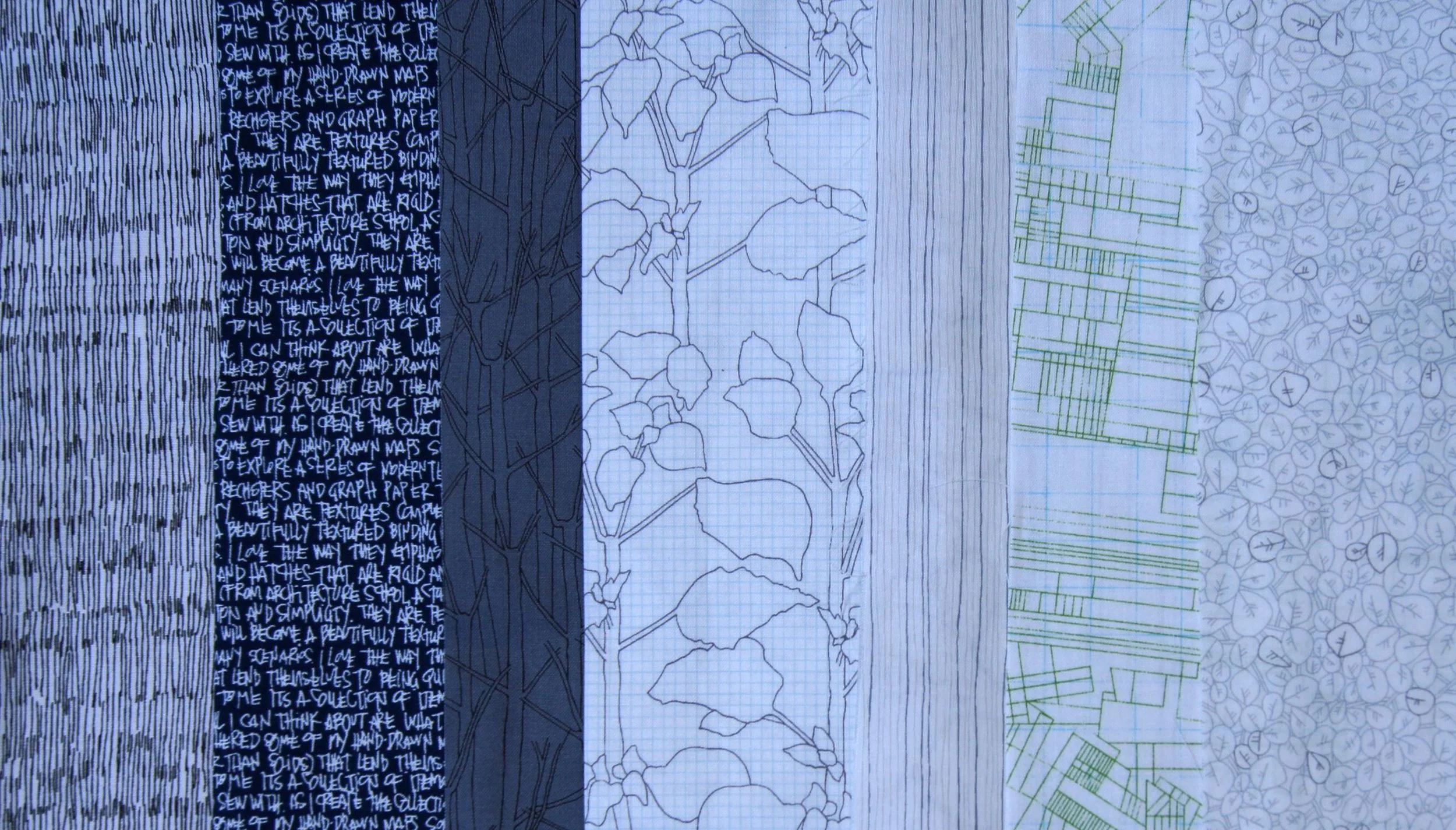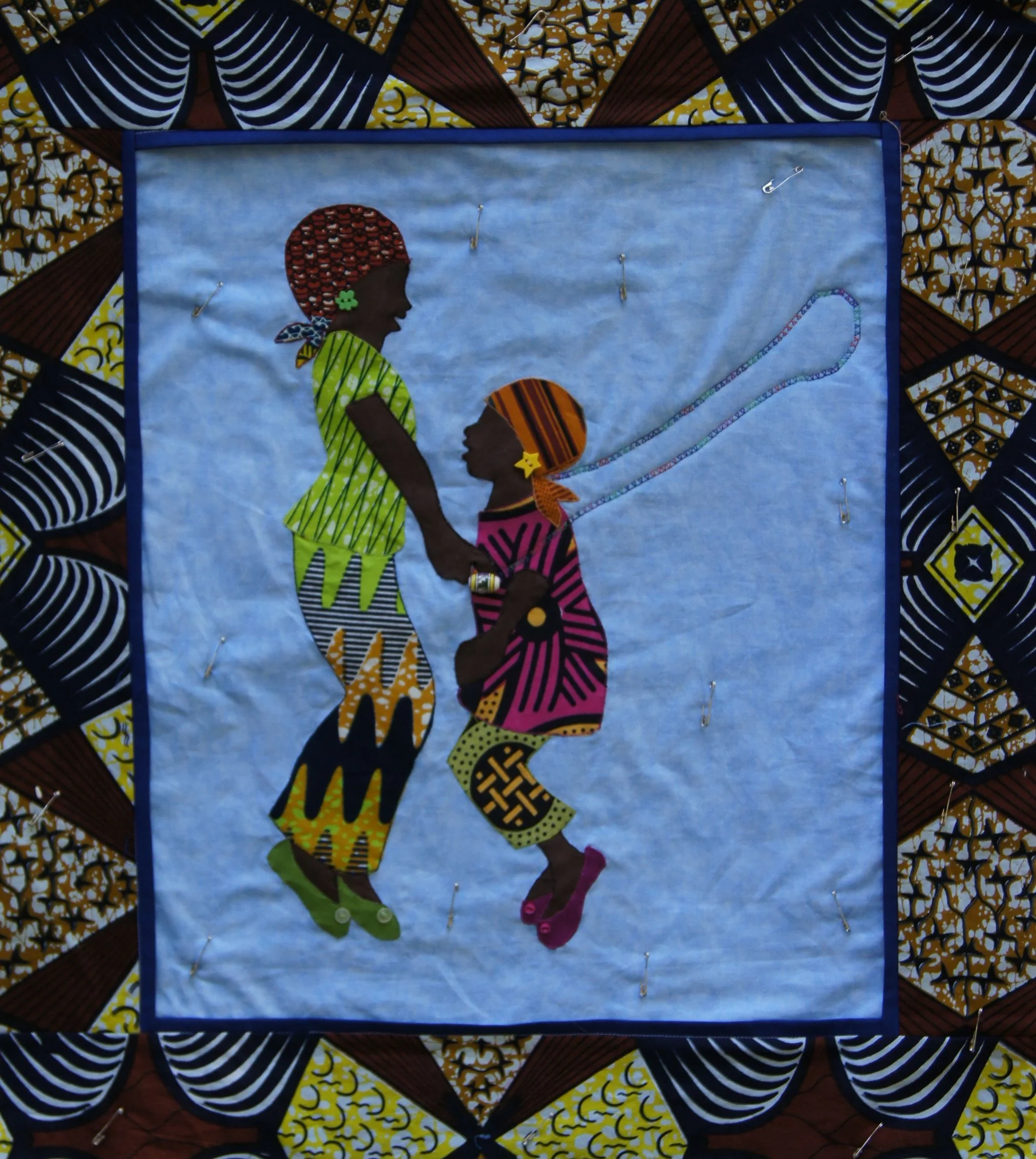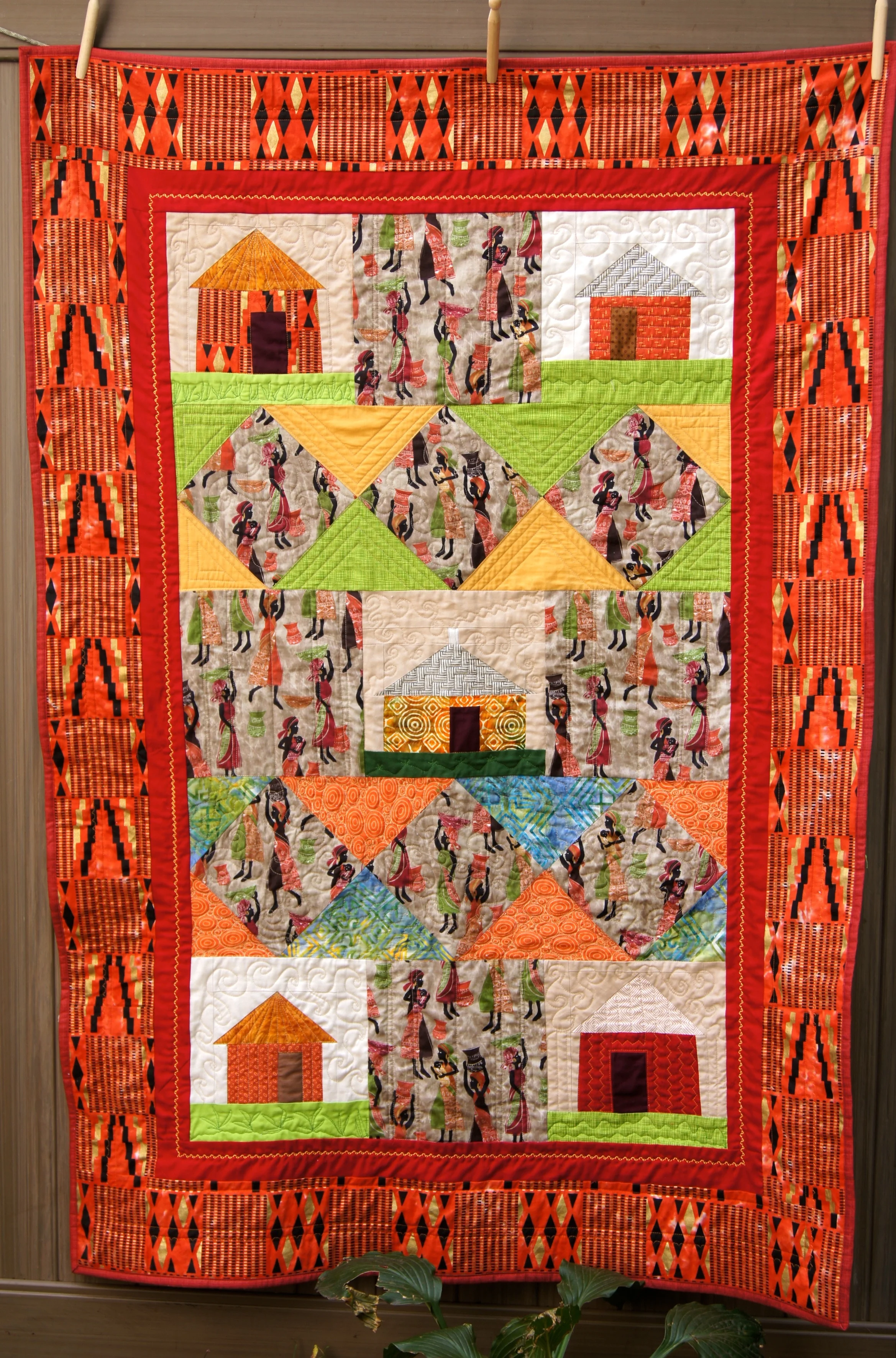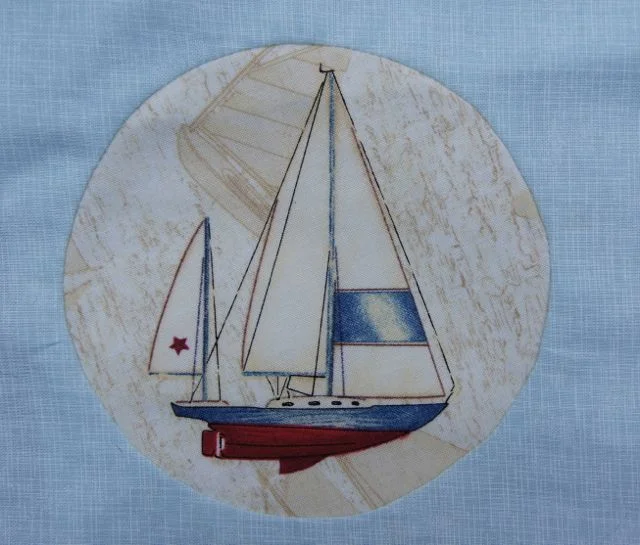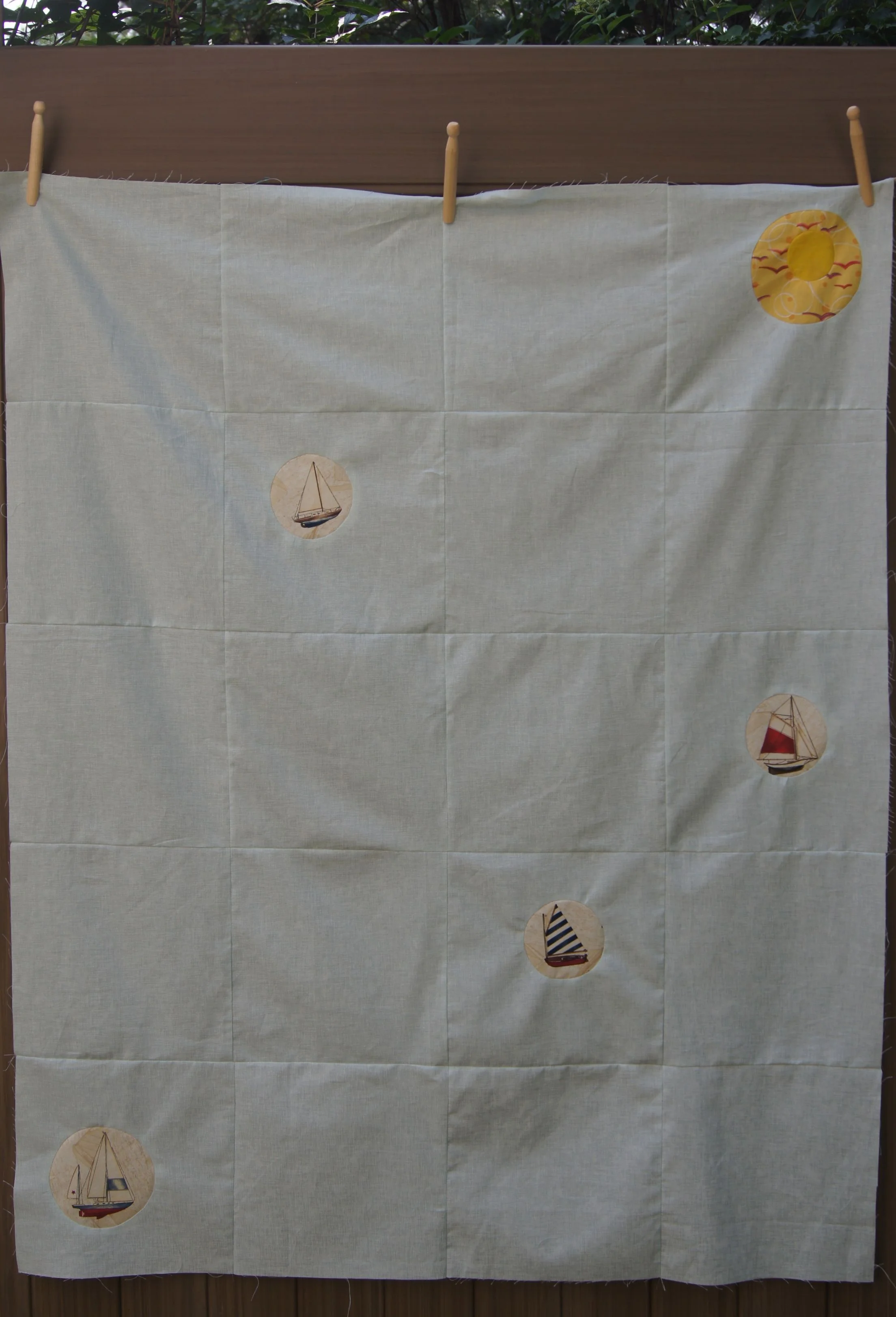
African Village Quilt--Completed.

by Judy Tucker


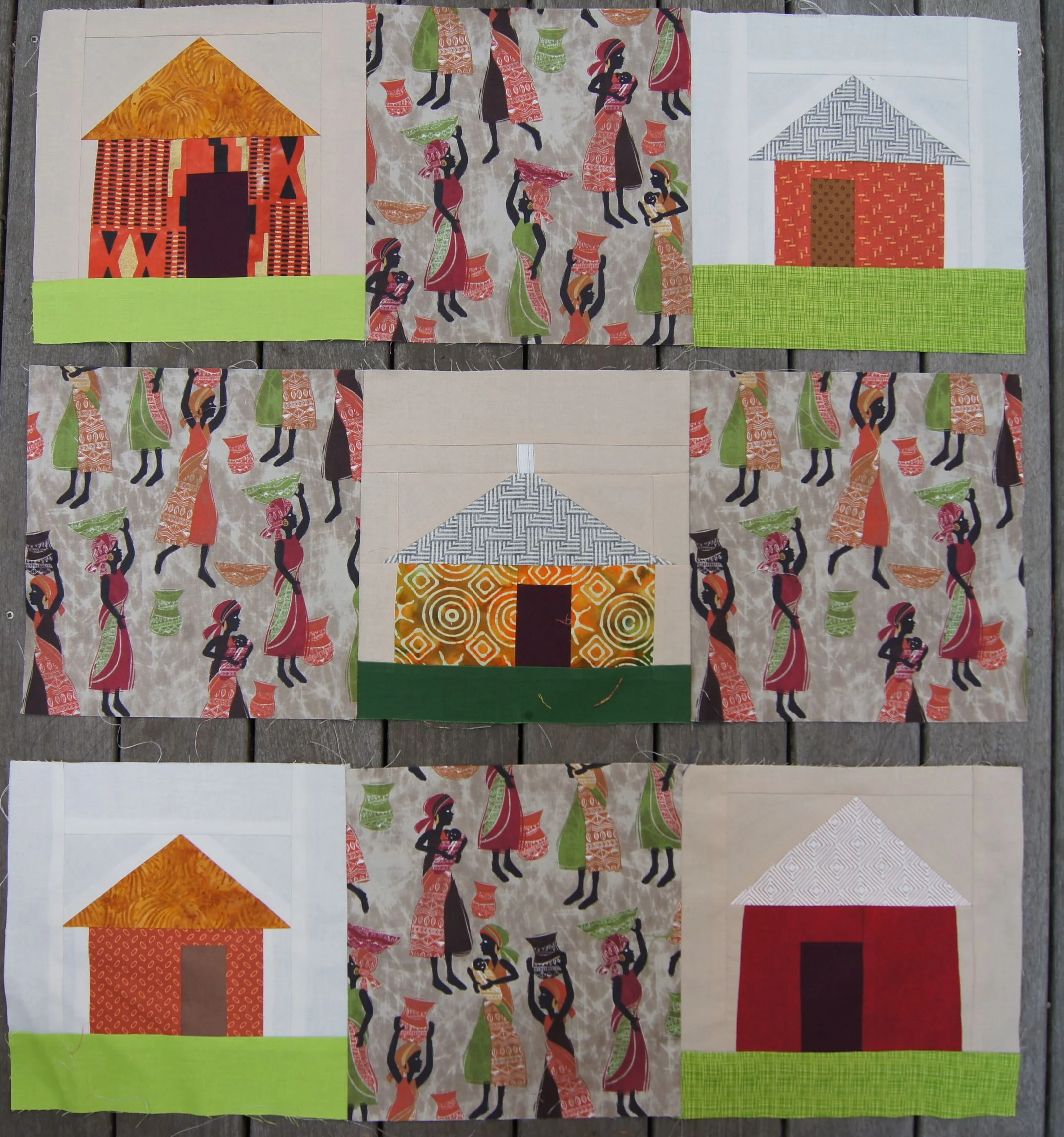
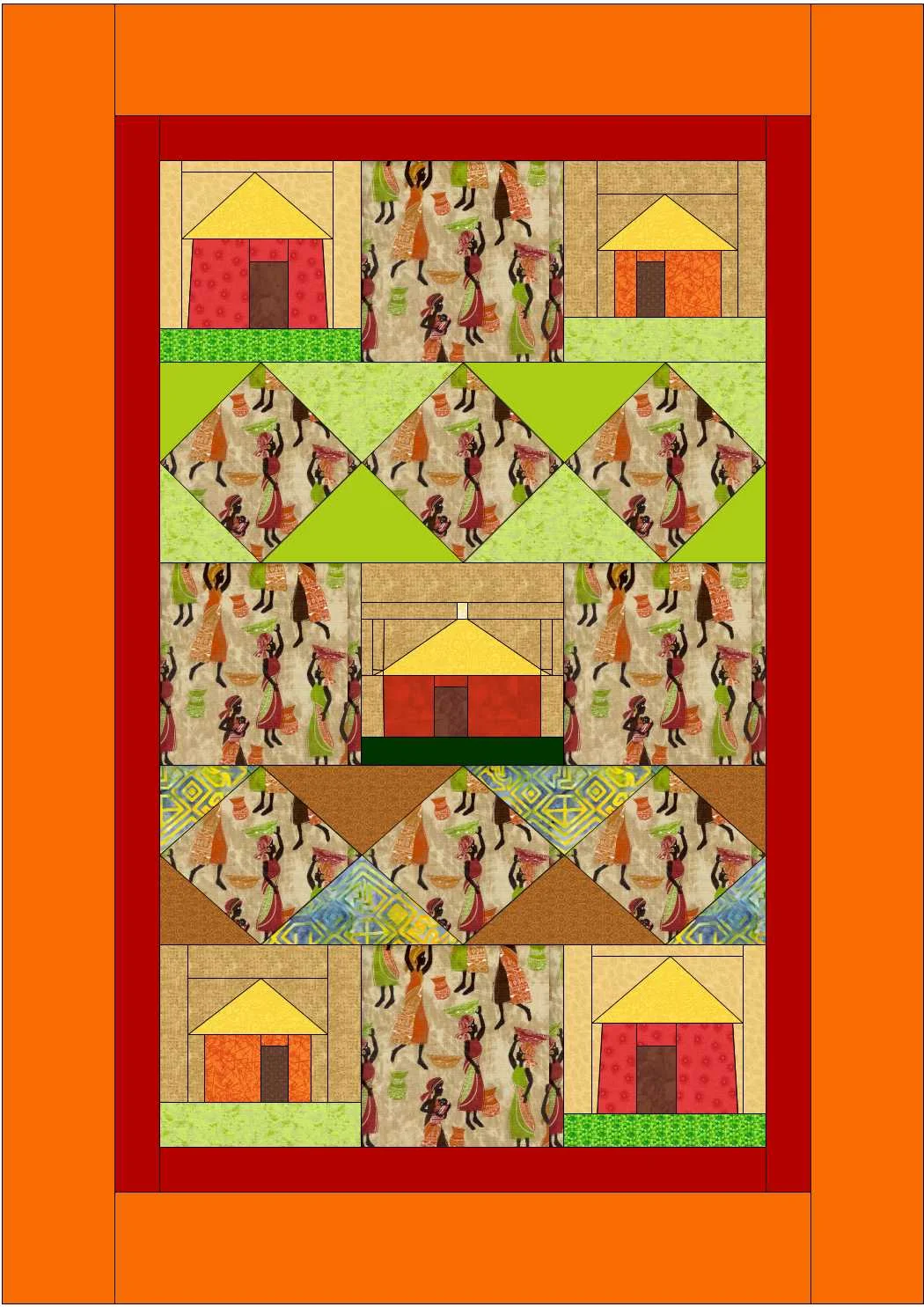
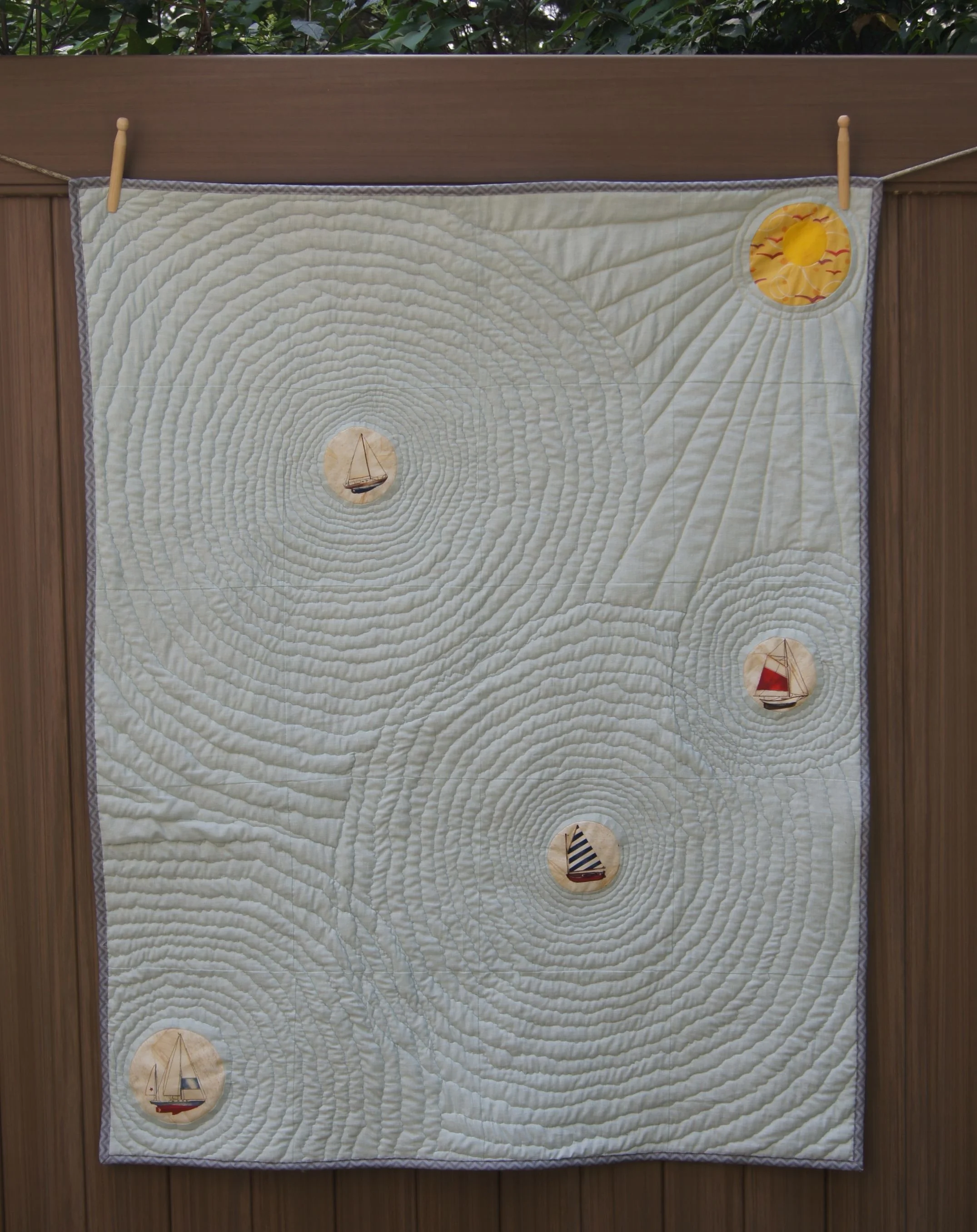
Here's my completed African Village Quilt.  It measures 40 x 57 inches. 

African Village Quilt

African Village Quilt

I recently took Jacquie Gering's Craftsy course, "Creative Quilting with your Walking Foot."  She had some great tips and suggestions about using the walking foot for quilting.  I used echoing in, radiating designs and straight quilting using a variety of specialty stitches on my domestic sewing machine. It was lots of fun to use her techniques.  

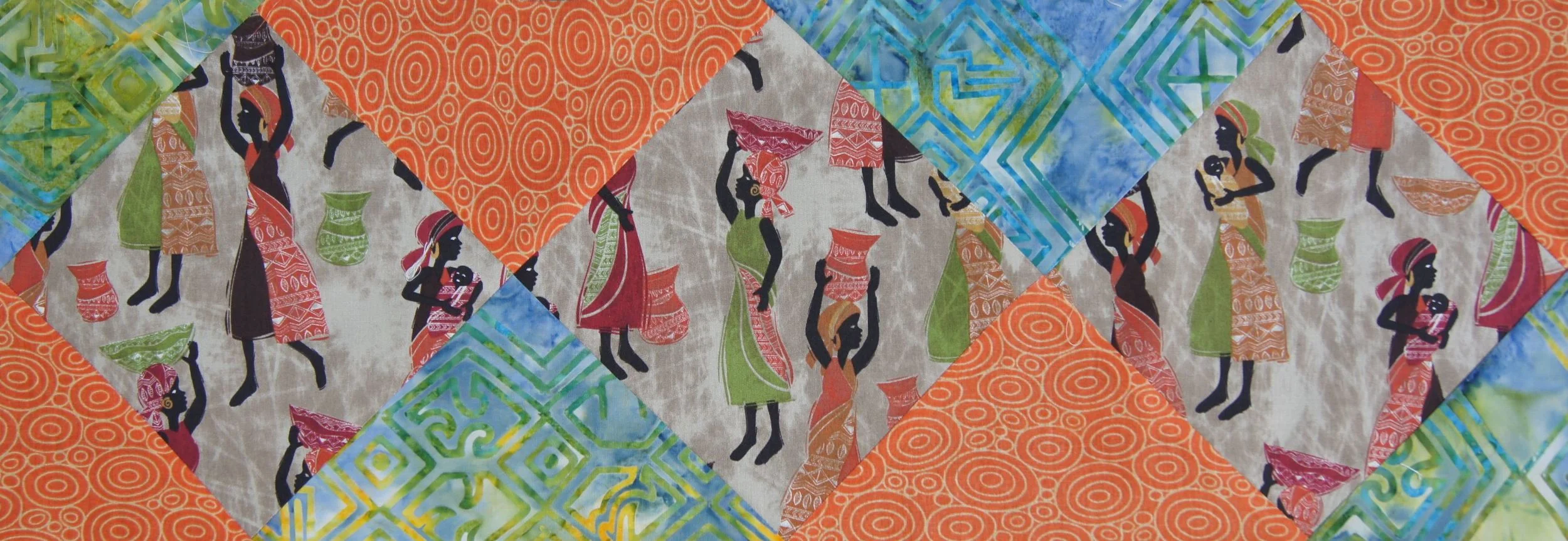
The echoing in stitching is in the setting triangles in the upper strip of diamonds. 

Here is a detail of radiating quilting on a roof. 

Radiating quilting done with walking foot on the hut roof,  Free motion quilting used to create grasses and heat swirls. 

Radiating quilting done with walking foot on the hut roof,  Free motion quilting used to create grasses and heat swirls. 

I used Jacquie's suggestion of using the Bernina specialty stitch #4, the serpentine stitch, to make the current in the river blocks. She said that this stitch is intended for use in garment construction making lingerie which needs to stretch!  Doesn't it make a lovely river current?

Bernina Stitch #4 to make the waves in the river blocks.  Free motion quilting to make the stream pebbles and swirls around the women.

Bernina Stitch #4 to make the waves in the river blocks.  Free motion quilting to make the stream pebbles and swirls around the women.

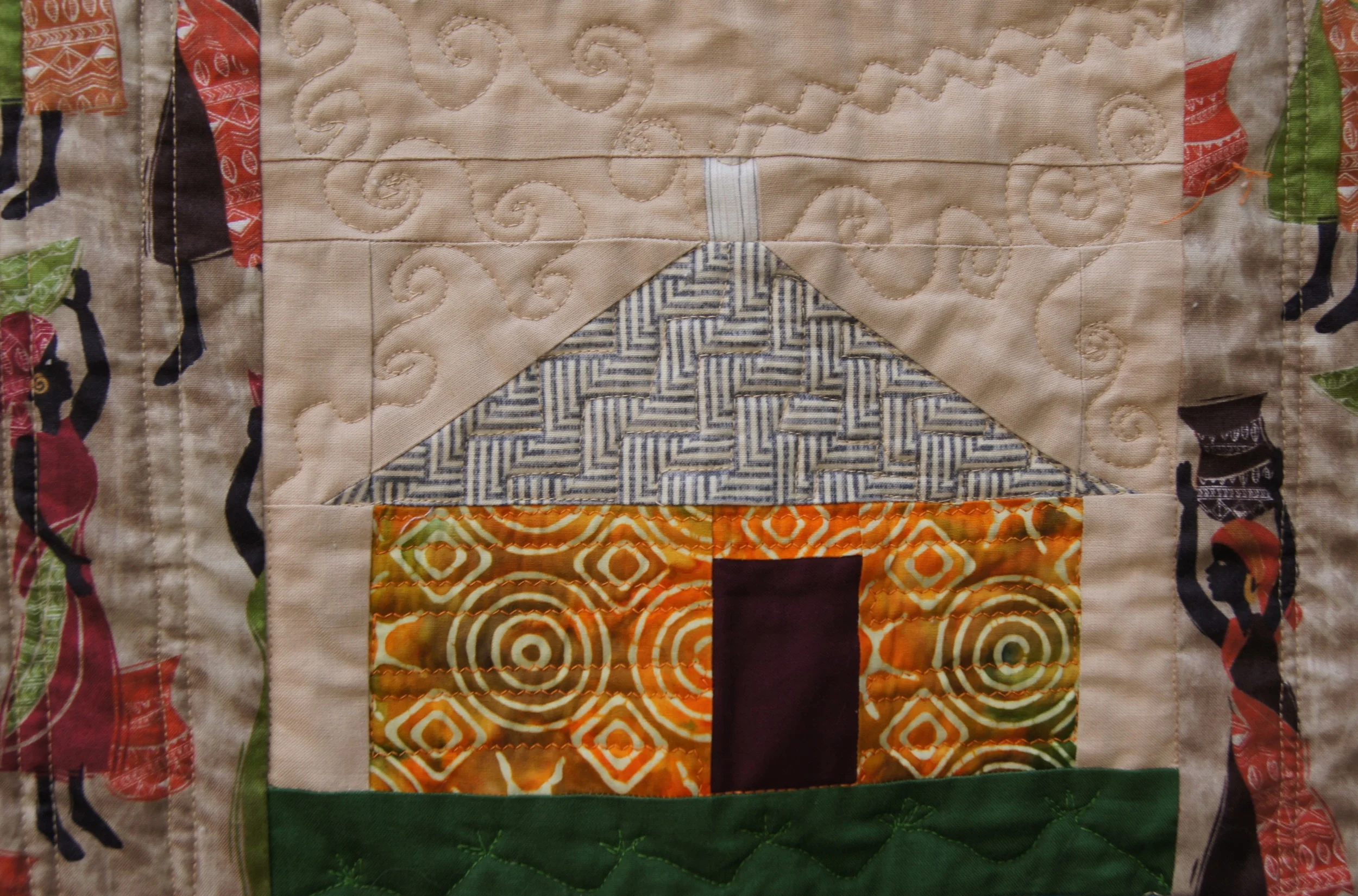
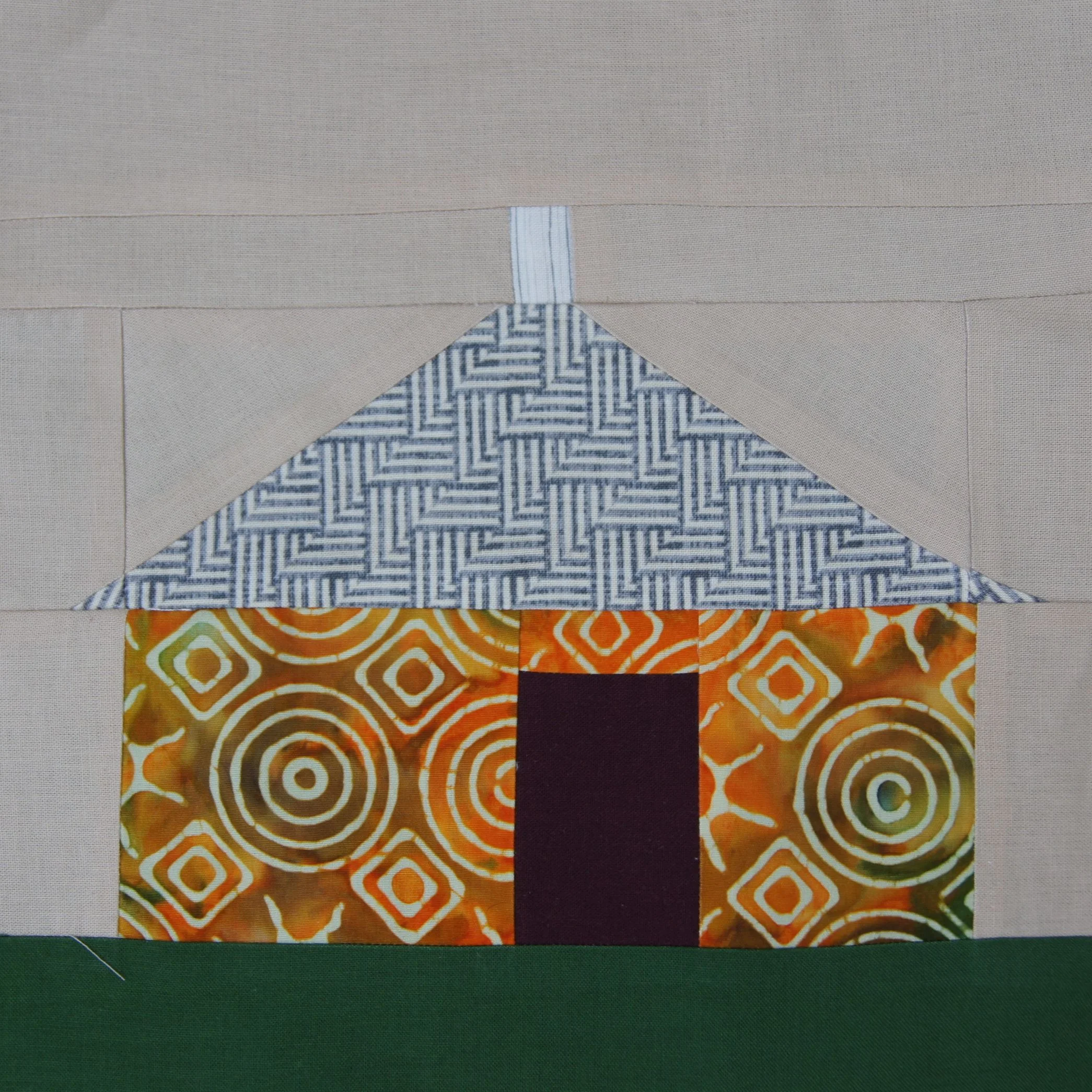
I also used the serpentine stitch to make the smoke coming out of the chimney in the central hut. 

Central hut showing serpentine stitch for smoke.  Also note the straight stitching done on the focus fabric blocks adjacent to the block and on the hut walls.

Central hut showing serpentine stitch for smoke.  Also note the straight stitching done on the focus fabric blocks adjacent to the block and on the hut walls.


There are also lots of straight stitching using the walking foot throughout the quilting. 

Straight stitching with the walking foot and 2 decorative stitches in the outer quilt border.

Straight stitching with the walking foot and 2 decorative stitches in the outer quilt border.

You'll also see free motion quilting on this quilt.  I used it to make heat currents, pebbles and grasses and other vegetation. 

This quilt was a lot of fun to make and to quilt.  

Note 2021: For those of you returning to the post, the free pattern no longer is available. I wrote it so long along that the files weren’t intact and no longer secure.

Thanks to everyone who did use the old pattern to make a quilt! I hope you enjoyed the process.


African Village Step 6--making the back and label

by Judy Tucker


NOTE 2021: The PDF patterns for this quilt are no longer available so the links to them have been deleted. I’ve left the other instructions in case you still have the original patterns.

The top of the African Village Quilt is done!   Great job.  Now it's time to make the back. 
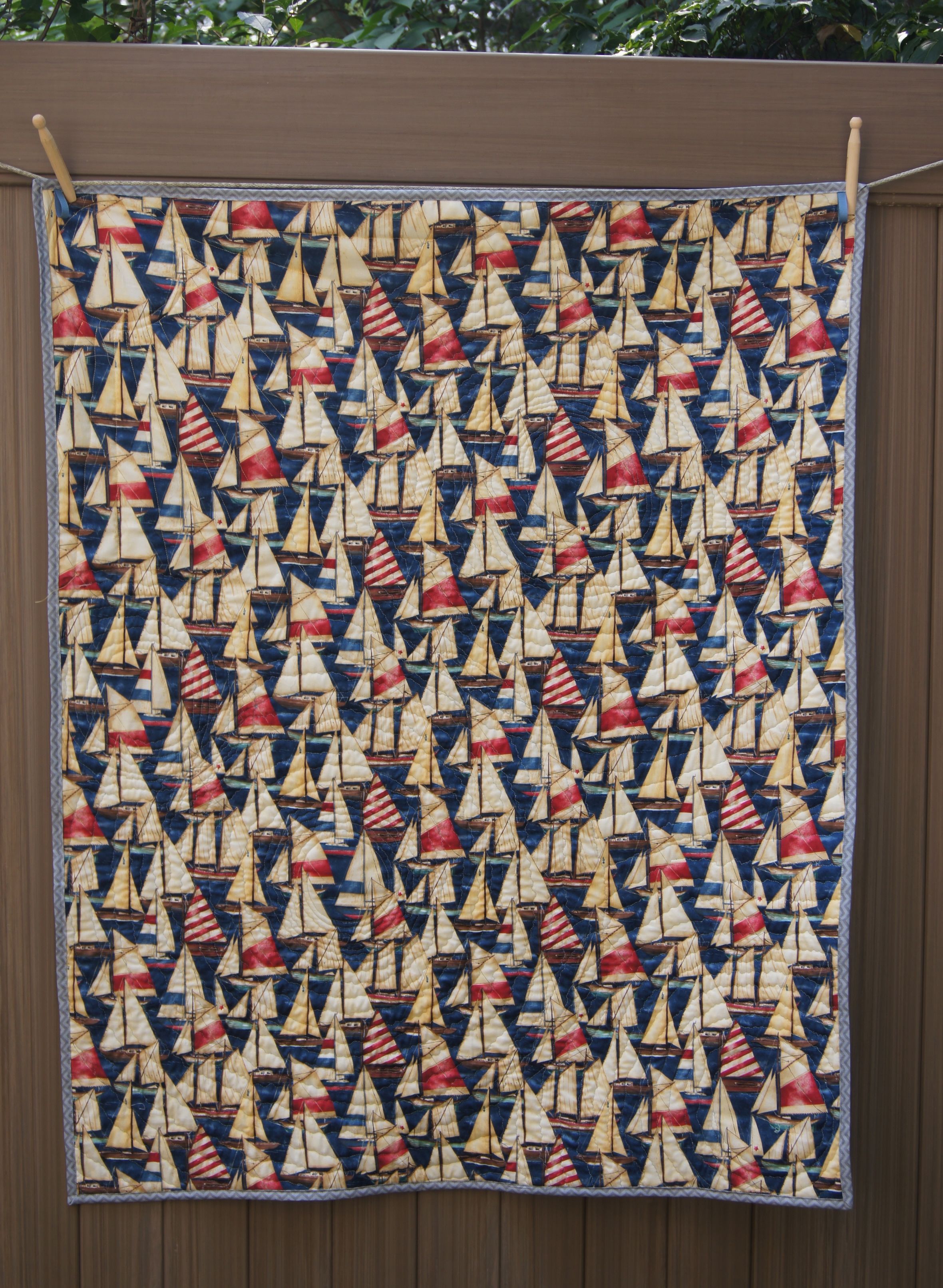
Back of the African Village quilt

Back of the African Village quilt

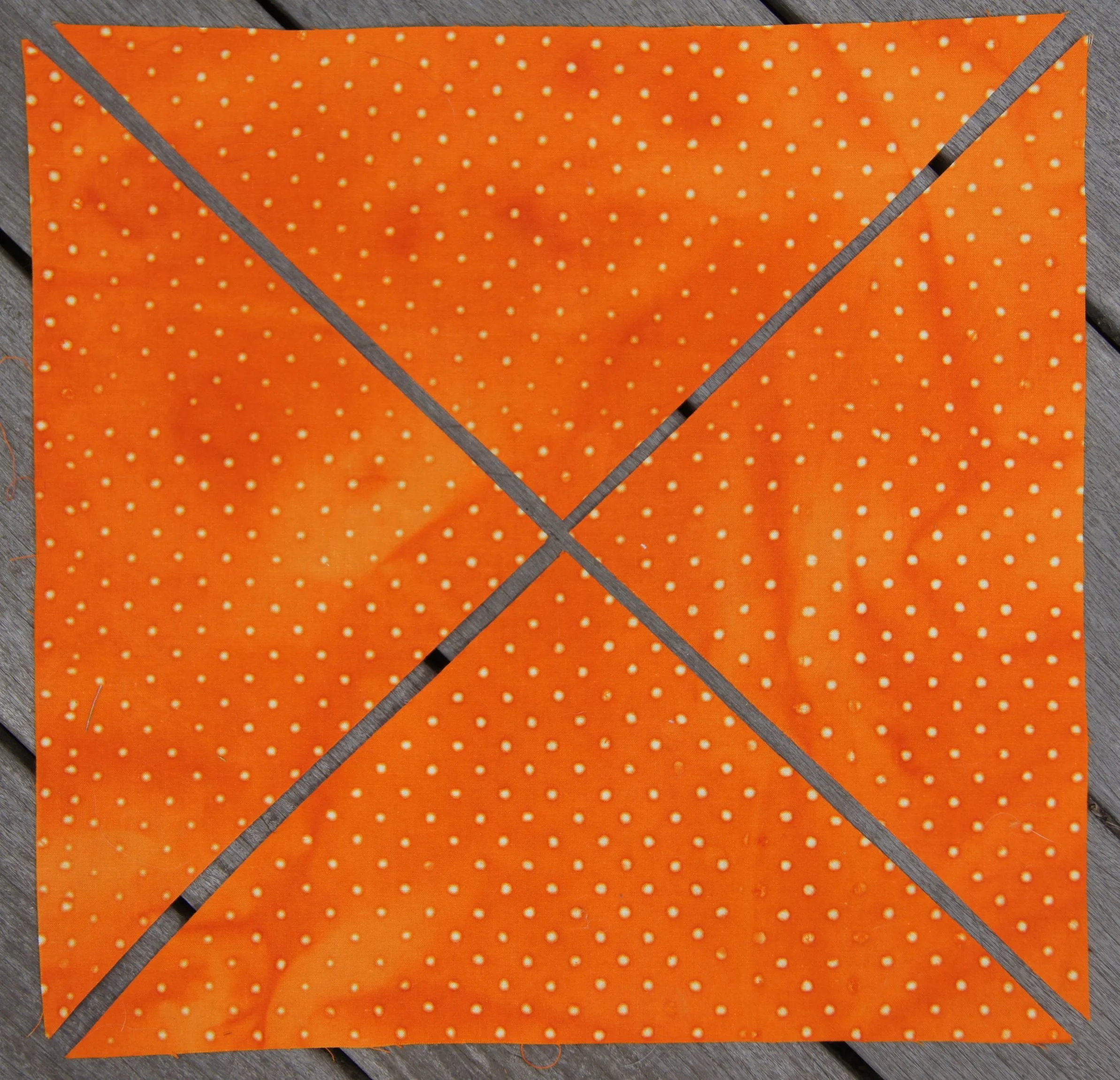
I had left over triangles from the setting blocks and corner blocks from the diamond strips on the front of the quilt.  I also had some triangles which I cut for the quilt and then decided that I liked other fabric better.  So I decided to make a strip back for my quilt. 

You will need a backing that measures at least 48 x 65 inches.  This will give you a 3 1/2-4 inch overhang.  If you plan to send it out to a long-arm quilter you may need it a bit larger.

I used fabrics for the strips that are in the quilt top and I varied the width of the solid color strips  to make the back more interesting.  I also made a few more half square triangles for the strips.  You'll note in the photo above that the half square triangle strips were extended with a piece of background fabric.   If you wanted to, you could just use a couple left over half square triangles and make the strip long enough with other fabrics. 

However you do it, it's all good! 

I really like this back.  It could stand on it's own as a quilt in its own right!

Once you finish the backing, layer sandwich your quilt with top, quilt batting and the bottom. I used a cotton baby quilt batting which measured 46 x 60 inches.

Quilt as desired or send it out to your favorite quilter!   Add a binding once it is all quilted.

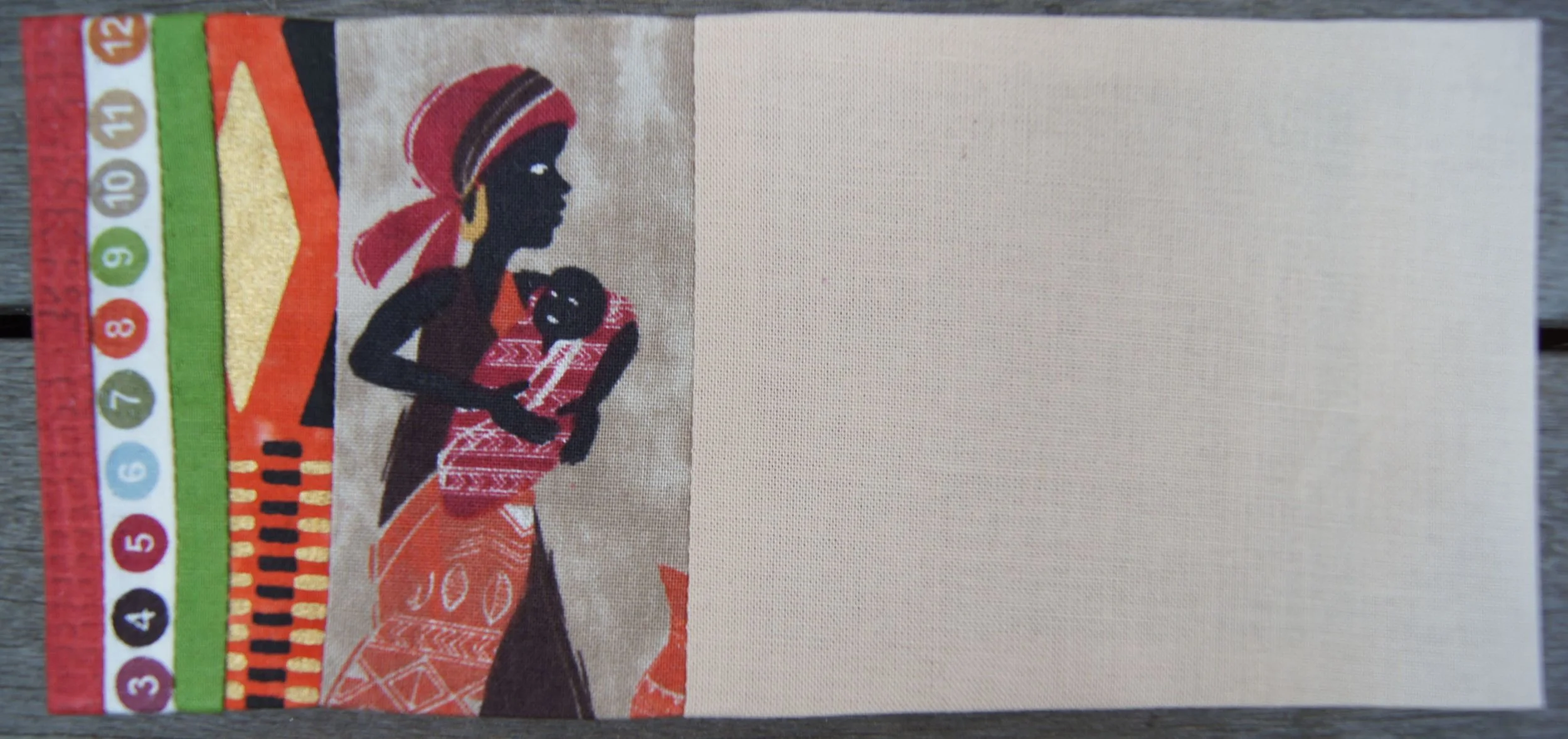
And finally make a label.  Here is my label before I wrote on it. I used some selvages from the fabric in the quilt along with a strip from my focus fabric.  It adds a bit more information about the quilt and it's fun!

Selvage label for the quilt

Selvage label for the quilt


Next post…my finished quilt!

Please leave me a comment to let me know how you are doing! 


African Village Quilt Step 5

by Judy Tucker


Completed Top African Village Quilt

Completed Top African Village Quilt

NOTE 2021: The PDF patterns for this quilt are no longer available so the links to them have been deleted. I’ve left the other instructions in case you still have the original patterns.

We will be able to finish the quilt top today. 

One last bit of cutting to do first. 

For the blocks on either side of the African Hut blocks:

Cut 4 squares of your Focus Fabric 9.5 x 9.5 inches.

Now you should have all the components of the quilt completed.  So let's assemble the rest the quilt.

The quilt is assembled in strips.  Starting at the top here are the strips with the African Huts and Focus fabric. 

AfricanVillageHutStrips.jpg

1. Sew the African Hut 2 B (door facing right)  to one of the 9.5 inch squares of Focus Fabric. Then sew African Hut 1 B (door facing left)  to the other side of the 9.5 inch Focus Fabric square.

2. For the middle strip, sew a 9.5 inch square of Focus Fabric to each side of African Hut 3.

3. For the bottom row sew African Hut 1 A (door facing right) to a 9.5 inch square of Focus Fabric.  Then sew African Hut 2 A (door facing left) to the other side.  Now you have all the strips completed. 

4.  Sew them together in this order:   Top Hut strip, first diamond strip, Middle Hut Strip, 2nd diamond strip, Bottom Hut strip.  Great!  The center of your quilt will all the blocks is done.

Borders

AfricanVillageQuiltMeasuring.jpg

For the Inner Border:

Step A:

Lay your quilt top on a flat surface.  Measure the middle of the quilt from top to bottom.  Then measure from side to side in the middle of the quilt and ADD 5 inches to this measurement. 

Add the length and width of the quilt and multiple by 2 to get the total length of fabric you need for the first border.  Divide this number by 40 to get the number of WOF (wide of fabric) strips you need to cut.  

Cut:

2.5 wide inch strips x WOF  for your first border.  I needed to cut 4.  
Sew this 4 strips together end to end, either with a bias seam or a straight seam, whichever you prefer. 

Sew the first border on to your quilt top.


For the Outer Border:

 Repeat Step A and measure your quilt top again with the first set of borders attached. 

Cut:

5.5 inch wide strips x WOF to obtain the length you need.  (I needed 4 strips).  Sew the 5.5 inch strips together.

Sew the 2nd border to the quilt top. 

Congratulations!  Your African Village Quilt top is complete!

I will blog about the backing for the quilt on Friday, August 15, 2014.

Did you have fun making this quilt top?  Please leave me a comment! Thanks!  I can't wait to hear how you did. 


African Village Quilt Step 3

by Judy Tucker


African Village Hut 3

African Village Hut 3

We are up to Step 3 of my African Village Quilt.  Here is the 3rd hut.  It is a little more complex to paper piece than Hut 1 and Hut 2 but it's really not hard to sew.

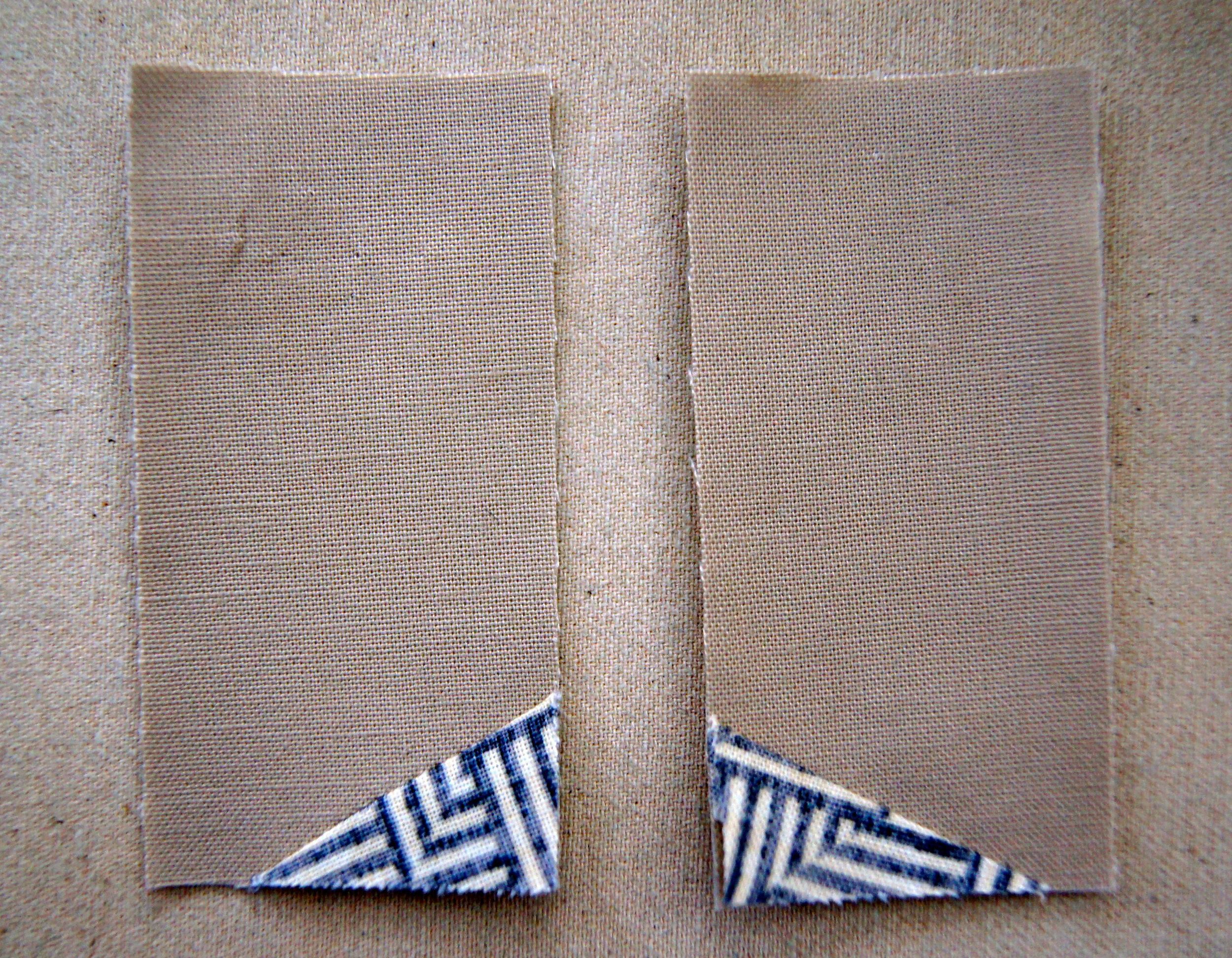
The two corners of the roof extend beyond the hut walls and are on separate pattern pieces.  I recommend that before you cut out these 2 pieces (D and E of the pattern)  that you draw an arrow on the pattern to indicate which way is up.  That will just make it a bit easier to know which way they attach to the roof when you are sewing all the pieces together.

Here is a photo of D and E ready to be attached to the hut roof.

Pieces D and E of the Hut 3 Pattern ready to be attached to the roof

Pieces D and E of the Hut 3 Pattern ready to be attached to the roof

NOTE 2021: The PDF patterns for this quilt are no longer available so the links to them have been deleted. I’ve left the other instructions in case you still have the original patterns.

This is the final hut needed for the Village and it is the last of the paper pieced blocks for this quilt.  

Next Monday, August 11, 2014, I'll post Step 4 for my African Village Quilt.  We'll be sewing the 2 diamond strips then. 

Please do leave me a comment. I'd love to know what you are doing if you are sewing along with me. Thanks!


On the Move!

by Judy Tucker


The SleepingDogQuilts Blog is Under Construction!

UnderConstruction.jpg


I've moved over to the Squarespace web platform from Blogger and will be using a new, simpler URL. The bones of this new site are here but I'm still working on adding back all the information that was available here on Blogger.


The Squarespace platform will be cleaner, load faster, be more mobile friendly and has lots of room for me to grow SleepingDogQuilts. 


One of the new features on the site is a Gallery of my quilts.  I'm in the process of posting photos of some the quilts I have made.  It won't be my total collection but there should be a fun selection for you to look at.


Here is the new URL.  Leave me a message and let me know how you like the new space!


SleepingDogQuilts.com


Hope you enjoy the new look! 


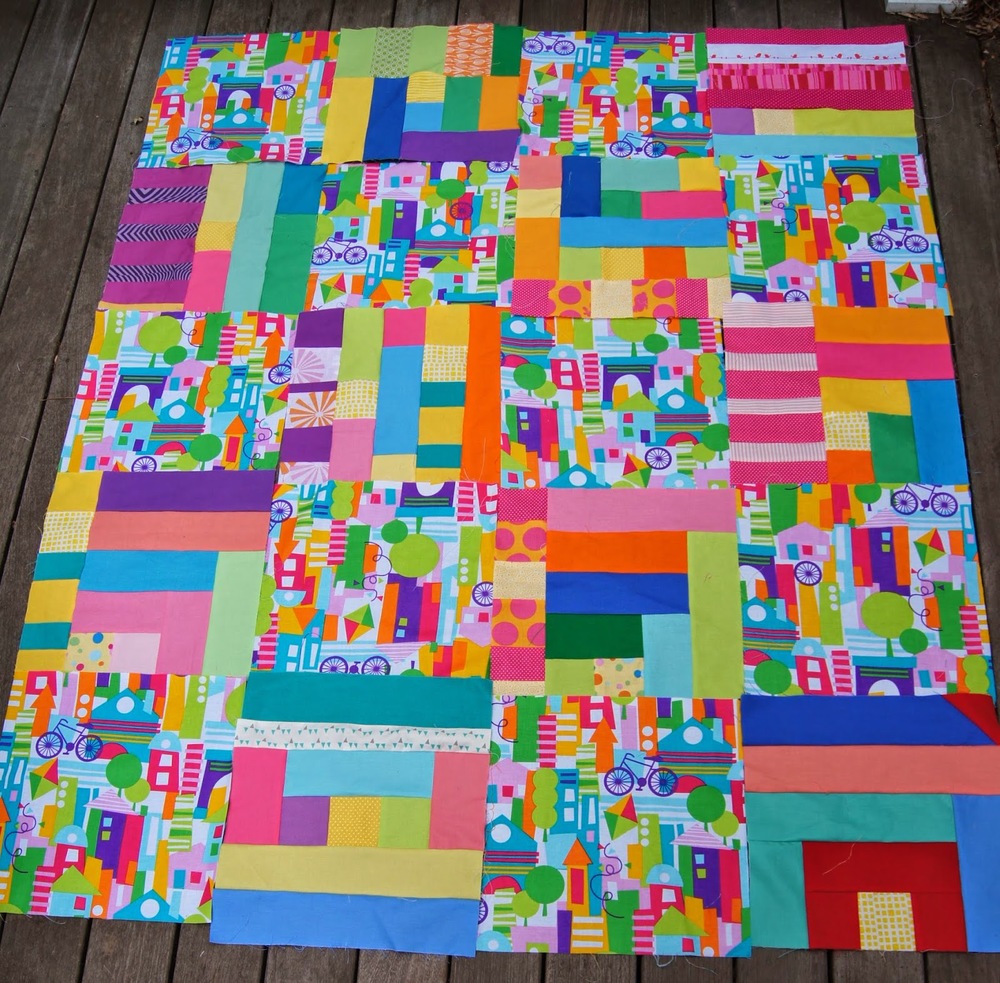
Modern Log Cabin WIP update

by Judy Tucker


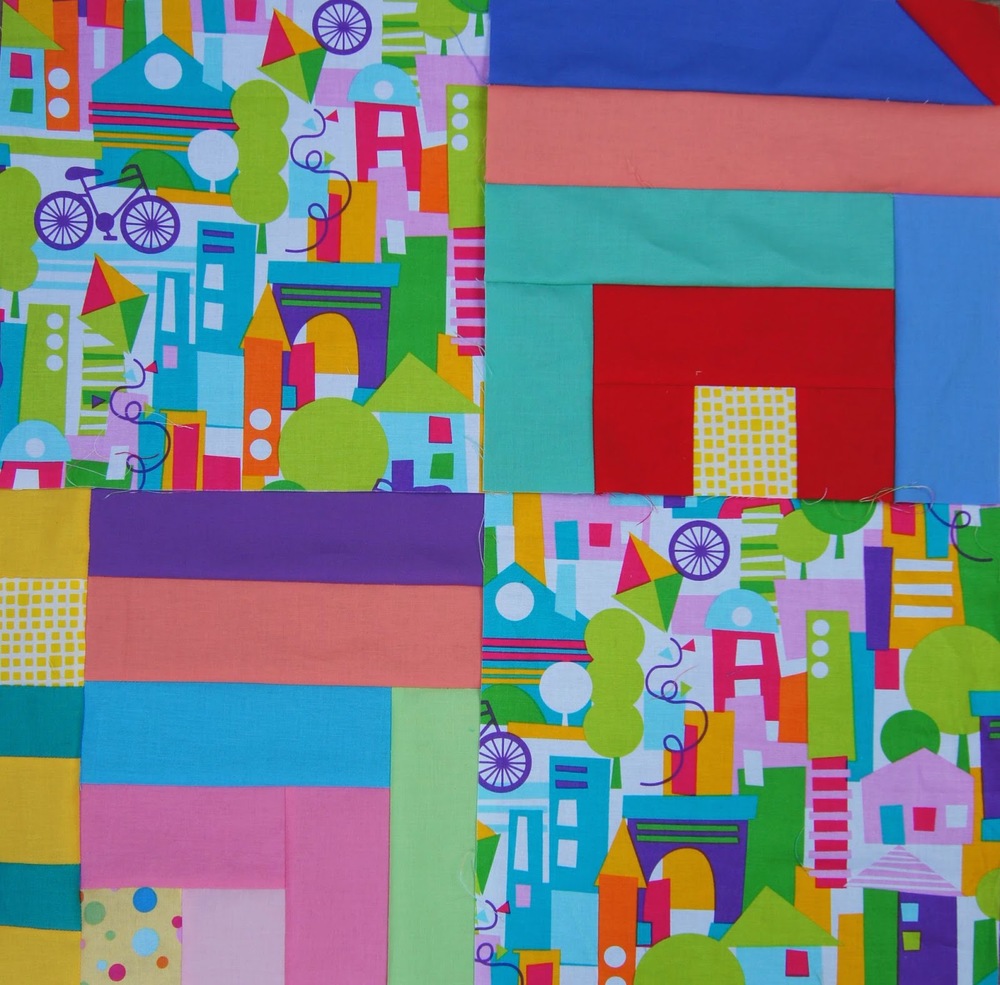
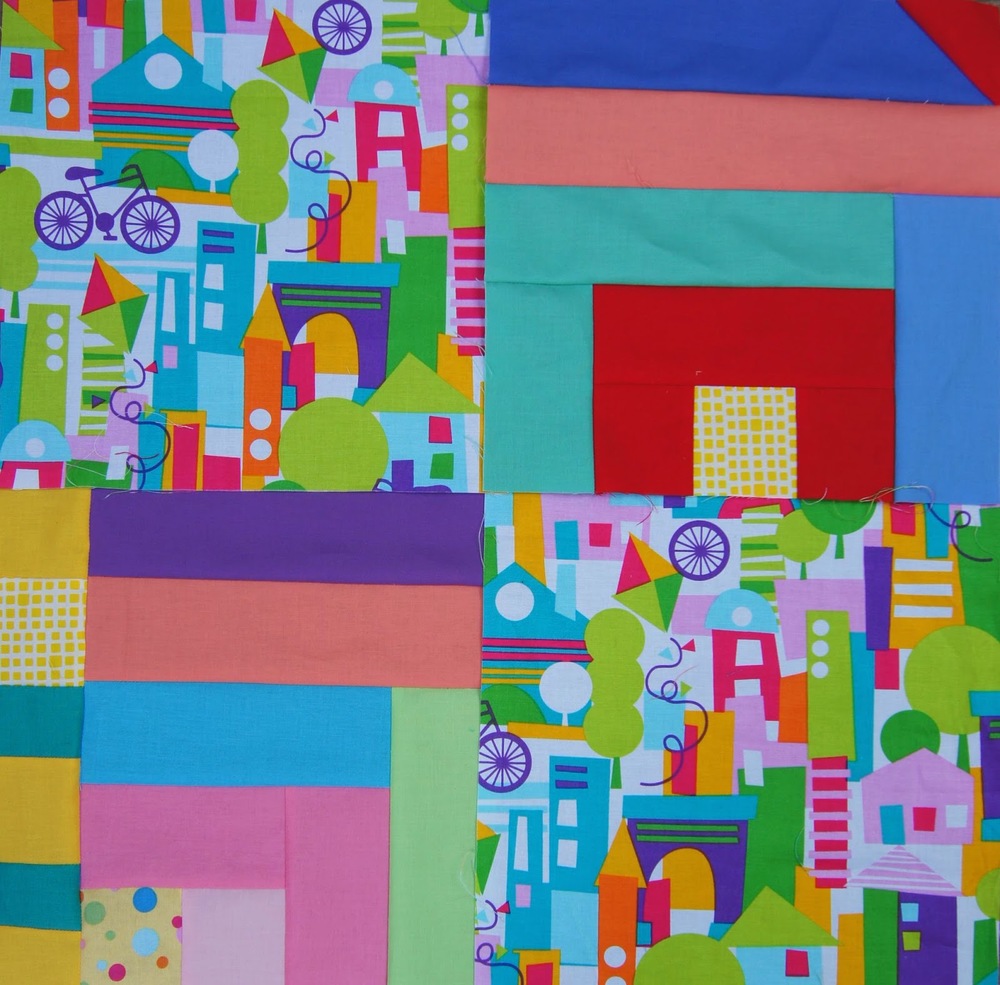
Detail of blocks. They aren't sewn together yet.

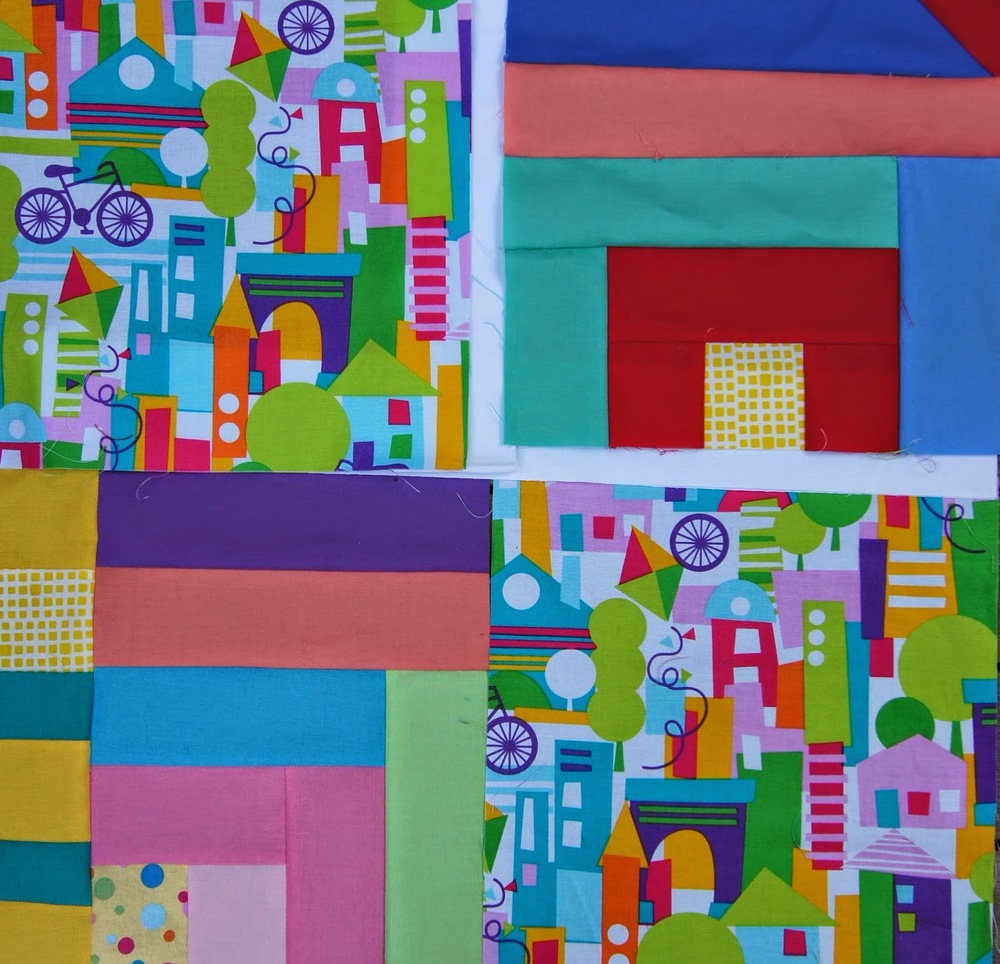
My Modern Improv Pieced Log Cabin quilt is coming along.  I've decided I like it busy, without any white sashing between the blocks.
All the blocks so far

I started out systematically writing down the sizes of the strips and how I was sewing the pieces together.  I initially thought I would make 2 different log cabin blocks and alternate them.  Not exactly improv…

But by the time I got to my 3rd block I was having so much fun that the blocks really turned totally improv.  I'm working from a design roll of 2.5 inch strips so the pieces are square rather than irregular. Each of the Log Cabin blocks is unique. However each block intentionally includes one 2.5 x 2.5 inch yellow square.  It's a nod to the tradition of using a red central block which some folks say is representative of the hearth in the home.

It really does feel liberating to just sew strips together without a specific plan.  I do audition each new piece to make sure it goes with the other strips in the block, but with this collection of happy colors, it's almost impossible to make a mistake.

14 more Log Cabin blocks to go!

Modern Log Cabin WIP

by Judy Tucker


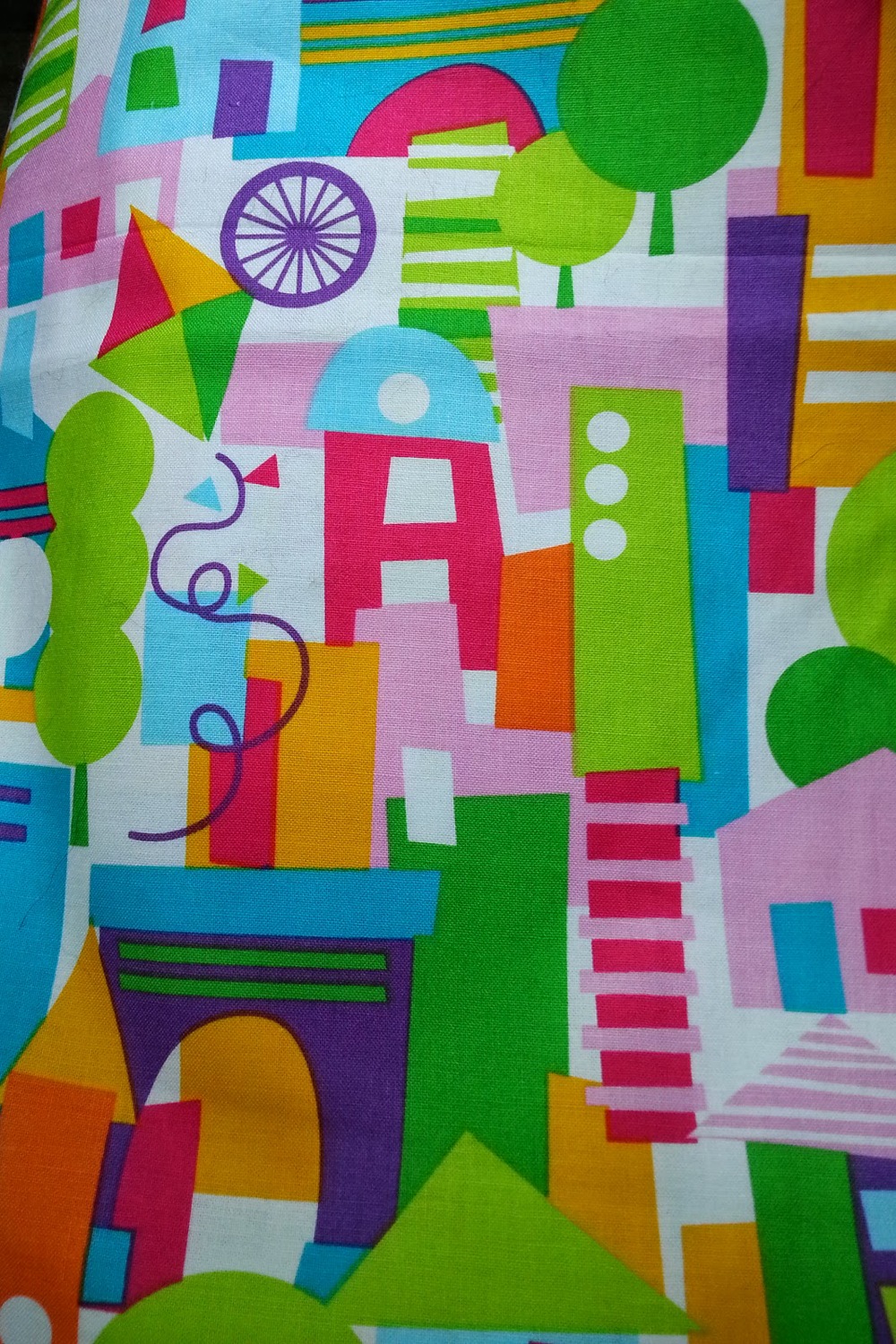
I picked up 2 yards of Michael Miller's Happy Town fabric this weekend.   I love all the bright colors.  The design reminds me of the building blocks we loved to play with when we were children.

Happy Time by Michael Miller Fabrics
I have a Kona Cotton New Bright design roll that I used part of for my Jumbled Spools Quilt.  The colors of the design roll are a great match for the "Happy Time" fabric.

I want to see the "Happy Town" design in the quilt so I cut 10.5 x 10.5 inch squares for half the blocks in the quilt.  The alternating blocks will be improv pieced Modern Log Cabin blocks.   I want to echo the striped elements in the fabric so I'm making strips of stripes which I plan to incorporate into the Log Cabin blocks.

This quilt is so busy that I think it might be a good idea to add some white.  It could be sashing strips intersperced randomly between some of the blocks or maybe just incorporated into the Log Cabin blocks.

Here 4 blocks laid out 2 different ways:
                                                                                 
Auditioning white sashing--I don't think this works.                                              
Without the white sashing strips. 

I think I need to make some more blocks and then will decide what looks best.  Suggestions are welcome…please leave a comment if you have an idea. 

Modern Hexagon Quilt finished!

by Judy Tucker


Modern Hexagon Quilt

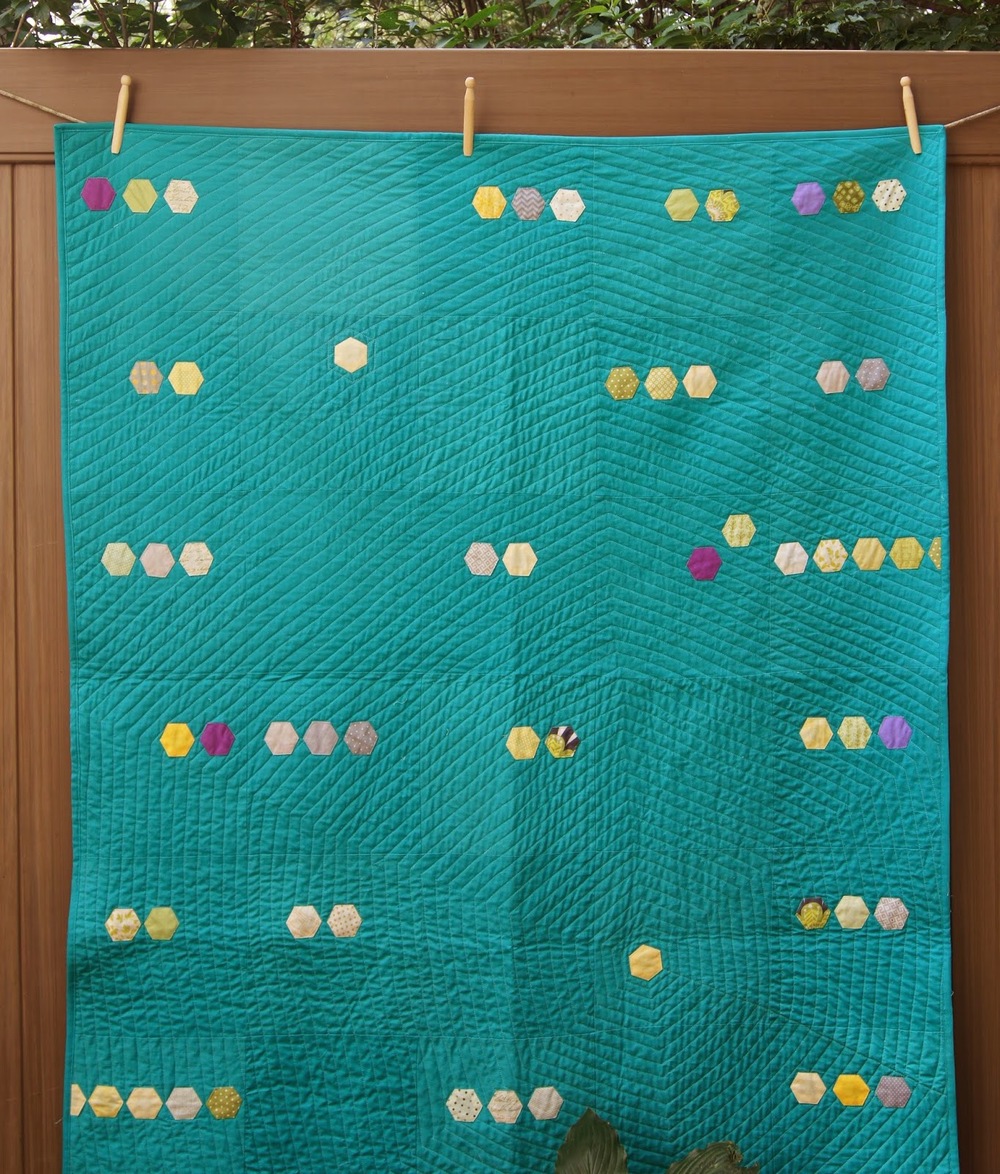
My Modern Hexagon Quilt is done!  It was so much fun to make.  The challenge of this quilt was working with all the negative space in this 48.5 x 59 inch quilt.
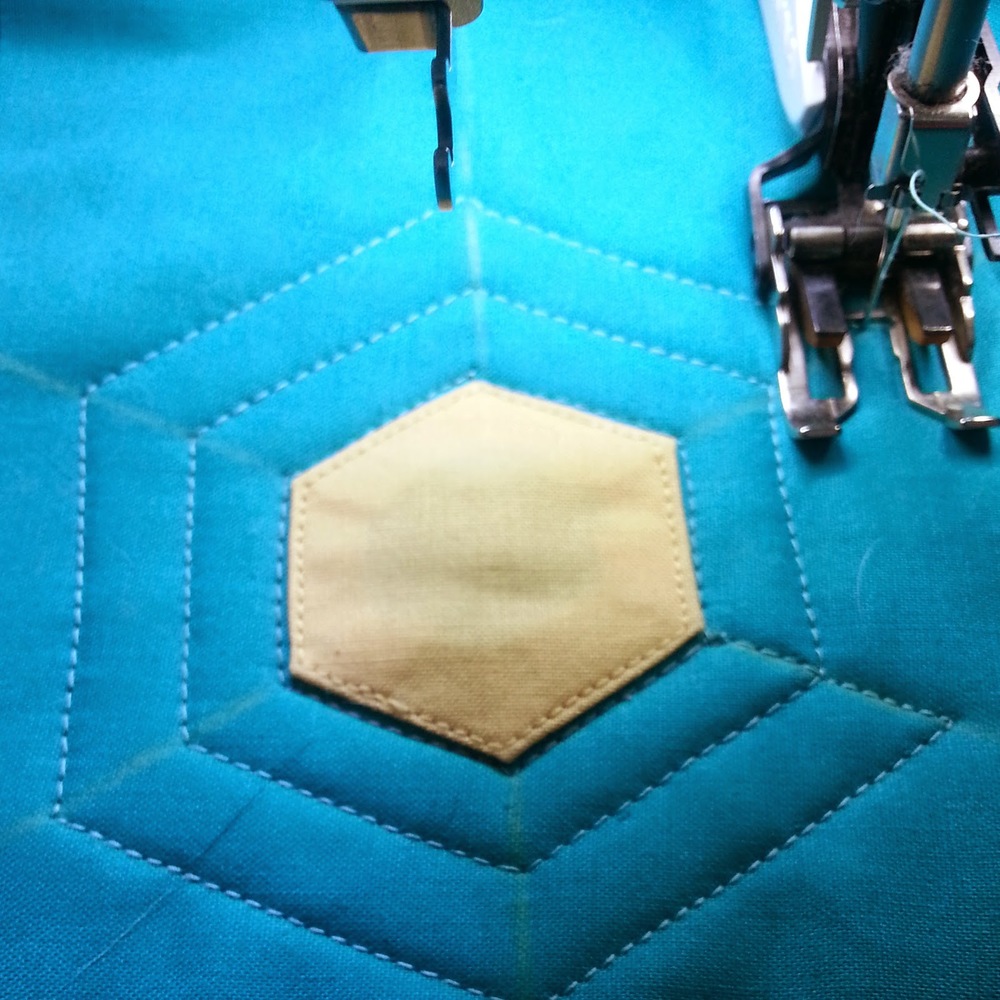
Originally thought I would quilt concentric hexagons around the two single hexagons in the quilt.  I was going to let the hexagon relax into a circle as it got further away from the index hexagon, like waves in a pond.


Beginning to quilt around a hexagon
But I found that it was fairly easy to continue quilting in a hexagon pattern when I marked the quilt with dress-maker's chalk and I wasn't sure how it would look if it morphed into a circle.  (You can see the markings in the photo above). 

Using the bar on my walking foot to keep the quilting lines
the same width

I ended up quilting from the lower single hexagon all the way across the entire quilt.  The hexagon shape decayed a bit the further I got from the starting hexagon but I was able to maintain reasonably well across the whole quilt.

I couldn't wait to start quilting around the 2nd hexagon in the upper part of the quilt to see how the lines intersected.   I put in about 7 rows of quilting and it quickly became clear that it just wan't going to work.  The quilting lines were running off-kitler to each other and not crossing the way I hoped they would.  It looked really awful.   I ripped it all out without taking a photo.   Sorry--it would have been interesting to share what it looked like.

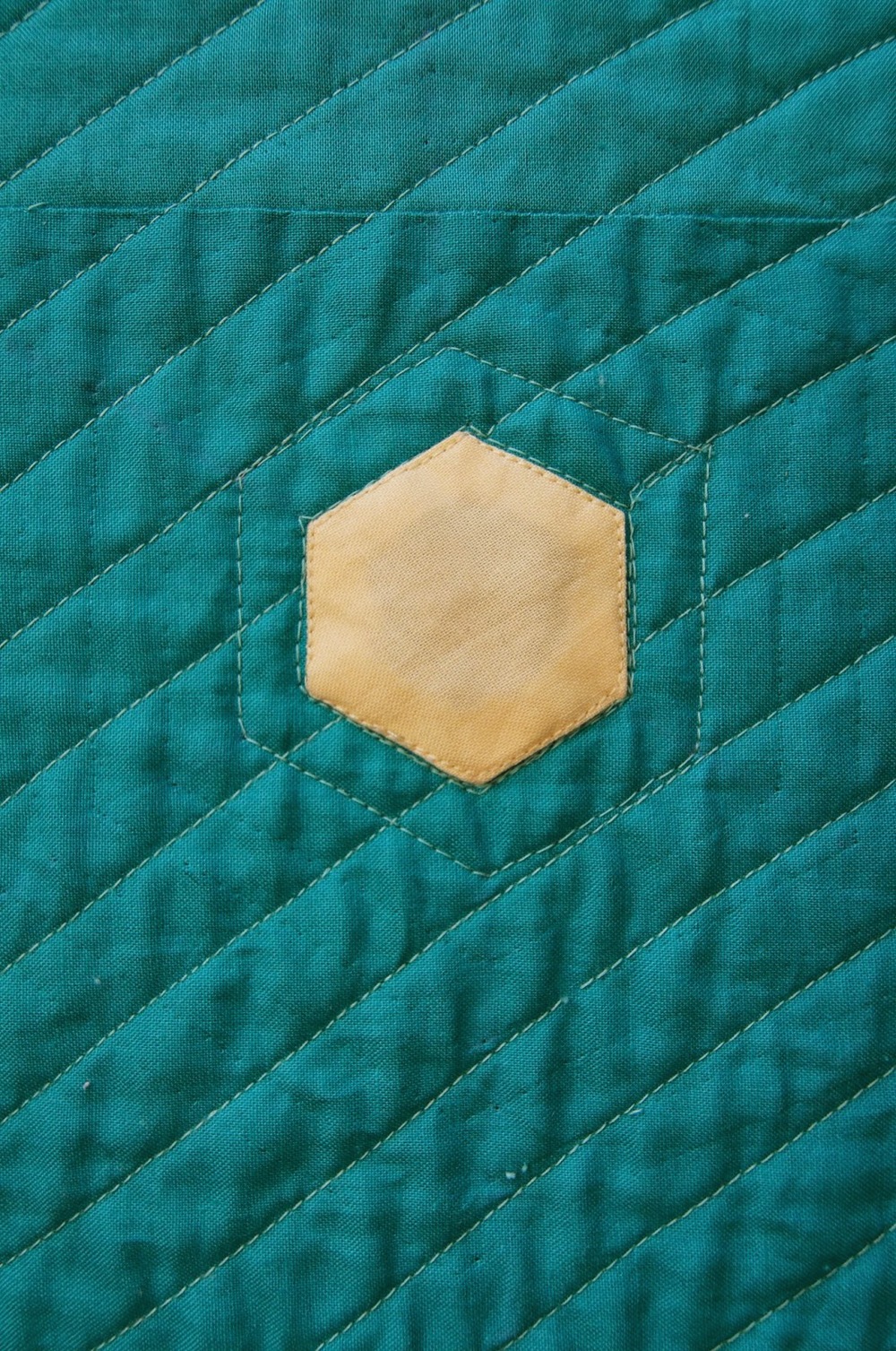
However, I did leave in a single row of quilting around the second hexagon.  I think that works. 


Here's a close-up of the quilting.  I went around each of the hexagons, rather than quilting over them.  That was a challenge in itself because I had to pick up the parallel quilting line on the far side of the hexagon after I had detoured around it.  Some are better than others, but mostly it worked.


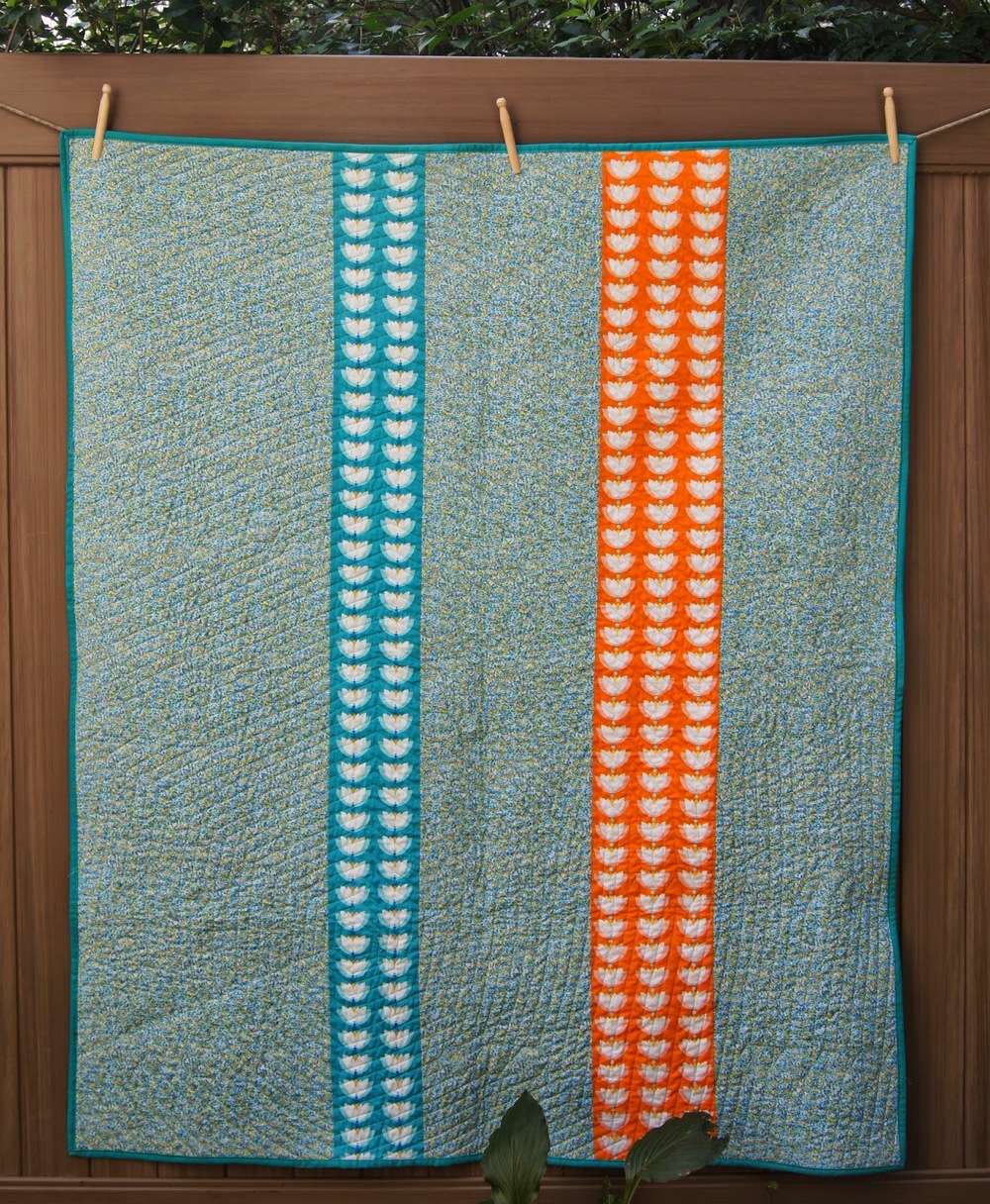
Finally, here is the back with the Lotus Drop flowers.
Modern Hexagon Quilt Back
I'm still intrigued by the idea of intersecting lines of concentric quilting.   I think it might work if I quilt in circles and make sure to start quilting each circle separately, moving outward until the lines start to intersect.   A project for another week!


Hue--Let's talk blue

by Judy Tucker


As I mentioned in my post the other day, I finally understand what "hue" means after reading Kari Vojtechovsky's workshop "Principles of Color: a design workshop" in the new book,  Essential Guide to Modern Quilt Making.

I've understood hue to mean a color.  But what does that mean?  I always used the word as "that's a nice hue" related to the gradation of a color. That's the first definition in the dictionary.

 Kari defines hue in technical terms as "the location of a color in the color spectrum"  of visible light.  That's the second definition in the dictionary.

Brilliant.  Green is the green in the rainbow.  Red is the red in the rainbow. Violet is the violet in the rainbow.  That is really clear.  She goes on the say that even with all the possible variants of a color, the color's hue is always its pure form as seen in the light spectrum (rainbow).

Kari states she likes to use the light-based color wheel of cyan, yellow and magenta.  But my stash worked out better using a color in the pigment-based color wheel (red, blue, yellow).

So, let's think about blue.
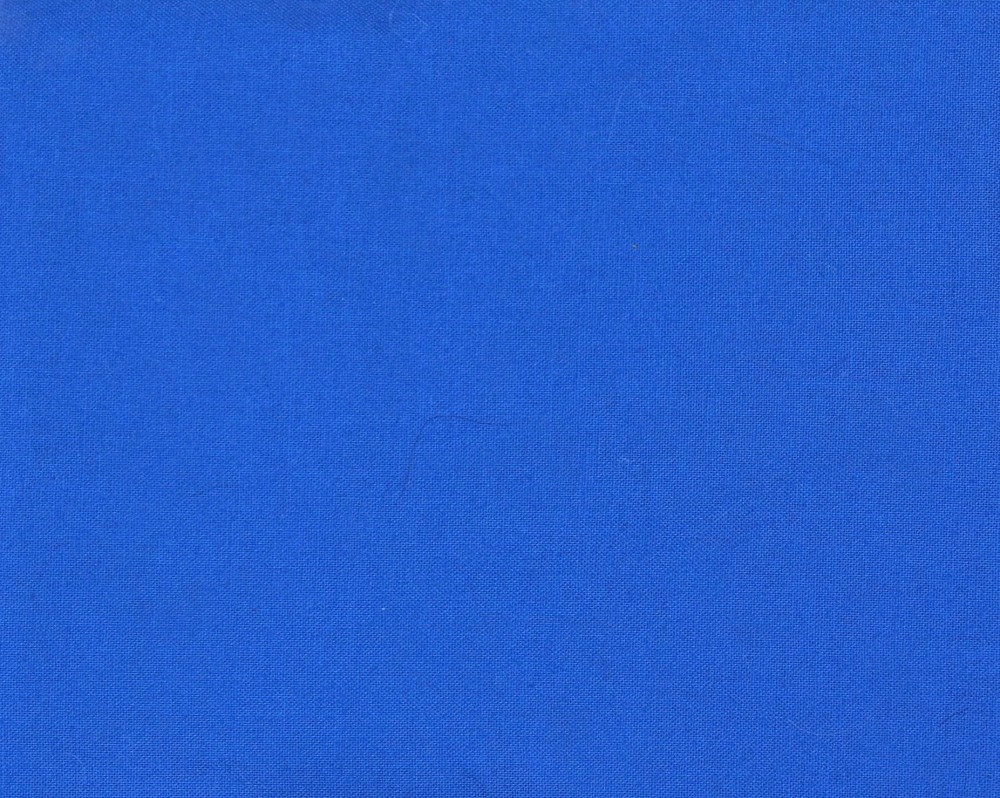
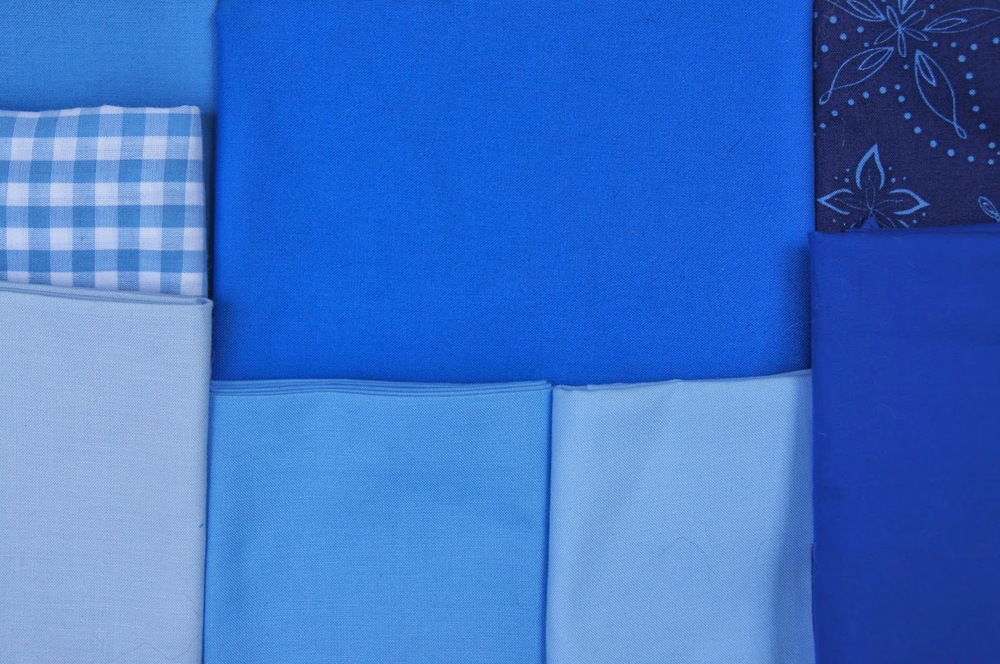
Of all the fabrics in my stash, I felt that this blue was the truest of the blues. So this blue is my Blue Hue.

Hue: Blue

Kari goes on to discuss how the saturation, the "degree of purity," of a color can be changed.

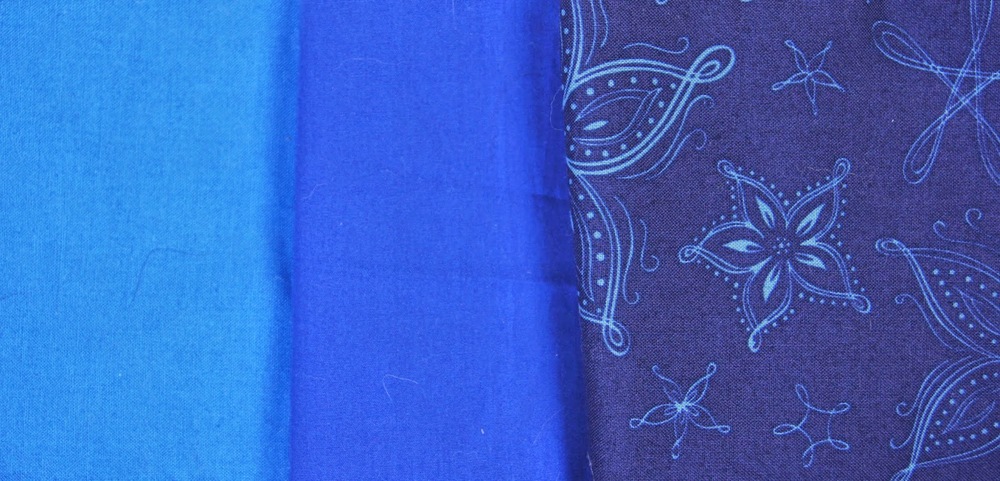
Add black to the hue and you get a "shade".  Believe it or not, the color to the far right is the same blue fabric shown above.  The middle and right fabrics are darker.  It's clear in the fabric on the right that black was added to make that very dark blue, but harder to see in this photo with the middle fabric.
(All these photos were taken outdoors, a couple minutes apart).


The Hue Blue on the far left, with 2 shades of blue

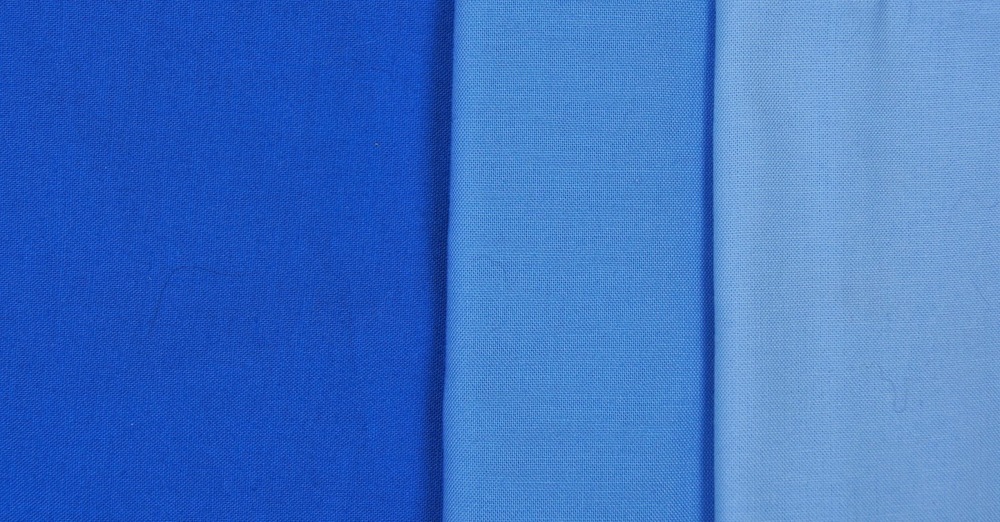
Add white to the hue and you get a "tint".

The Hue Blue on the far left, with 2 tints of blue

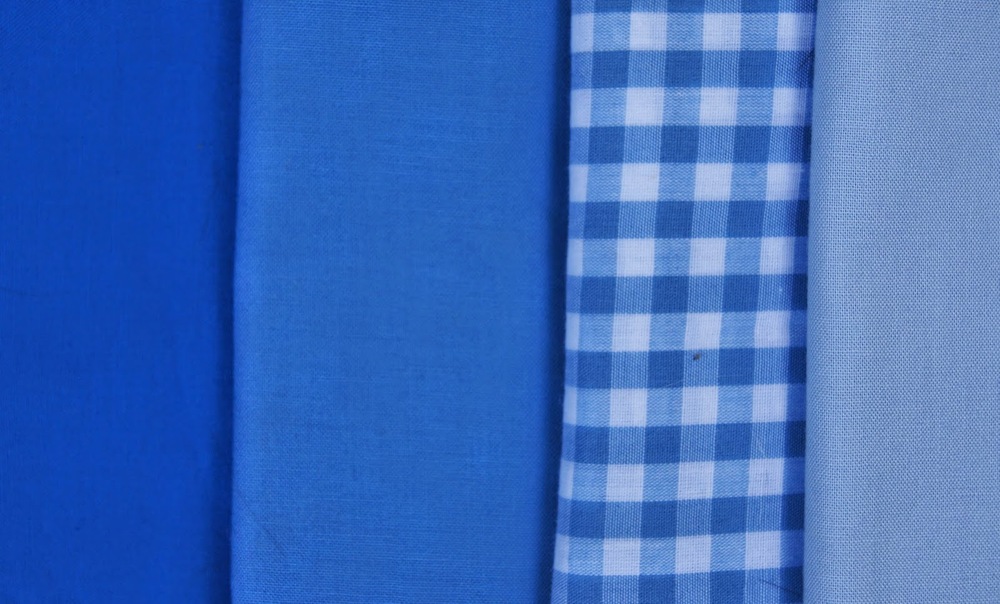
Add grey to the hue and you get a "tone."  That was a new concept for me.  I always thought about adding either black or white to a color to get gradation. I never considered adding a mix of black and white…although I know I did it when I was a child and mixing paints.  If black made my paint color too dark, I added white.  It's the same idea.

The fabric colors in the photo below look much brighter than they really are. You can tell the far right color has grey added to the hue but it's not as apparent with the two middle colors.  In actuality, all three of the colors to the right look greyish.

It's interesting that the Blue Hue fabric looks much darker and richer next to the fabrics where the hue has had grey added to it.

The Hue Blue on the far left with 3 tones of blue

So, that's hue in a nutshell.  If the color is found in a real rainbow, that's a hue, in this case, blue.  If you add light or dark to a color, the hue is still blue but the saturation has been altered.

The Hue Blue is upper middle, the two tints are lower middle.
The greyed tones are the far left and the black shades are far right.

Kari has so much great information about color in her workshop.  It's a lot of fun and really worth reading.

Book Review: Lucky Spool's Essential Guild to Modern Quilt Making

by Judy Tucker


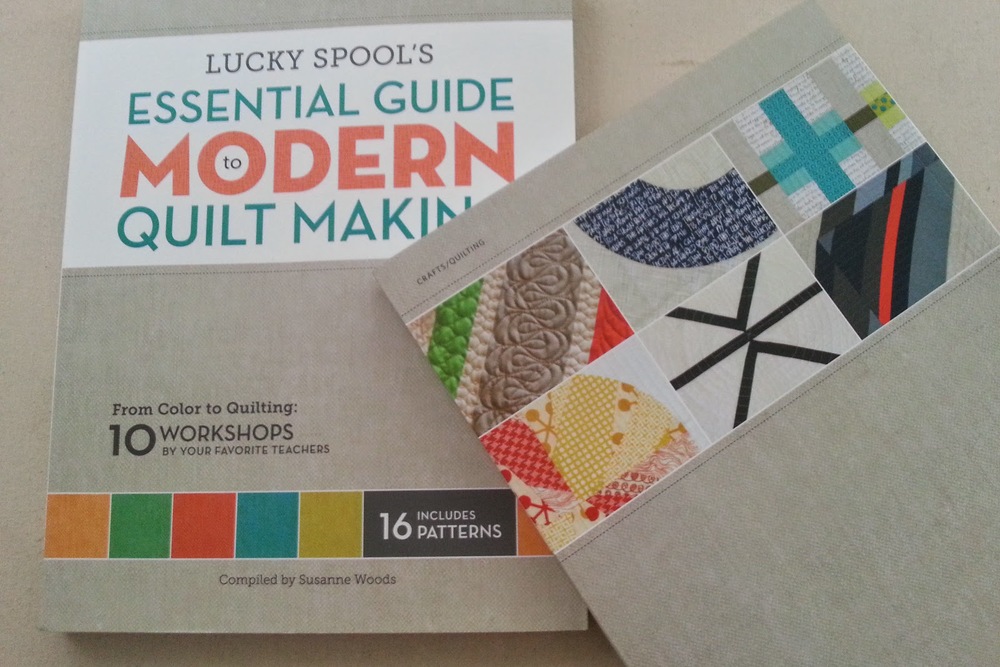
Yesterday the UPS deliveryman dropped a gem of a book on my front porch!  Lucky Spool's Essential Guild to Modern Quilt Making complied by Susanne Woods a great reading and a great resource for anyone making Modern Quilts.

Each of the chapters in this book is a "workshop" in Modern Quilting.  The teachers are active, and well known, in the Modern quilting world. The workshops are based the class each of these master quilters is asked to teach most often. 

The first workshop is "The Principles of Color" written by Kari Vojyechovsky.  It is an excellent discussion of the use of color in quilts.  I finally understand what  "hue" is. (I'll discuss hue in a post later this week).  Subsequent chapters include workshops on "Working with Solids" by Alissa Haight Carlton and "Working with Prints" by Dan Rose.

Jacquie Gering has a workshop on "The Alternative Grid".   Of particular interest for readers in Massachusetts/New England:  Among the quilts she has included in her lesson is a bold quilt that is difficult to look at.  Jacquie crated this quilt, named "Aftermath", following the Marathon Bombings in Boston.

Much to my delight, Cheryl Arkison has a workshop on "Circles and Curves".   I took her class on Craftsy which is excellent.  I am so happy to now have the instructions for making her Reverse Circles in a book!   I used her technique to create the inset circle in my "Diamond in the Woods" quilt. 


Penny Layman has a great workshop on "Paper Piecing".  On this hot summer day, I was tickled to see her snow cone pattern.  And I know her stiletto shoe design is going to be a bit hit with readers!  (The templates for her designs are included at the back of the book).

There is an interesting workshop on "Large-Scale Piecing" by Heather Jones.  Learn to make a full size quilt with just a single block or a few large blocks.

Angela Walters has a workshop on "Modern Quilting"--how to do the quilting on modern quilts. She has instructions for some quilting designs which are very do-able and will give great results. 

Finally Heather Grant's workshop is a "Study of Modern Quilts".  It is a "show" of 50 Modern Quilts.  Each quilt has a comment from the quilter.  You'll feel like you've been to see an exhibit at a museum after you've read this chapter. 

I am so excited about this book.  Run to your local shop or on-line store and get yourself a copy.  You'll be glad you did!


"Sending Greetings" Quilt Design: building quilting skills

by Judy Tucker


I've been thinking about a quilt design which could be used in a class to build skills for intermediate quilters.  I expect this class will have students who have made a simple quilt or two but still don't have a lot of experience.  I'm still thinking about the definition of an "intermediate" quilter so this is a work in process.

Thinking about "next step" piecing skills I decided sewing seams on the bias and working with triangles seemed to fit the bill.  I sat down at my computer using EQ7 (Electric Quilt 7) and started experimenting with some of the blocks from the program's block library.

I wanted the quilt to be in the Modern Quilt genre and amenable to using a variety bold, bright modern prints and/or solids.

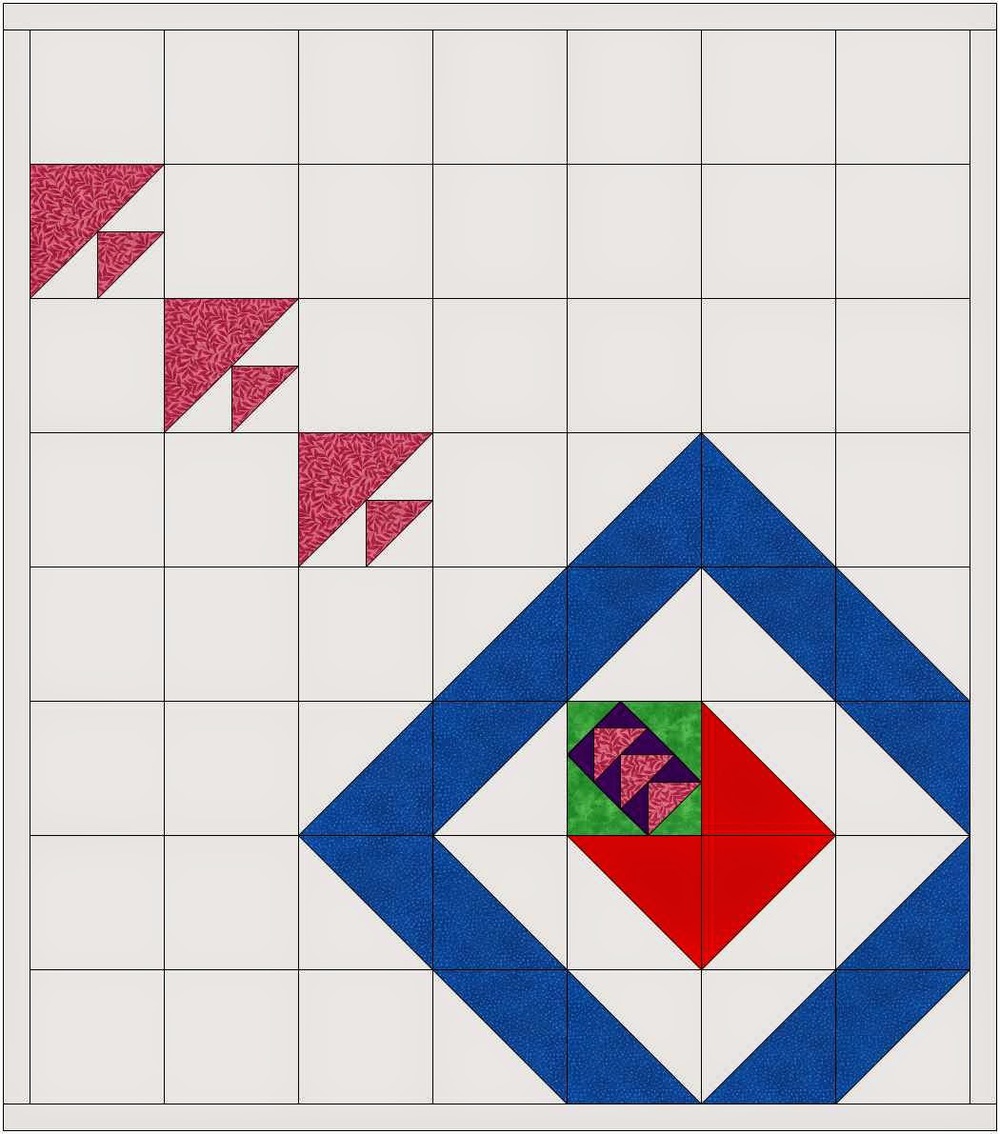
Here's what I came up with.


I like the negative space and the bold asymmetric diamond in this design. I think it might be fun to use some text fabrics with this pattern, either inside the envelope flap or as the background of the quilt. I think the background would also be beautiful using a quilting linen.

This pattern uses half square triangles, flying geese, fold over triangles on the large flying bird block which EQ7 calls Flying Goose and corner setting triangles in the "envelope" flap around the series of small flying geese. In addition to working on piecing skills, the students will have to think about color and contrast to make this design shine.

It can be quilted with a simple grid but there is also lots of negative space to which could be used to practice free motion quilting.

If you have thoughts about this pattern or suggestions for "intermediate" skills for quilters please send me a comment.  I'd love to hear what you think.

Matching the design when piecing fabrics for quilt backs

by Judy Tucker


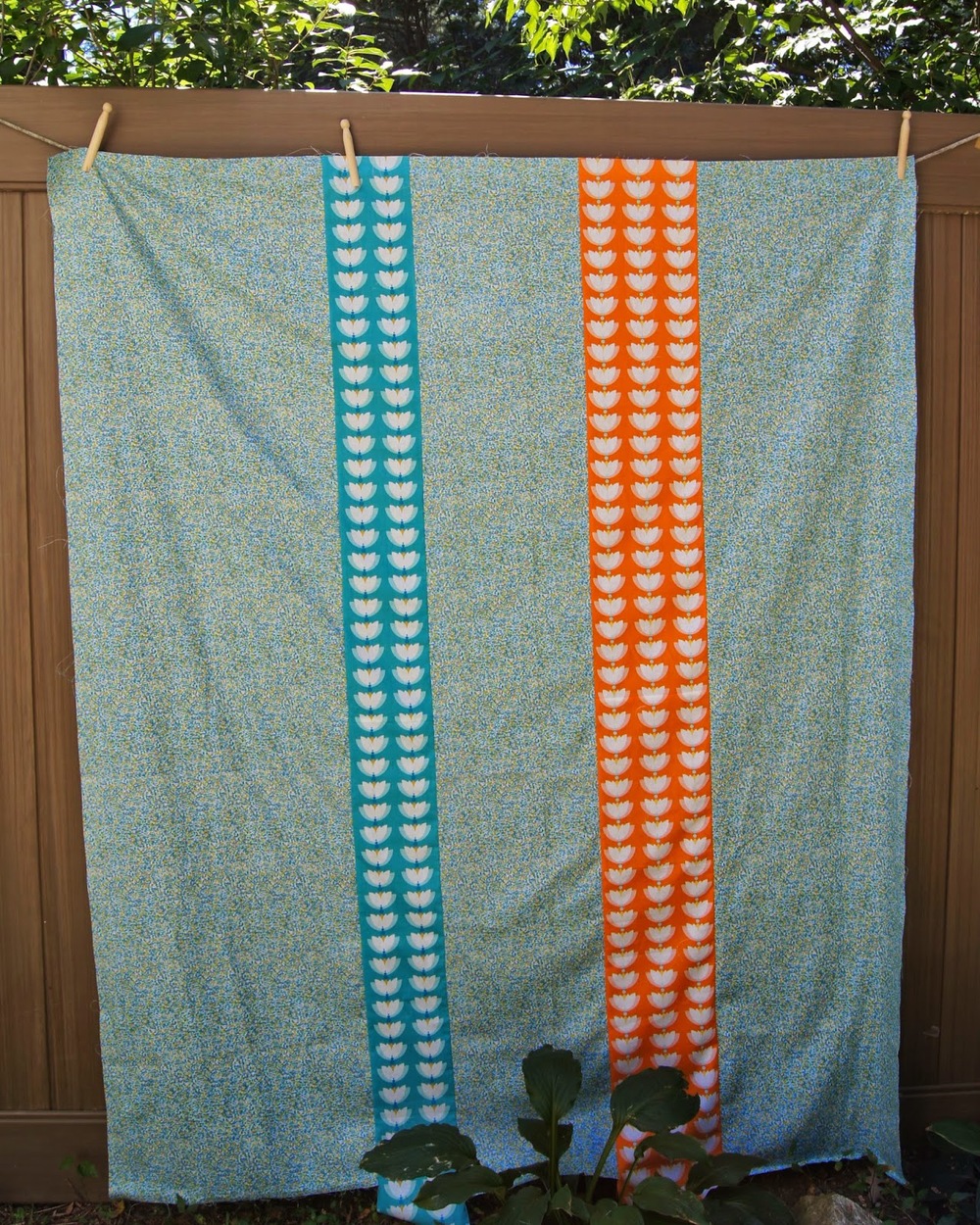
2 Sections of the Lotus Drop fabric have been
sewn together to make a strip long enough for
a quilt back.


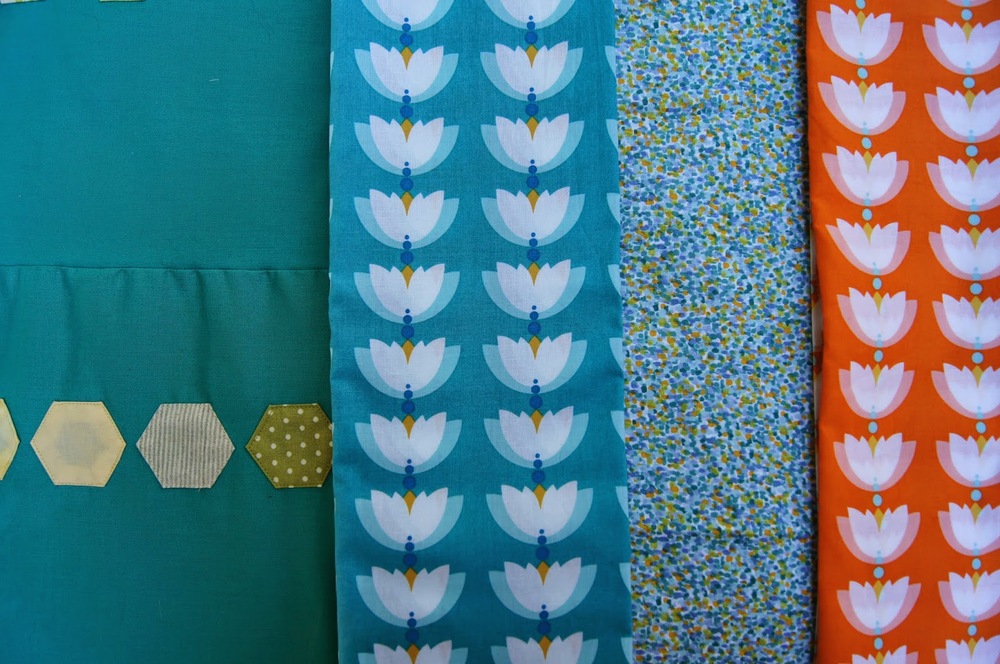
My Lotus Pond fabrics made by Cloud 9 Fabrics arrived in the mail yesterday.  They are so beautiful.  I immediately stopped the project I was doing and starting working on the quilt back for my Modern Hexagon quilt. One thing led to another and by the end of the day, I had made backs for 3 quilts.

Detail of hexagon quilt top
with the 3 backing fabrics
Completed backing

I found I needed to match the designs in the fabrics for all three of the quilt backs so thought I would share with you how I did that.

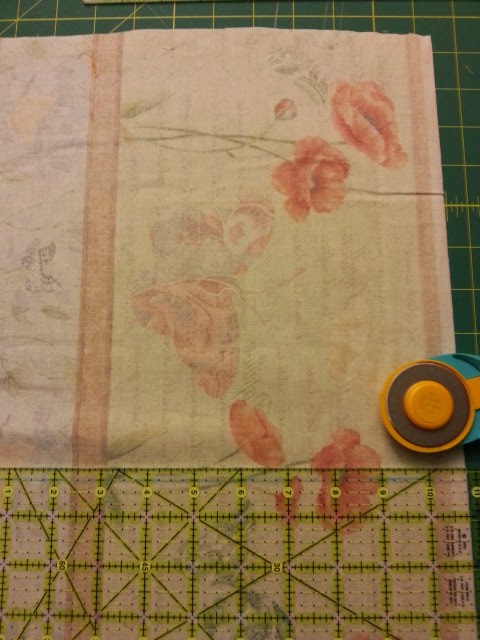
Step One:  To attach two strips together to make a longer piece, make a fold in the piece of fabric that will be added the first section of the fabric.  Use the fold line to exactly match the designs on both pieces of the fabric.

Fabric to be added is folded and placed on top
of the 1st section, exactly matching the design

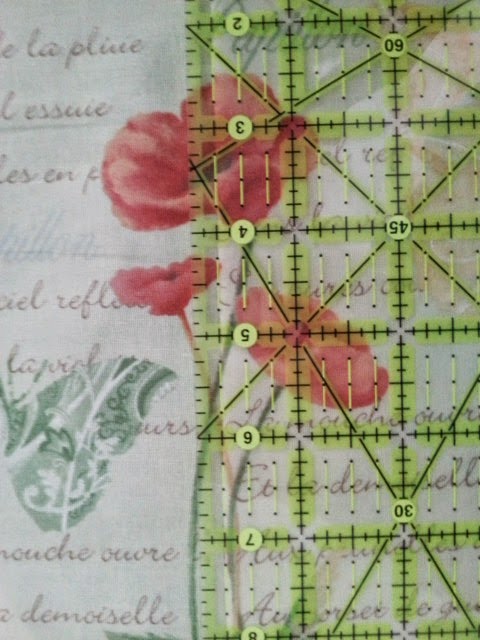
Step 2:   Lay your ruler on the fold so that the 1/4 line of the ruler is along the fold line and the ruler extends beyond the fold 1/4 inch.  Hold the ruler in this position and use it as the line to cut the first section of fabric.

Ruler with 1/4 mark over the fold of the piece being added
and the ruler extending 1/4 inch over
the first section of fabric.

Step 3:  Take the 2nd piece of fabric that you folded in Step 1 and turn it with the wrong side of the fabric facing up.  Open up the fold and mark it with chalk or soluble marker if you have difficulty seeing the fold line.  Place the 1/4 inch inch line of the ruler on the fold line.  (I drew blue chalk line on the fold so you can see it in the photograph).  The edge of the ruler extends 1/4 inch above the fold on the side closest to the raw edge of the fabric.  Cut along this line.

Cut 1/4 inch above the fold line on the side
closer to the raw edge of the fabric

Step 4:  Place the two pieces of fabric, right sides together and sew them together with a 1/4 inch seam. Press the seam.  You may find you get a better match if you press the seam in one direction and a less good match if pressed the other direction. Press the seam in the direction that gives the result!


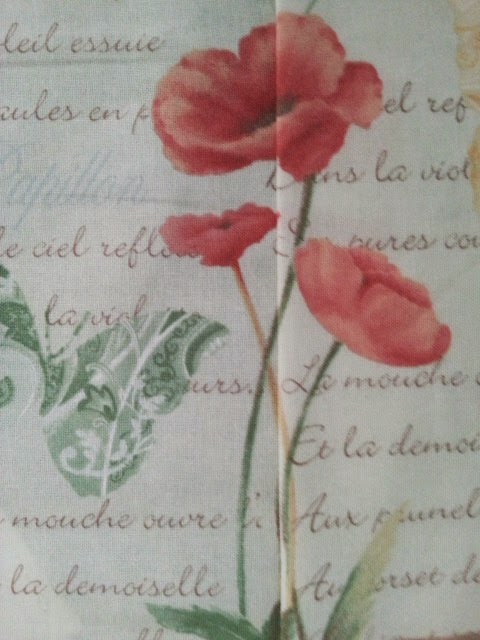
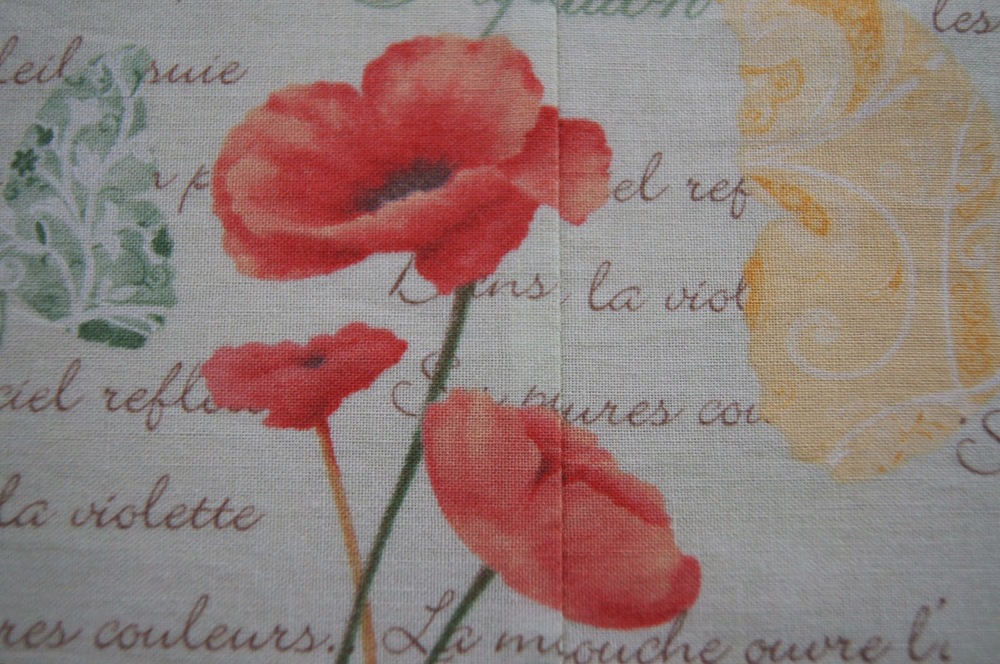
Here is the result:


Here is the same trio of poppies on an uncut section of the original fabric:


It takes a bit of practice to get a great result.  But it so rewarding when the design matches perfectly! 

I recommend that you practice matching designs with a couple pieces of scrap fabric once or twice before you cut into the fabrics for your quilt.  I find I still check and recheck to make sure I have it right before I cut!  


Modern Half Square Triangle Quilt--Diamond in the Forest

by Judy Tucker


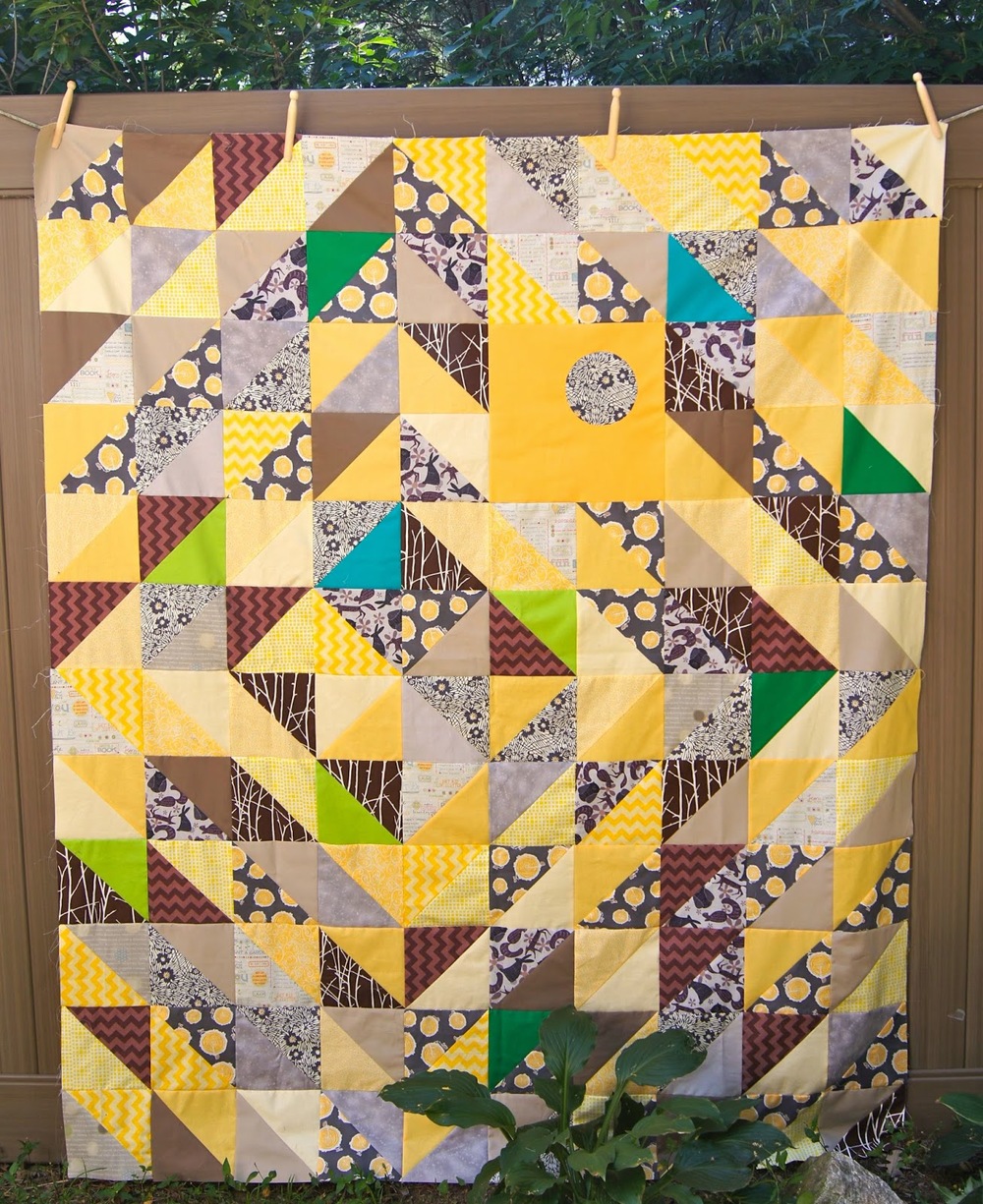
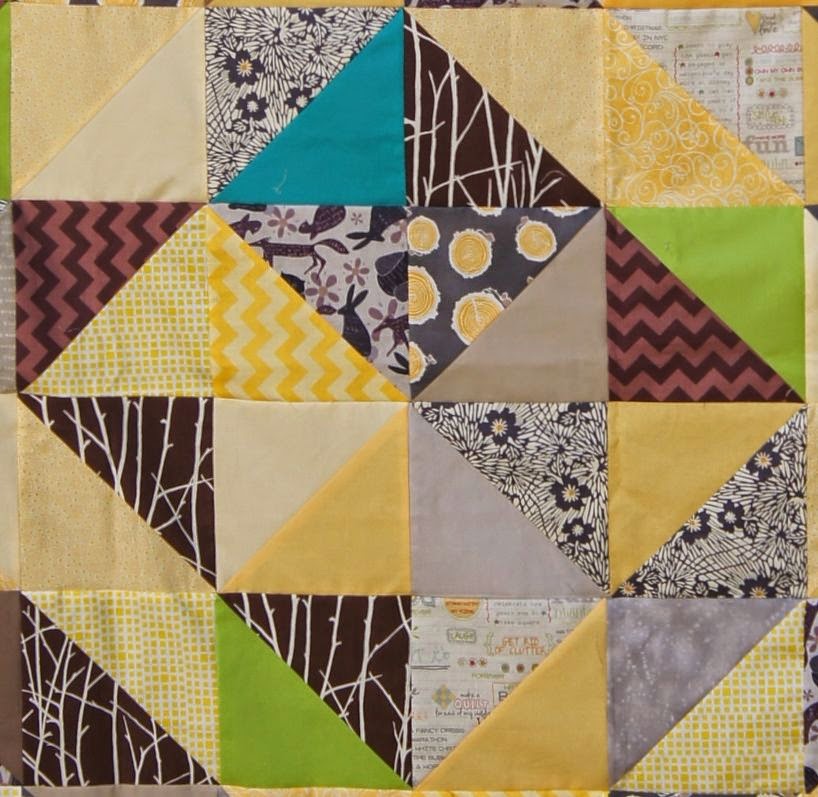
Here's my Modern Half Square Triangle, "Diamond in the Forest."   My plan was to make a Random Half Square Triangle (HST) quilt.  It turns out that I am too much of a control freak to go random!

The loss of randomness started with the initial piecing.
  • I couldn't bring myself to put the pieces in a paper bag which would have insured the HSTs were really random.   Instead I intentionally picked fabrics which complemented each other for the HSTs.

When I put the HSTs on the design wall any attempt at randomness ended.
  •  As I put the blocks on the design wall, I made sure that the fabrics in adjacent blocks weren't the same.
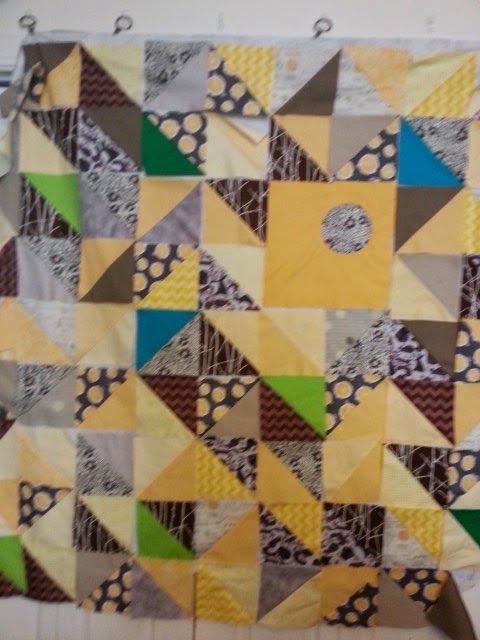
  •  Then my eye caught the beginning of a pattern in the blocks…and I went for it.  Good-bye Random HST quilt!  Can you see the diamond shape slightly left of middle in the lower half of the blocks on the design wall?   Just one block on the right side needs to be turned to close the diamond.  This photo is fuzzy… it was a quick snap in case a dog ran by and the blocks flew off the design wall. Yes… it has happened. Not good!


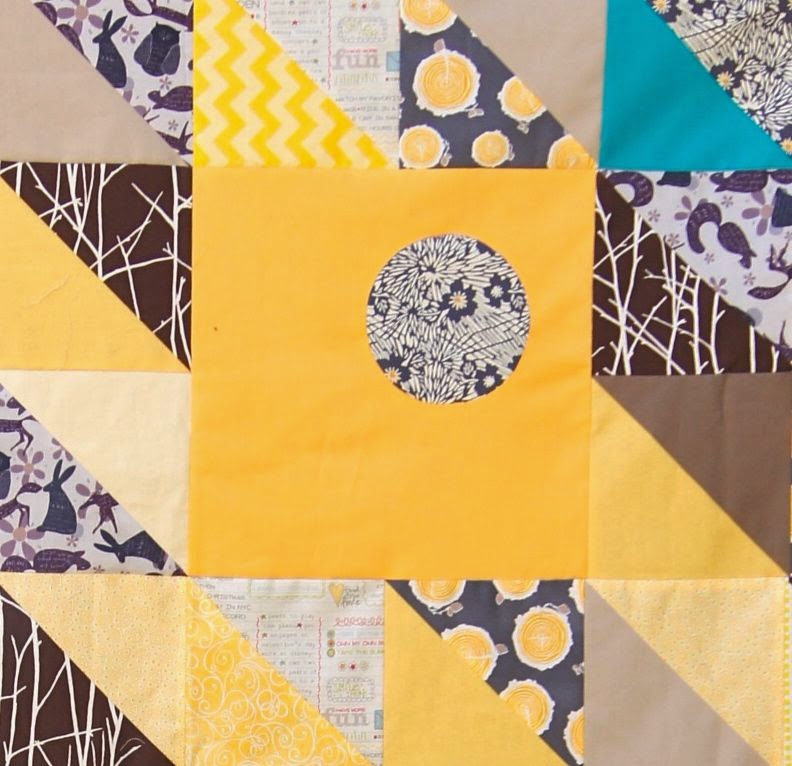
Here's a detail of that focus diamond in the finished top.


The inspiration for this project came from a quilt made by Kali Zirkle which was posted on the Museum of Fine Arts, Boston, Facebook page on Happy Huesday.  Kali's quilt was made with Kona Cotton solid fabrics and her quilt is a Random HST quilt.

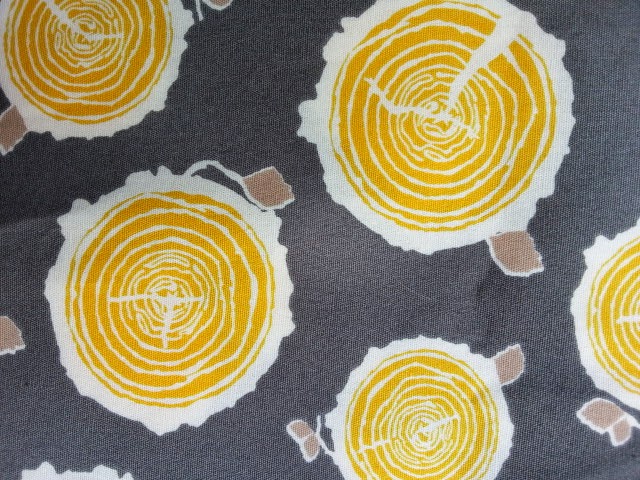
The actual planning for this quilt started when I found the "Sweet as Honey" fabric with the cut tree stumps.  It is an Art Gallery Fabric and was designed by Bonnie Christine.  I found in the shop at J.P. Knit & Stitch.   I collected yellow, brown, tan and grey fabrics to complement it.  My intention was to make the quilt with just those 4 colors.

Art Gallery Fabrics "Sweet as Honey"


However, one afternoon I had a DYI home improvement show on in the background while I was sewing.  I wasn't really paying attention to it so I don't know what the show was nor the cable channel airing it. I looked up to see one of the finished rooms. The walls were painted a soft orange yellow with turquoise and white throw pillows on the two setting areas on either side of the fireplace.

The proverbial lightbulb over my head flashed on.  This quilt would be so much more interesting with a couple of accent colors.  I added a bit of turquoise, yellow green and bright green.  That was just what this quilt needed.

I put the block with the reverse circle in the quilt to echo round tree stumps in the "Sweet as Honey" fabric.  The background fabric of that block is Kona Cotton Cheddar yellow!  For those of you who have been following my blog for a while…yes, cheddar yellow fabric has finally made it into one of my quilts!

This quilt which started out in one direction morphed into something different in the process of sewing it.  Could that be called Random Designing?