Little Spools Wall Hanging

by Judy Tucker


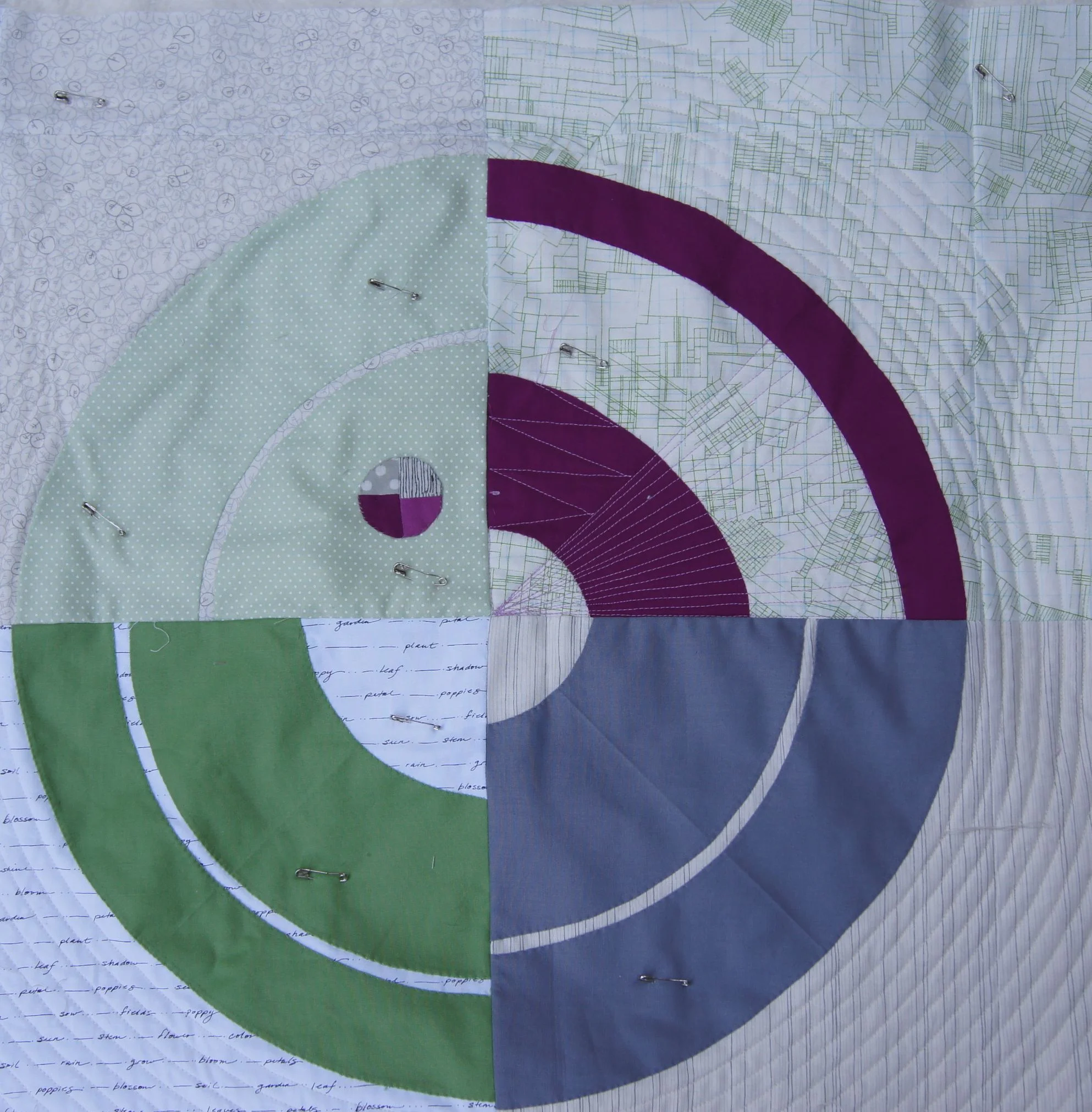
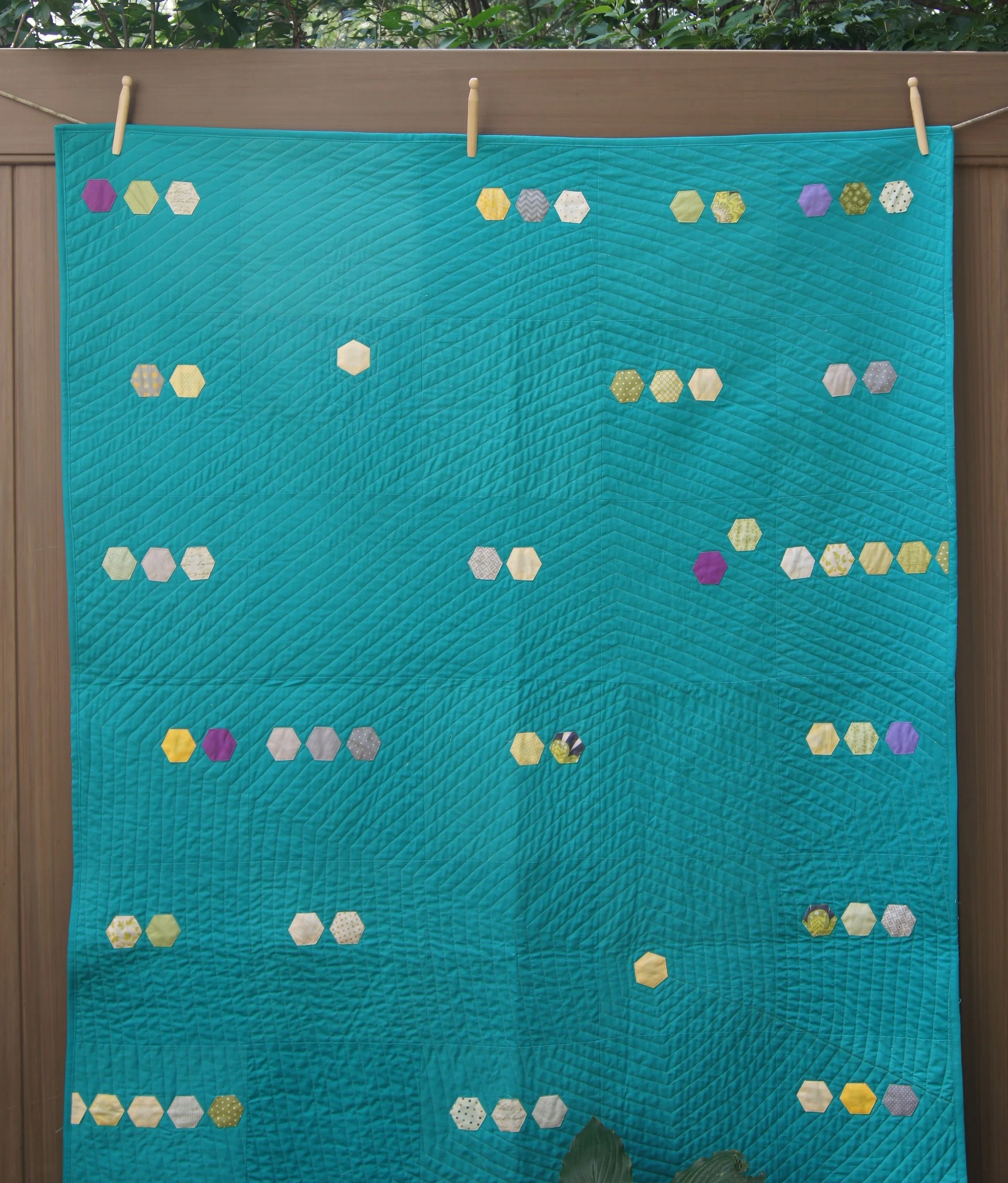
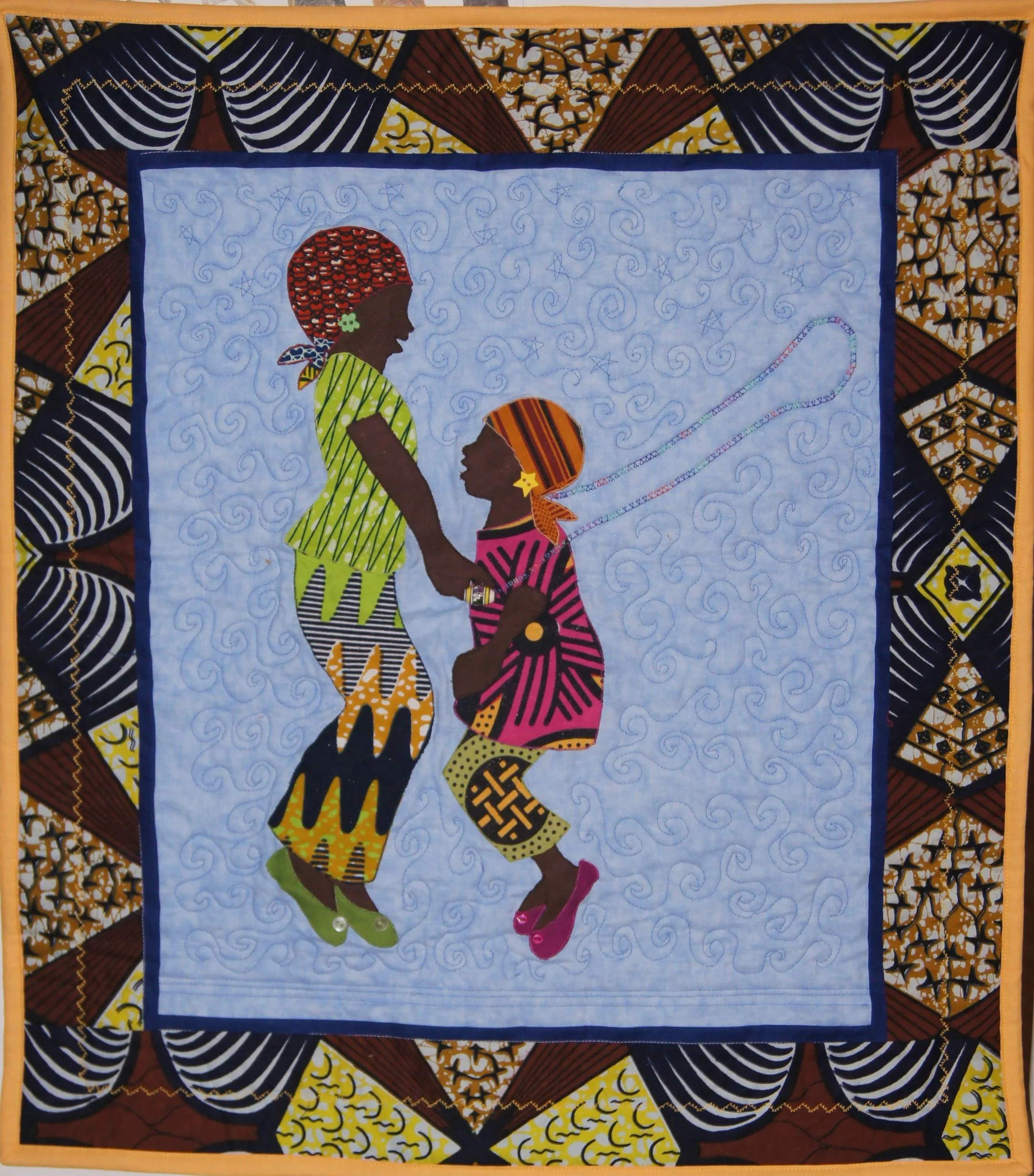
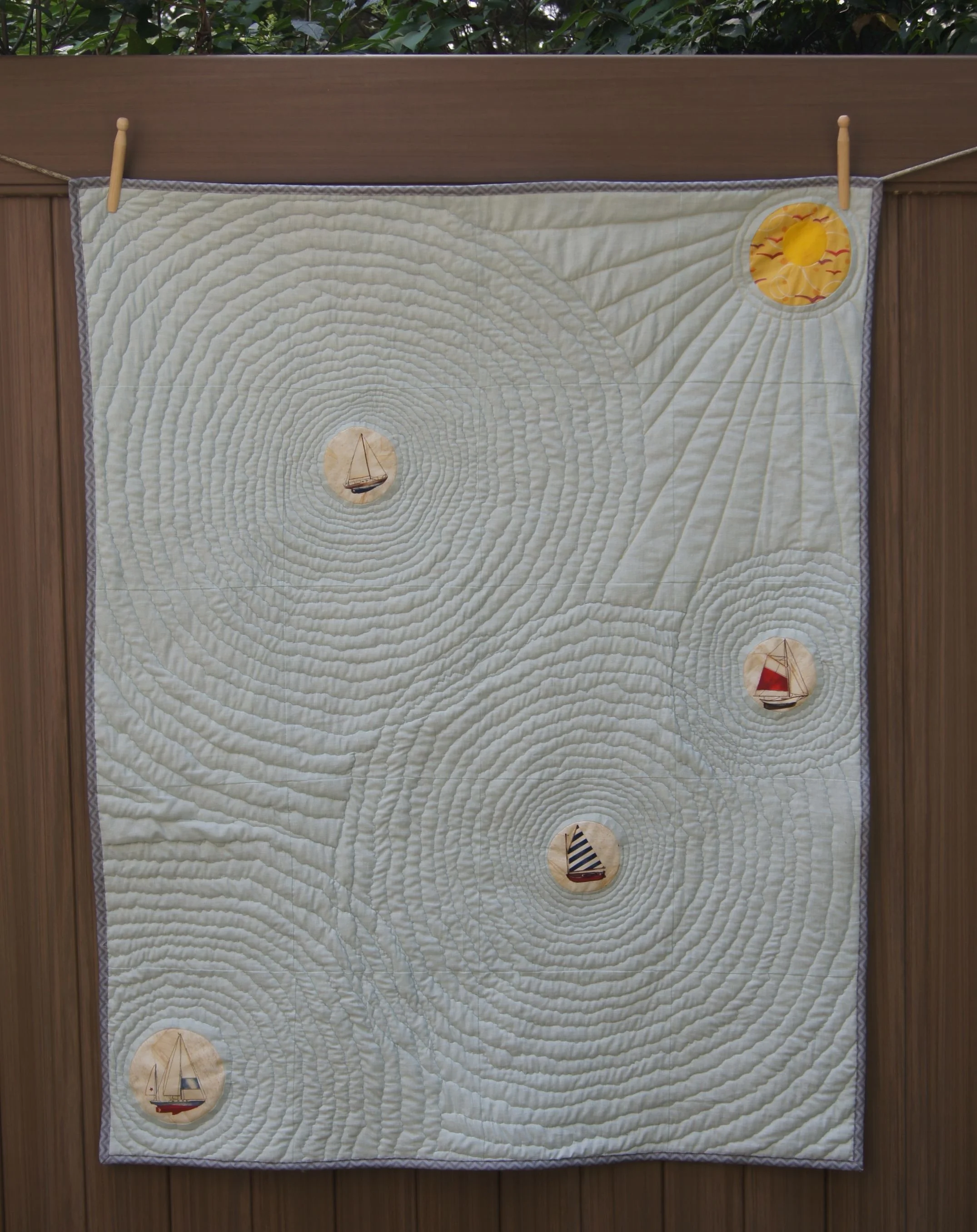
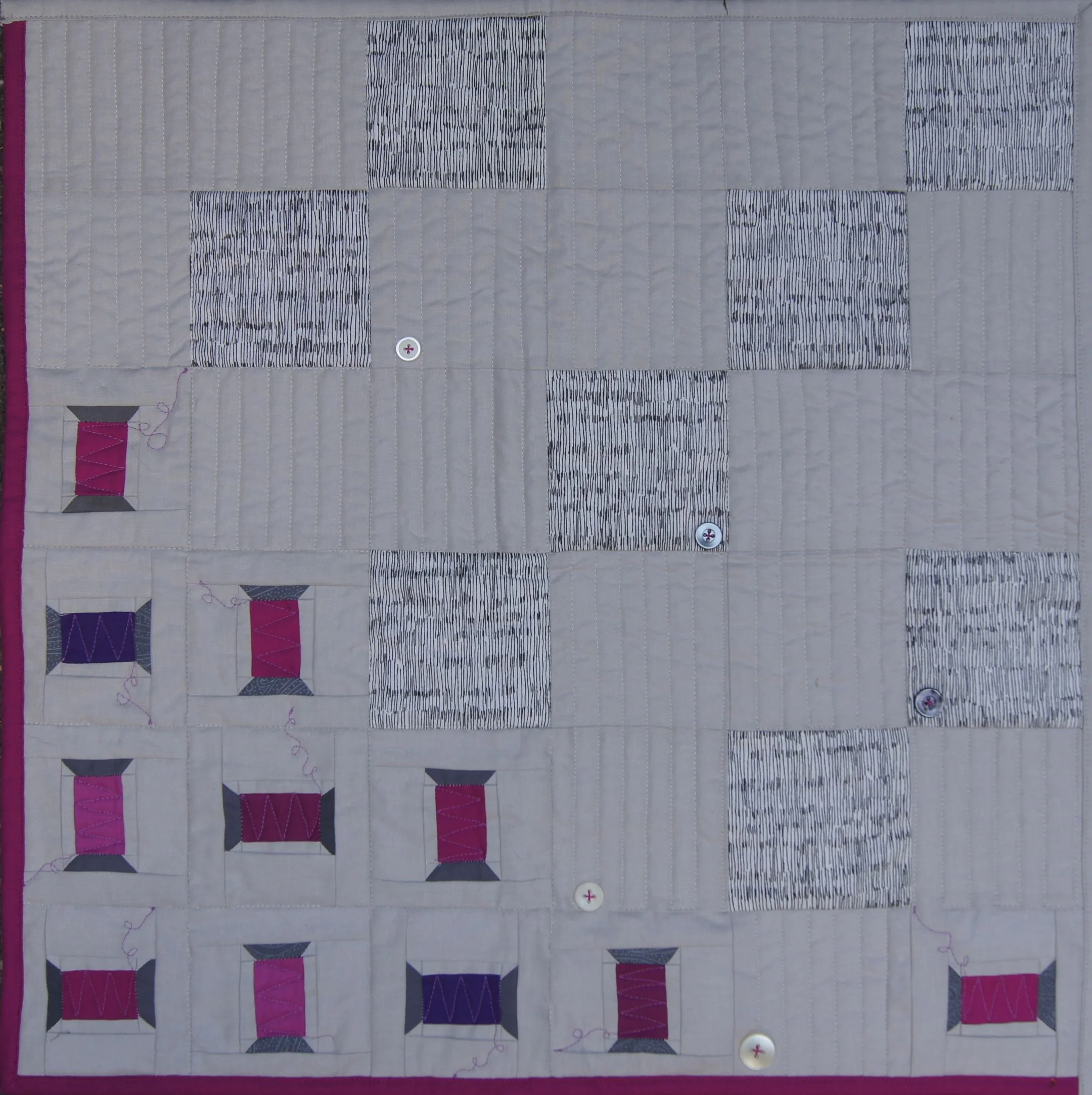
"Mending the Bishop's Buttons"  21 x 21 inch wall hanging

"Mending the Bishop's Buttons"  21 x 21 inch wall hanging

The Proper Bostonian Quilt Guild runs a Summer Challenge every year.  It's a project to keep everyone sewing in the summer months when the guild doesn't meet!  And it's a contest.

This year there were two options for the Summer Challenge quilts.  Both options must be based on a specific inspiration which can be explained in a sentence. 

  1. A small quilt, 24 x 24 inches or smaller using the Pantone Color of the Year for 2014, Radiant Orchid (Kona cotton's Cerise).  We were required to use all of a Fat 1/16  (a piece of fabric 9.5 x 11 inches) which was provided at the last meeting in June. It had to incorporate 3-5 Modern Quilting Design Characteristics. ( A list of 11 characteristics was included.  You can see the list if click on the link above and then on the link for the Summer Challenge Instructions). 
  2. A quilt 36 x 36 inches but less than not larger than 72 x 72 inches.  It must incorporate 3 to 5 Modern Quilting Design Characteristics.  

The Purple family is not a slice of the Color Wheel I would typical use as a color for a focus fabric. I'm more likely to add a magenta or purple as an accent.  So this challenge definitely pushed me right out of my comfort zone. 

I took one look at that rectangle of Kona Cerise fabric and thought, "That looks like the color a Bishop's clerical shirt."  Turns out that Bishop's shirts come in 2 colors--Red Purple similar to Radiant Orchid and Blue Purple.  Awesome.  That added another color and interest for the quilt!

This idea didn't totally come out of left field.  I have 2 great friends who are married.  Our friendship goes back to our days when we were college age. He's grown up to become an Anglican Bishop.  She loves to sew and does some quilting.

I had just finished my Jumbled Spools Quilt.  A friend in the Guild saw that quilt and told me that years ago she made a Spool Quilt with little spools.   So I took the color inspiration from the Bishop's colors and the idea of a quilt of Little Spools and designed the wall having above.

It meets the Modern Quilt criteria by having an asymmetric pattern, texture from dense linear quilting, lots of negative space and no borders. 

I thought it would be fun with some button  to add some visual accents.  Hence the title, "Mending the Bishop's Buttons."

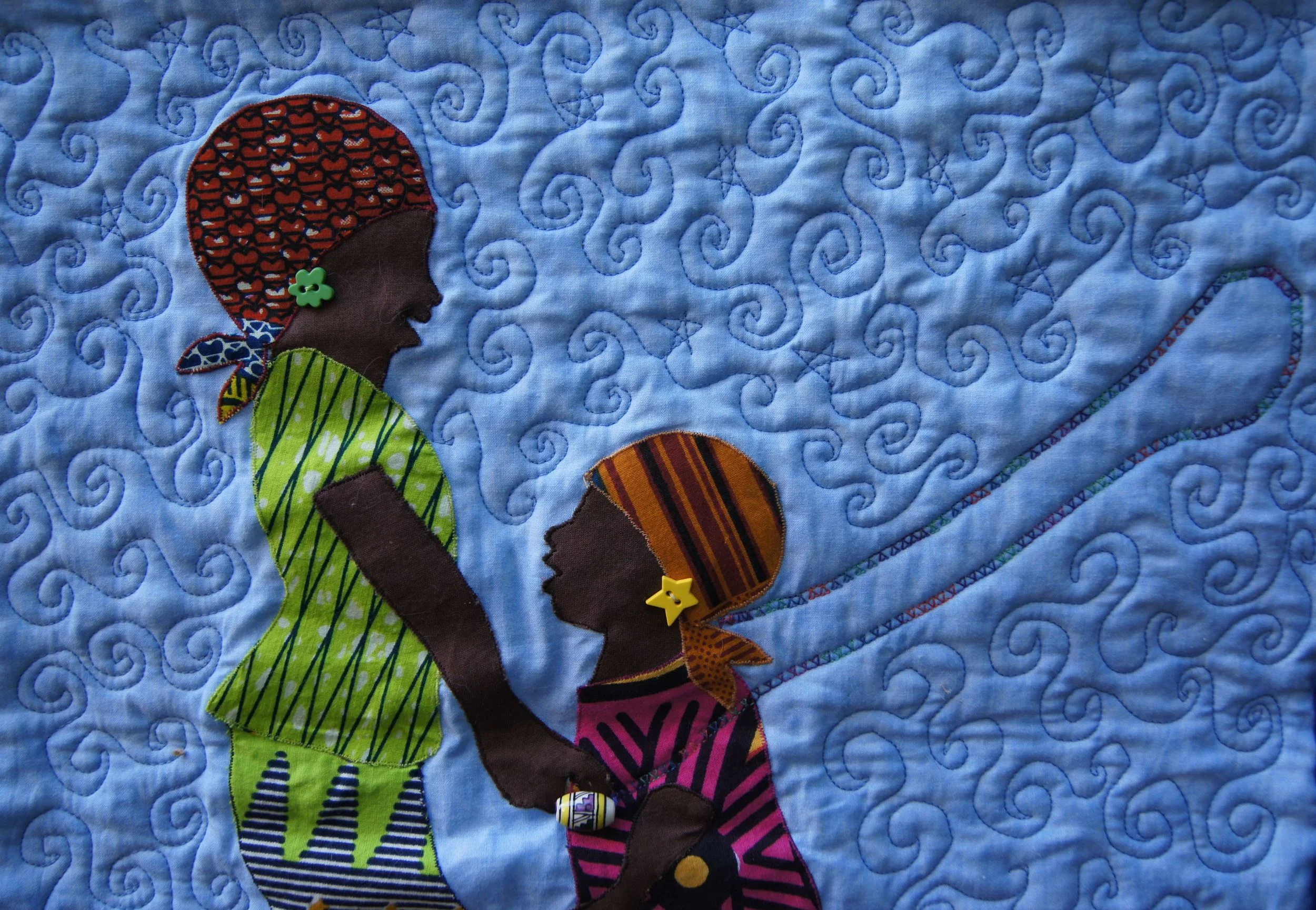
When I quilted it, I quilted the spools so that the thread on some of the spools dangling. More than once I've run my hand across this little quilt to brush off the loose threads!   Except they aren't loose--it's the quilting!  Too funny!
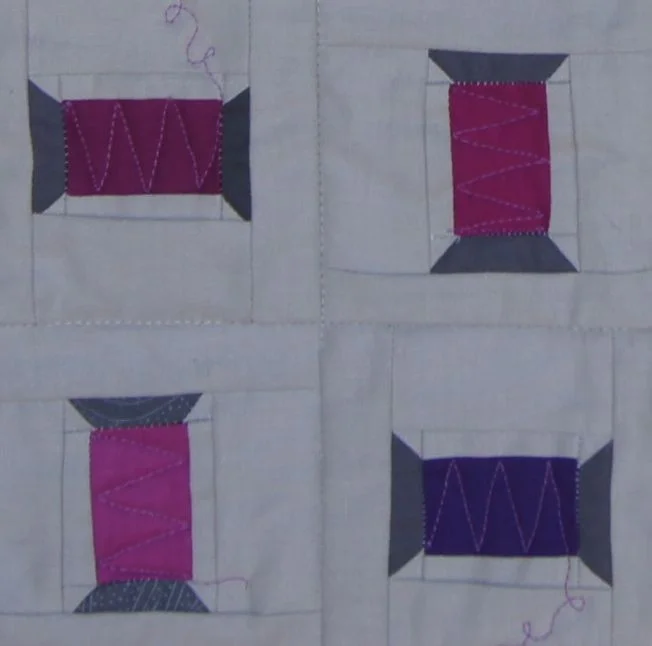
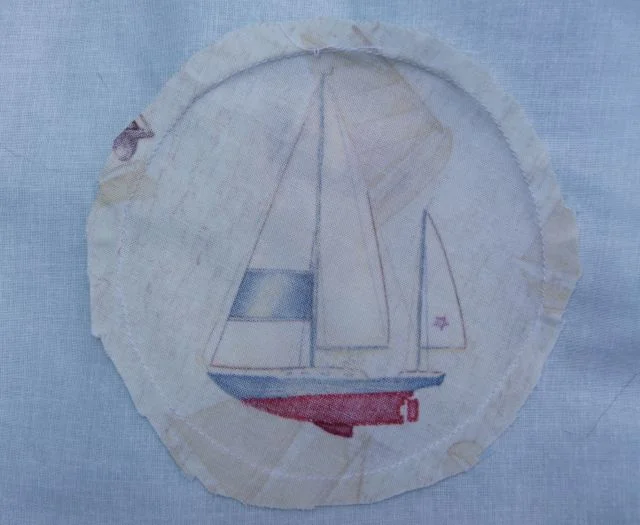
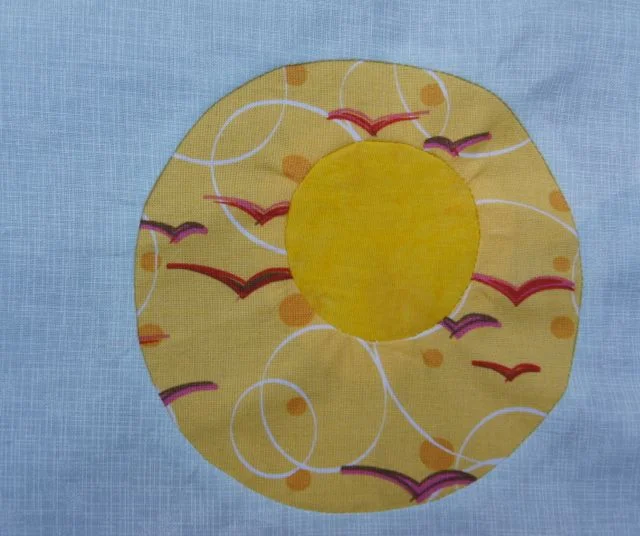
Detail of Spools.  The spool upper right is Kona Cerise, the lower Right is a Blue Purple

Detail of Spools.  The spool upper right is Kona Cerise, the lower Right is a Blue Purple

This year all the PBQ Summer Challenge quilts will be in a show at the library in West Roxbury, MA, November 13-15. 2014. 

Our first meeting of the fall is tonight.  Can't wait to see what everyone as created for this Summer Challenge!

Dog Training Apron: Cotton + Steel

by Judy Tucker


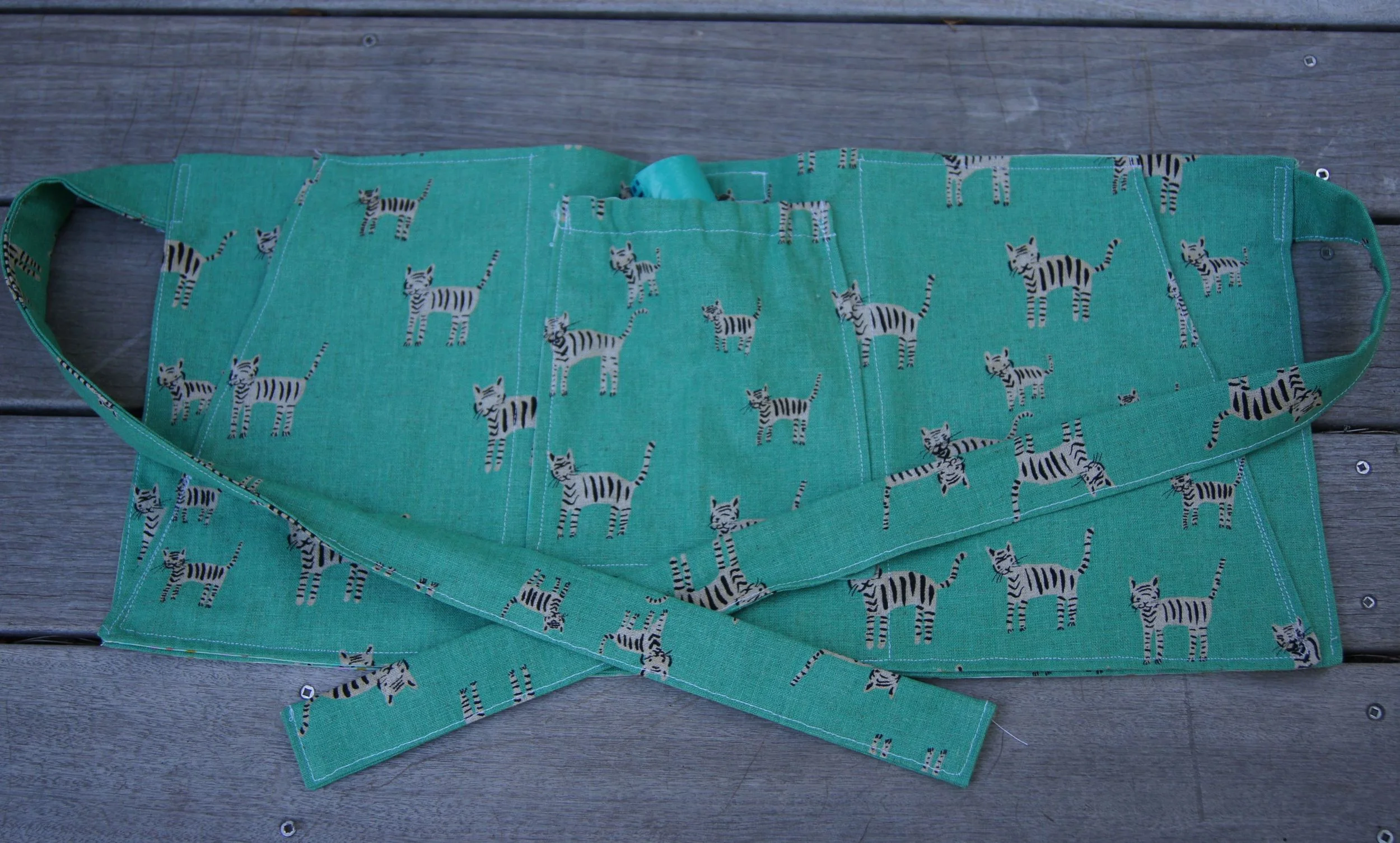
Dog Training Apron Cotton + Steel "Tiger Stripes"

Dog Training Apron Cotton + Steel "Tiger Stripes"

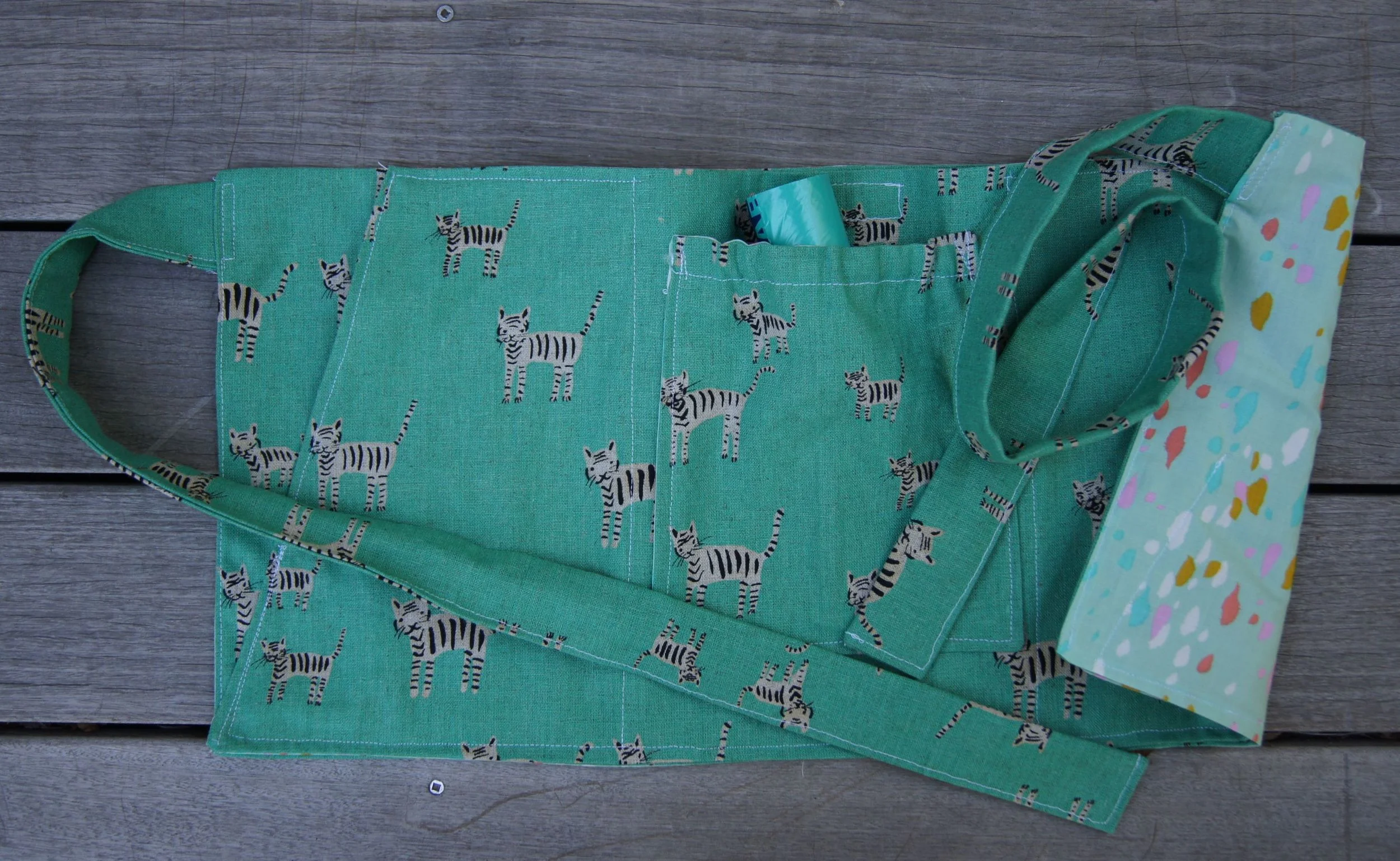
Here's the first of my completed September projects, a new dog training apron.  

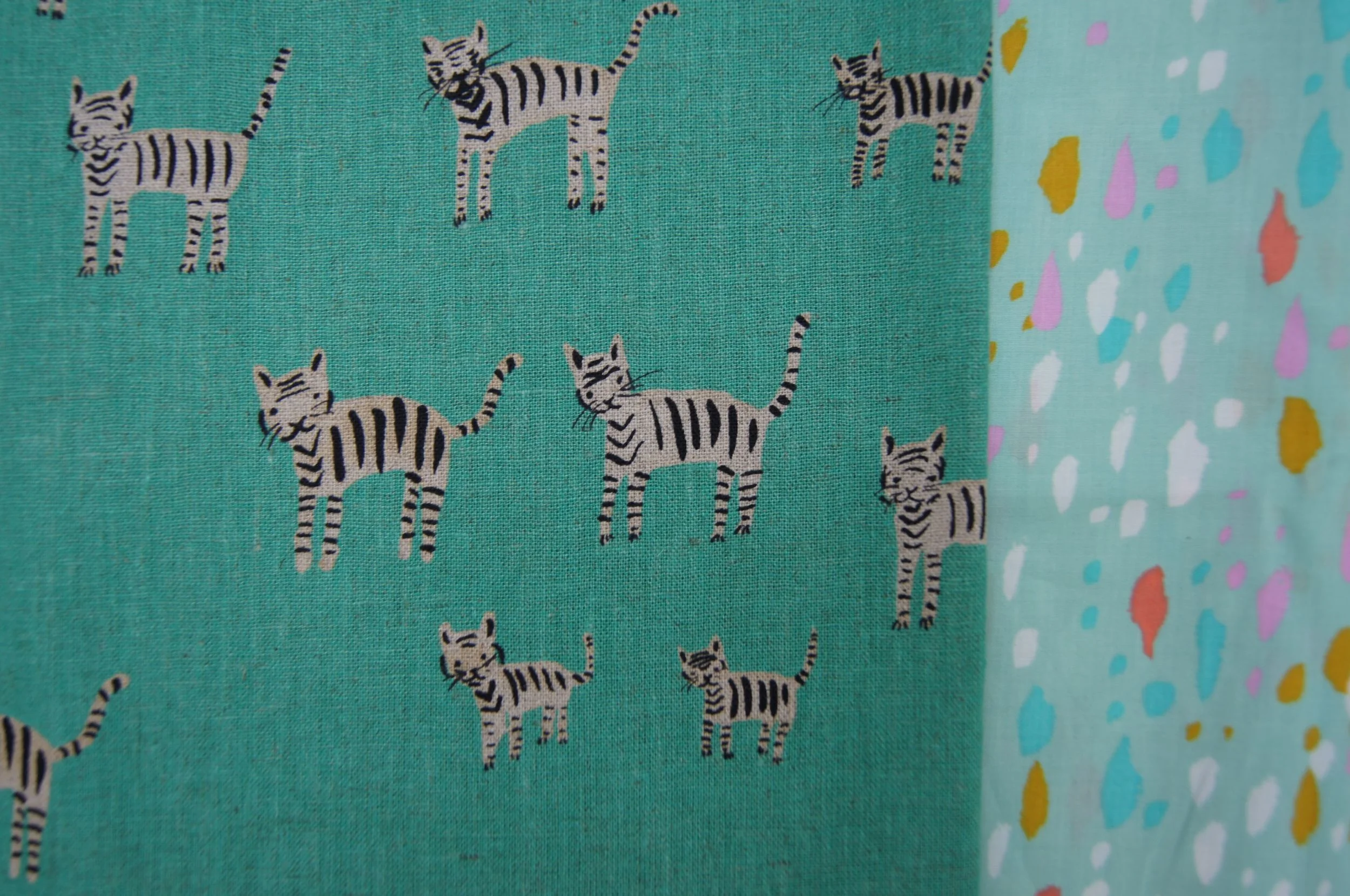
I used the Cotton + Steel canvas (home dec weight) fabric for the body of the apron.  It's lined with "Stampede" a soft cotton, also from Cotton + Steel.

I hadn't made a dog training apron for several months. so I used my tutorial.  I ended up with the soft lining material on the back of the apron instead of peeking out of the pockets per the directions. The canvas is a bit scratchy so it's better to have the soft fabric on the back of the apron. 

Cotton + Steel fabrics: "Tiger Stripes"  cotton canvas body, "Stampede" cotton lining

Cotton + Steel fabrics: "Tiger Stripes"  cotton canvas body, "Stampede" cotton lining

I got a good chuckle when I realized my roll of bags was the same color as the fabrics!  

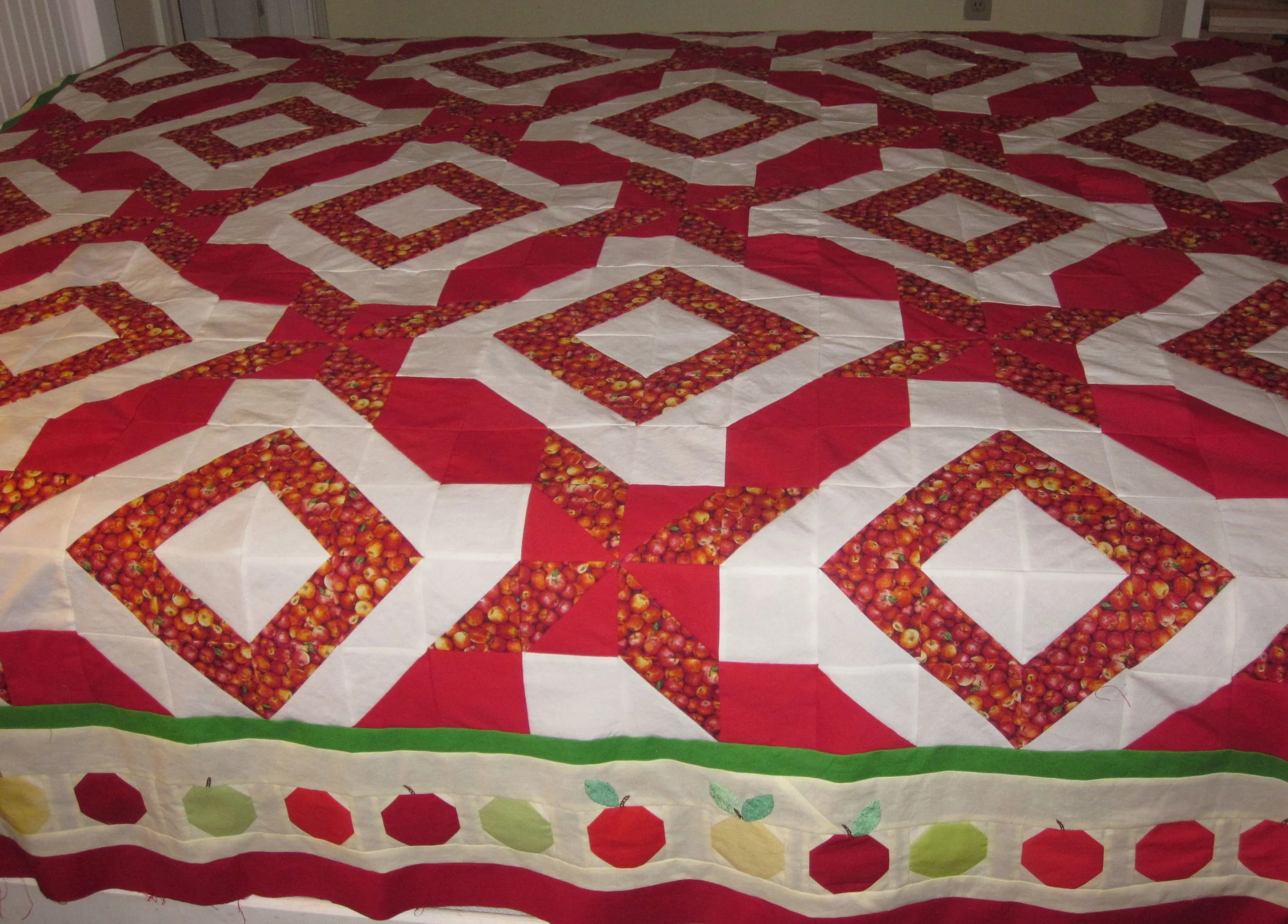
Apple Picking Time quilt top.  A Quilters Club of America Mystery Quilt. The apple border is my design.

Apple Picking Time quilt top.  A Quilters Club of America Mystery Quilt. The apple border is my design.

Update on my other September projects:

  • I took my apple quilt up to the attic on Wednesday to quilt it on my mid-arm.  It's too wide for the rails!  A Queen is as big as I can quilt on my frame.  Guess this quilt is a generous queen.  Looks like I need to take a trip to Pelham, NH to rent a long-arm for a day at Bits 'n Pieces Quilt and Fabric Shoppe.  That's always great fun.
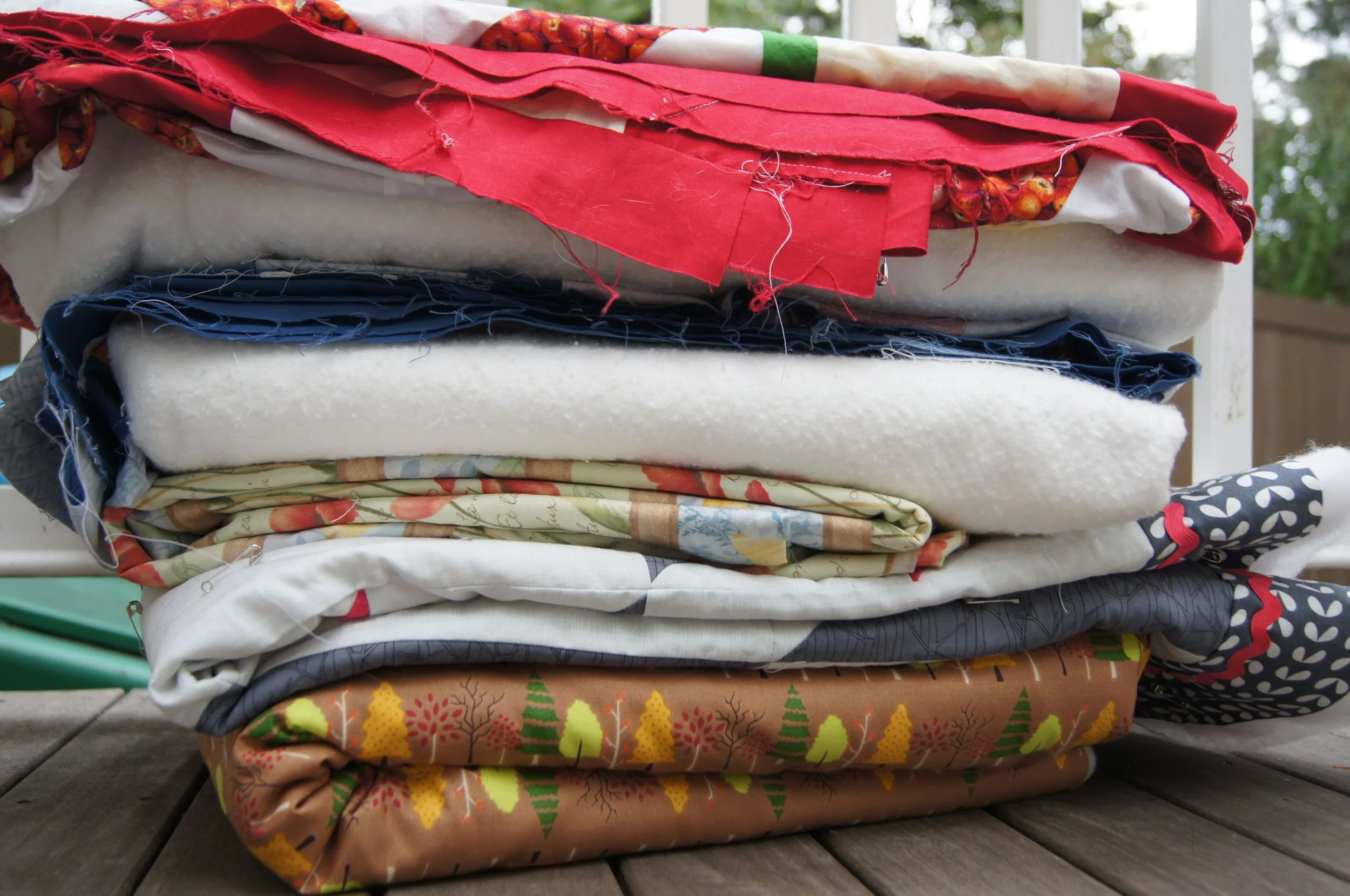
  • I've ADDED the first of 2 Improv Log Cabin quilts (see my last post) to my stack of UFOs waiting to be quilted.  Now there are 5 quilts in the stack!  Is this progress or not?   (Probably)!
  • I spent some time doing a home dec project on Saturday.  I picked up some cute patterned sheer curtains with a modern tree and bird pattern at IKEA.  They were 98" long.  I really liked the long look with the bunched up fabric on the floor. But with 3 dogs, that is seriously not practical.  They now 63 inches, well off the floor.  Much better!

This Wednesday is the first meeting of the fall for the Proper Bostonian Quilt Guild. Our Summer Challenge had 2 options.  One was to make a quilt 24 inches or smaller and the other was to make a quilt 36 inches or larger but no larger than 72 inches. Both need to have 3-5 characteristics of Modern Quilts. It's a contest…so I can't show you my entries yet. But I'll post my small entry on Wednesday and my larger entry on Friday.  The Pantone Color of the Year, Radiant Orchid will be included.  Stay tuned!  Can't wait to show you what I've made. 


Improv Log Cabin Quilt #1 Top

by Judy Tucker


Improv Log Cabin #1    50 x 50 inches

Improv Log Cabin #1    50 x 50 inches

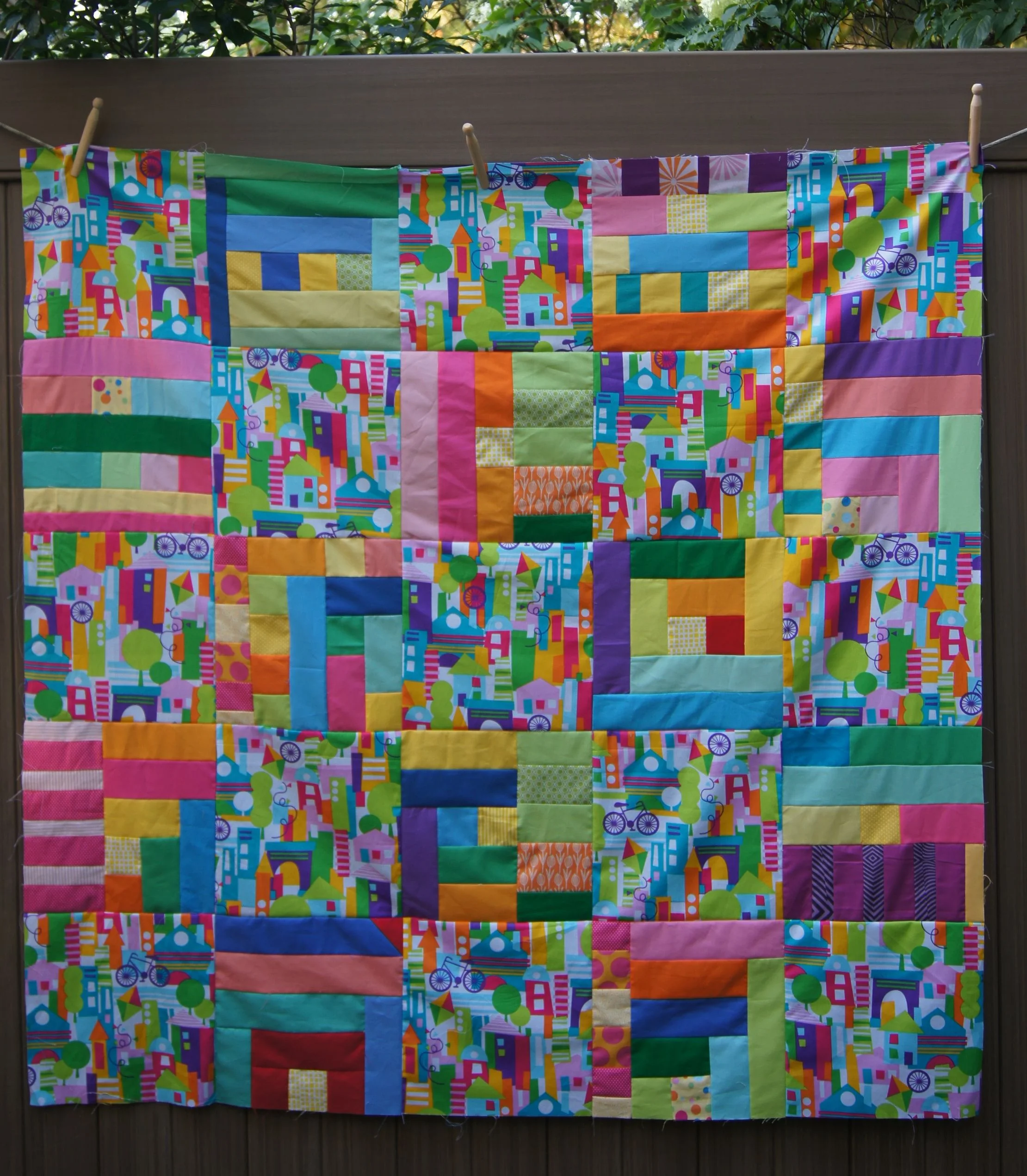
Here's my Improv Log Cabin #1 quilt top.  This has been my "take along" project this summer. I've kept all the fabric and completed blocks in a bag.  If I'm going over to a friend's house to sew, I've been able to grab the bag and my sewing machine and head out the door. It's been nice not to have to think about which project to take or needing to gather up the necessary components for a project.

I originally thought I was going to make a bed size quilt. But this is a busy quilt. Very busy!  So i've decided to make 2 smaller quilts.  I think they'd be great for floor time play for a baby.  Lots of interest and visual stimulation!  

This is Improv Log Cabin #1.  The construction of the log cabin blocks in this quilt is somewhat  traditional. The yellow square (there is one in every block) is mostly near the center of these blocks and the block has been built around it.   Improv Log Cabin #2 has log cabin blocks with longer strips.  I haven't put it on the design wall yet, but I think it will have a different feel. 


Designing Notes: Contrast

by Judy Tucker


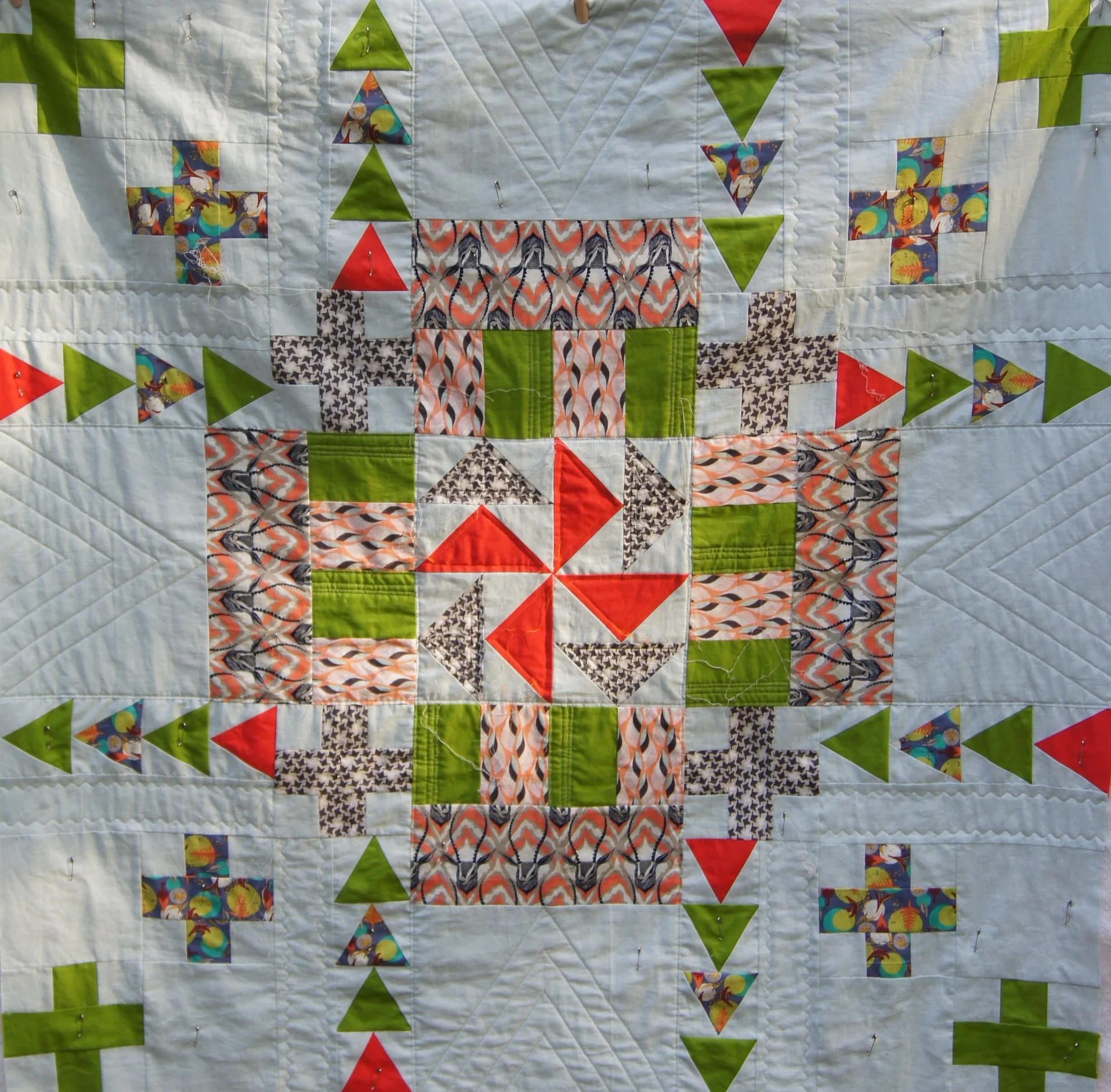
Medallion quilt with gazelle WIP  Version 3, partially quilted

Medallion quilt with gazelle WIP  Version 3, partially quilted

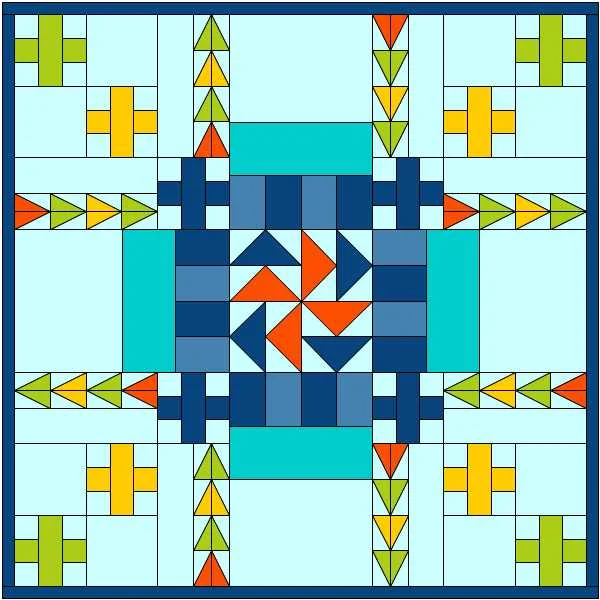
This Medallion quilt which I designed on the computer in EQ7 has turned out to be an interesting study in value, contrast and saturation of colors. I like the quilt above…but it's Version 3.  

Quick review:

  • Value is how dark or light a color is.  The closer the color is to looking black, the higher value while pastel is low value.
  • Contrast is the difference in value between to colors (or fabrics in our case). A very dark color with a very pastel color or white has high contrast.
  • Saturation is the purity of a color.  The pure color (the true hue)  is vibrant at full saturation, pale at low saturation. 

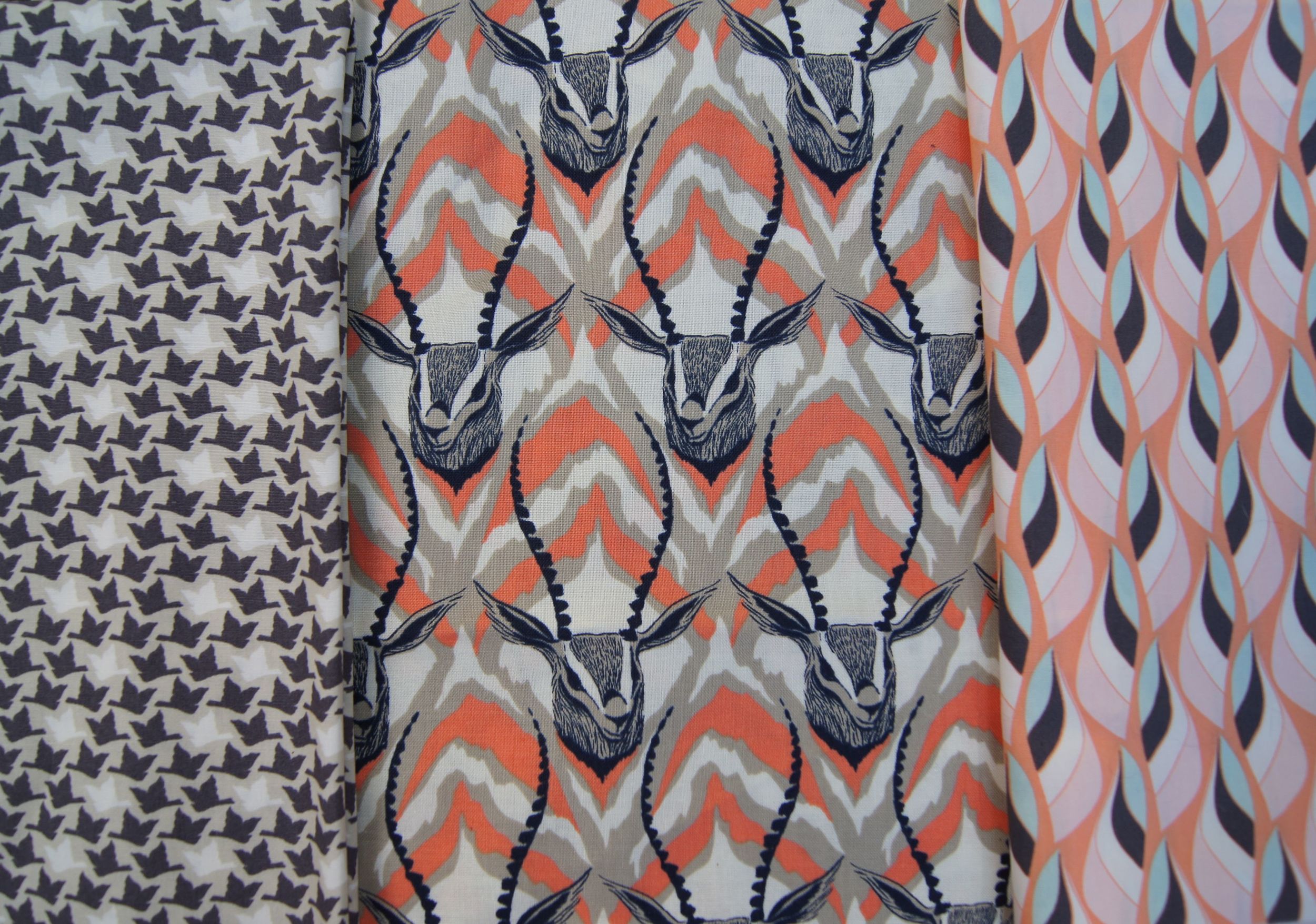
The focus fabric in this quilt is Cotton and Steel Gazelle from Sarah Watts' August collection.  The two fabrics I picked out to co-ordinate with that are from Art Gallery's Winged Collection. 

Art Gallery Winged, Cotton and Steel Gazelle, Art Gallery Winged.

Art Gallery Winged, Cotton and Steel Gazelle, Art Gallery Winged.

As you can see, all three fabrics share shades of brown and two have soft oranges.  The contrast among three fabrics is on the low side.  They almost blend together. 

The background fabric of the quilt is Robert Kaufman's Cotton Linen in Mist which coordinates very well with the aqua in the Winged fabric on the right above.

I added a very high saturation red orange to compliment the soft oranges in the focus fabrics and a high saturation yellow green to go with the green in the final fabric, Rowan's Free Spirit Charleston Farmhouse in the middle crosses.

I knew I needed high contrast in the Dutchman's Puzzle central block, but I thought the low contrast of the blocks around the center medallion was fine.  The fabrics looked great together in the store and the pieces looked fine while I sewing the blocks. 

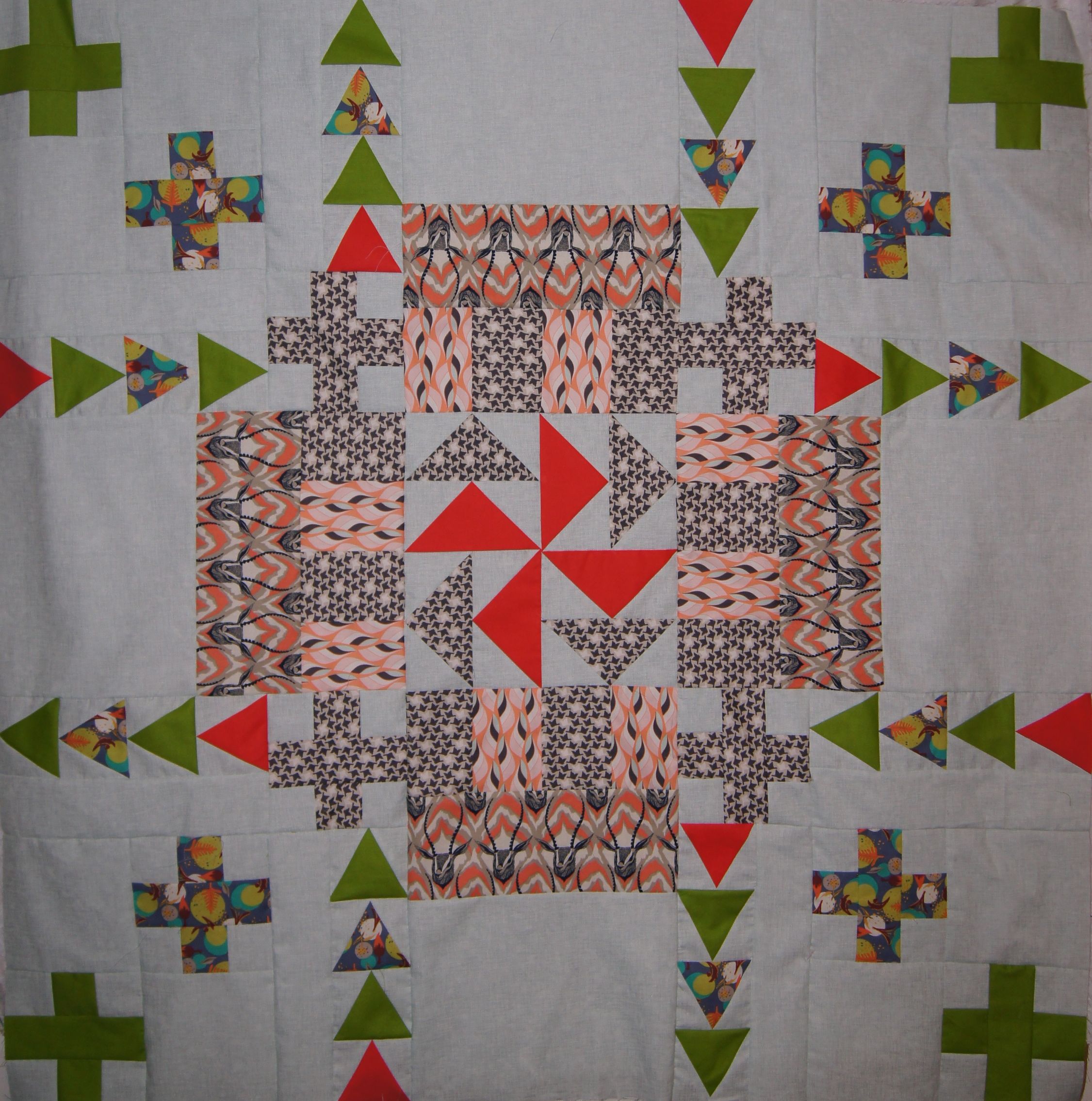
And then I put the finished top on the Design Wall to get a good look a it.  Here is Version 2.

Medallion quilt with Gazelle Version 2

Medallion quilt with Gazelle Version 2

My immediate thought: the center of the quilt looks like a guy's jacket from the 1940s.  It is just dull.  What to do?  

I wanted to stay with the fabrics I had collected for this quilt.  Putting the red orange in the bar blocks was just too close to the central pinwheel and was distracting.  My other high contrast, high saturation fabric was the yellow green.  

When I auditioned the green in the place of the fabric with the small brown birds I suddenly had a very different quilt.  The block with the parallel bars that just looked dull and "same"  in Version 2 instantly revealed its asymmetry and movement with the high saturation green.  That asymmetry actually seems to give central red orange pinwheel a spin!

The one other thing I might have done differently in this quilt would be to replace the inner crosses with the small brown birds with a solid fabric in the same shade of brown.  I think the higher contrast of a solid color cross would add another pop to the quilt.

Here is the computerized pattern with another color way.  Seeing the Cotton and Steel Gazelle fabric in the store changed my original plan!

 There is moderate contrast in the bar block in this design but there is not a high enough contrast between the 2 blues to create the visual movement from the asymmetry.

Medallion Quilt Designed in EQ7  Version 1

Medallion Quilt Designed in EQ7  Version 1


I have to say this project really surprised me. I thought Version 2 with the fabrics was fine until I saw it all together. But this quilt pattern really needs the contrast to make it shine.  

Designing is a fascinating process!  


African Village Quilt--Completed.

by Judy Tucker


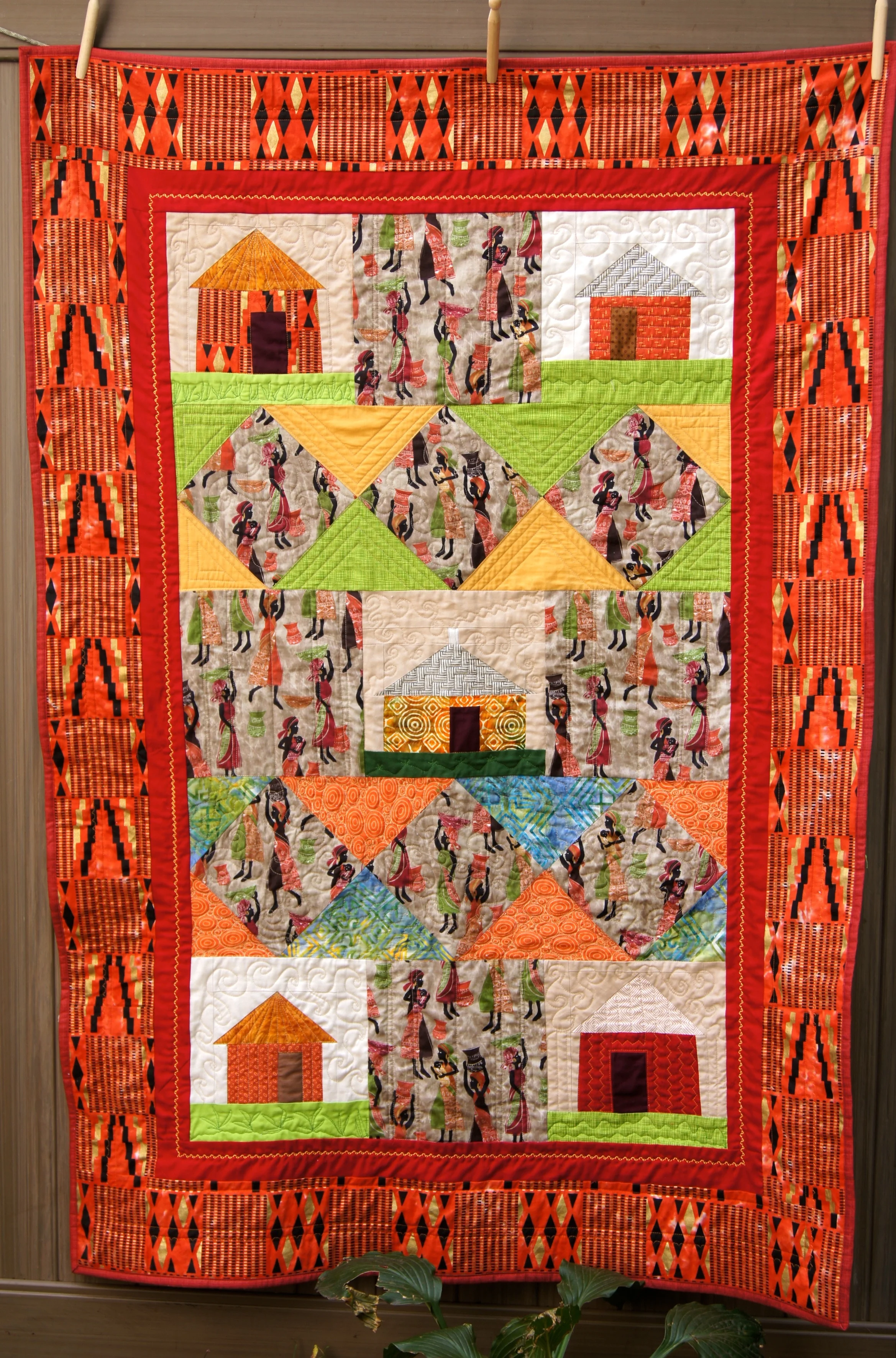
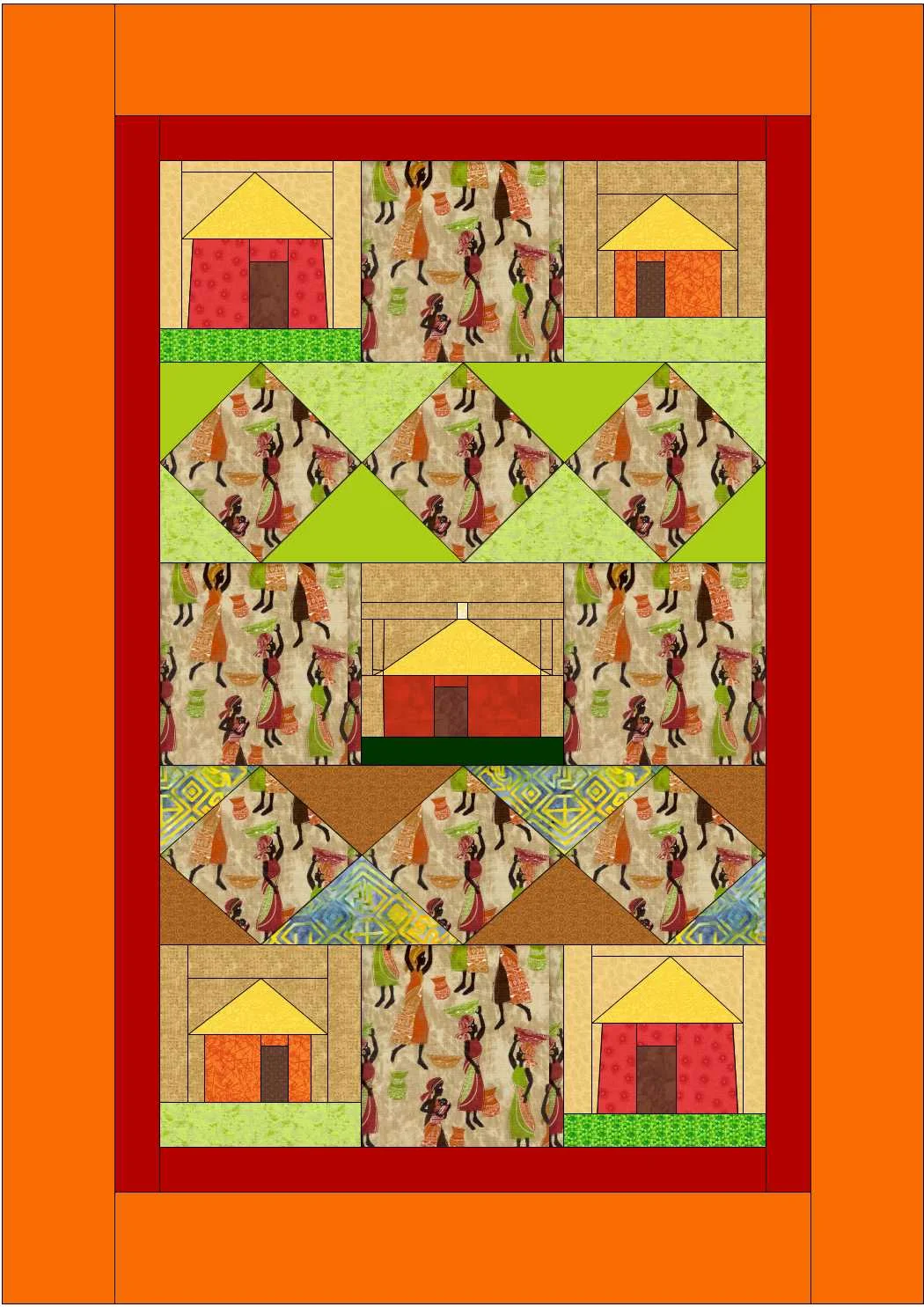
Here's my completed African Village Quilt.  It measures 40 x 57 inches. 

African Village Quilt

African Village Quilt

I recently took Jacquie Gering's Craftsy course, "Creative Quilting with your Walking Foot."  She had some great tips and suggestions about using the walking foot for quilting.  I used echoing in, radiating designs and straight quilting using a variety of specialty stitches on my domestic sewing machine. It was lots of fun to use her techniques.  

The echoing in stitching is in the setting triangles in the upper strip of diamonds. 

Here is a detail of radiating quilting on a roof. 

Radiating quilting done with walking foot on the hut roof,  Free motion quilting used to create grasses and heat swirls. 

Radiating quilting done with walking foot on the hut roof,  Free motion quilting used to create grasses and heat swirls. 

I used Jacquie's suggestion of using the Bernina specialty stitch #4, the serpentine stitch, to make the current in the river blocks. She said that this stitch is intended for use in garment construction making lingerie which needs to stretch!  Doesn't it make a lovely river current?

Bernina Stitch #4 to make the waves in the river blocks.  Free motion quilting to make the stream pebbles and swirls around the women.

Bernina Stitch #4 to make the waves in the river blocks.  Free motion quilting to make the stream pebbles and swirls around the women.

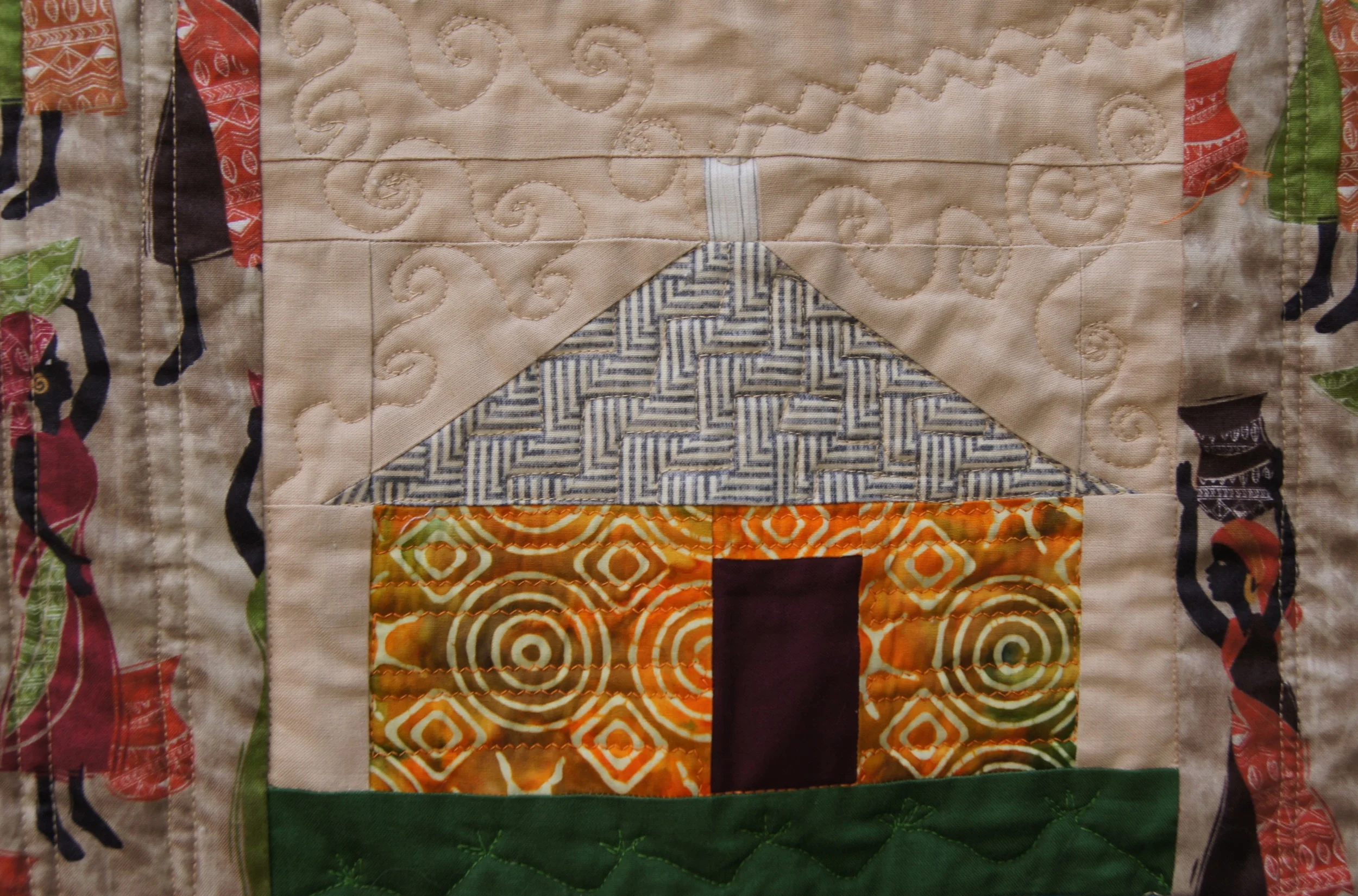
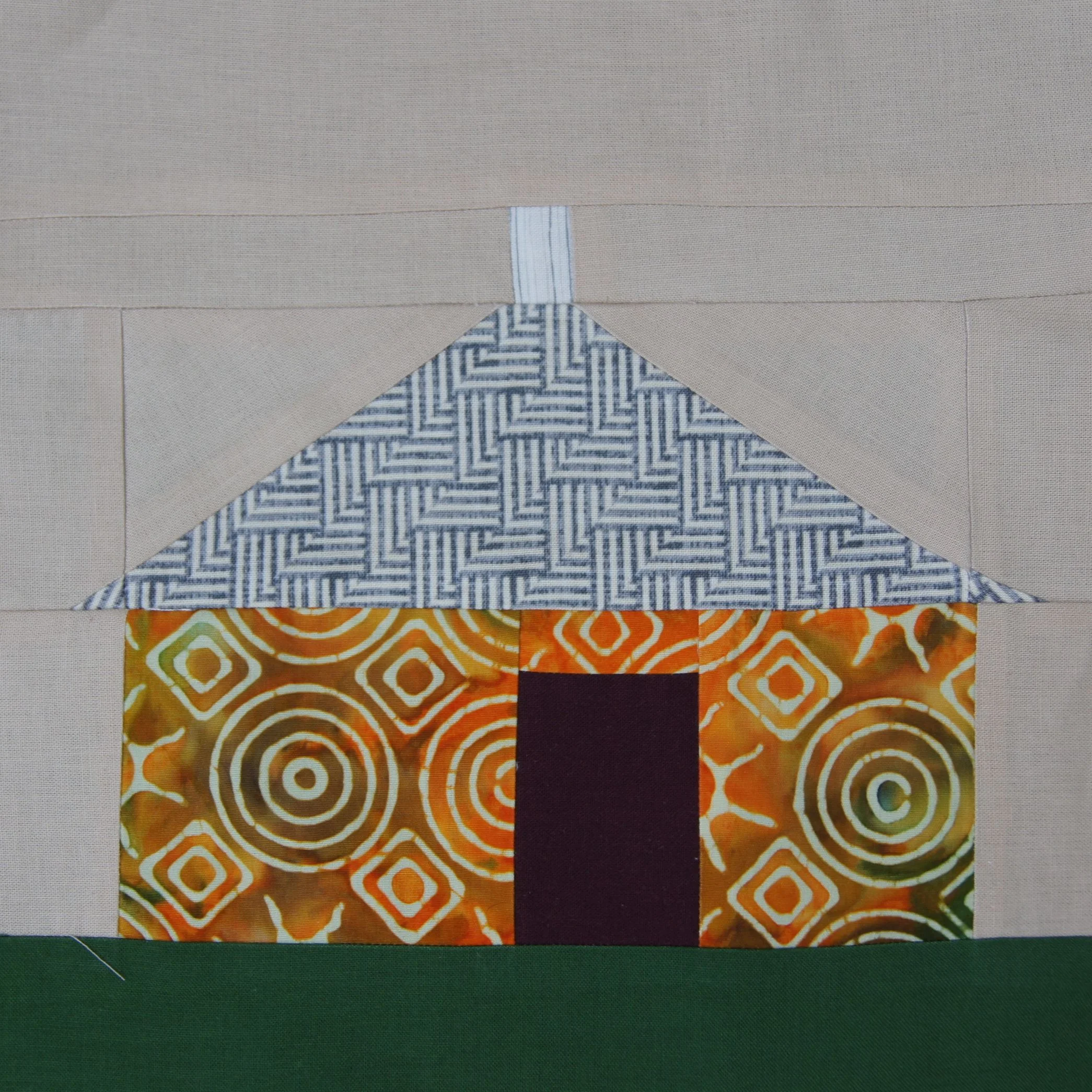
I also used the serpentine stitch to make the smoke coming out of the chimney in the central hut. 

Central hut showing serpentine stitch for smoke.  Also note the straight stitching done on the focus fabric blocks adjacent to the block and on the hut walls.

Central hut showing serpentine stitch for smoke.  Also note the straight stitching done on the focus fabric blocks adjacent to the block and on the hut walls.


There are also lots of straight stitching using the walking foot throughout the quilting. 

Straight stitching with the walking foot and 2 decorative stitches in the outer quilt border.

Straight stitching with the walking foot and 2 decorative stitches in the outer quilt border.

You'll also see free motion quilting on this quilt.  I used it to make heat currents, pebbles and grasses and other vegetation. 

This quilt was a lot of fun to make and to quilt.  

Note 2021: For those of you returning to the post, the free pattern no longer is available. I wrote it so long along that the files weren’t intact and no longer secure.

Thanks to everyone who did use the old pattern to make a quilt! I hope you enjoyed the process.


African Village Step 6--making the back and label

by Judy Tucker


NOTE 2021: The PDF patterns for this quilt are no longer available so the links to them have been deleted. I’ve left the other instructions in case you still have the original patterns.

The top of the African Village Quilt is done!   Great job.  Now it's time to make the back. 

Back of the African Village quilt

Back of the African Village quilt

I had left over triangles from the setting blocks and corner blocks from the diamond strips on the front of the quilt.  I also had some triangles which I cut for the quilt and then decided that I liked other fabric better.  So I decided to make a strip back for my quilt. 

You will need a backing that measures at least 48 x 65 inches.  This will give you a 3 1/2-4 inch overhang.  If you plan to send it out to a long-arm quilter you may need it a bit larger.

I used fabrics for the strips that are in the quilt top and I varied the width of the solid color strips  to make the back more interesting.  I also made a few more half square triangles for the strips.  You'll note in the photo above that the half square triangle strips were extended with a piece of background fabric.   If you wanted to, you could just use a couple left over half square triangles and make the strip long enough with other fabrics. 

However you do it, it's all good! 

I really like this back.  It could stand on it's own as a quilt in its own right!

Once you finish the backing, layer sandwich your quilt with top, quilt batting and the bottom. I used a cotton baby quilt batting which measured 46 x 60 inches.

Quilt as desired or send it out to your favorite quilter!   Add a binding once it is all quilted.

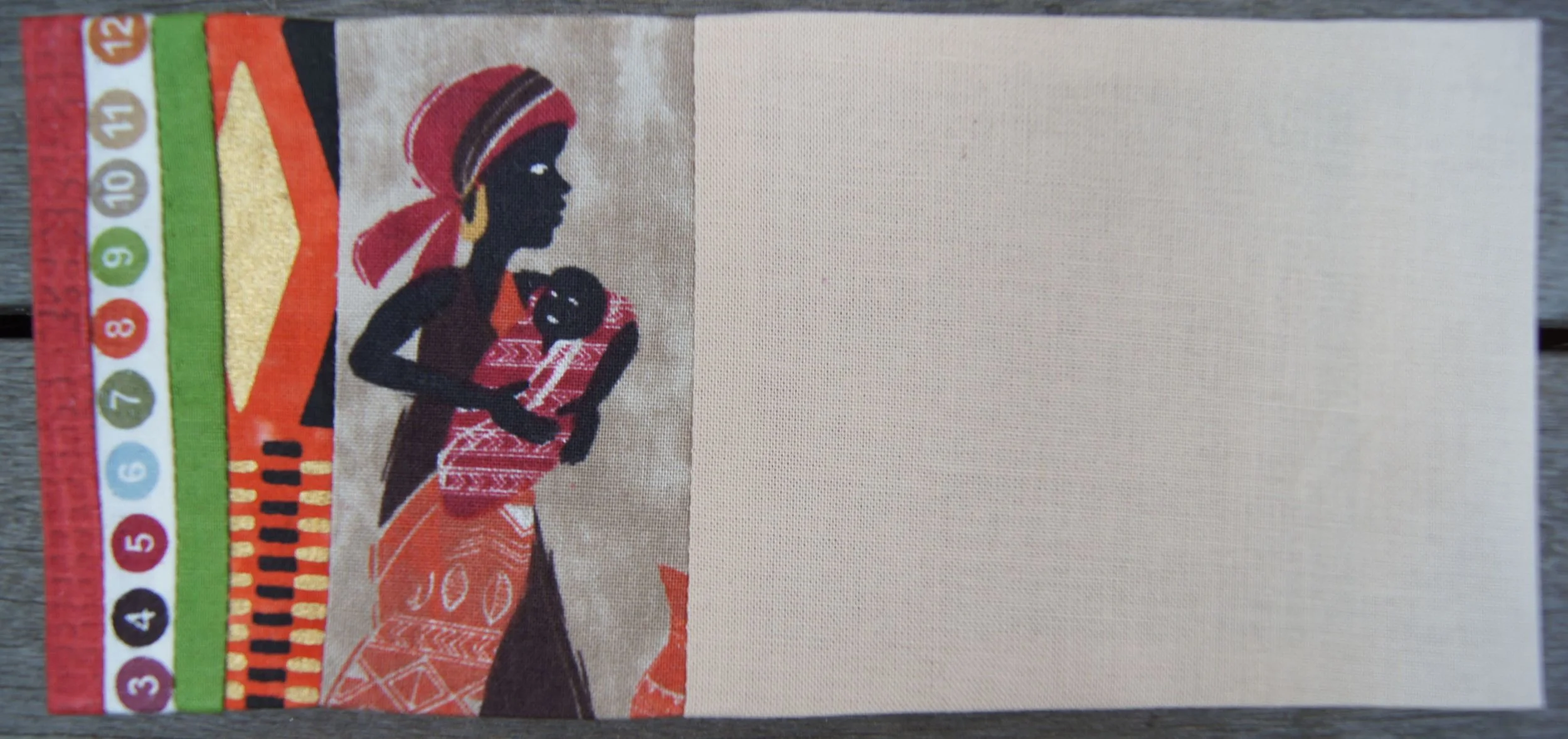
And finally make a label.  Here is my label before I wrote on it. I used some selvages from the fabric in the quilt along with a strip from my focus fabric.  It adds a bit more information about the quilt and it's fun!

Selvage label for the quilt

Selvage label for the quilt


Next post…my finished quilt!

Please leave me a comment to let me know how you are doing! 


African Village Quilt Step 5

by Judy Tucker


Completed Top African Village Quilt

Completed Top African Village Quilt

NOTE 2021: The PDF patterns for this quilt are no longer available so the links to them have been deleted. I’ve left the other instructions in case you still have the original patterns.

We will be able to finish the quilt top today. 

One last bit of cutting to do first. 

For the blocks on either side of the African Hut blocks:

Cut 4 squares of your Focus Fabric 9.5 x 9.5 inches.

Now you should have all the components of the quilt completed.  So let's assemble the rest the quilt.

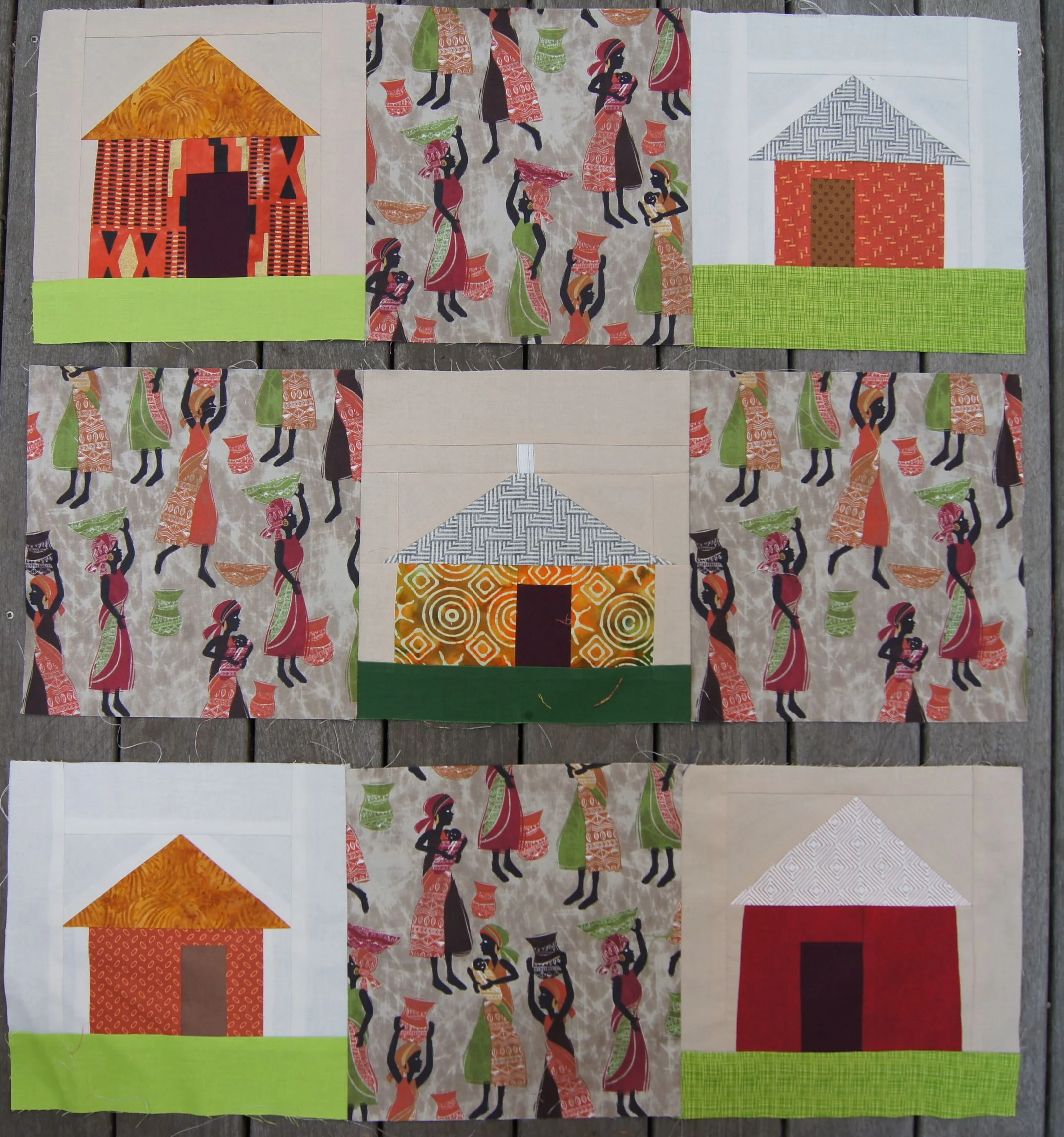
The quilt is assembled in strips.  Starting at the top here are the strips with the African Huts and Focus fabric. 

AfricanVillageHutStrips.jpg

1. Sew the African Hut 2 B (door facing right)  to one of the 9.5 inch squares of Focus Fabric. Then sew African Hut 1 B (door facing left)  to the other side of the 9.5 inch Focus Fabric square.

2. For the middle strip, sew a 9.5 inch square of Focus Fabric to each side of African Hut 3.

3. For the bottom row sew African Hut 1 A (door facing right) to a 9.5 inch square of Focus Fabric.  Then sew African Hut 2 A (door facing left) to the other side.  Now you have all the strips completed. 

4.  Sew them together in this order:   Top Hut strip, first diamond strip, Middle Hut Strip, 2nd diamond strip, Bottom Hut strip.  Great!  The center of your quilt will all the blocks is done.

Borders

AfricanVillageQuiltMeasuring.jpg

For the Inner Border:

Step A:

Lay your quilt top on a flat surface.  Measure the middle of the quilt from top to bottom.  Then measure from side to side in the middle of the quilt and ADD 5 inches to this measurement. 

Add the length and width of the quilt and multiple by 2 to get the total length of fabric you need for the first border.  Divide this number by 40 to get the number of WOF (wide of fabric) strips you need to cut.  

Cut:

2.5 wide inch strips x WOF  for your first border.  I needed to cut 4.  
Sew this 4 strips together end to end, either with a bias seam or a straight seam, whichever you prefer. 

Sew the first border on to your quilt top.


For the Outer Border:

 Repeat Step A and measure your quilt top again with the first set of borders attached. 

Cut:

5.5 inch wide strips x WOF to obtain the length you need.  (I needed 4 strips).  Sew the 5.5 inch strips together.

Sew the 2nd border to the quilt top. 

Congratulations!  Your African Village Quilt top is complete!

I will blog about the backing for the quilt on Friday, August 15, 2014.

Did you have fun making this quilt top?  Please leave me a comment! Thanks!  I can't wait to hear how you did. 


African Village Quilt Step 3

by Judy Tucker


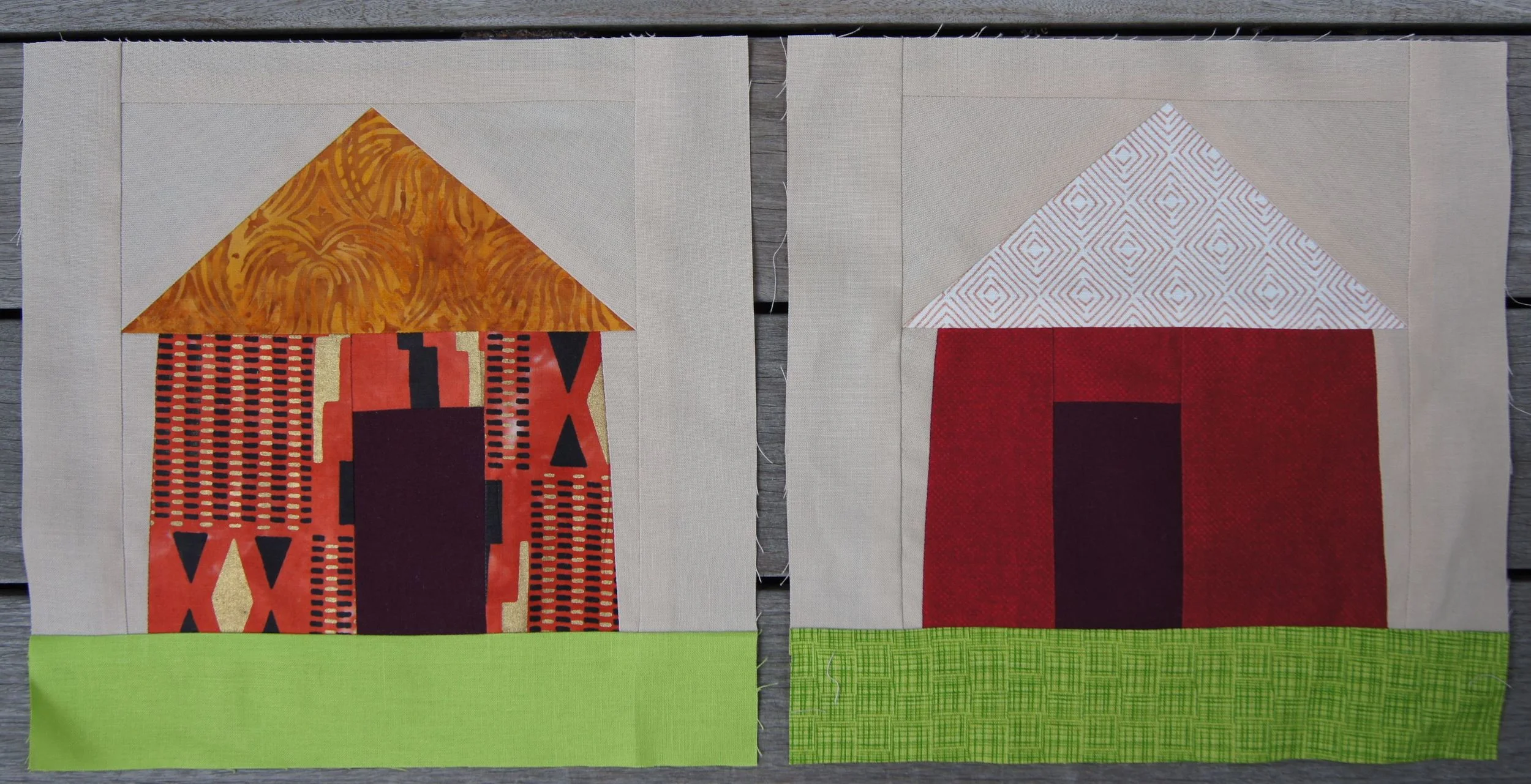
African Village Hut 3

African Village Hut 3

We are up to Step 3 of my African Village Quilt.  Here is the 3rd hut.  It is a little more complex to paper piece than Hut 1 and Hut 2 but it's really not hard to sew.

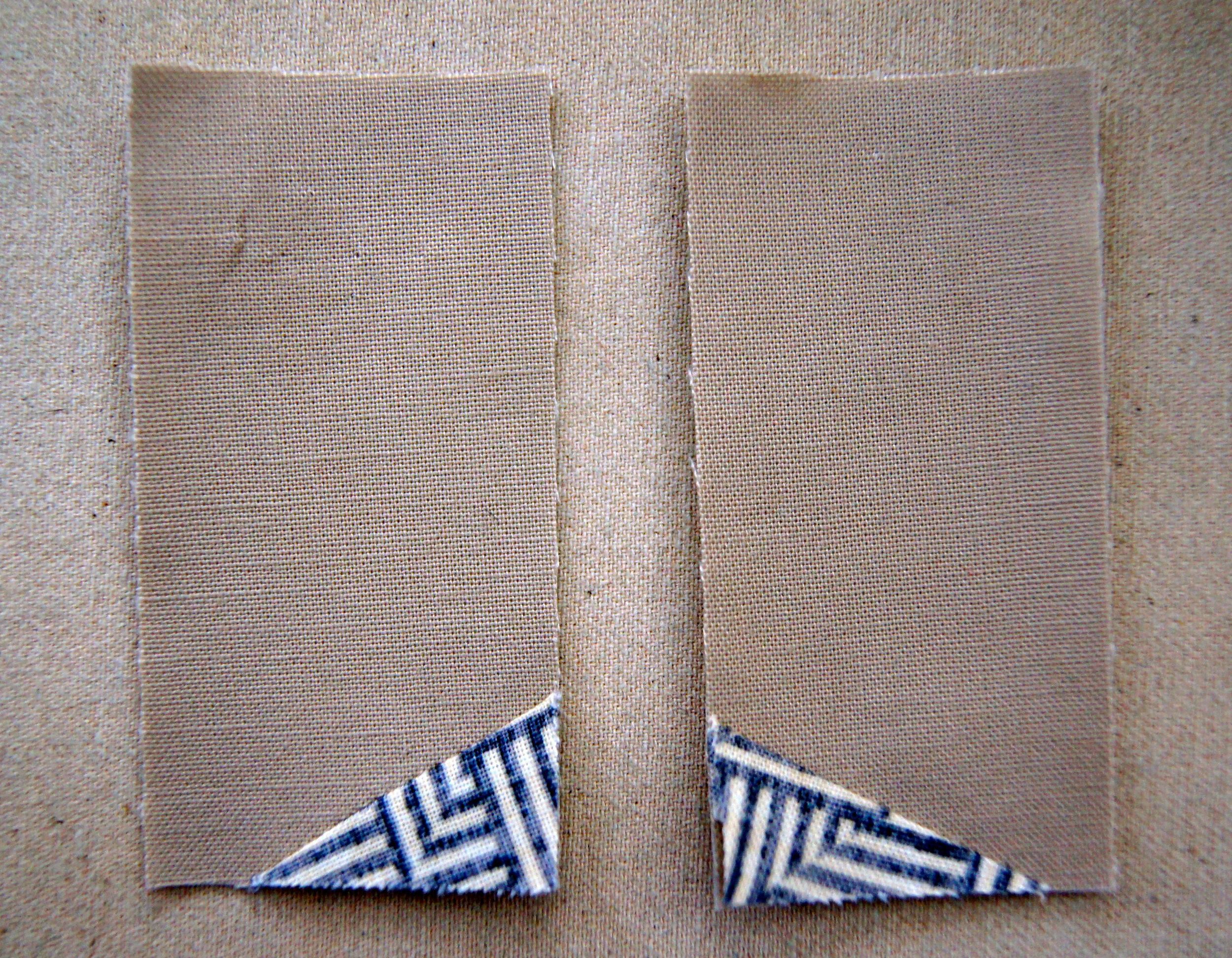
The two corners of the roof extend beyond the hut walls and are on separate pattern pieces.  I recommend that before you cut out these 2 pieces (D and E of the pattern)  that you draw an arrow on the pattern to indicate which way is up.  That will just make it a bit easier to know which way they attach to the roof when you are sewing all the pieces together.

Here is a photo of D and E ready to be attached to the hut roof.

Pieces D and E of the Hut 3 Pattern ready to be attached to the roof

Pieces D and E of the Hut 3 Pattern ready to be attached to the roof

NOTE 2021: The PDF patterns for this quilt are no longer available so the links to them have been deleted. I’ve left the other instructions in case you still have the original patterns.

This is the final hut needed for the Village and it is the last of the paper pieced blocks for this quilt.  

Next Monday, August 11, 2014, I'll post Step 4 for my African Village Quilt.  We'll be sewing the 2 diamond strips then. 

Please do leave me a comment. I'd love to know what you are doing if you are sewing along with me. Thanks!


On the Move!

by Judy Tucker


The SleepingDogQuilts Blog is Under Construction!

UnderConstruction.jpg


I've moved over to the Squarespace web platform from Blogger and will be using a new, simpler URL. The bones of this new site are here but I'm still working on adding back all the information that was available here on Blogger.


The Squarespace platform will be cleaner, load faster, be more mobile friendly and has lots of room for me to grow SleepingDogQuilts. 


One of the new features on the site is a Gallery of my quilts.  I'm in the process of posting photos of some the quilts I have made.  It won't be my total collection but there should be a fun selection for you to look at.


Here is the new URL.  Leave me a message and let me know how you like the new space!


SleepingDogQuilts.com


Hope you enjoy the new look!