Search
  • Information
    • About
    • Contact
    • Privacy Policy
  • Blog
  • Subscribe
  • Tutorials
    • Tutorials
    • Doll Clothes: Photos and some Patterns
  • Suggested Reading
  • Quilts: My Original Designs
  • Gallery: Color Studies
  • Gallery: Quilts I've Made
  • Doll Making Blog Posts
  • Recent blog posts
  • Quilts Based on The Improv Handbook for Modern Quilters
Close
Menu
Search
Close
  • Information
    • About
    • Contact
    • Privacy Policy
  • Blog
  • Subscribe
  • Tutorials
    • Tutorials
    • Doll Clothes: Photos and some Patterns
  • Suggested Reading
  • Quilts: My Original Designs
  • Gallery: Color Studies
  • Gallery: Quilts I've Made
  • Doll Making Blog Posts
  • Recent blog posts
  • Quilts Based on The Improv Handbook for Modern Quilters
Menu

Sleeping Dog Quilts

SLEEPING DOG QUILTS

December 19, 2019

Waldorf Birthday Ring/Seasonal Decoration

by Judy Tucker


Winter/Christmas Waldorf Birthday Ring

Winter/Christmas Waldorf Birthday Ring

Winter/Christmas Waldorf Birthday Ring

Winter/Christmas Waldorf Birthday Ring

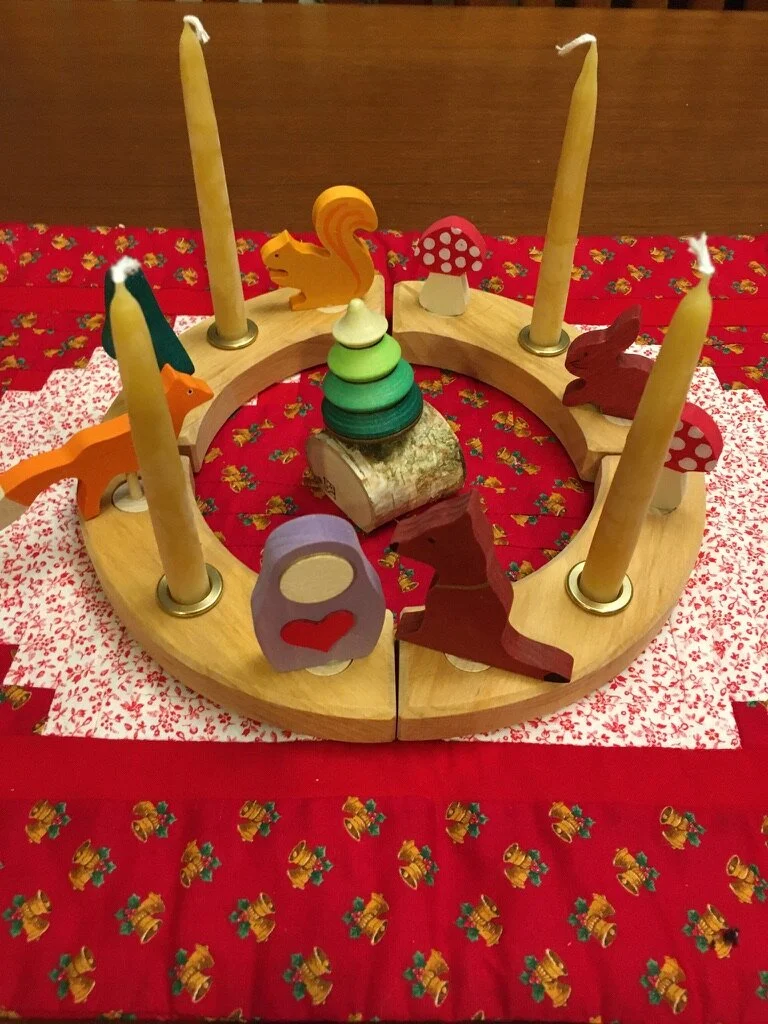
I recently purchased Waldorf Birthday Ring from TheWoodenWagon.com. I’ve been admiring birthday rings for while. I’m using mine as a seasonal decoration. I purchased a fox, a dog, a squirrel, a rabbit, 2 mushrooms, a pine tree and a Matryoshka doll for my Christmas ring.

The four tiered pine tree in the center is a spinning top resting in a log which also came from The Wooden Wagon online shop. I set the ring on a quilted log cabin table runner made for me by a friend.

If you purchase a ring and wish to use candles, make sure to also buy the brass (or other metal) inserts. The holes for the peg figures are too large to hold the beeswax candles. (The candles aren’t lit in my pictures because I have 3 intermittently bouncy dogs).

As I understand it, when this is used as a birthday ring, the number of candles in the ring match the age of the child. The candles are lit one by one, with the family telling the birthday child about the events of each year of their life I love that.

My family would have lit the first candle and told me again how my mother, who was in labor with me, had to make jello for my older brother’s after-school snack before she could go the hospital! My brother was just here with me for a visit. I asked him if he remembered what flavor the jello had been. Alas, that detail has dissolved into the fabric of time!

I’m so enjoying my ring. I’m looking forward to adding to my collection of birthday ring ornaments! So far, 2 sheep and a couple tulips are awaiting Spring!

Notice: This blog is not monetized: I do not use affiliate links. When there are links in a post, they are to give credit to another creative person, because I like or have used a product, or to help the reader easily find supplies for a project.
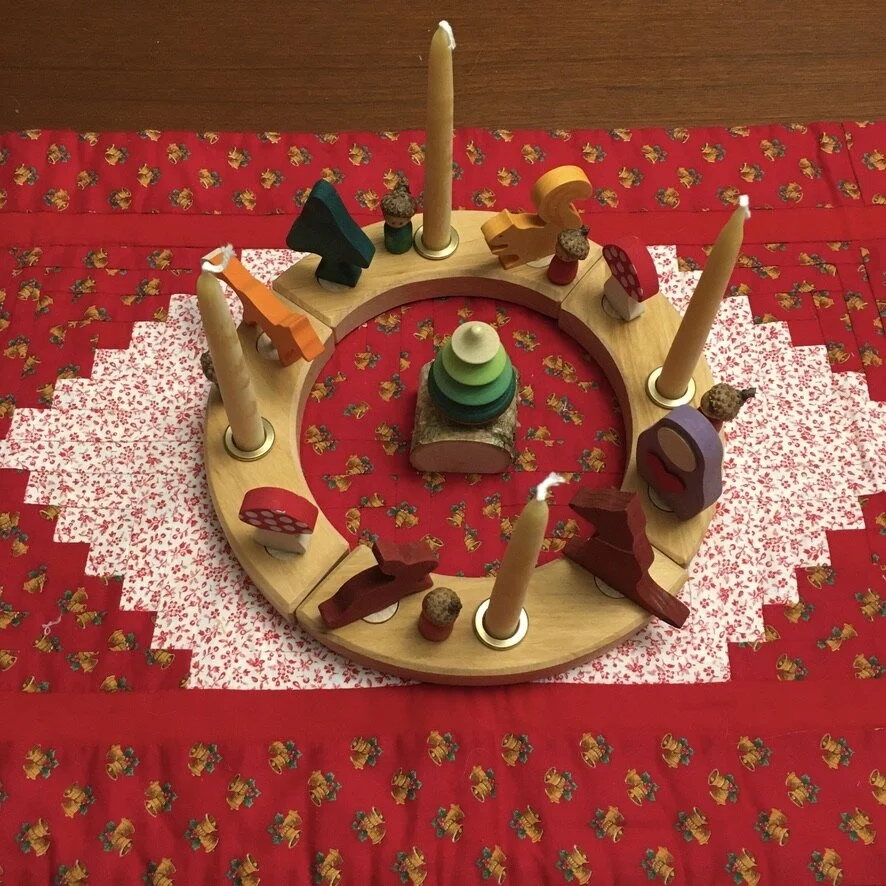
Bird’s Eye View of my Waldorf Birthday Ring. A couple of acorn peg dolls are standing on the ring in this photo!
Bird’s Eye View of my Waldorf Birthday Ring. A couple of acorn peg dolls are standing on the ring in this photo!
TAGS: Waldorf Birthday RIng, Waldorf Inspired Seasonal Ring, The Wooden Wagon


December 12, 2019

Christmas Peg Doll Gnomes and a Pine Cone Wreath

by Judy Tucker


Christmas Peg Gnomes

Christmas Peg Gnomes

Christmas Peg Gnomes

Christmas Peg Gnomes

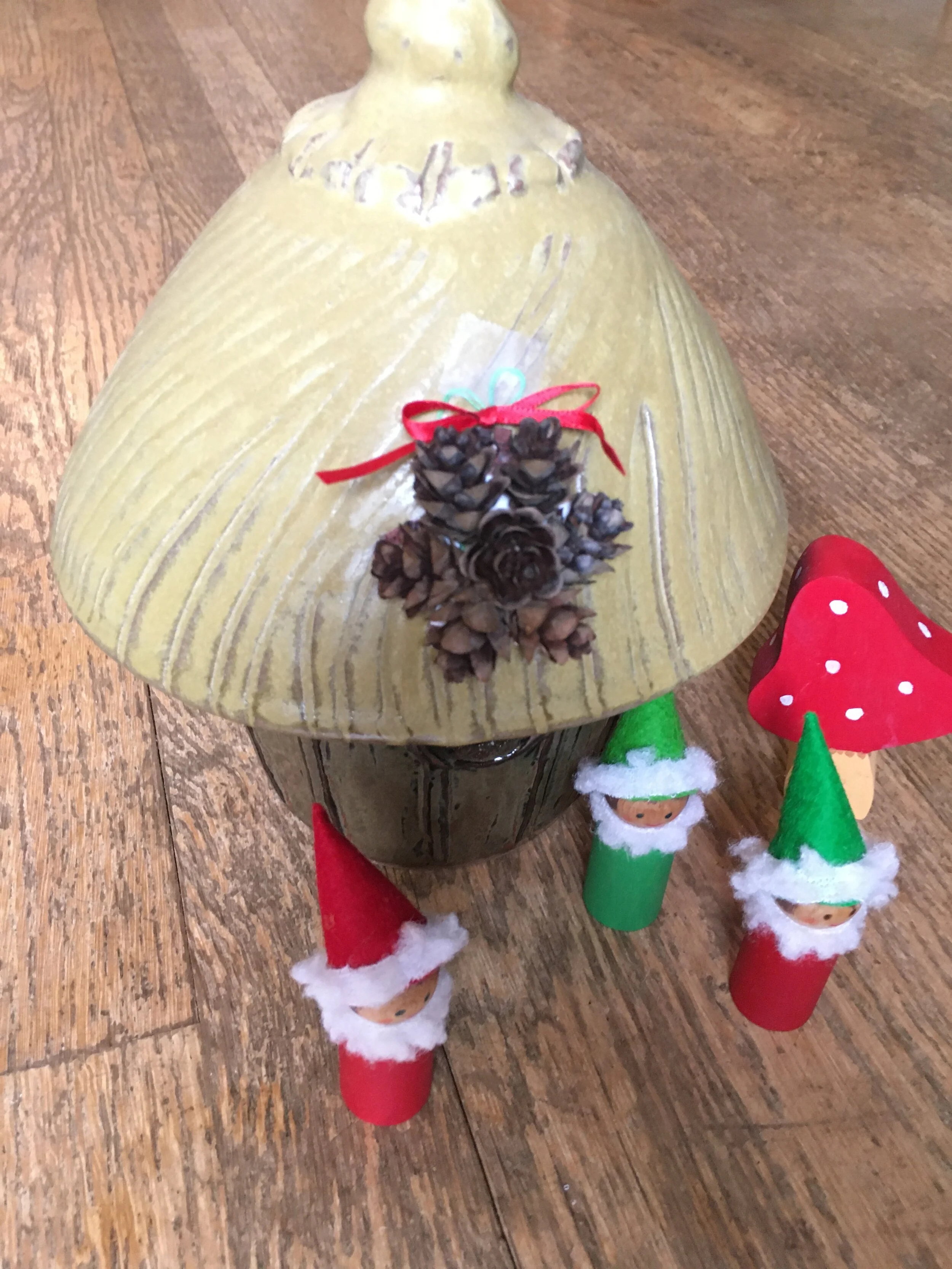
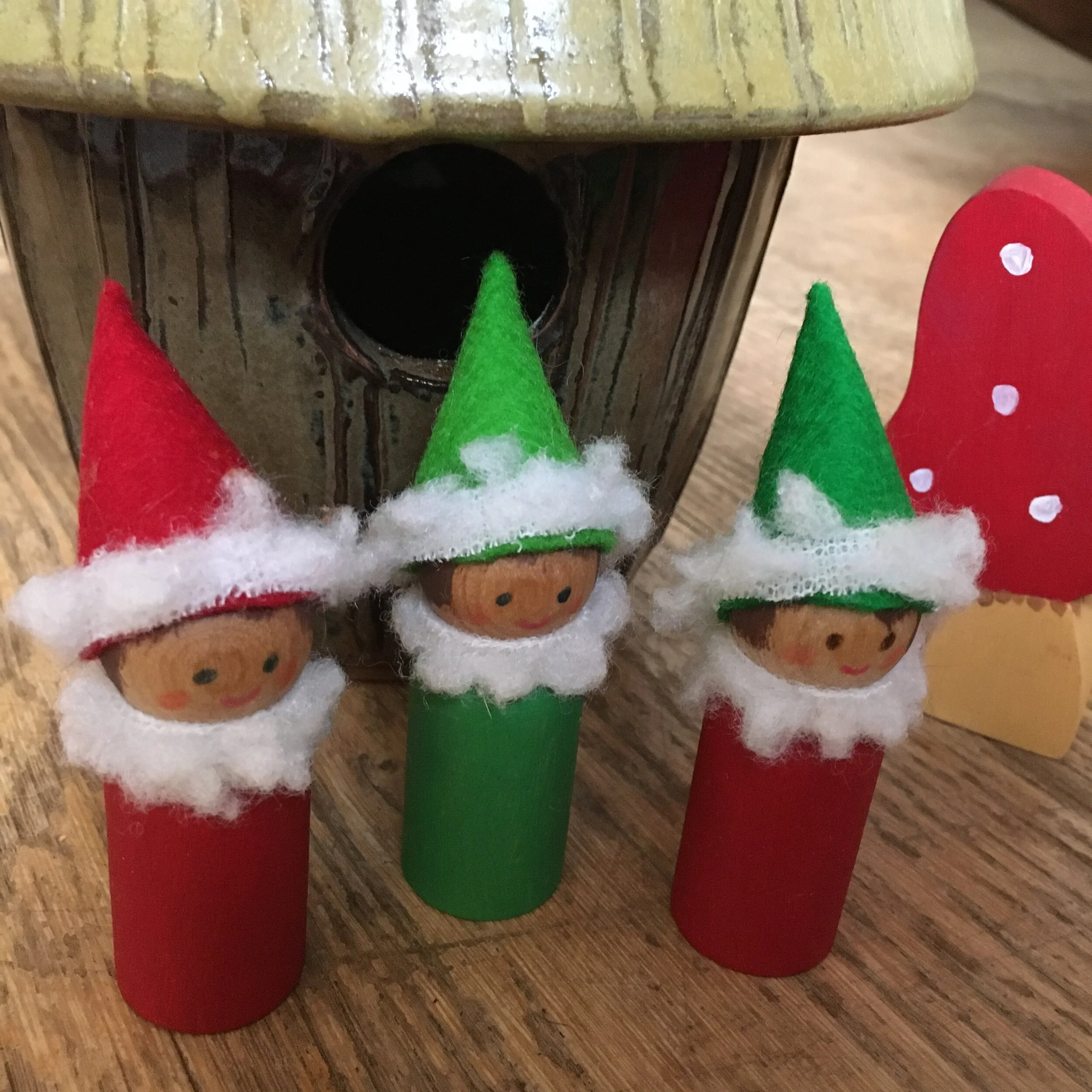
The Peg Gnomes have on their Christmas togs and have decorated their Gnome Home with a pine cone wreath which they made.

I had a scrap of sherpa fleece that I was about to toss in the trash. But taking one last look I realized it would make fabulous fur trim for peg doll Christmas outfits. So now I have a even smaller scrap but am definitely keeping it!
The pegs are painted with a opaque non-toxic paint. They have a ruff of sherpa fleece around their necks made out of a 1/4 inch strip of sherpa fleece that is stitched closed in the back. The hat from the gnome hat pattern in Margaret Bloom’s book Making Peg Dolls with an added trim of sherpa fleece stitched onto the edge of the hat before the back was sewn together.

I saw these tiny pine cones on the sidewalk when I was walking my dogs this fall. Every day I picked up a few more until I had a little jelly jar full. The gnomes saw what I had and asked if they could use it to make a wreath. (Just what I’d planned to do)!
The gnomes cut out a base of cardboard in the shape of a ring, but as it turns out, just cutting out a circle would have been better. The pine cones are glued on using craft glue. The wreath looked a bit bare until they added the center pine cone. They trimmed the cardboard away around the pine cones around the outer edge and used a brown maker on the bits that could be seen to make the base “disappear”. Then the gnomes added the 1/4 inch red ribbon and a piece of green thread so the wreath could be hung up.

The gnomes are pretty proud of their handiwork. I think it looks great on their pottery home!

Christmas Gnomes

Christmas Gnomes

TAGS: Christmas Peg Gnomes, Peg dolls, Doll size pine cone wreath


December 5, 2019

Showcase: Postage Stamp Christmas Quilt

by Judy Tucker


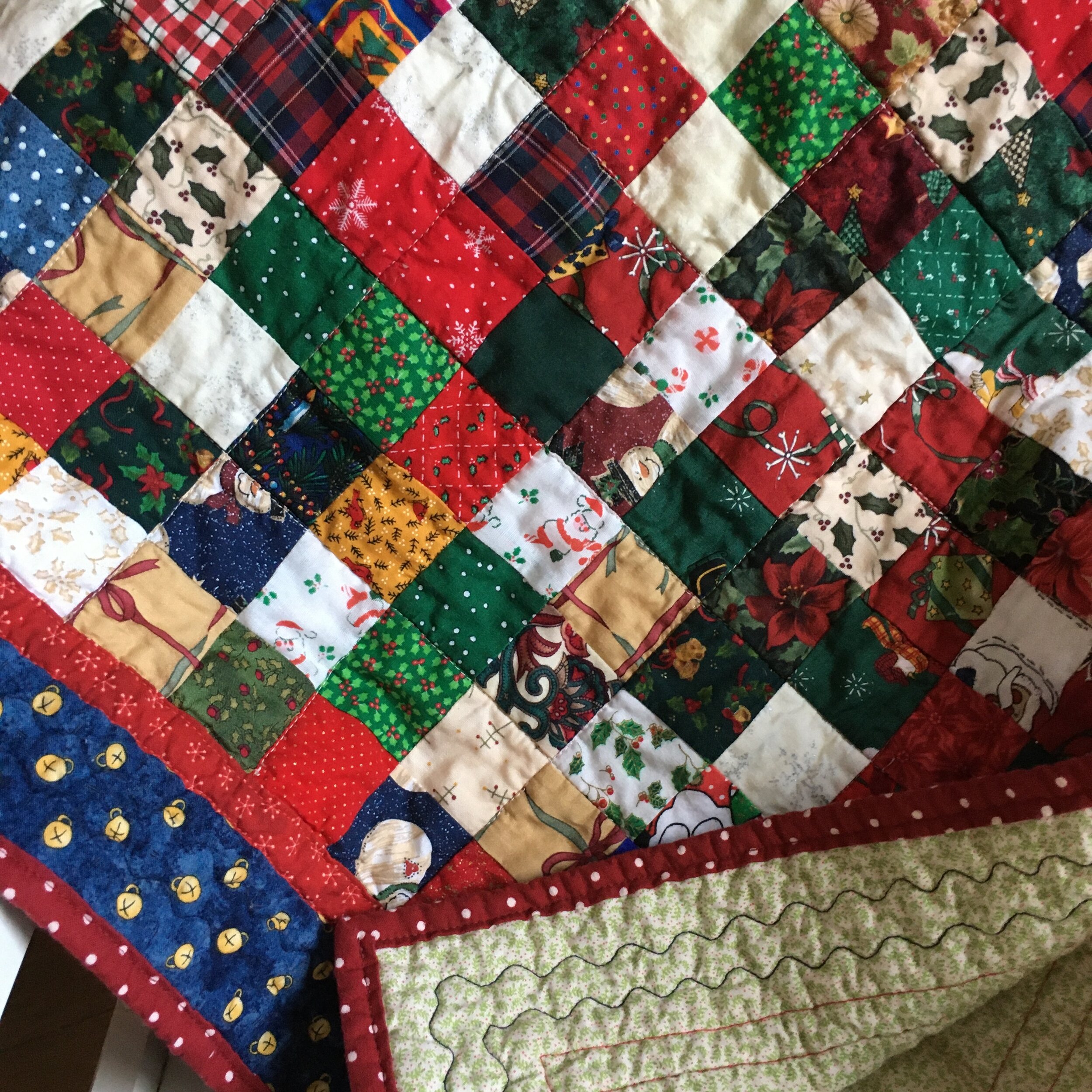
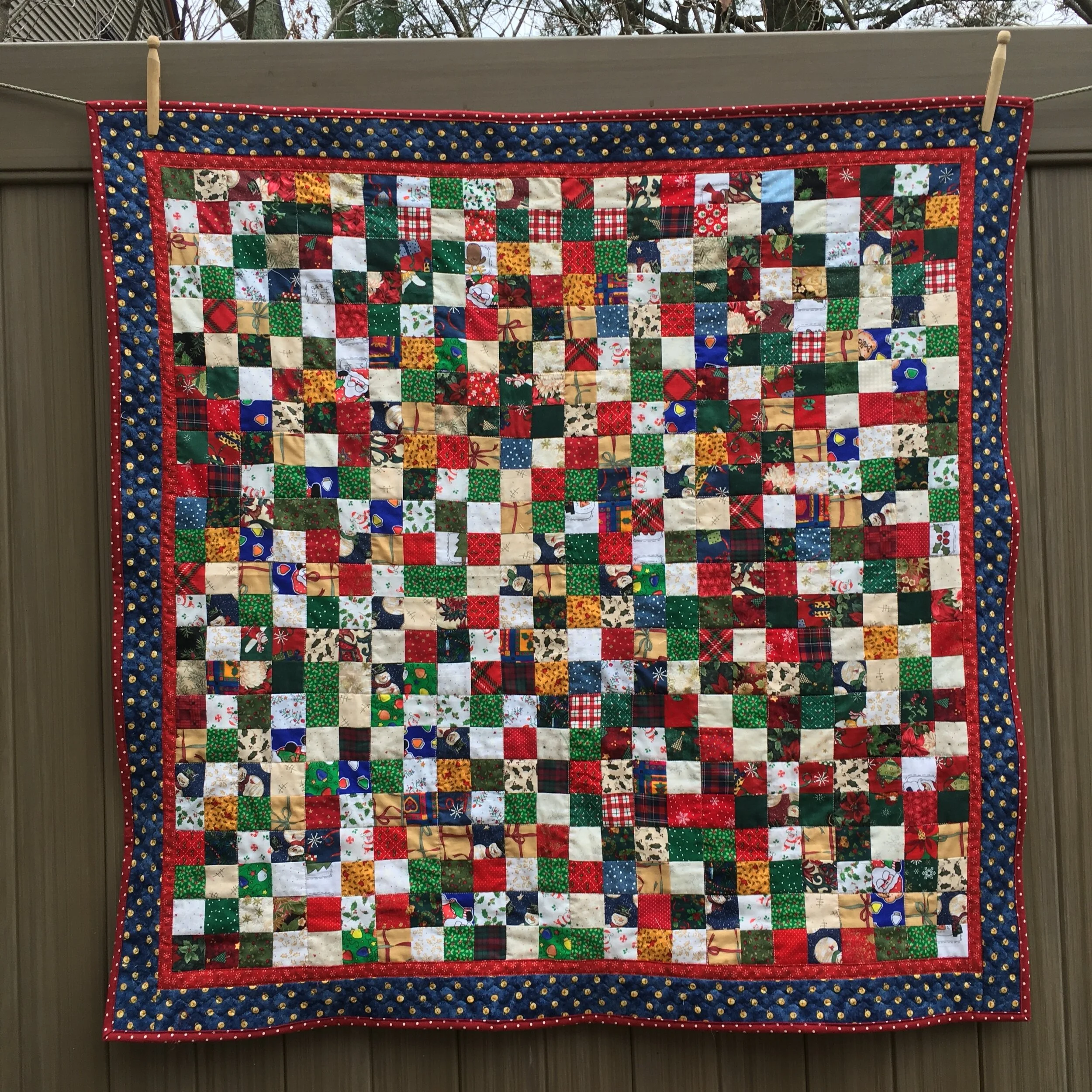
40 inch square postage stamp quilt

40 inch square postage stamp quilt

40 inch square postage stamp quilt

40 inch square postage stamp quilt

This is such a fun quilt. It’s a postage stamp quilt, comprised of lots of little squares of Christmas fabrics. It was pieced by a member of The Proper Bostonian Quilters Guild . The top was donated to be used as a charity quilt. I picked it up at the last meeting and brought it home to finish it

I added the narrow inner red border and the wider blue border with the jingle bell. It is quilted in the ditch every other row. I thought about quilting every row, but this is going to be wheelchair quilt and I wanted it to stay light and drape well.

The border has two rows of quilting using the Bernina #4 lingerie stitch with an increased stitch length of 2.5 which creates a gentle wave. It adds great texture. The person who gets this quilt will be able to recognize the quilt by just touching the border.

The photo above was taken before the quilt was washed. I like it even better now after it has been washed and dried. It’s such a cheerful quilt!

After being washed. Note the texture from the stitching in the outer border.

After being washed. Note the texture from the stitching in the outer border.


TAGS: Postage Stamp Quilt, Christmas Quilt, Charity quilt


November 21, 2019

Showcase: Local Crafters, ceramics

by Judy Tucker


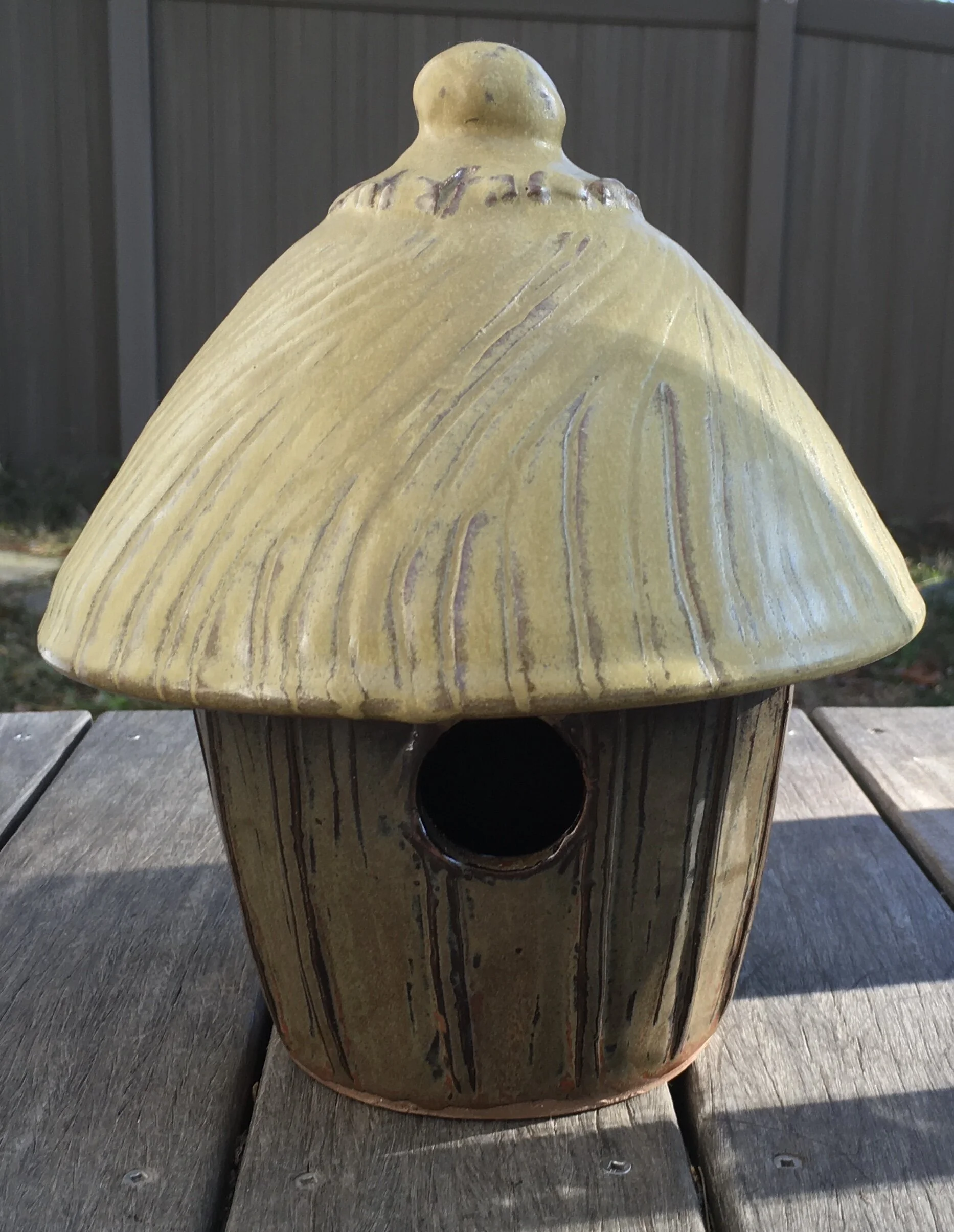
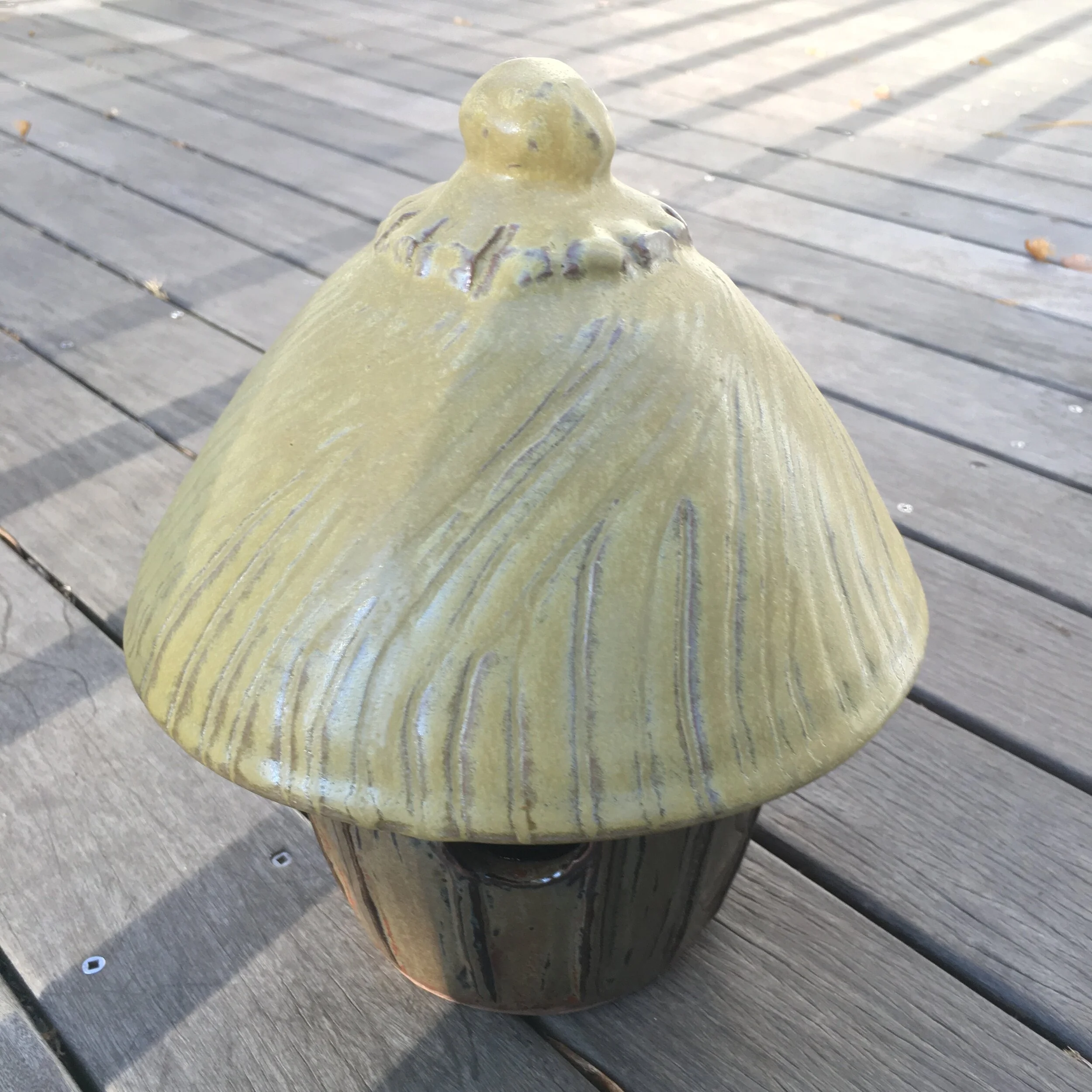
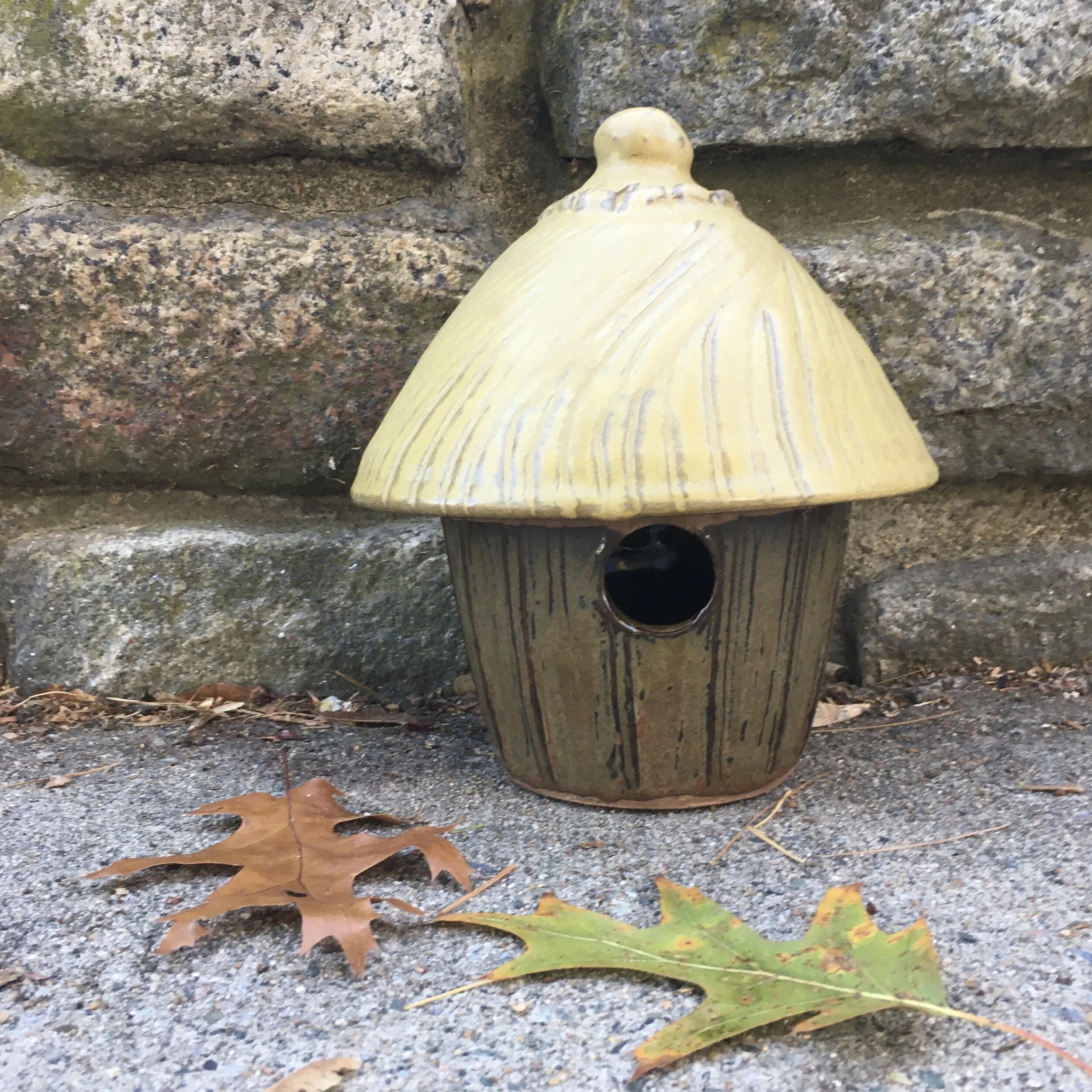
Ceramic Bird house by Michele Clark Pottery

Ceramic Bird house by Michele Clark Pottery

Ceramic Bird house by Michele Clark Pottery

Ceramic Bird house by Michele Clark Pottery

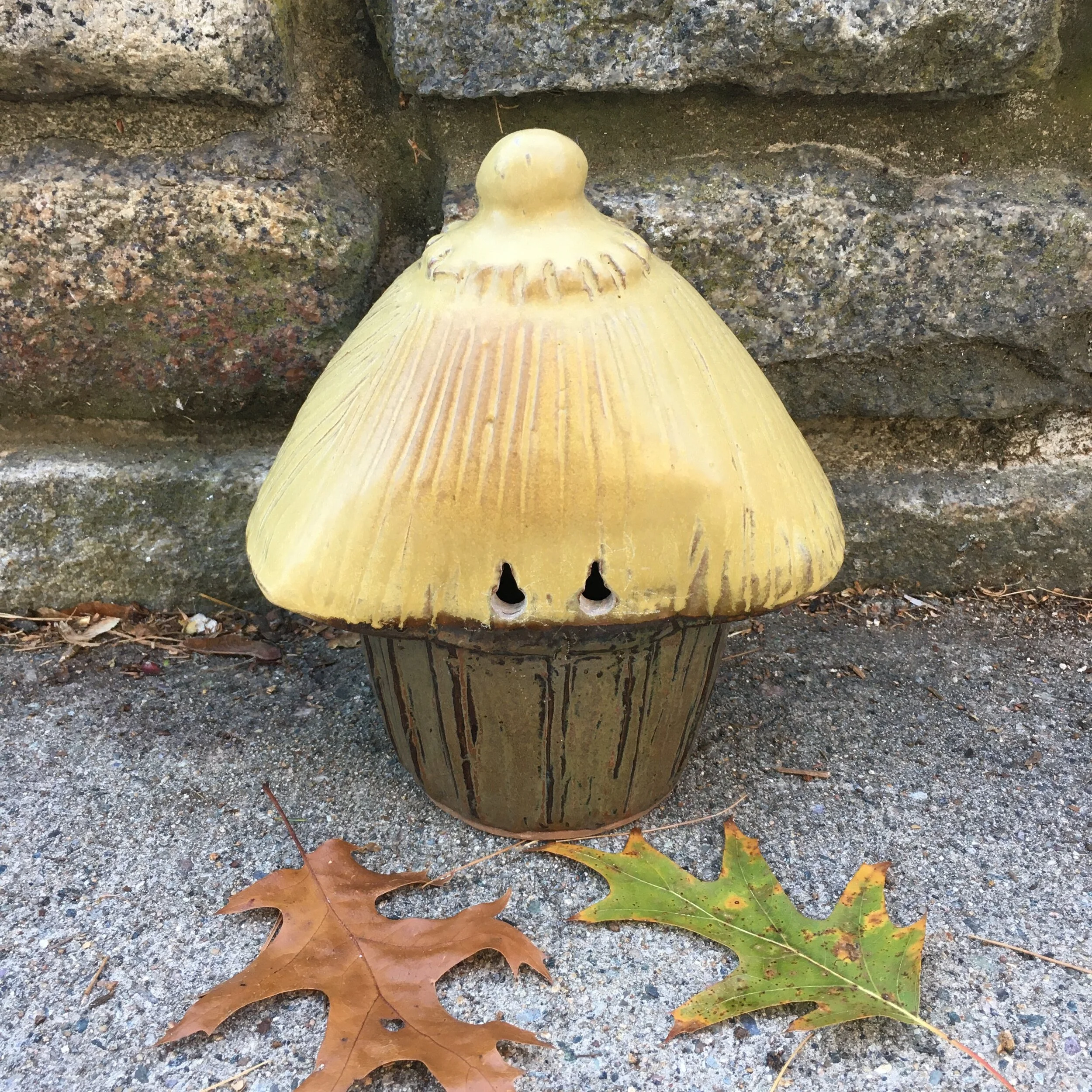
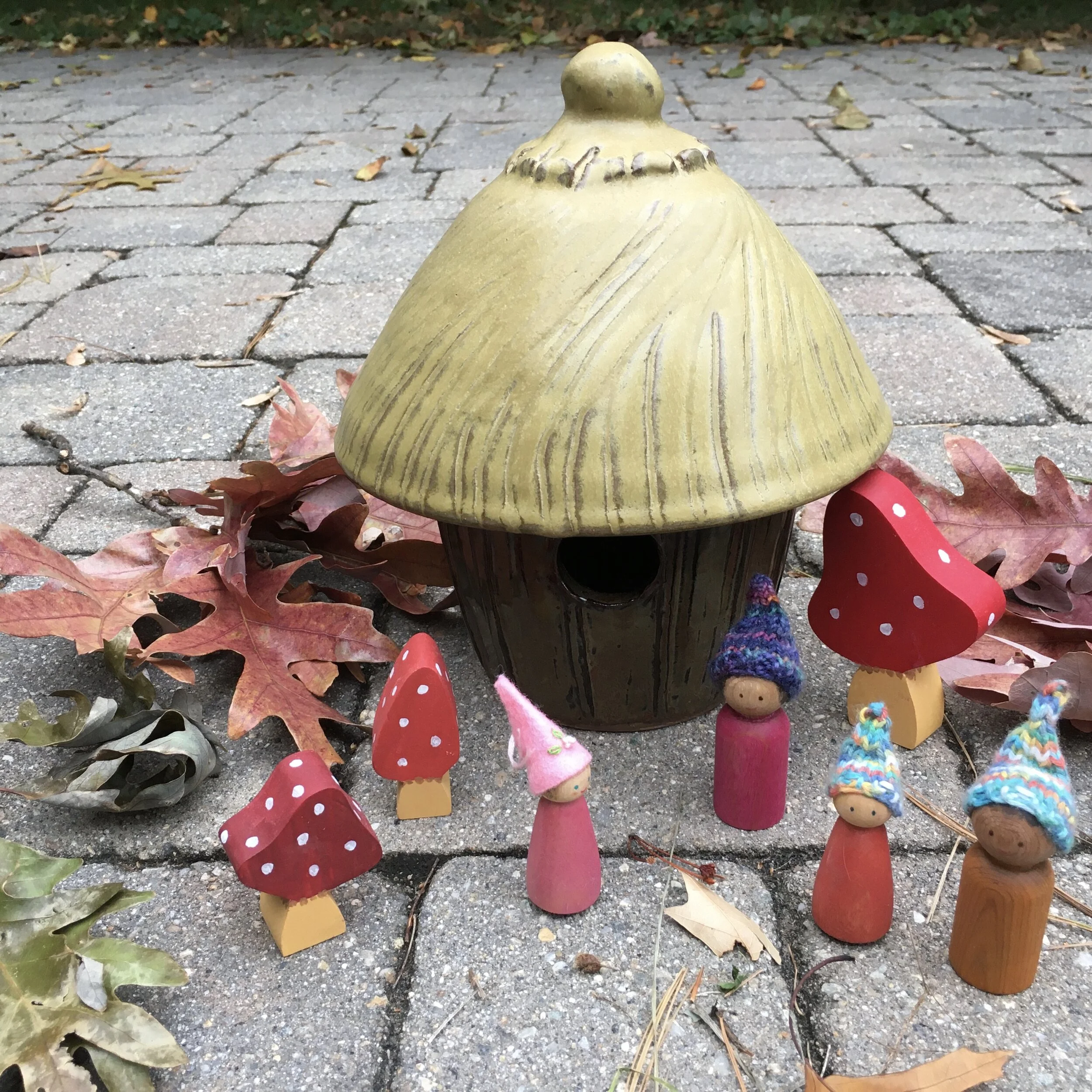
I wandered into one venue at the recent Roslindale Open Studios and met Michele Clark, a local potter. She had a beautiful group of ceramic bird houses. I took one look a her amazing birdhouses and instantly thought “gnome home for a peg dolls!” I had hard time choosing just one birdhouse from her wonderful collection, but the thatch like roof on this house cinched the deal. It turned I had picked her favorite birdhouse!

3A57FD47-8735-4C20-ADFC-97D2804F01E7.jpeg
CF636CF7-E64D-4CDE-8782-25CA5E86631D_1_201_a.jpeg
EFC7679F-5B93-4EAD-9EE5-0244796B43C8.jpeg

MIchele was a good sport when I told her I was re-purposing her birdhouse as a gnome home!

PotteryGnomeHome.jpg

MIchele can be reached on Instagram at @mclarkpottery. You can see more of her wonderful ceramic birdhouses on her IG site.

TAGS: Ceramic Birdhouse, Pottery Gnome Home, Peg Dolls, Pottery Bird House, Michele Clark Pottery Birdhouse


November 14, 2019

Showcase: Local Crafters

by Judy Tucker


NaturallyDyedWoolRoving.jpg

A few weeks ago, Roslindale Village, a neighborhood in the CIty of Boston, MA, had their annual Open Studios weekend.

Makers cluster in a renovated substation, the old Roslindale High School, now senior apartments, the Irish Social Club, local shops, their own homes and studios. It’s fun to walk around and see what everyone is doing. I’ve lived around here a long time now, so I know some of the makers just from being part of the community which makes it even more fun.

Some of work I purchased are photographs, prints or fine art which I can’t showcase online without permission, so I thought I’d share some of the craft items I purchased over the next week two.

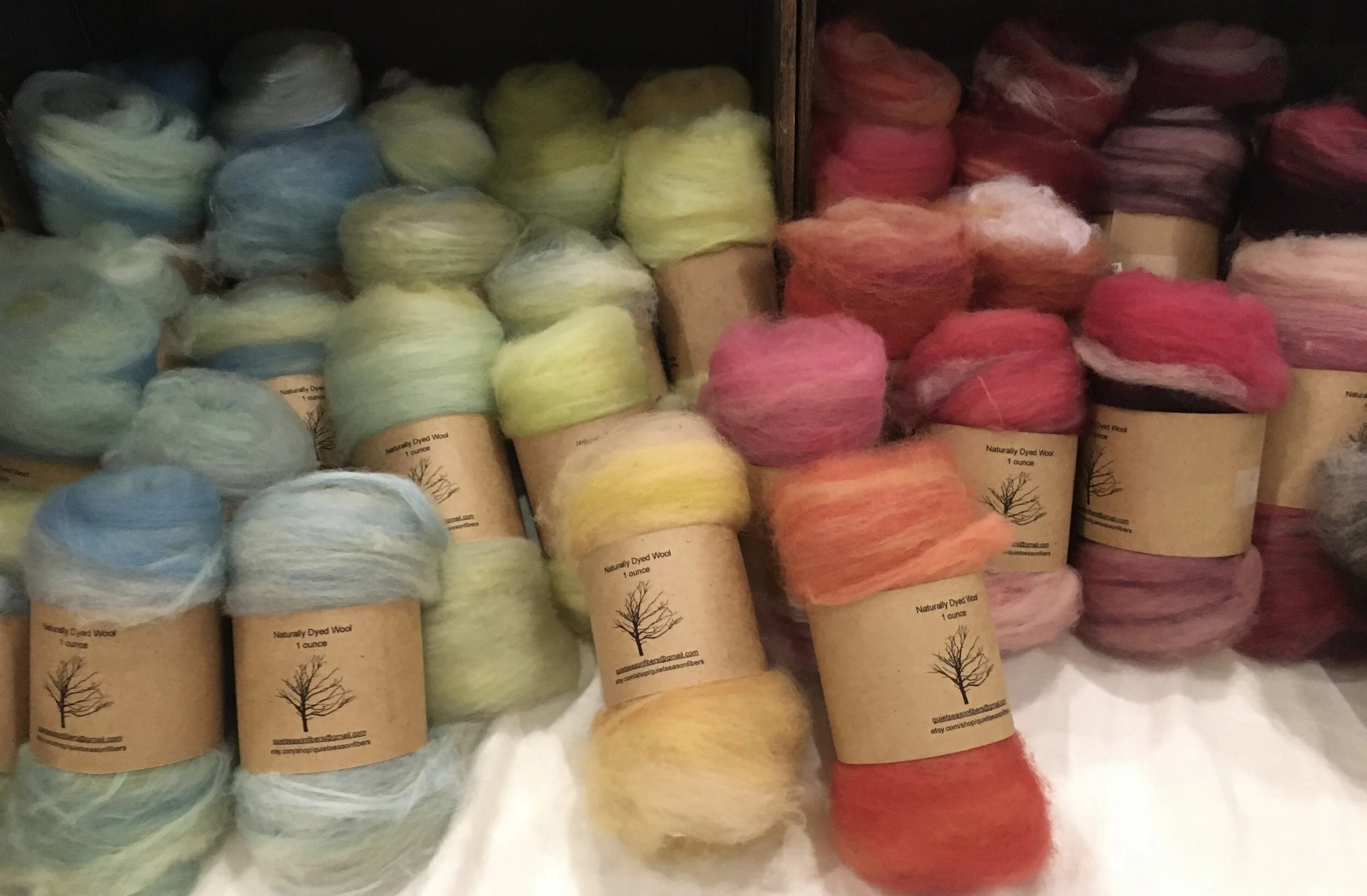
The photo above was the display for wool roving which was dyed with natural dyes by Quiet Seasons Fibers. The colors are gorgeous and the wool is lovely to the touch. I bought the yellow and melon color wool roving bundles shown at the front of the photo. I’m planning to get out my drop spindle and try spinning some yarn again. I’ve never been very successful but even less than perfectly spun yarn can make a nice addition to the hair of the Waldorf type dolls I occasionally make.

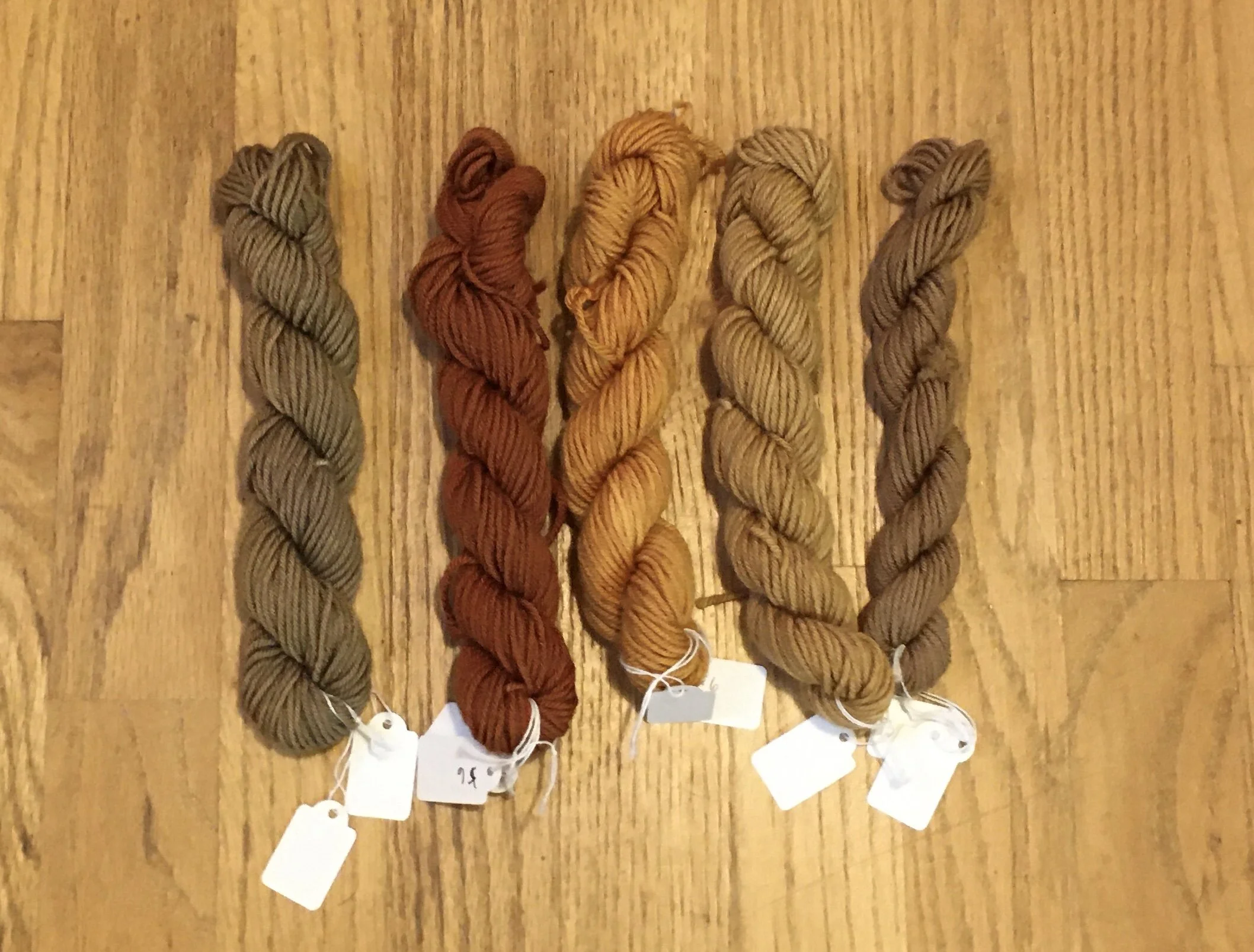
I also purchased some small skeins of commercially spun wool that Virginia had dyed with her natural dyes. I bought them specifically to use as doll hair. Here’s what I chose and with a notation of was used to dye the colors.

Left to right:

Brown with an olive green tint: Fustic (from a tree in the mulberry family) and log wood

Burnt umber: Marigold and madder (an herb)

Sienna: Onion skins

Gold: Marigold

Light brown: Walnuts

335FE73C-67F2-456D-A709-18C3B4BC838F_1_201_a.jpeg

Isn’t all this wool beautiful?


Virginia has some of her naturally dyed, handspun yarn available for sale in her Quiet Season Fibers Etsy shop. Check out her beautiful yarn!


TAGS: Naturally Dyed wool, Naturally dyed roving


November 7, 2019

"Triple Barnstar" Quilt Completed

by Judy Tucker


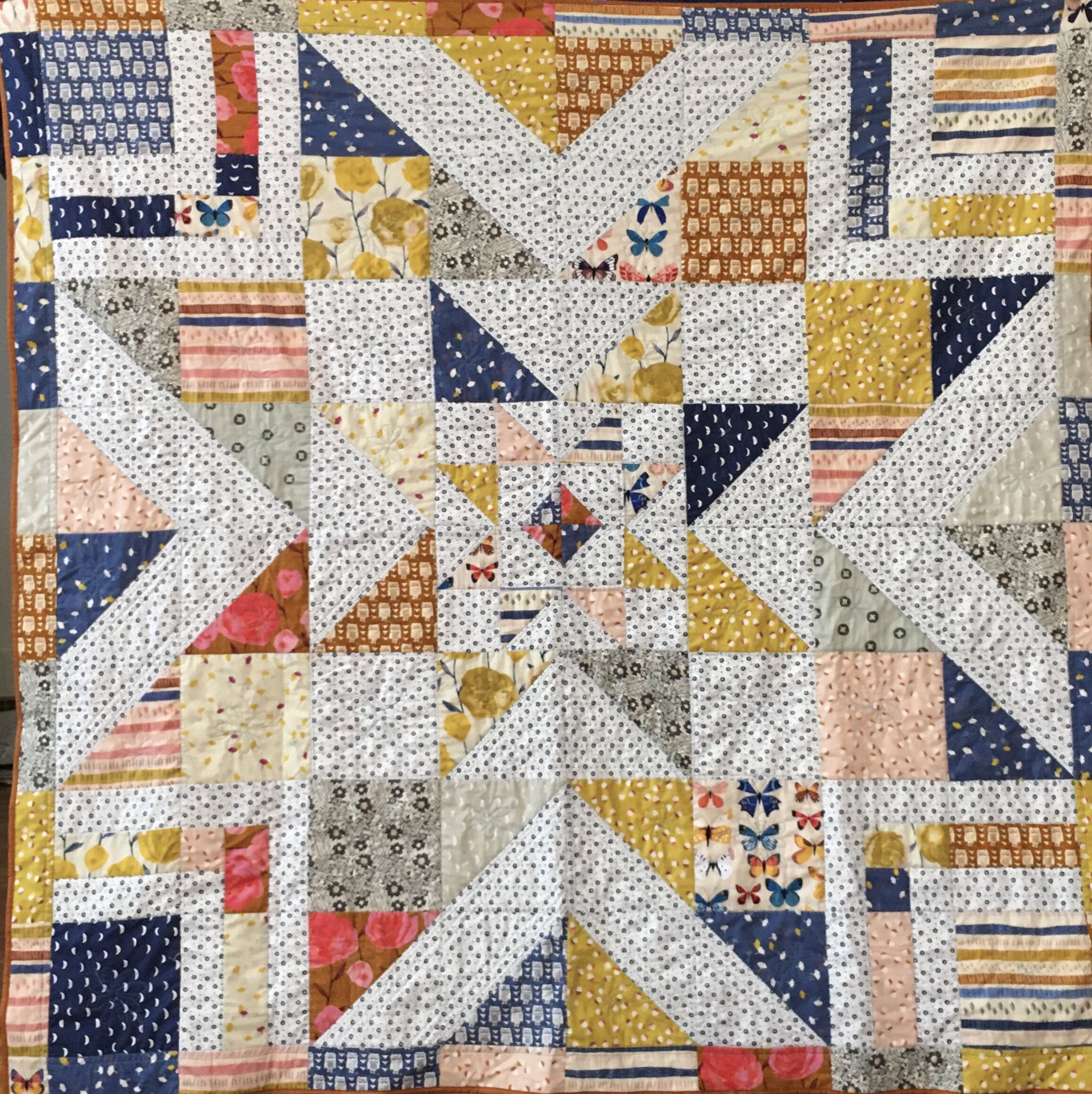
“Triple Barnstar” Queen Size quilt

“Triple Barnstar” Queen Size quilt

“Triple Barnstar” Queen Size quilt

“Triple Barnstar” Queen Size quilt

Done!
Here’s my “Triple Barnstar” quilt designed by Amy Gibson. The pattern is a star, in a star, in a star!

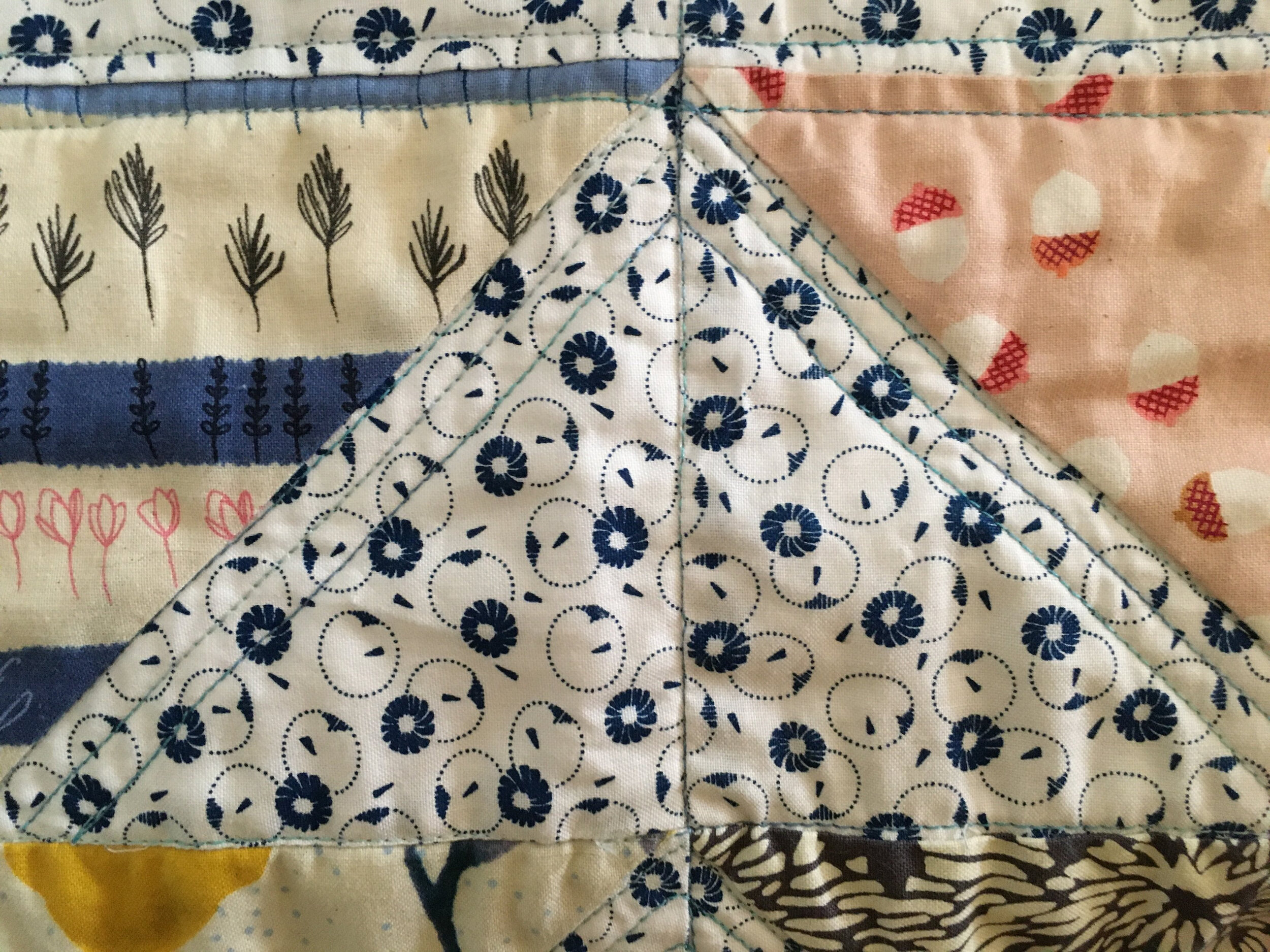
I did walking foot echo stitching around the stars, with sitch-in-the-ditch along the grid lines between the blocks. I never really pay close enough attention to really keep all the stitching in the ditch between the blocks. I much prefer stitching 1/8 to 1/4 inch away from seams where a little wobble isn’t as obvious!

Walking Foot Stitching and Stitch-in-the-Ditch (sort of!)

Walking Foot Stitching and Stitch-in-the-Ditch (sort of!)

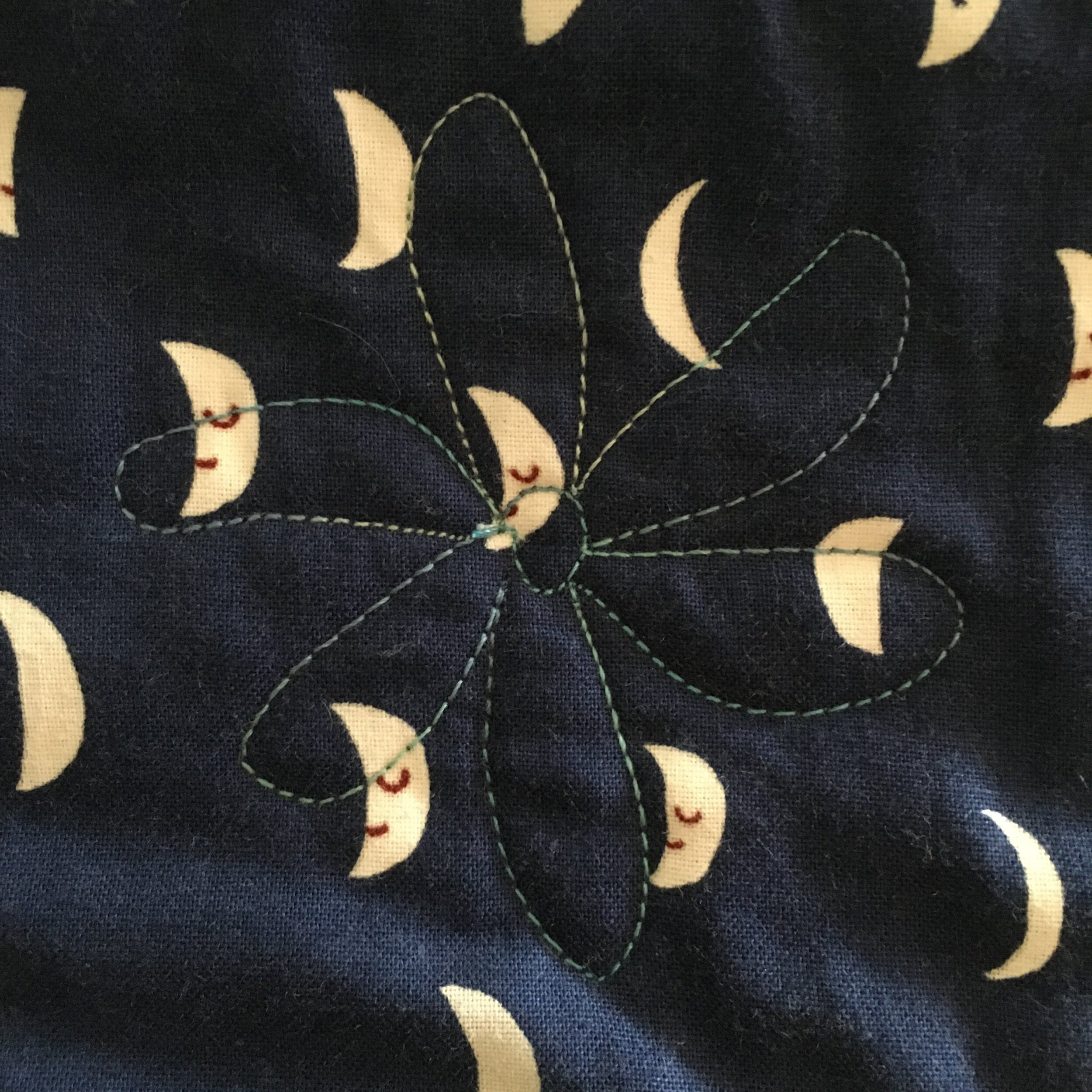
In open large triangles there are flowers without leaves and in the blocks without any piecing I did free motion flowers with 2 leaves. There is also a big of meandering and loops in the very large triangles near the center of the quilt.

1A950876-E4DE-4273-BADF-6CF11C8252E7.jpg
B8F9BDD3-2BC8-4153-B27C-389E69529A69.jpeg

So, this big project is finally done. And just in time—I heard something about possible snow in the coming week! It’s a perfect autumn quilt.

TAGS: "Triple Barnstar" Quilt Top by Amy Gibson, Free Motion quilting a flower design, Walking Foot quilting


October 24, 2019

How To Quilt a Free Motion Flower Design

by Judy Tucker


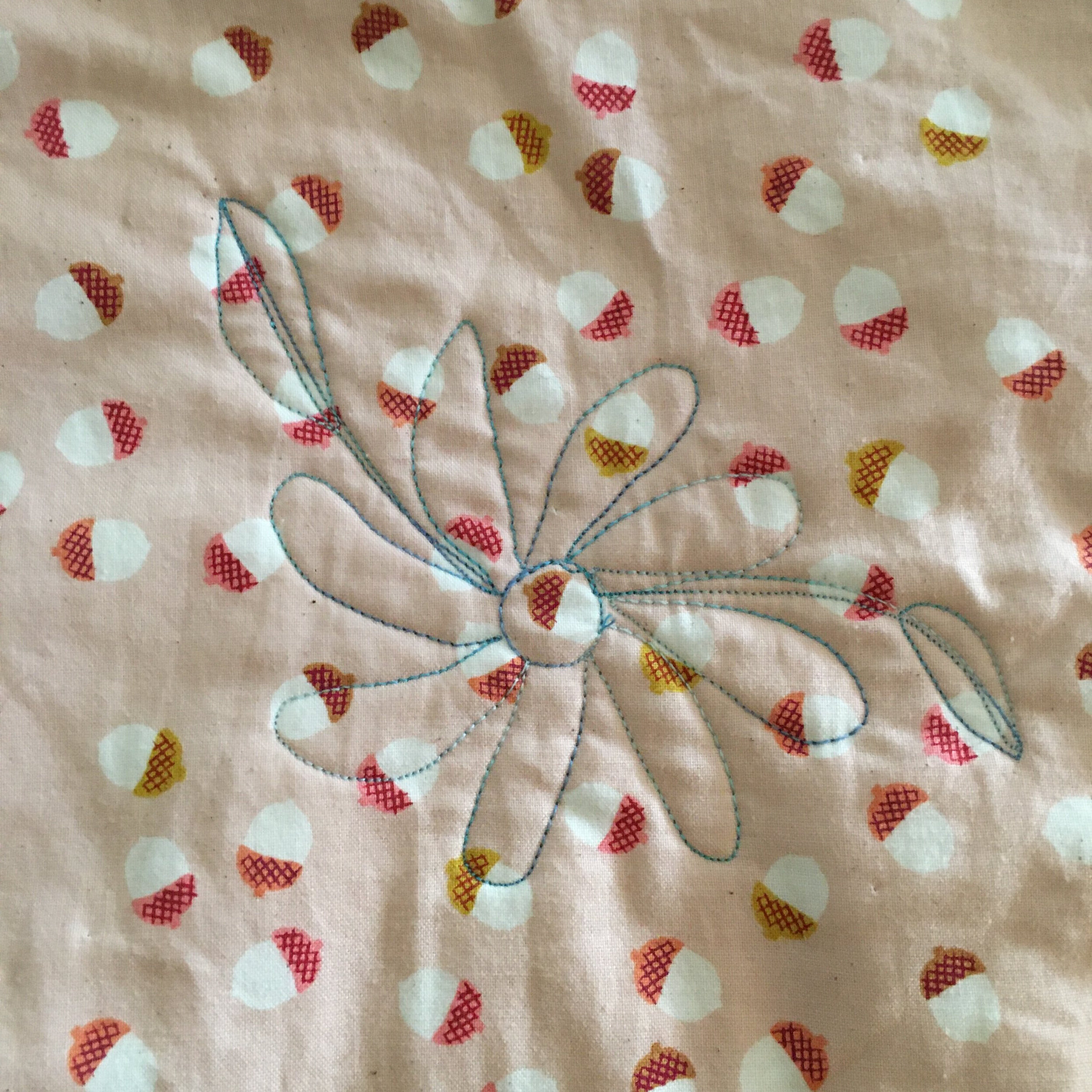
Free Motion Flower Design

Free Motion Flower Design

Free Motion Flower Design

Free Motion Flower Design

I’ve just finished quilting the “Triple Barnstar” queen size quilt. I used my walking foot and did a lot of linear quilting, But this quilt has a number of large 9 inch blocks and large triangle blocks. Those blocks were still empty when I finished the linear echo stitching around the 3 stars in this quilt.

It’s a bit unconventional to mix walking foot quilting with free motion quilting but it was the right answer for this quilt. (In fact, I often mix these two methods of quilting).

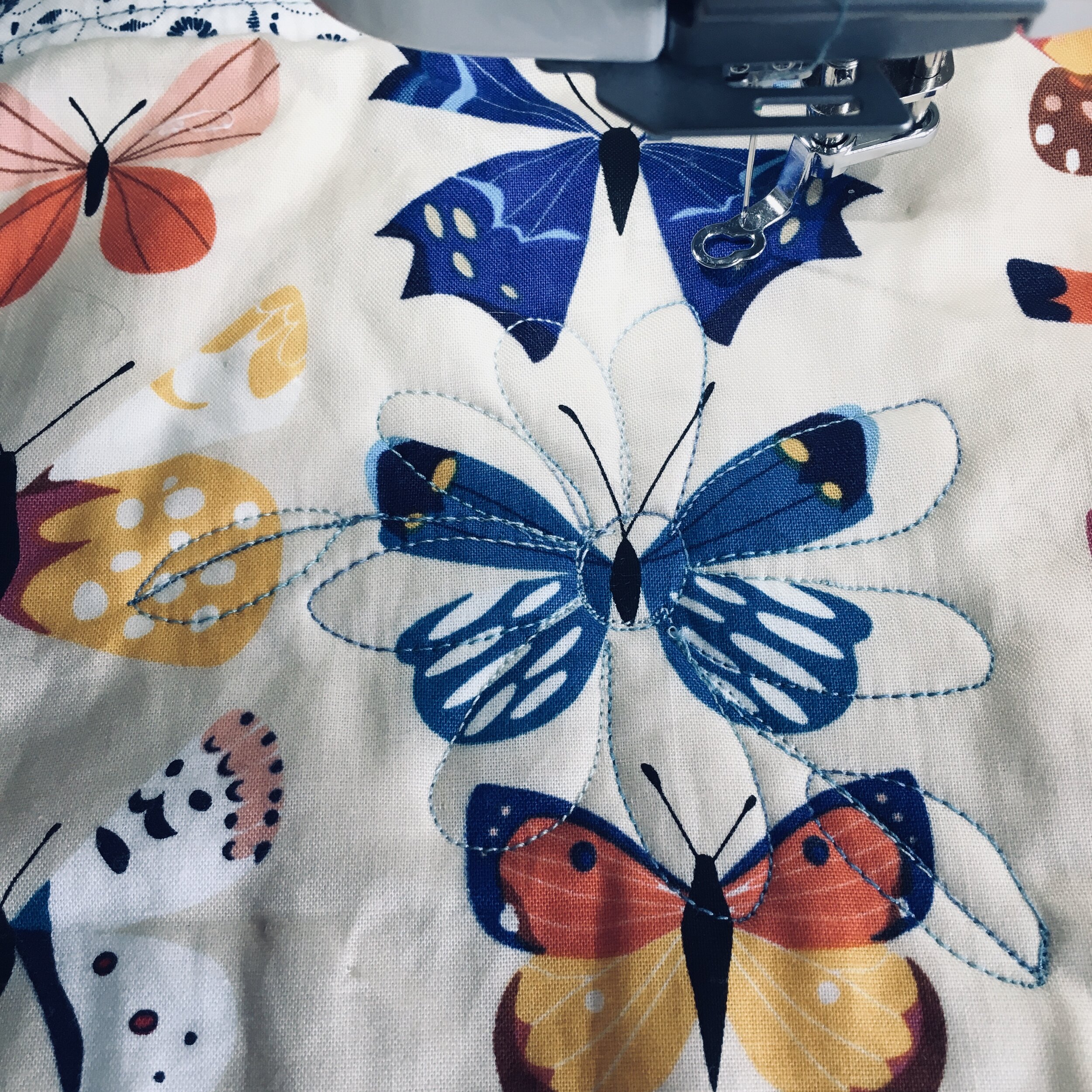
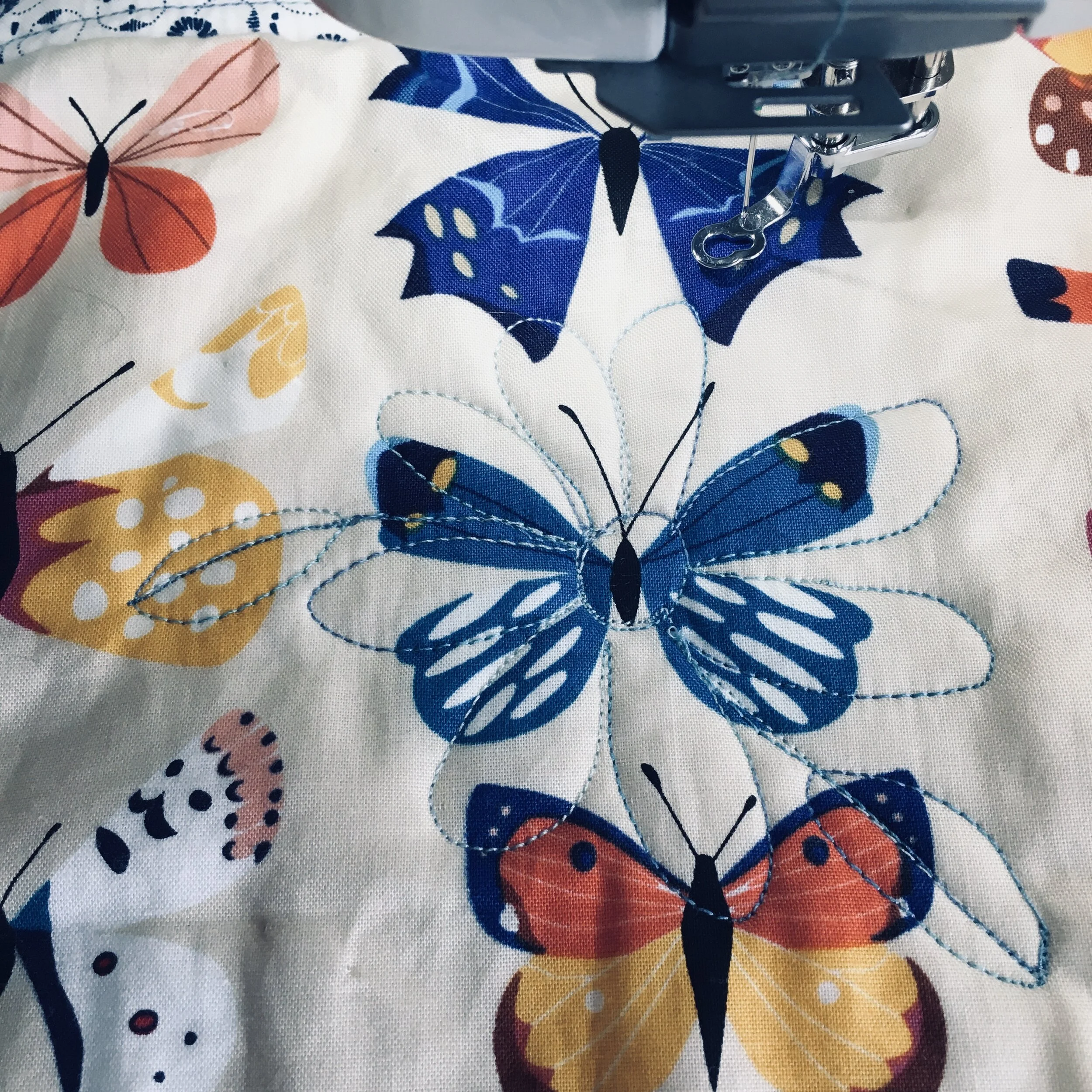
I picked up the aster-like floral design from my background fabric and modified it to get a large daisy flower. You can see that little blue flower in the right hand upper corner of the photo below.

Here is how I stitched out my flower.

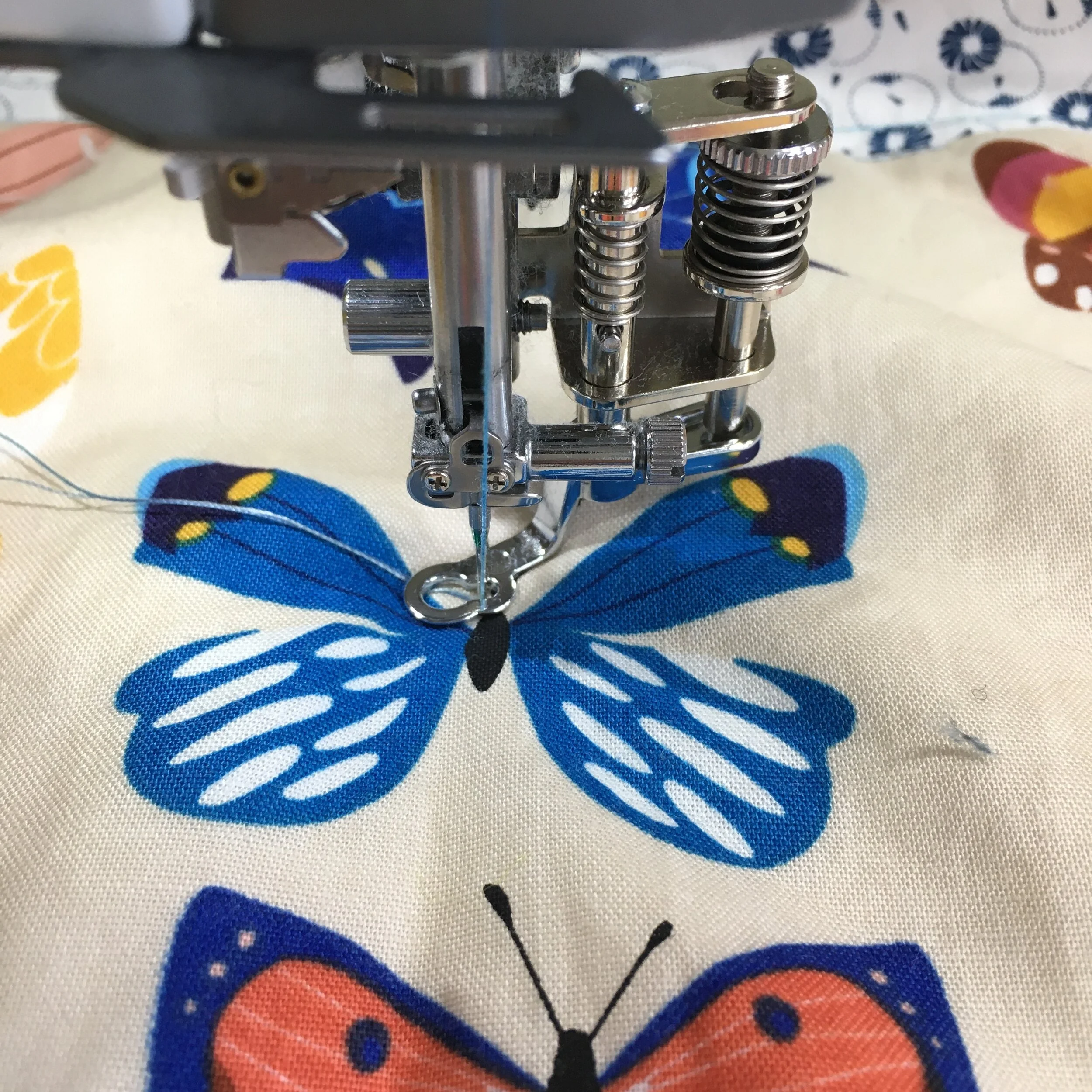
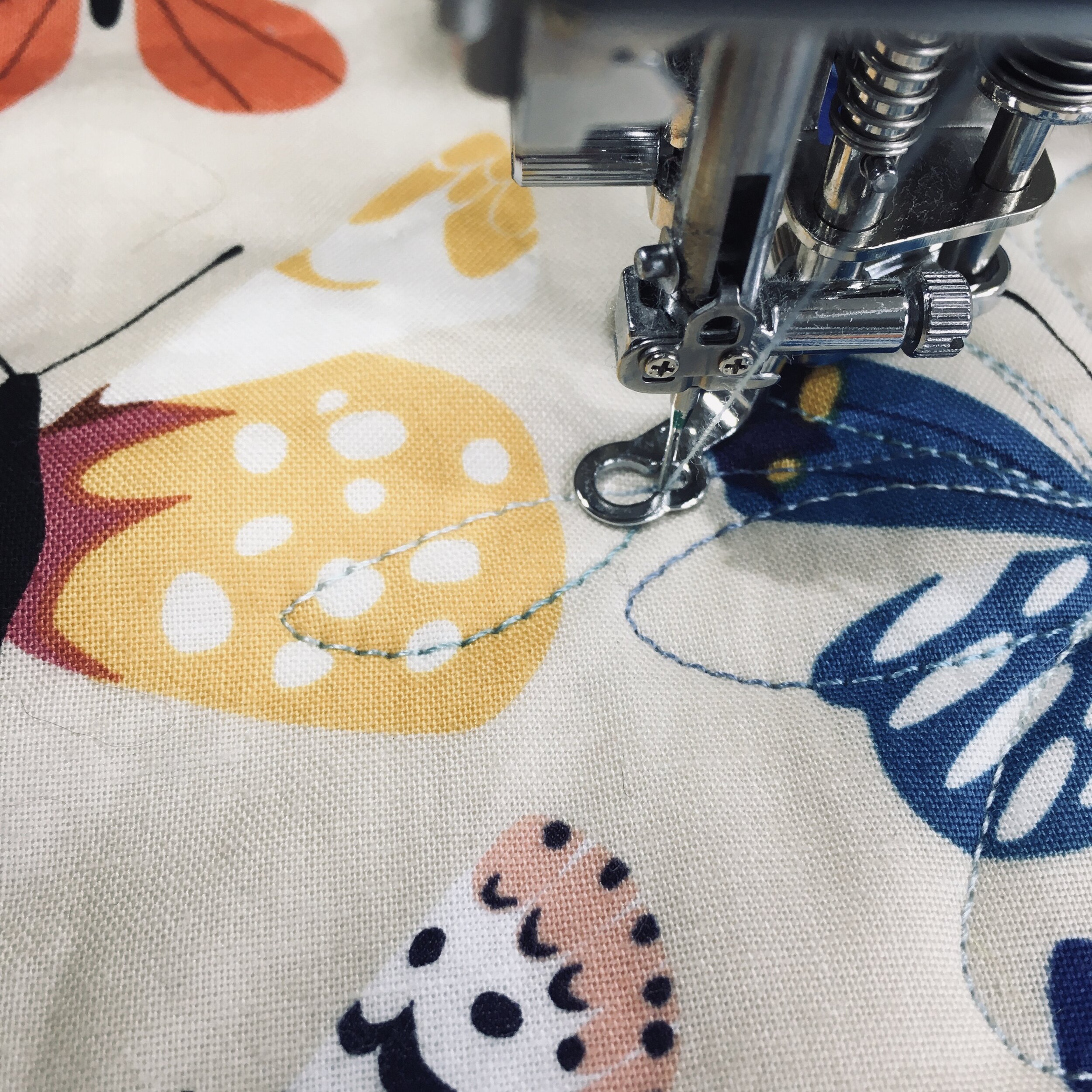
Set up your machine for free motion quilting. Drop the feed dogs on your machine and attach the darning foot. Make sure you are using a sewing machine needle meant to be used for quilting. It helps to have a low friction mat (I use a the regular Supreme Slider), on the table of your machine under the quilt, and pair of quilting gloves or clean gardening gloves with gripper dots to help move the quilt as you stitch. (The bright yellow gloves that you can see in one of the photos below are Dritz Fons and Porter Quilting Gloves. I also really like Machingers Quilting Gloves).

Start in the center of the block. Using the up-down needle needle function on your machine, pull the the bobbin thread from the back of the quilt. Put the needle in the down position.

Bobbin thread has been pulled up from the back of the quilt.  Needle is down, reading to start quilting

Bobbin thread has been pulled up from the back of the quilt. Needle is down, reading to start quilting

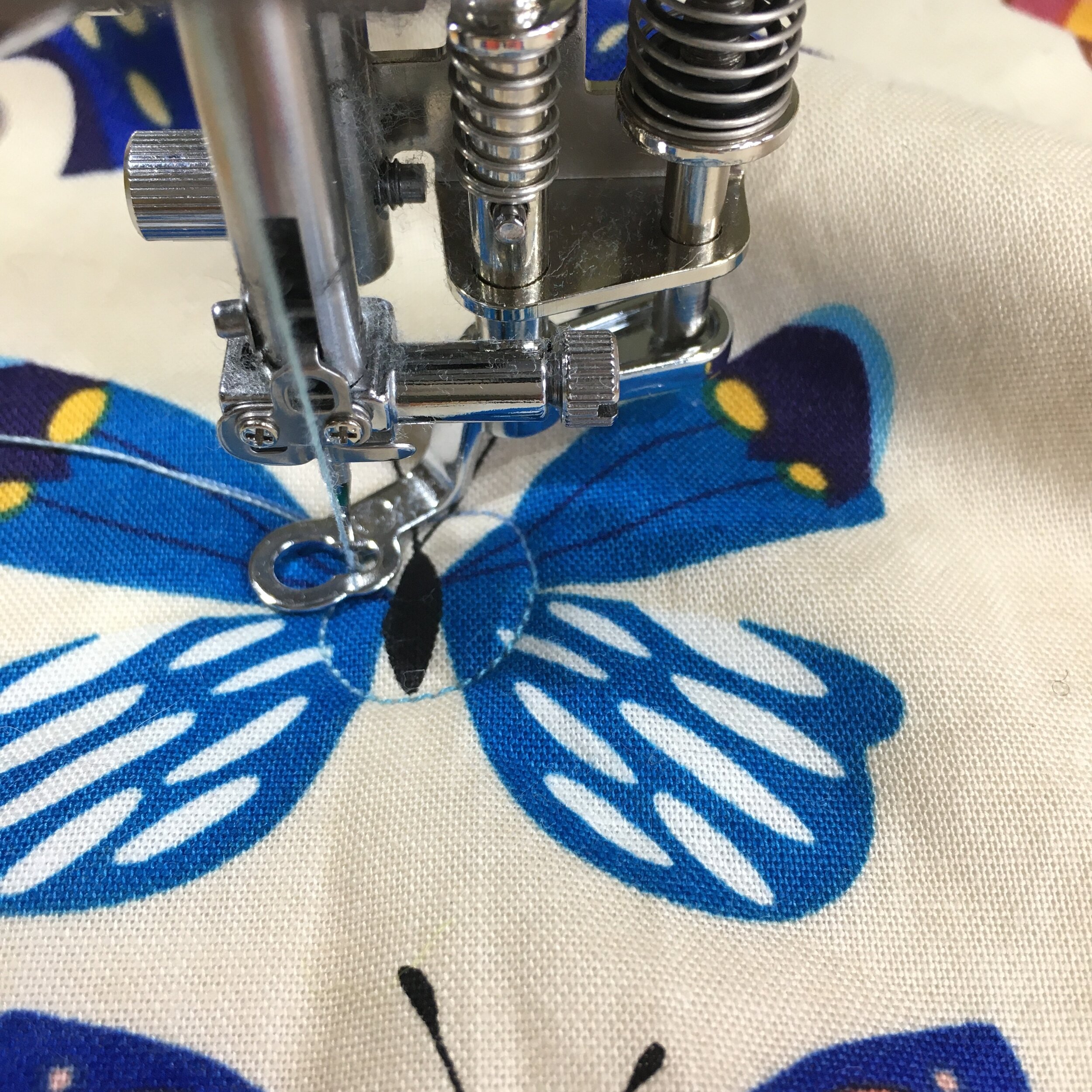
Grab the tails of the two threads and stitch a circle, ending a couple stitches over your start point. I clipped the two threads now. If you are quilting a quilt for a show or as an heirloom, you should use a sewing needle to bury the thread ends in the middle of the quilt sandwich.

FreeMotionquiltingFloral center.jpg

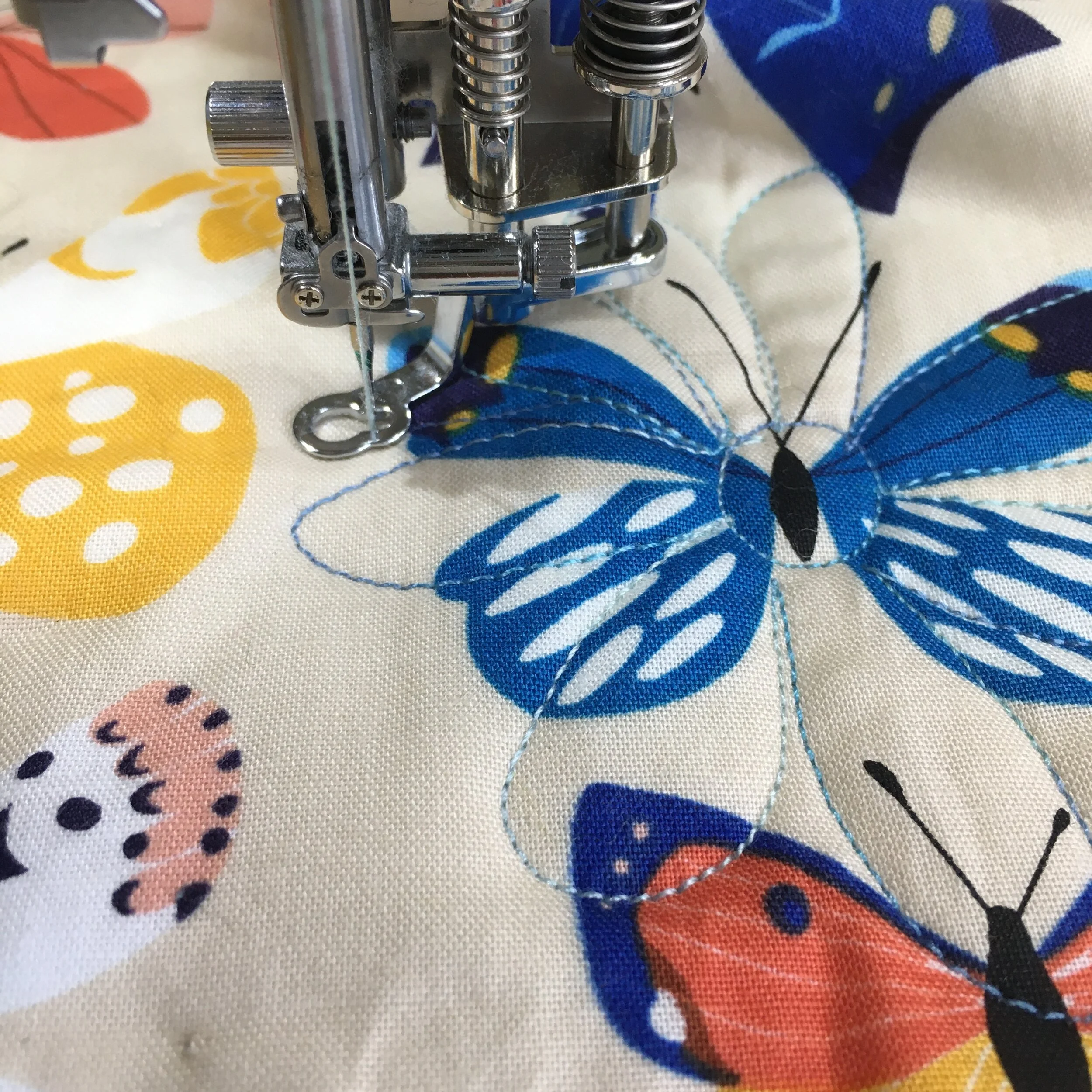
Stitch loops around the circle, creating the flower petals. Stitch at an even speed, slower than you normally would sew. It helps to turn down the stitching speed on your machine if you have that option. The slower speed helps to keep your stitch length regular and helps to prevent pulling on the back creating eyelash stitches. They eyelash stitches look like eyelashes. You’ll know them immediately if you see them. Eyelash stitches should be removed and resewn because the stitches aren’t anchored.

Sewing loops off the central circle to make lower petals

Sewing loops off the central circle to make lower petals

Once you have petal stitched all the way around the central circle, stitch a line between two to the petals to create a stem for a leaf.

Starting to stitch a stem for a leaf

Starting to stitch a stem for a leaf

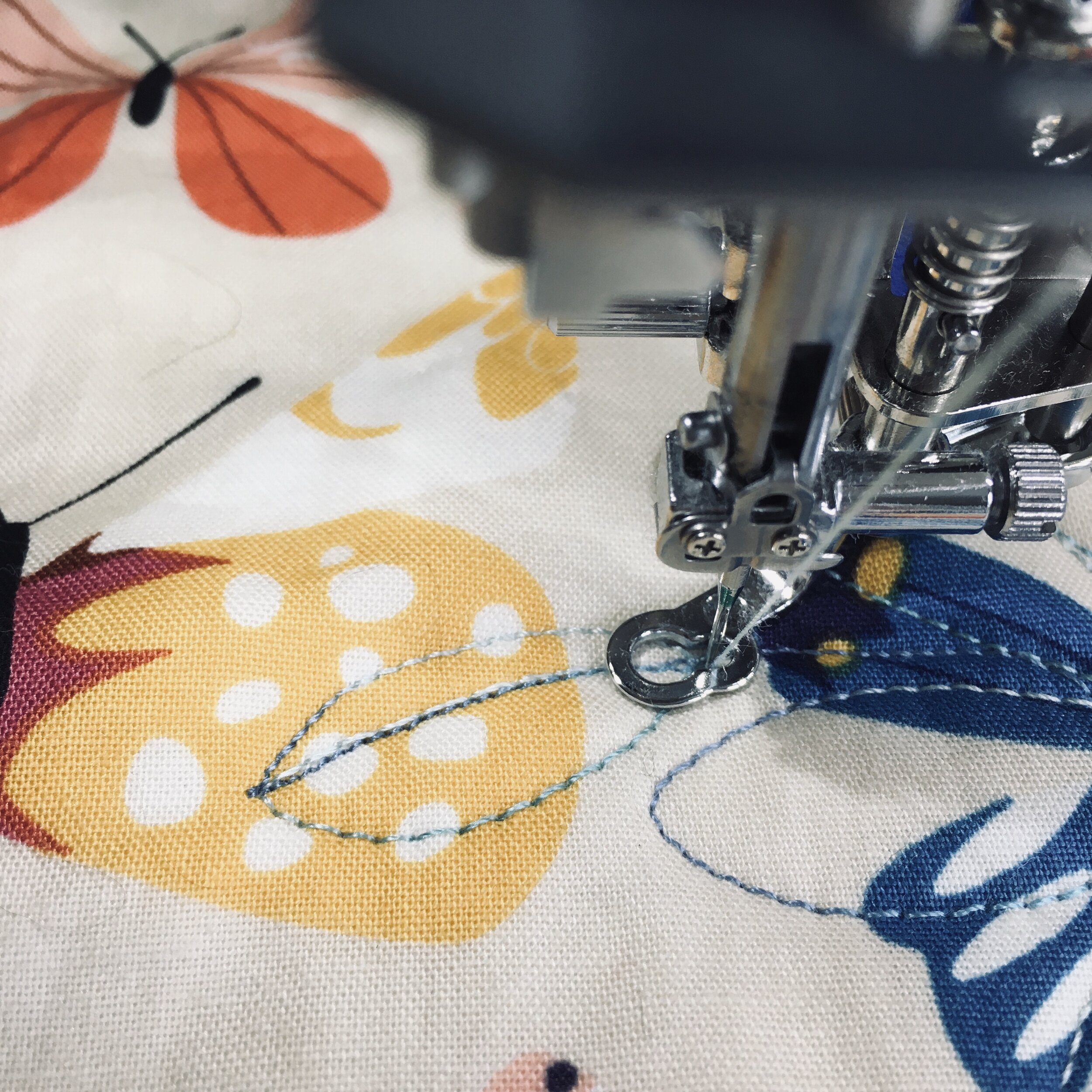
Once the stem is the length you want, stop stitching. This will allow you to get a point on the end of your leaf. Then stitch a curve that will be half the leaf back to the stem stitching.

First half of the leaf

First half of the leaf

Now stitch the the other side of the leaf by sewing a loop on the other side of the stem, ending at the tip of the leaf. Then travel stitch back down the center of the leaf, on top of your initial line of stitches. And the end of the leaf, I usually stop travel stitching and stitch a couple of millimeters away from the first stem stitches to create a more realistic looking stem.

Travel stitching back along the stitches in the center of the leaf

Travel stitching back along the stitches in the center of the leaf

I only made a wider stem on side of this flower. After you reach the center of the flower, travel stitch around the circle and out between two other petals to make another leaf if you want to do that. I initially quilted two flower with 4 leaves each, but then decided I preferred the 2 leaf design better.

CompletedFlower.jpg

Free motion quilting uses “motor memory”—your muscles working with your brain. It takes practice. Some designs, like these flowers come easily to me. Some I really struggle with. I have a friend who loves stitching a paisley pattern. Please don’t ask me to do a paisley design! I’ve learned to stitch what feels right to me, not what someone else can do. And it’s totally fine to create your own designs. In fact, with free motion quilting, I think that stitching designs that come naturally to you is the best way to go.

Notice: This blog is not monetized: I do not use affiliate links. When there are links in a post, they are to give credit to another creative person, because I like or have used a product, or to help the reader easily find supplies for a project.

TAGS: How to free motion quilt, Free motion Quilting, Free Motion quilting a flower design, Step-by-Step free motion quilting a flower design


October 17, 2019

Halloween Crafts: A Show and Tell

by Judy Tucker


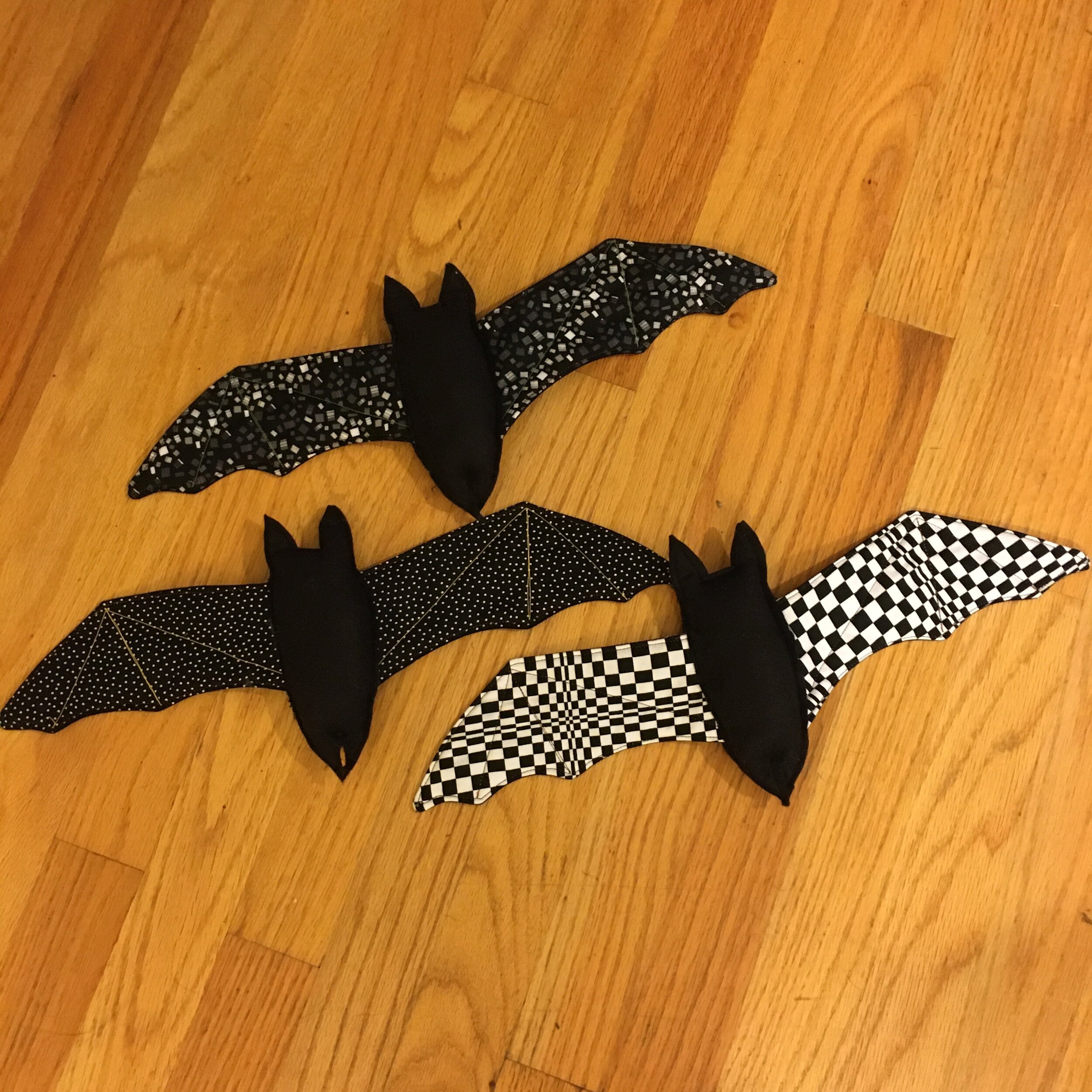
Bats from Modern Textiles tutorial

Bats from Modern Textiles tutorial

Bats from Modern Textiles tutorial

Bats from Modern Textiles tutorial

I’m making slow progress on quilting my queen sized autumn quilt. The days when it has been dark and stormy, when I want to quilt, my noise-sensitive springer spaniel can’t settle down due to the wind so sewing is pretty much out of the question. We’ve had some spectacular fall days too, so I’ve been lured outside planting Hope in the form of daffodil, tulip and Siberian iris bulbs, and cutting back my perennials so that I have a nice level surface to to toss my shoveled snow on when that day comes!

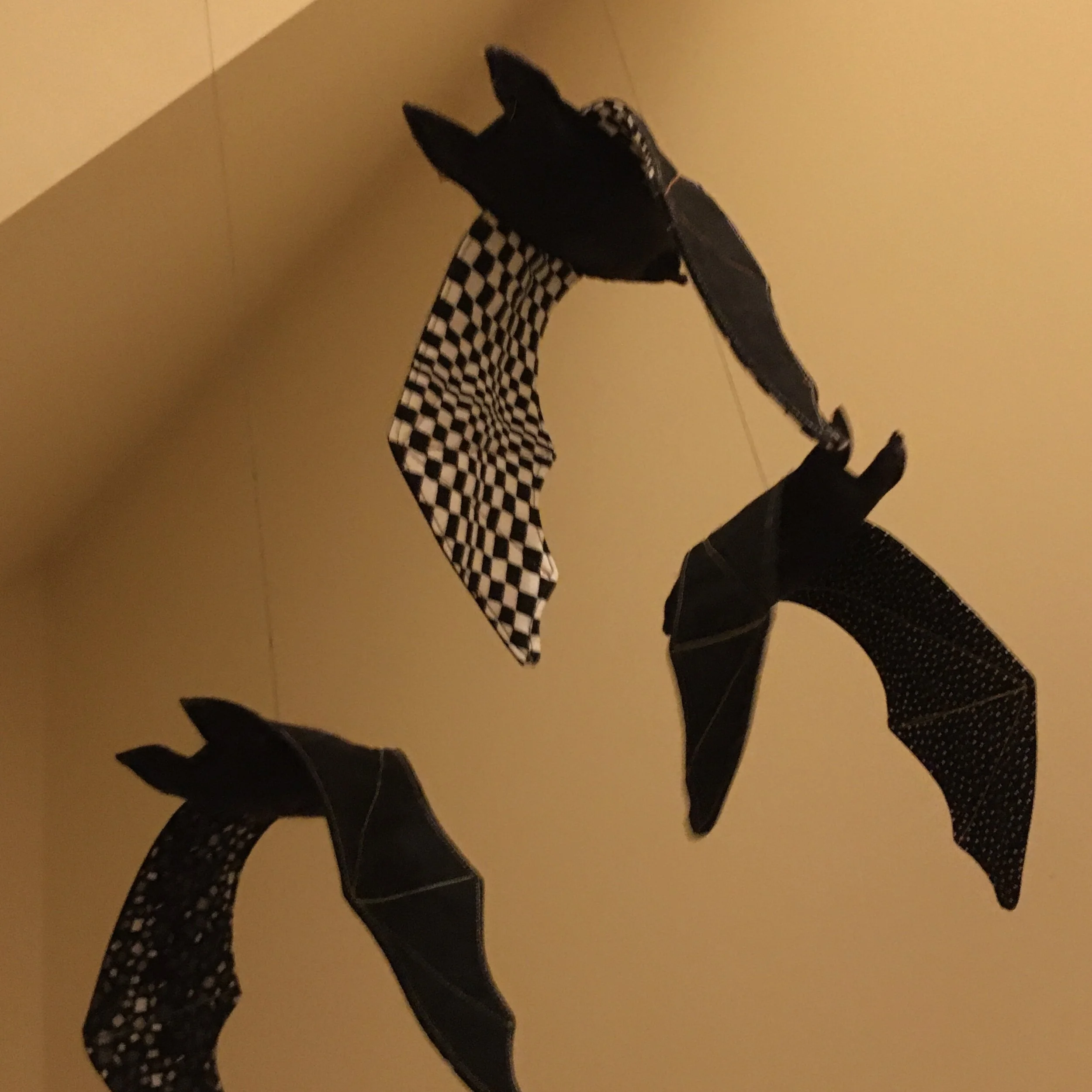
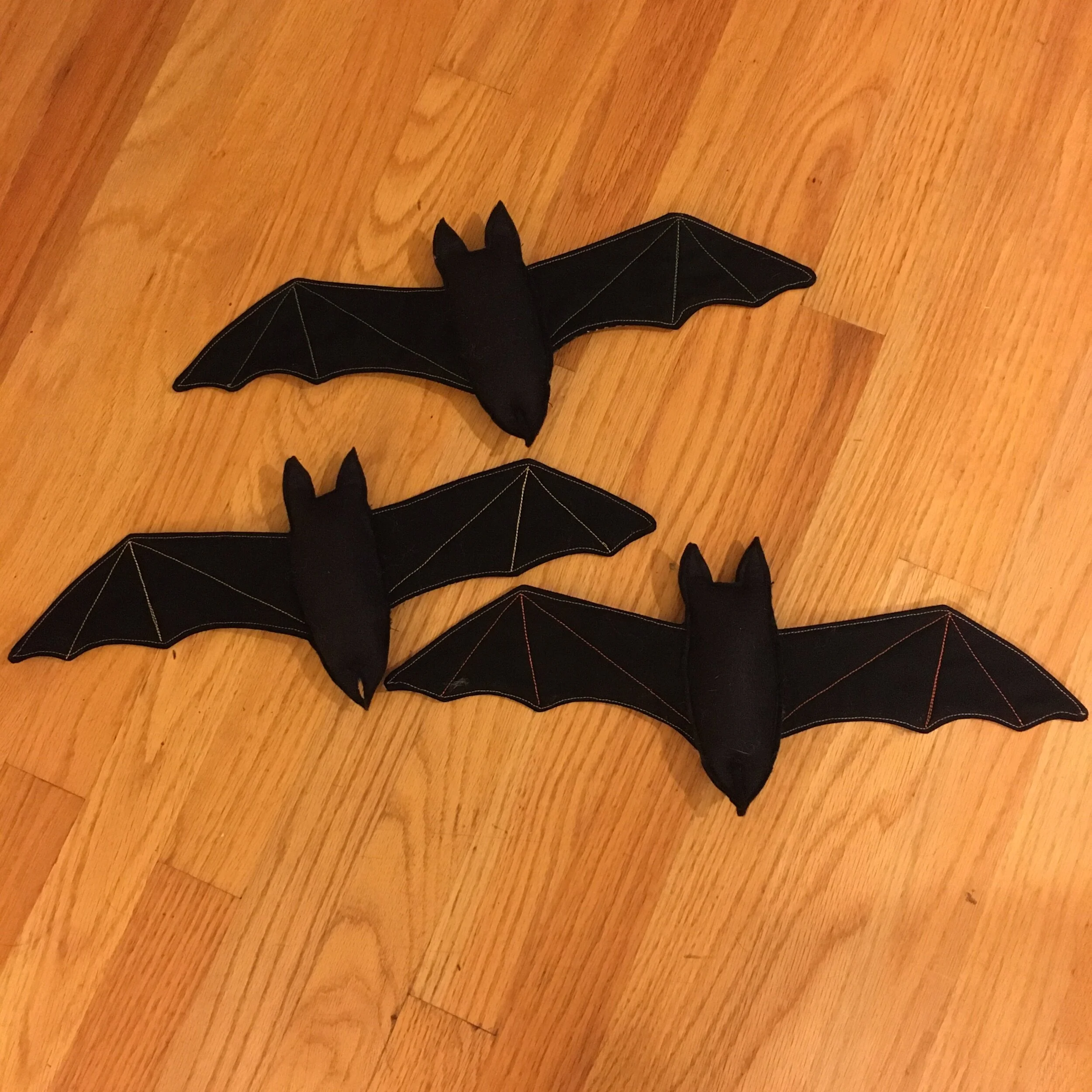
So I’ve decided to show you some of the Halloween crafts I’ve been working on. The bats, shown above, are from a great tutorial from Modern Textiles in Minnesota. You can find the free Bat Tutorial here. I had fun looking through my seldom-used stash of black fabrics for the undersides of the bat wings. I decided to hang my bats differently than the recommendation in the tutorial. I used black carpet thread and rang the thread from the under belly of the bat, right through the body. That way the thread could be easily removed if the child preferred to have the bat as a soft toy rather than hanging it up. The bats have flown off and totally delighted 3 children who range from Kindergarten age to Middle School.

IMG_0946.JPG
IMG_0947.JPG

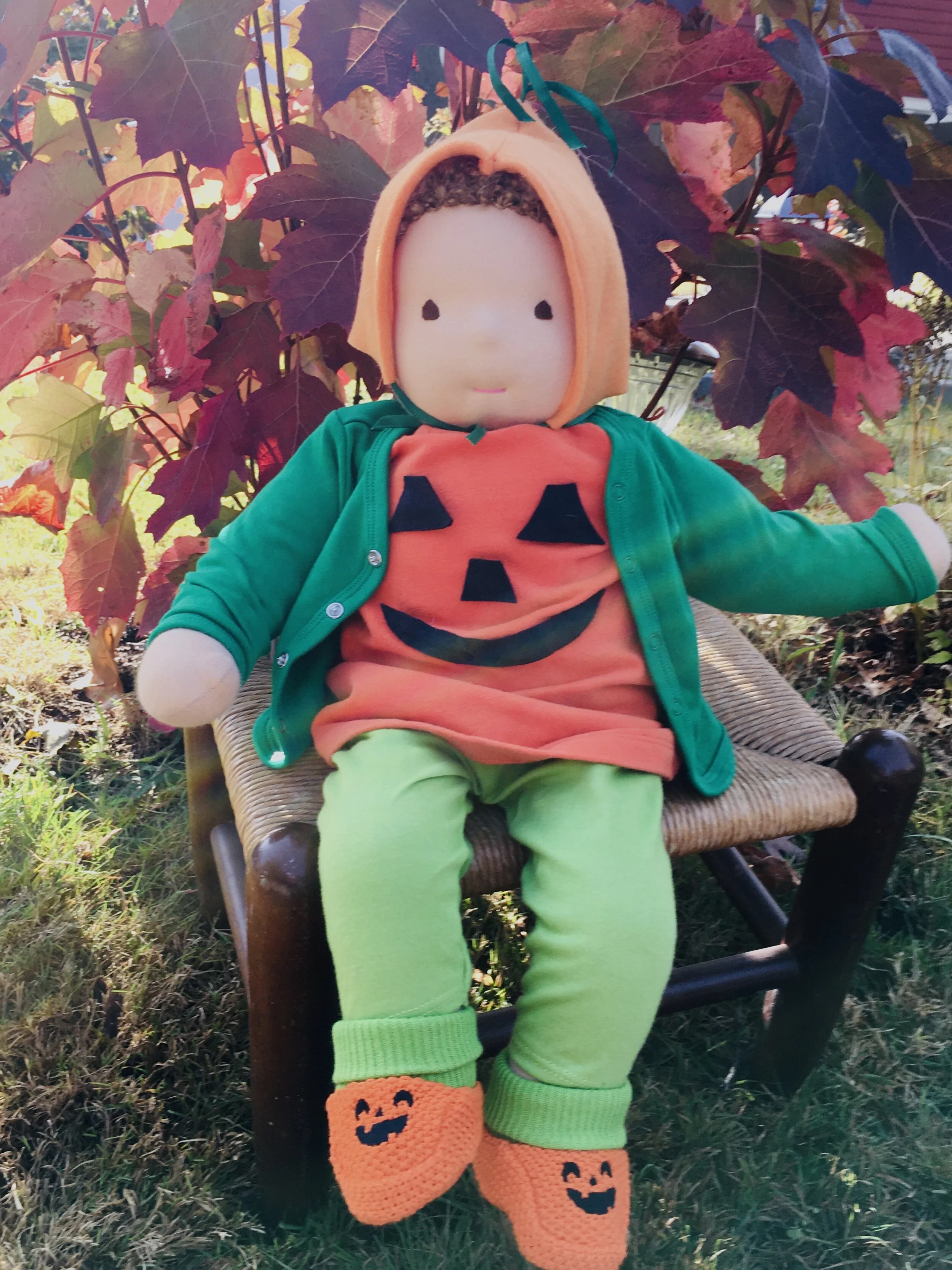
With some scraps from the felt I used for the body of the bats, I made a Jack ‘o Lantern face to put on an orange baby dress for my Bamboletta Big Baby for her Halloween costume. I used a scrap of orange fleece and some ribbon to make her bonnet and the cute booties came from Carter’s. (I found the orange baby dress and green sweater at Primary.com last summer and the lime green leggings came from a thrift store). So Big Baby now has a cute DYI Halloween costume. I can take the felt face off the dress and the green sweater and leggings will be great for St Patrick’s Day too.

Big Baby’s Halloween Pumpkin Costume

Big Baby’s Halloween Pumpkin Costume

So, not quilting much. but still having fun being creative!

Notice: This blog is not monetized: I do not use affiliate links. When there are links in a post, they are to give credit to another creative person, because I like or have used a product, or to help the reader easily find supplies for a project.

TAGS: Modern Textiles Bat Tutorial, Bamboletta Big Big Baby Doll, DYI Pumpking Costume for an Infant


October 10, 2019

About Basting Quilts

by Judy Tucker


Pin Basting a Quilt

Pin Basting a Quilt

Pin Basting a Quilt

Pin Basting a Quilt

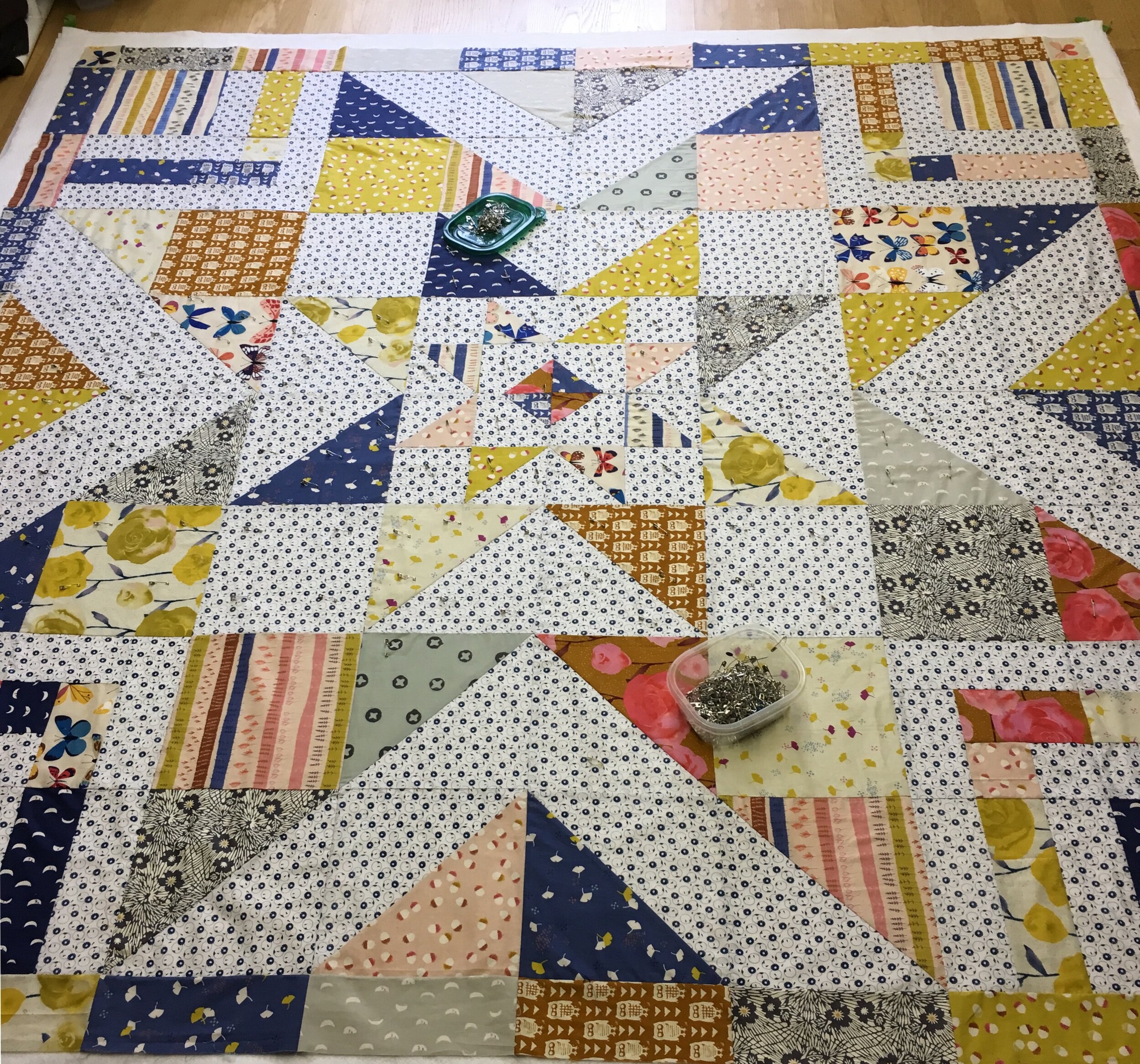
I just layered and pin basted a queen sized quilt. That gave me lots of time to think about all the different ways I’ve basted quilts over the years.

When I started quilting in the 1970s, all my basting was done with needle and thread, using long basting stitches. It was a slow method, but certainly did the job well. My layers stayed together until my hand quilting was done, and I pulled out all the basting threads.

When I started machine quilting, the clerk in the sewing machine store, suggested using a spray on temporary adhesive. I would spray on the adhesive and then pin the layers together. I was never brave enough to rely just on the adhesive without the pins. I found it worked well, but the fabric layers weren’t always a flat as they might have been, especially near the edges of the quilt.

Using an aerosolized flammable adhesive no longer appeals to me for environmental and health reasons. Why spray chemicals on a quilt someone is going to sleep under? Even if it is supposed to be temporary.

These days I put my backing down on the floor, wrong side up, and tape in about 6 to 8 places with painters tape. That gets the bottom layer smooth and flat and keeps it from shifting (at least most of the time). Then I put my batting on top of the backing, smoothing it out until it too lies nice and flat. Then I put on the the pieced top. and smooth that down.

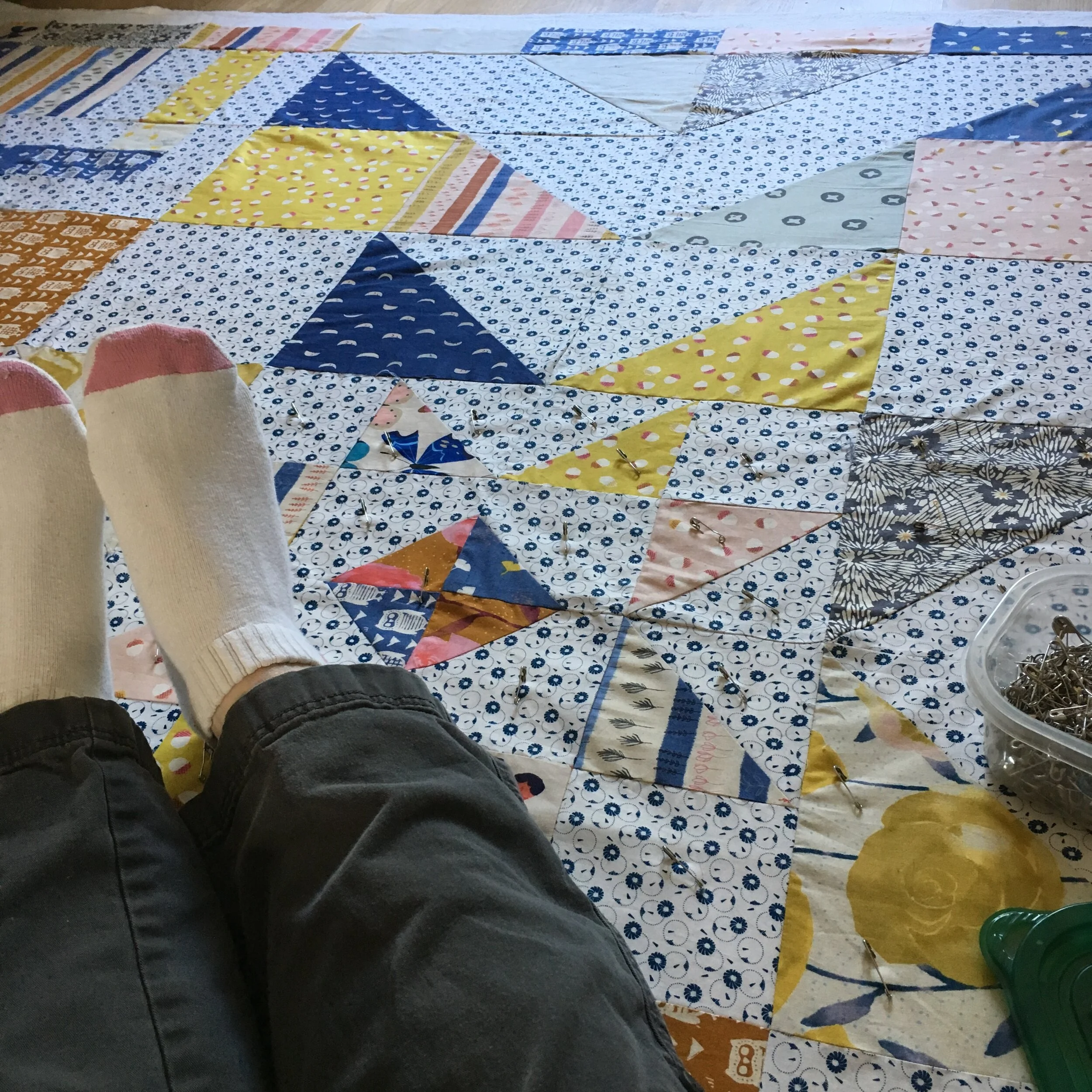
I use 1 inch curved quilting safety pins to baste the quilt. I put in a pin about every 3 inches. The blocks in the quilt I am working on now has 9 inch blocks. Each block has about 5 safety pins in it. I’ve seen other quilters pin their quilts in much smaller intervals, but I’ve never found I needed to put in more than every 3 inches or so.

Once I have the entire quilt pinned, I flip it over to see what the back side looks like. This is my opportunity to smooth out any bumps or ripples. I sometimes find them along the edges of the quilt. This time it all looked great.

As I quilt, I undo the pins and toss them, still open, into the plastic container I used to store them. That way they are all ready for my next project.

If you access to a church hall or a function room with folding banquet tables, two tables pushed together make a great elevated surface for pin basting a quilt. My back doesn’t appreciate it when I lean in to pin the center of the quilt when it’s on a table. So, for now, pin basting on the floor is still my preference.

Here’s my quilt with the borders added to it.

Pin Basting the “Triple Barnstar” Quilt

Pin Basting the “Triple Barnstar” Quilt


TAGS: Basting a Quilt, Pin Basting a Quilt, Basting a Quilt with Curved Safety Pins, Three ways to baste a quilt


October 3, 2019

Pumpkin and Bat Peg Dolls for Halloween

by Judy Tucker


Pumpkin and Bat Pegs

Pumpkin and Bat Pegs

Pumpkin and Bat Pegs

Pumpkin and Bat Pegs

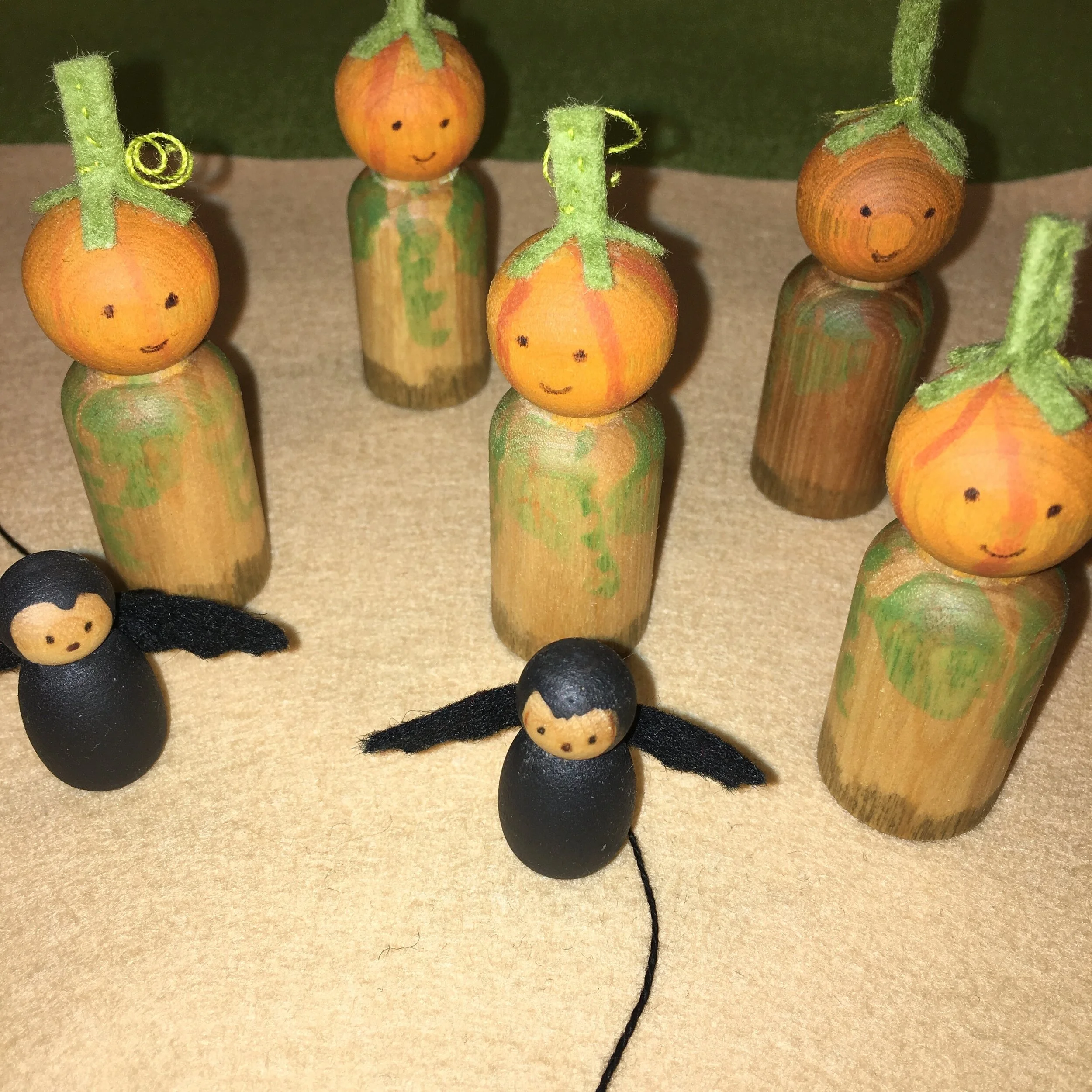
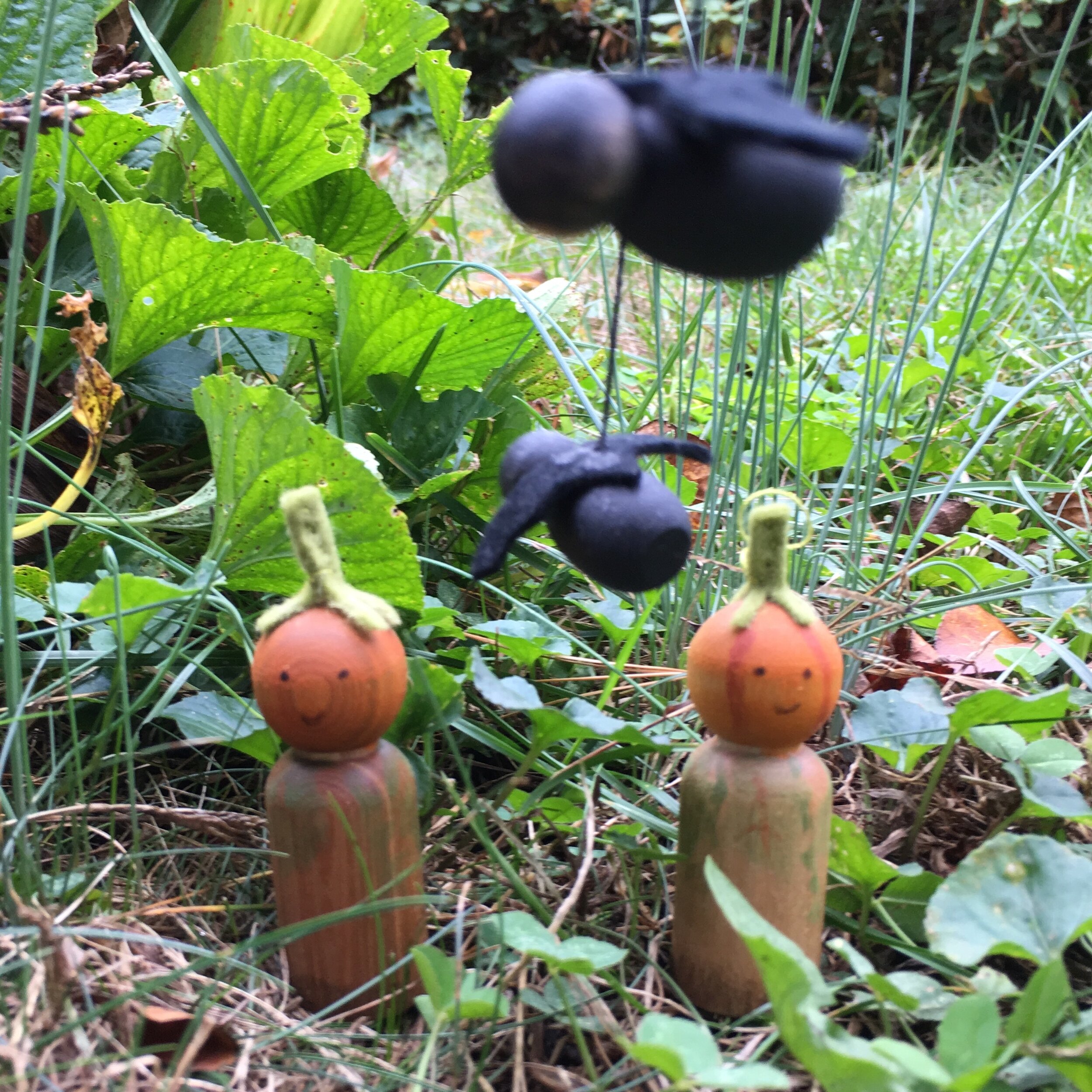
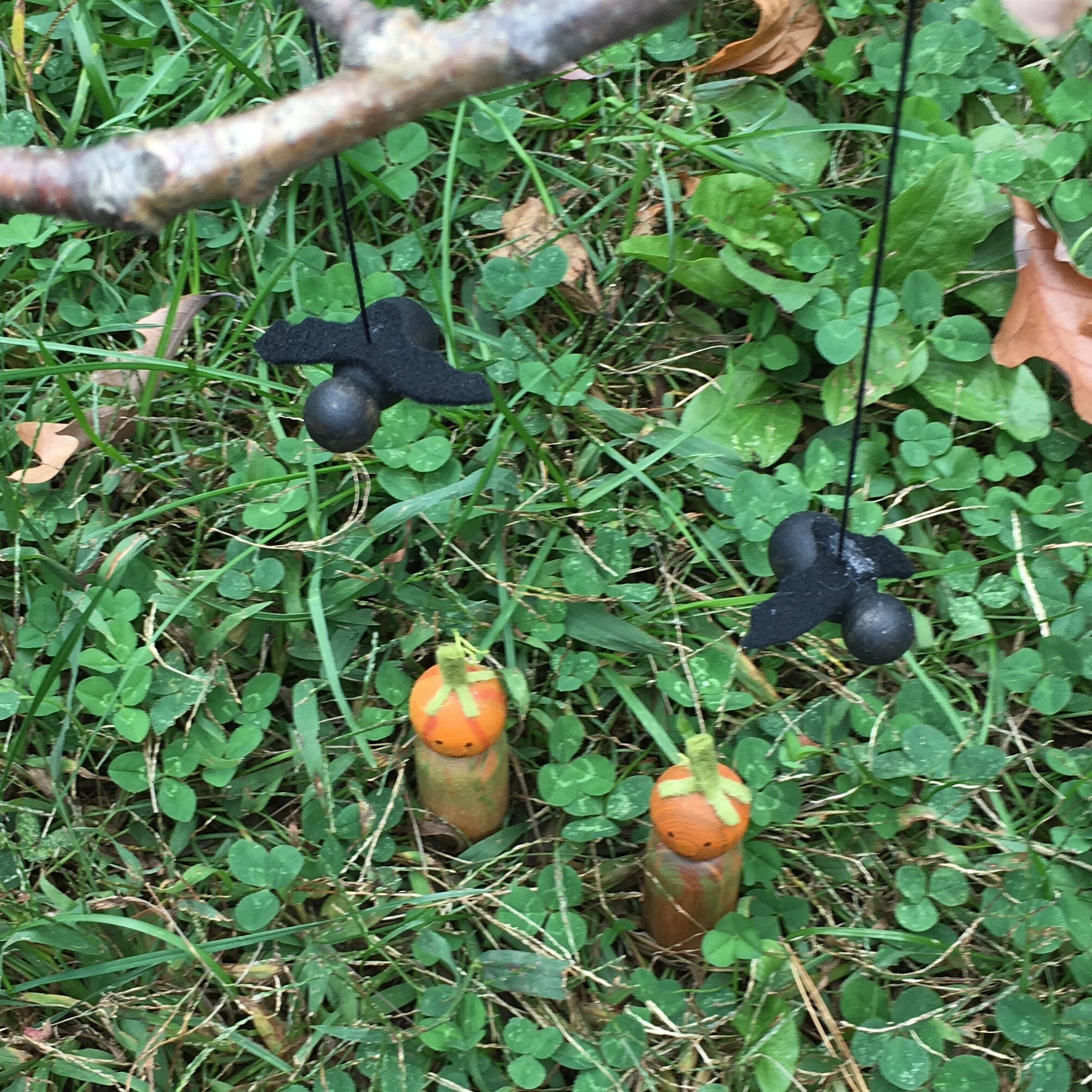
Here are some Halloween pegs. I decided to make a pumpkin patch and a couple of bat friends! Nothing gory here!

I thought about making scarecrows with pumpkin heads but decided that was a bit too creepy for my taste. Then I thought about pumpkins on fence posts or stone pillars. When I sat down to make them, I decided they should just be pumpkins in their own bit of pumpkin patch! I used standard size pegs, 2 3/8 inches tall. I painted pumpkin leaves and curly cues and a bit of dirt at the base and then painted the head as a pumpkin. The stem is narrow piece of felt, folded in half and stitched. The peg end of the stem is cut into 4 tiny strips which are glued to the head.

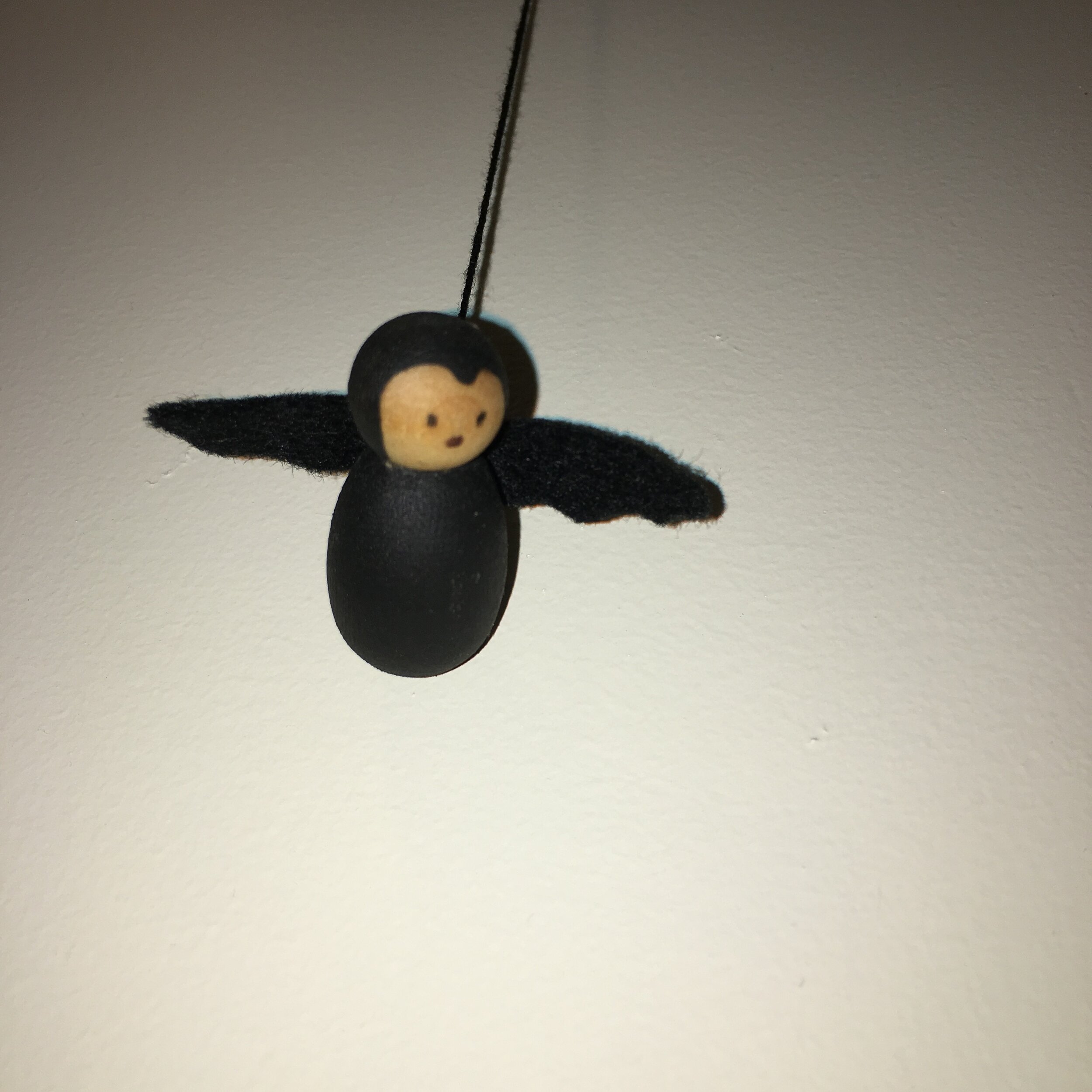
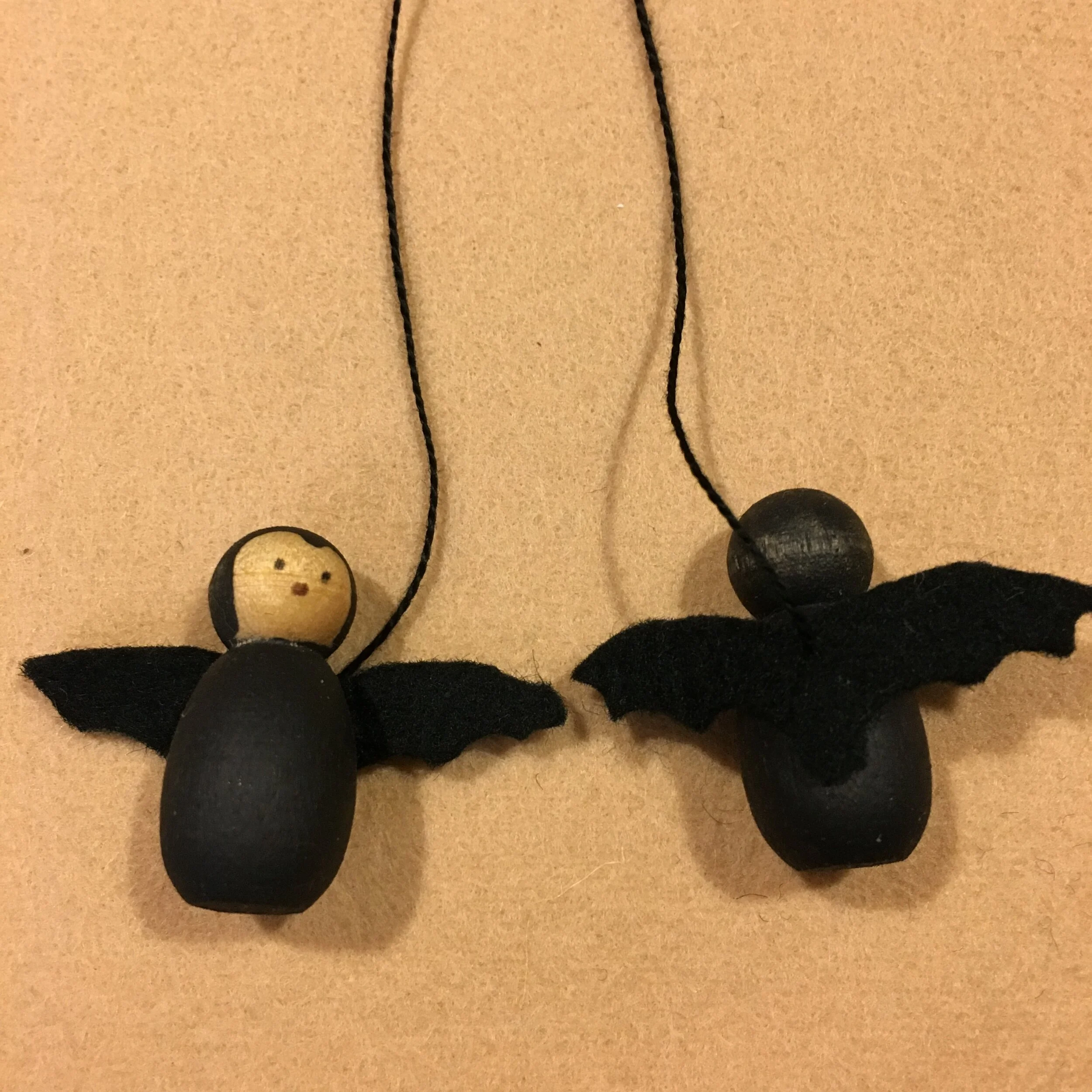
The bats are tiny “bee” pegs at 1 3/8 inches. I adapted the bats from the design on Margaret Bloom’s October 18, 2014 blog post “A Little Batty: A Tutorial” . Click on the link for instructions for making bat pegs. Bee pegs are tiny so I chose not to put ears on my bats. I decided to run a piece of black perle cotton through the middle of the wings before I glued the wings to the peg. This lets the bat fly or hang from a hook.

Flying bat peg

Flying bat peg

Bat Pegs

Bat Pegs

fullsizeoutput_16af.jpeg
fullsizeoutput_16b0.jpeg

What Halloween pegs are you planning to make this year?

Safety note: The pumpkin pegs are not for children under age three due to small parts. I would suggest not giving the bat pegs to a child under age 5 years due to their tiny size.

TAGS: Bat Peg Doll, Pumpkin Peg Doll, Halloween peg dolls, Peg Dolls


September 26, 2019

"Triple Barnstar" Quilt top, a Work-in-Progress

by Judy Tucker


“Triple Barnstar” Queen size quilt top, work in progress

“Triple Barnstar” Queen size quilt top, work in progress

“Triple Barnstar” Queen size quilt top, work in progress

“Triple Barnstar” Queen size quilt top, work in progress

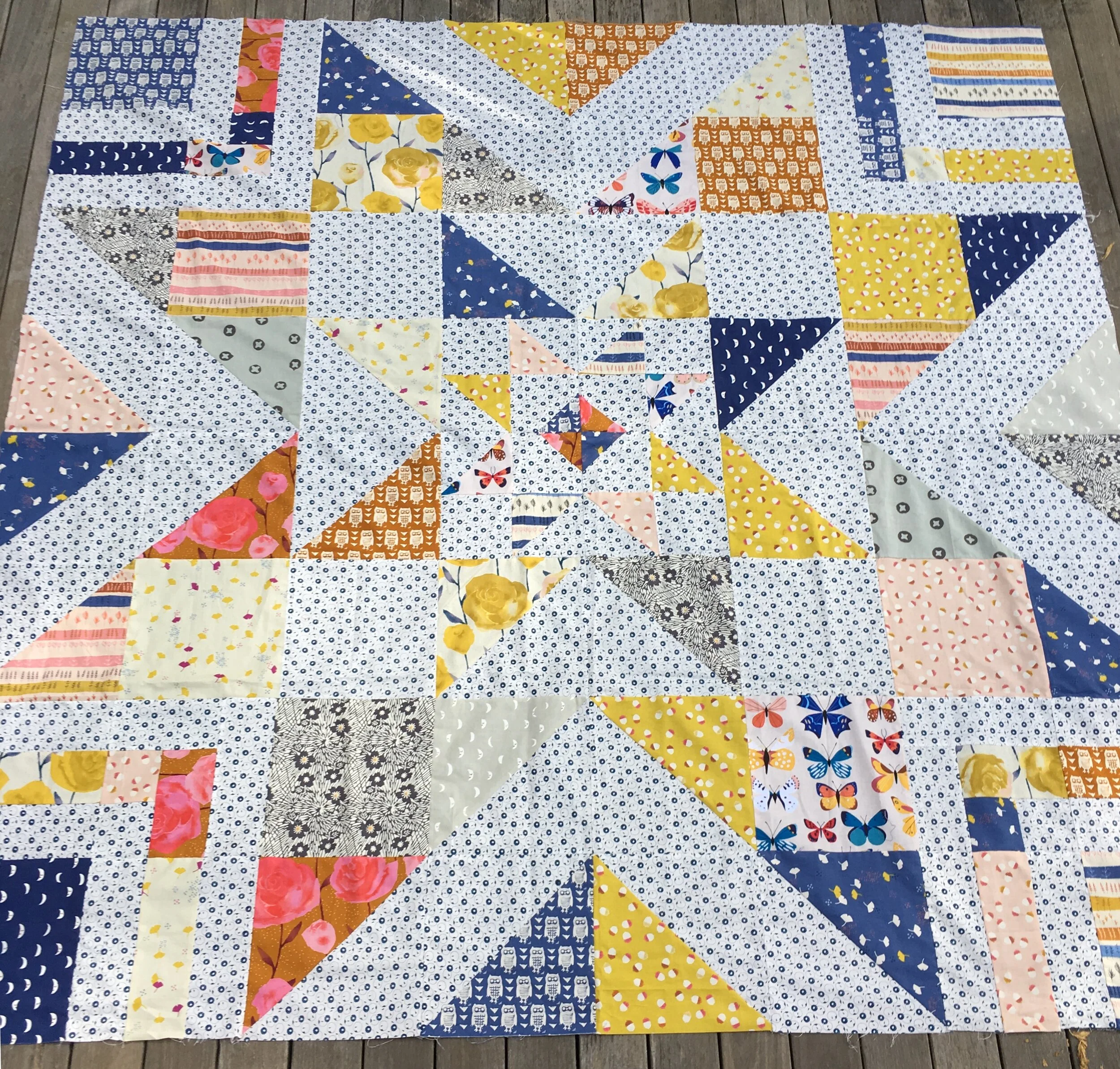
Here’s the quilt top I’m working on. It is a pattern by Amy Gibson of Stitchery Dickory Dock and called “Triple Barnstar”. (Look carefully and you’ll see that there is a star, in a star in a star). I think this is going to become the quilt I use during the Fall.

The pattern is for a throw or a queen size quilt. I started to make the throw but discovered it really covered the top of my bed, so I’m going to add on a scrappy border of the feature fabrics I have left over and call it a queen.

Despite the fact that I’ve been working on this quilt on and off all summer, it really does come together quickly. I like this quilt but it really doesn’t show off the star design very well.

If I make it again, I think it would be fun to use bold solid colored fabrics. One color for each star, and another for the designs between the star points of the largest star and the center square. While white or off-white would be the obvious choice for the background of that quilt, I think using that a low volume print as I did uin this quilt, would be fun.

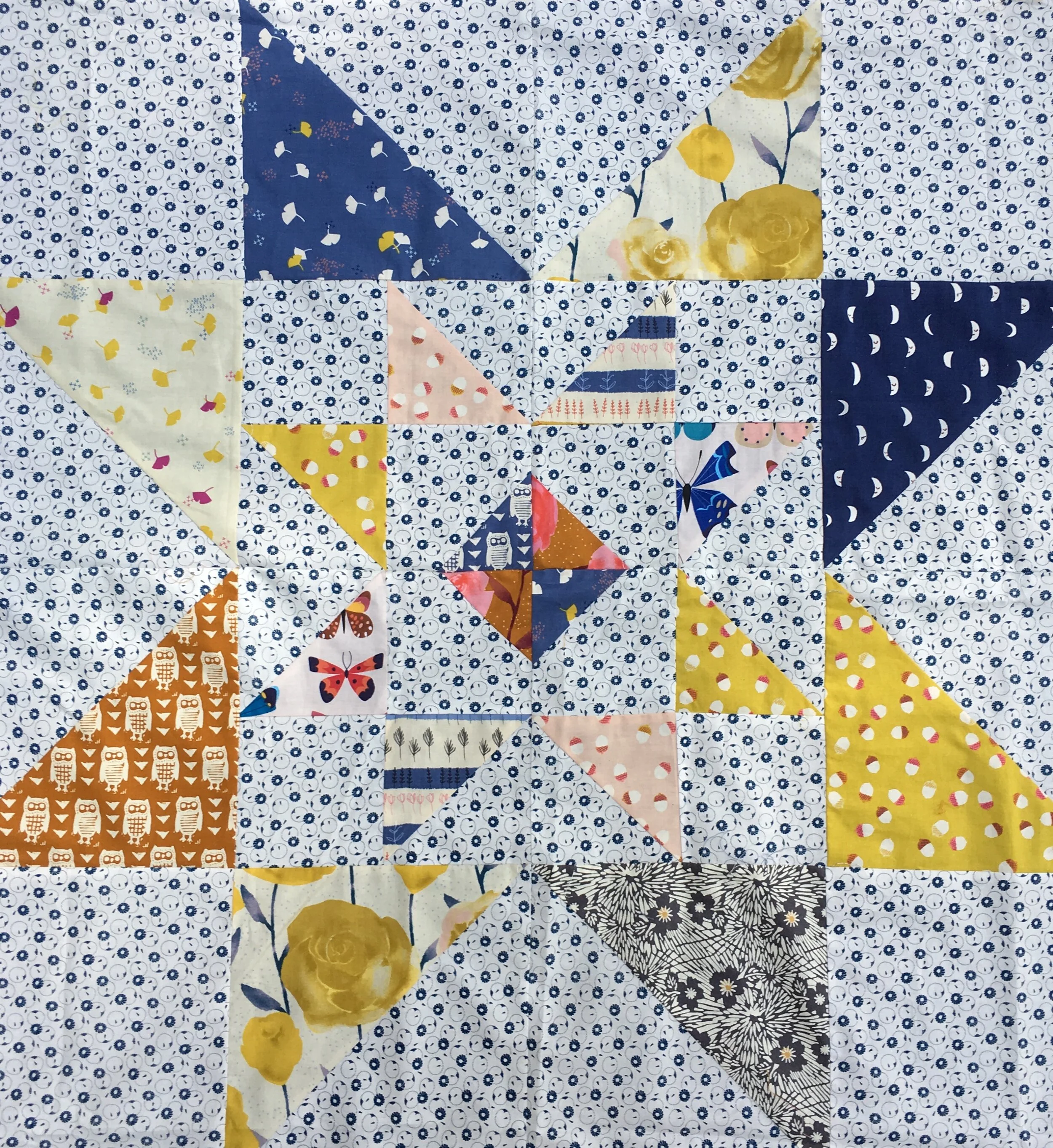
Here is a photo of the two inner stars and center square so you can see more of the detail in the fabrics.

TripleBarnstarInnerTwoStars.jpg

I’m off to go sew on the outer borders! This is a big quilt, so it will be a while before it’s done!

TAGS: "Triple Barnstar" Quilt Top by Amy Gibson, Amy Gibson, low volume fabrics


September 12, 2019

Lunar Felt Playscape with Peg Doll Astronauts

by Judy Tucker


Felt lunar playscape with standard peg doll astronauts

Felt lunar playscape with standard peg doll astronauts

Felt lunar playscape with standard peg doll astronauts

Felt lunar playscape with standard peg doll astronauts

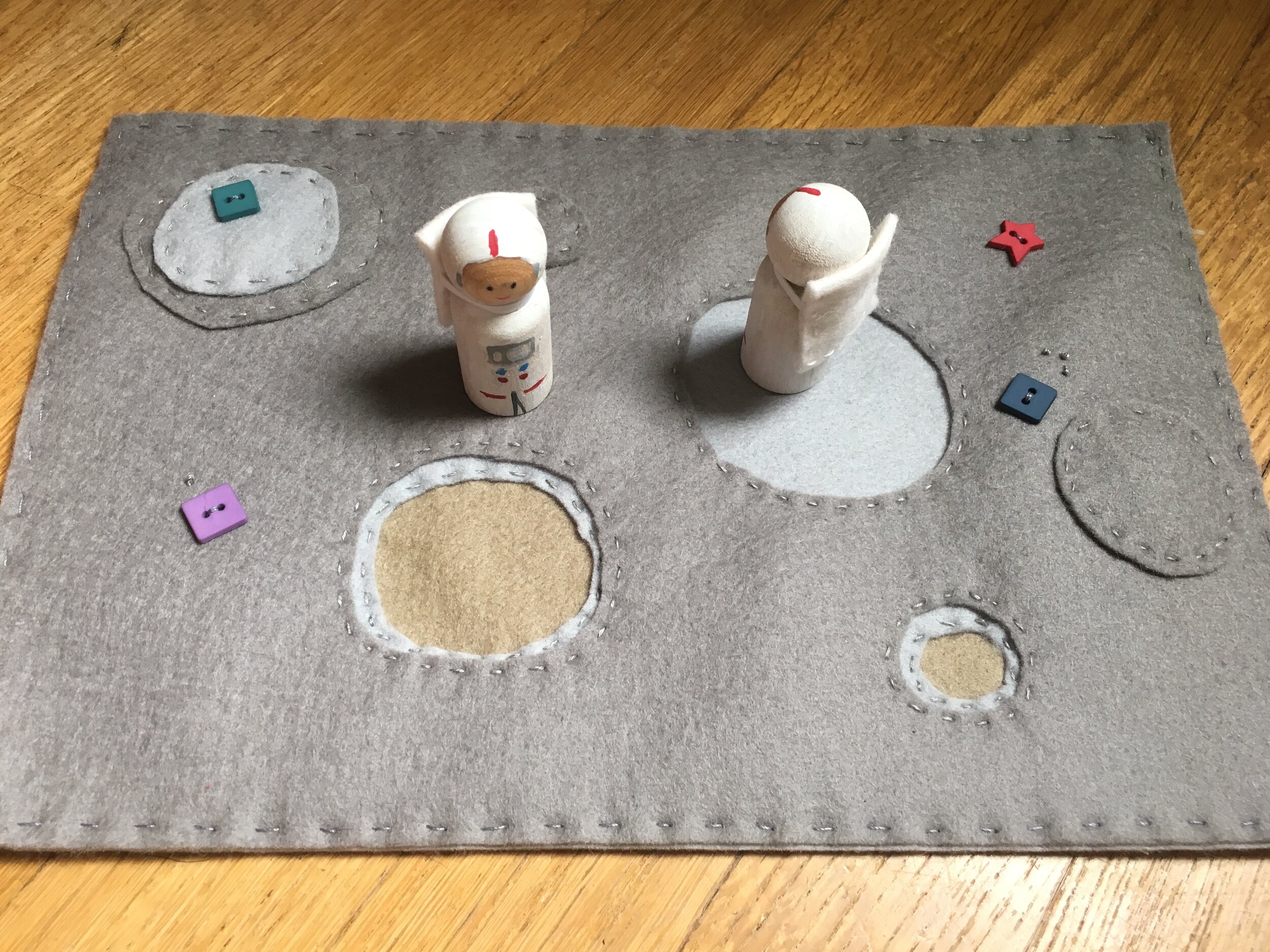
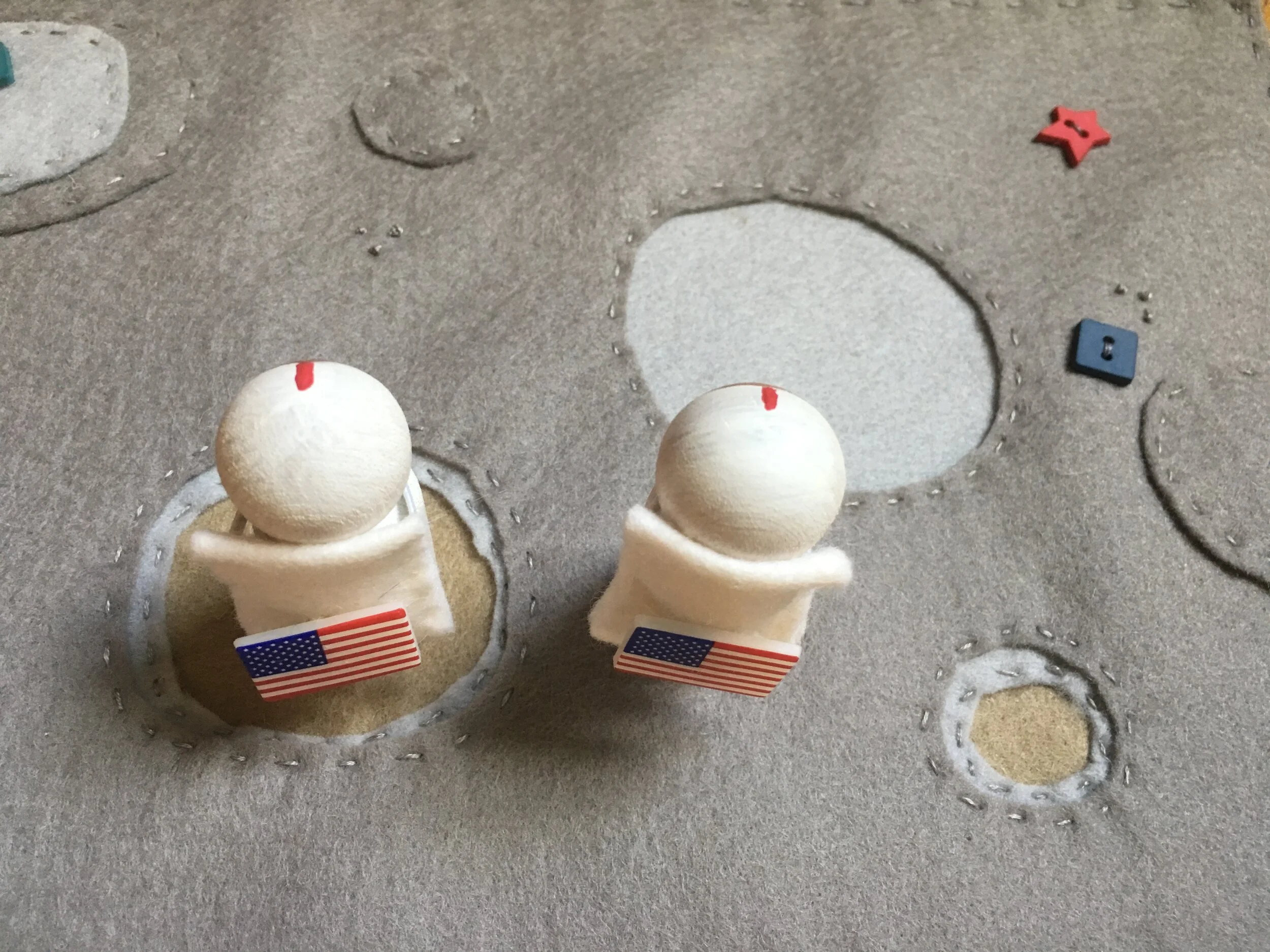
After making the felt meadow and brook playscape, I decided to make a lunar playscape with a couple of peg doll astronauts. Last week I sewed features on top of the base. This week I layered 3 sheets of wool felt and did cut-outs to the 2nd light grey layer and the 3rd light brown layer. Then I sewed the cut out felt scrapes to the top layer to create rocks and hills in the landscape.

This is a very grey landscape! I sewed on a few “mineral rock” buttons and a little bit of space “junk” (the red star) that must have fallen off the rocket!

It was so much fun making the peg dolls. I used the standard size pegs. I picked Apollo era type suits and made felt life packs. The life pack is held on the doll by a 1/4 inch white elastic around the neck.

Astronaut without the life pack on the left and the one on the right wearing it.

Astronaut without the life pack on the left and the one on the right wearing it.

After I had everything made, I found the tiny American flag buttons at a craft store. So I added those to the life packs.

Life Packs with the flag buttons

Life Packs with the flag buttons

I have a wood rocket ship I found on Etsy.com (which hasn’t arrived yet) to add to the set. The seven year old who will be the recipient lives near the ocean so I am going to suggest that he add some beach rocks for added interest.

Next week….maybe I’ll have be a quilt top to share. There is one nearly complete.


TAGS: Felt Lunar Playscape, Felt Playscape, Astronaut peg dolls, Imaginative play


September 5, 2019

Making a Felt Playscape

by Judy Tucker


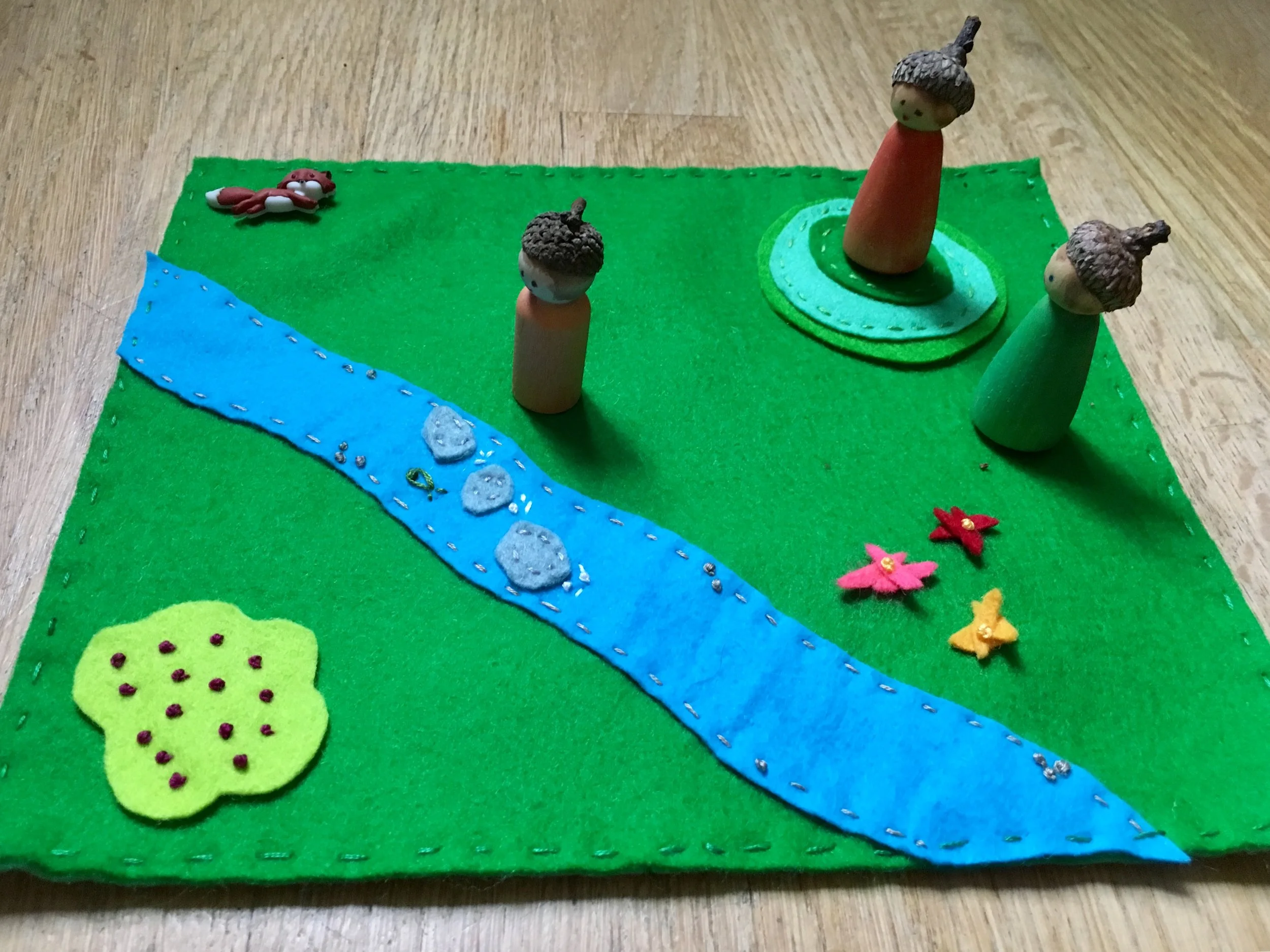
Felt Playscape, 9 x 8 inches

Felt Playscape, 9 x 8 inches

Felt Playscape, 9 x 8 inches

Felt Playscape, 9 x 8 inches

A photo of a felt playscape of a beach popped up on my Instagram feed this weekend. Wow. What a fun idea. It turns out there are lots of playscapes available on Etsy.com. (I actually purchased one that was amazing). But it’s really fun to make one with exactly the features you want.

I have a stash of wool felt but the greens and blues all had “nibbles” taken out of them from making peg doll outfits. Standard 8 x 12 inch felt rectangles would be ideal but I could only cobble together enough 8 x 9 inch pieces, so that’s how big mine I made it.

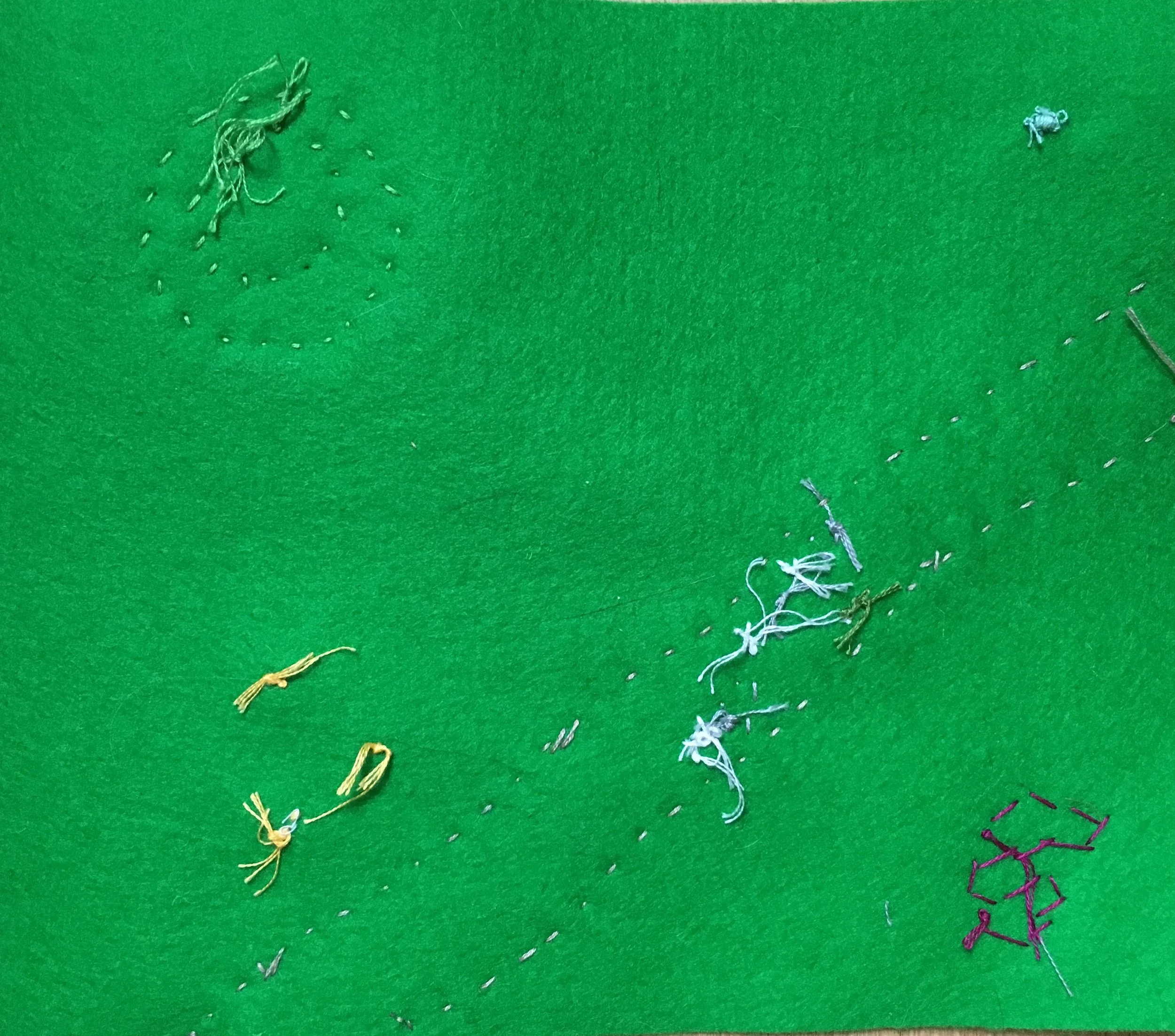
You need two pieces the same size for the base. I sewed the felt landscape components on with 3 strands of embroidery thread, using a running stitch and French knots. That left a lot of knots and loose threads on the back. So the 2nd piece of felt covers all that up and makes the playscape sturdier.

Back of the playscape base showing the stitching

Back of the playscape base showing the stitching

Here are my landscape components:

  • a hill, made by using 3 different size circles. The bottom two circles can be placed one on top of the other and sewn to the base together. Then the third circle is sewn on top of them.

  • a brook, with 3 stepping stones.

  • flowers made with scraps. Cute, but I think not sturdy enough to hold up to play. Next time I’ll just cut wavy circles and fasten them with French knots.

  • a trout, hiding near the stones in the brook

  • a blackberry bush

  • a fox that’s a button. The button has a loop on the back, so I cut a tiny slit with a craft knife and pushed the loop through and fastened it on the wrong side of the base. Safety note: do not use buttons if the playscape is for a child under 3 years old.

The dolls on the mat are 2 angel pegs and one boy peg that I made.

This is a great project for a child who has some basic hand sewing skills. And it also has STEAM potential for homeschoolers. Using my design a child can explore these topics:

  • Landscape design

  • Topographical maps

  • Foraging for berries (there are wild blackberries and wild blueberries near my house)

  • Fluid dynamics—I attempted to make eddies around the rocks in the stream and the fish is in a quiet space behind one of he rocks

  • Art—use of color, sewing as decoration

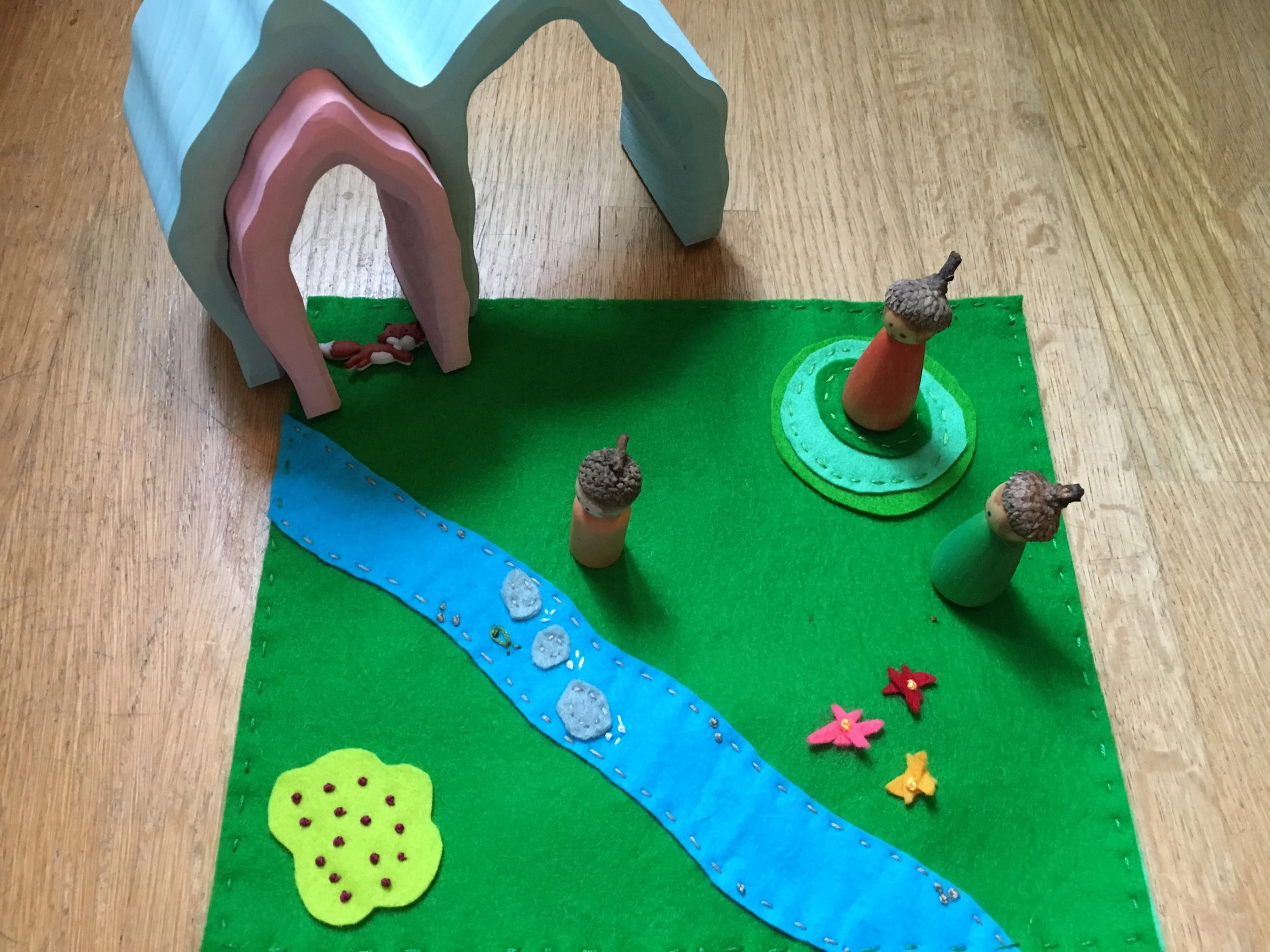
Adding other components makes the playscape even more exciting.

Playscape with 2 wooden arches from a Grimm Blue Grotto puzzle

Playscape with 2 wooden arches from a Grimm Blue Grotto puzzle

When designing felt playscapes, the sky’s really the limit. In fact, I’m planning to design a moonscape for my next one!


TAGS: Felt Playscape, Playscape, Making a felt playscape, Peg Dolls, STEAM project, Meadow Playscape, Meadow with a brook and hill playscape


August 22, 2019

Tutorial: Peg Doll Mermaid

by Judy Tucker in Tutorial


Peg Doll Mermaids

Peg Doll Mermaids

Peg Doll Mermaids

Peg Doll Mermaids

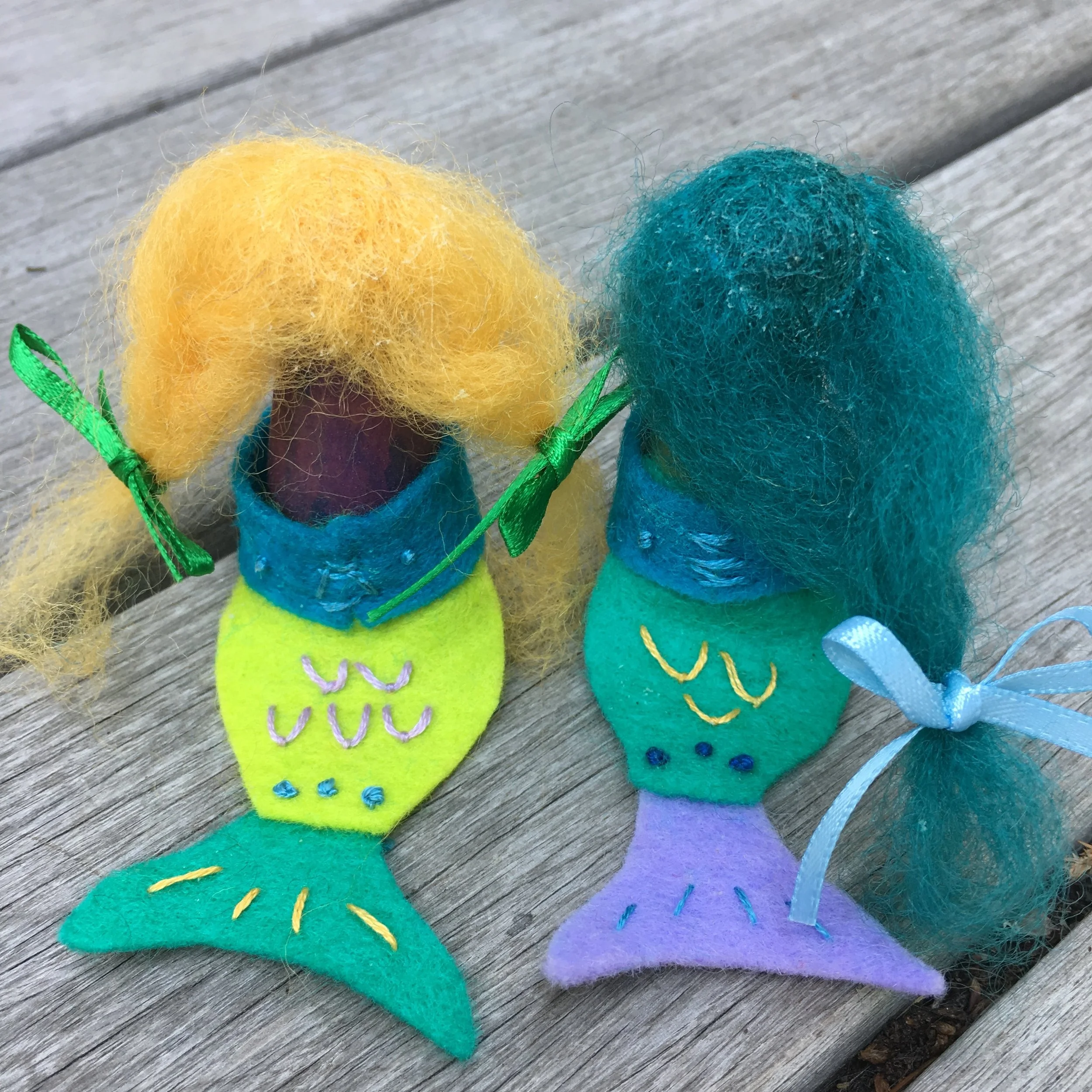
Before summer slips into autumn, I thought it would be fun to design a peg doll mermaid. I used angel/girl 2 inch tall pegs dolls. I painted them with Lyra opaque watercolors. I’m finding it’s great to layer several colors while the paint is still wet, so that the colors run together.

Their tails are attached to the body of the doll with a 1/2 inch band. This band can be glued to the doll, or left loose, allowing the tail to be removed.

NOTE: Because of the small size of the this peg doll, this mermaid is only for children age 3 and older.

PegDollMermaidsFrontView.jpg

One of my mermaids is going to a school age child so I’ve chosen not to glue on the tail. The mermaid told me that sometimes, especially on Thursday, she likes to step out of her tail and hitchhike to school in a child’s pocket!! She’s very interested in geography!

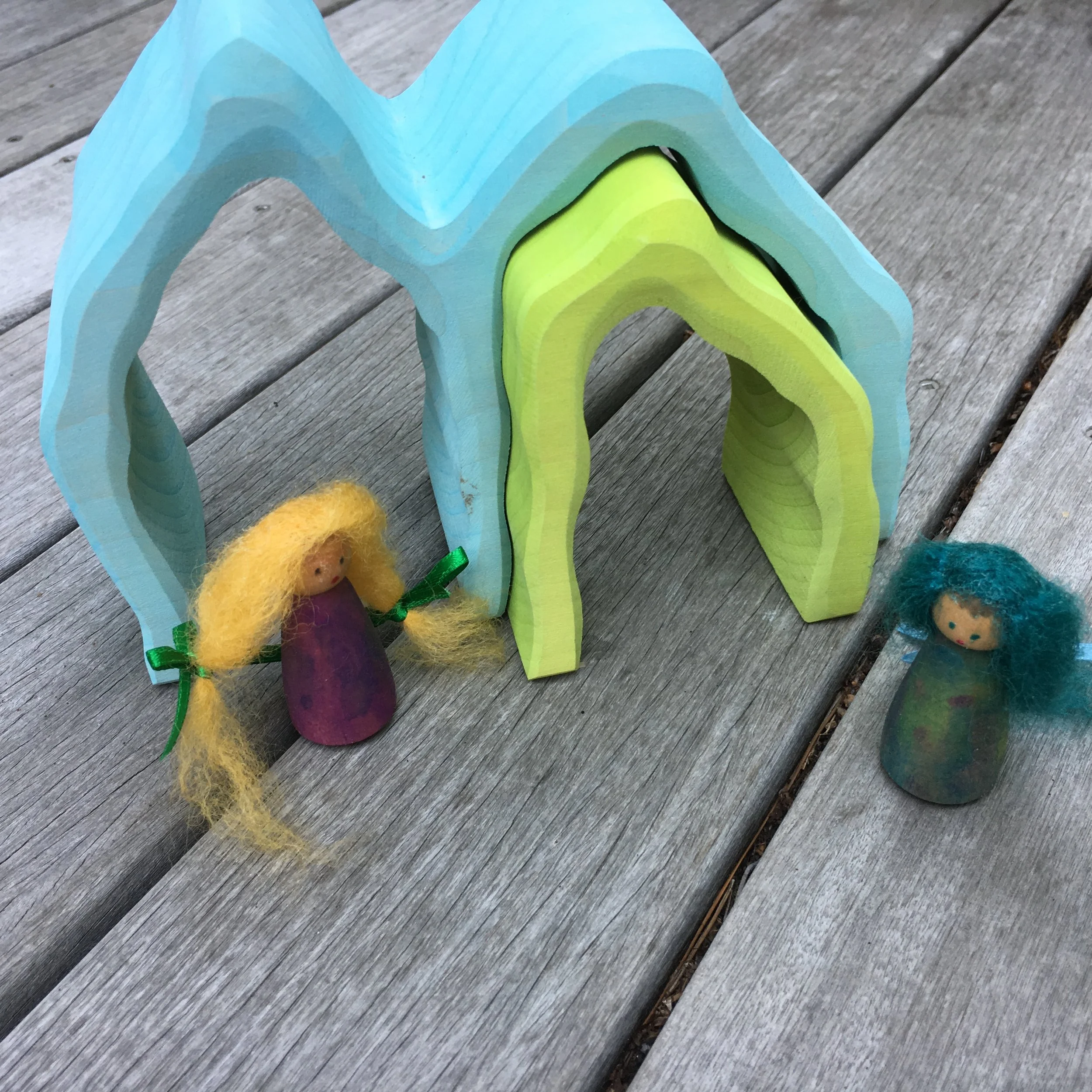
The mermaids without their tails, waiting for a ride to school, in front of two arches of a Grimm’s Playful Blue Grotto puzzle toy.

The mermaids without their tails, waiting for a ride to school, in front of two arches of a Grimm’s Playful Blue Grotto puzzle toy.

Instructions To Make a Peg Doll Mermaid

Supplies

  • 2 inch Angel/Girl/Women Wood Peg Dolls

  • Watercolor paints

  • Beeswax polish

  • Fine tip markers

  • Wool Felt

  • Embroidery thread

  • Wool roving and 1/8 inch ribbon if you want to add hair to the mermaid, felting needle and foam felting mat

  • Craft glue if desired

Instructions

  • Paint the peg doll and hair. Leave the face blank.

  • When the paint has tried, polish with beeswax polish. Allow to sit for an hour. Rub with a soft cloth (an old cotton sock is perfect) to remove the excess polish and give a mermaid a slight shine.

  • Using fine tip markers, give the mermaid eyes and a mouth.

  • Print the MERMAID PEG DOLL PDF pattern at 100% on your printer. Make sure the 1 inch gauge on your printed pattern measures 1 inch. Cut out the felt for the mermaid’s tail, fin and body band.

  • Embroider them as desired. I used french knots and an open daisy stitch

  • Sew the fin onto the tail. Then attach the tail to the body band, bringing the 2 ends of the body band to meet over the tail. Pin. Sew with simple over lapping stitches or a decorative design with embroidery thread.

  • Slip the band over the mermaid’s head and bring it down to where the tail can lie flat behind the mermaid. Blue to body if desired.

  • If adding roving for hair, pull off a piece of roving the desired length. At the center of the length of roving, gently felt a small section with the felting needle over the foam felting pad just until the strands of wool come together. Apply craft glue the felted section of the roving and glue it to the the mermaid’s head. Add a bow of 1/8 inch ribbon if desired.

Time to go to the beach! (Or to school, hidden in a pocket)!

Here’s a mermaid with painted hair,. I think she is every bit as sweet as the mermaids with roving hair. And probably better for 3-5 year children.

Here’s a mermaid with painted hair,. I think she is every bit as sweet as the mermaids with roving hair. And probably better for 3-5 year children.

TAGS: Mermaid Peg Doll, Mermaid Peg Doll with Removable Tail, Peg Dolls, Mermaid Peg Doll Tutorial


August 15, 2019

Tutorial: Bamboletta Baby Doll Dress with FREE pattern

by Judy Tucker in Tutorial


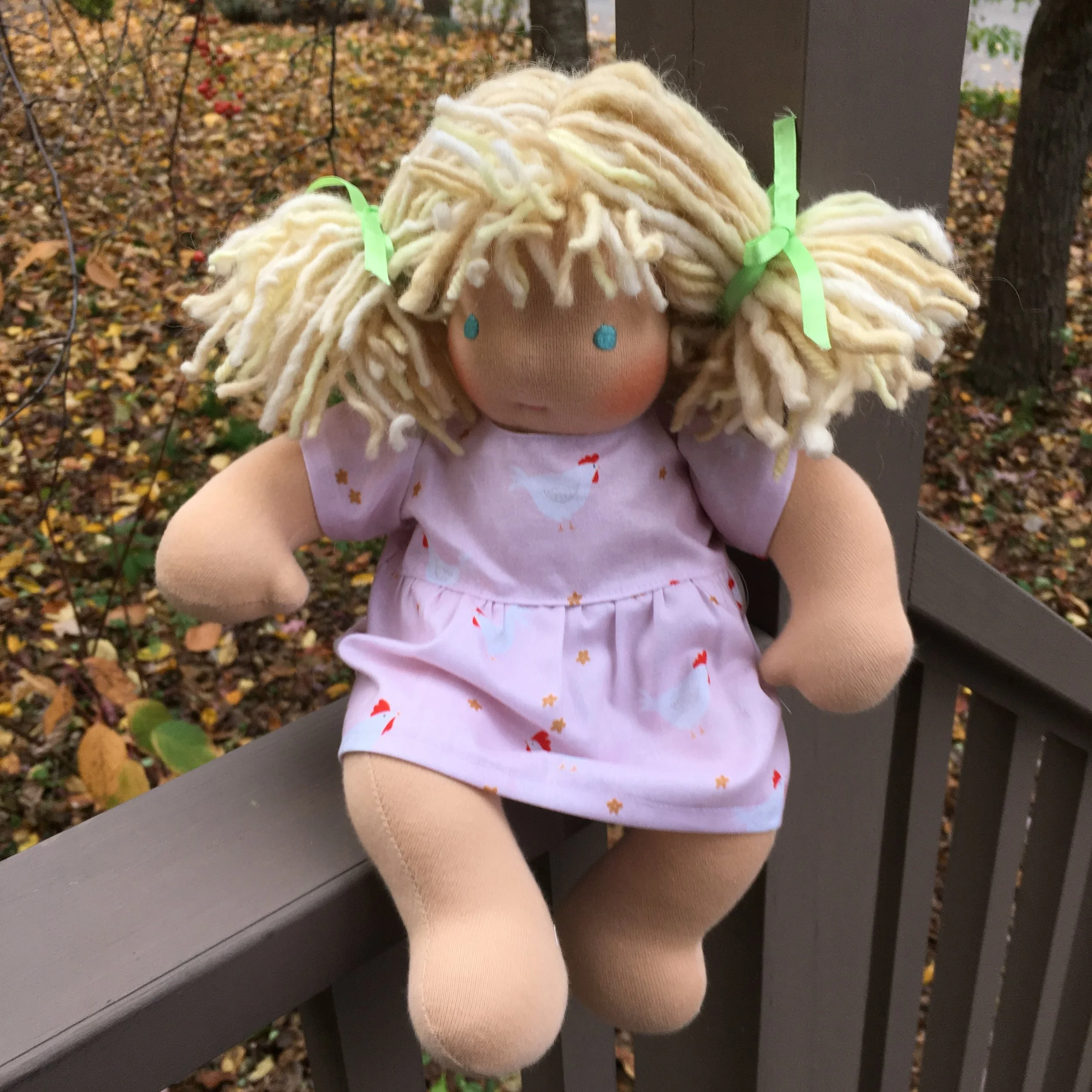
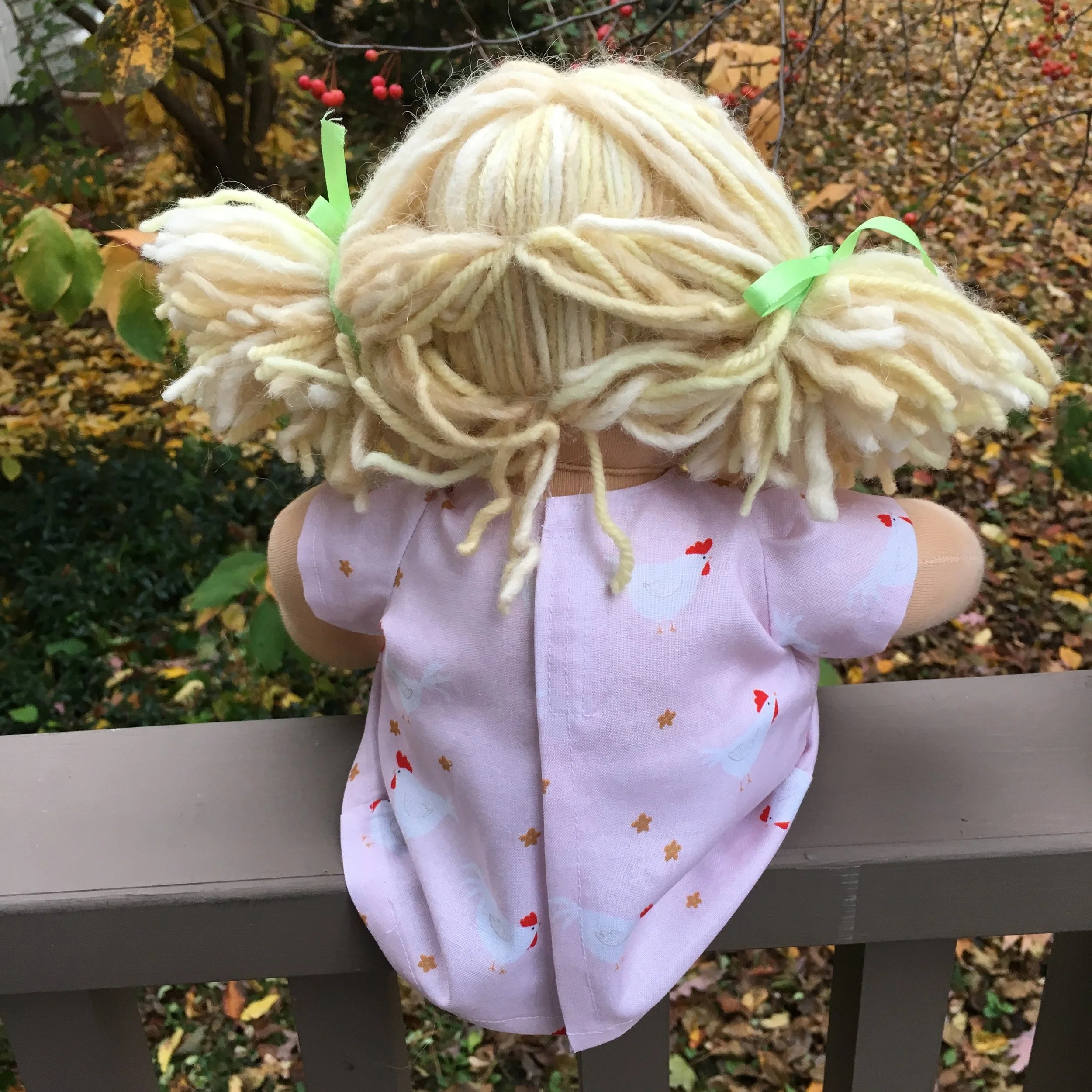
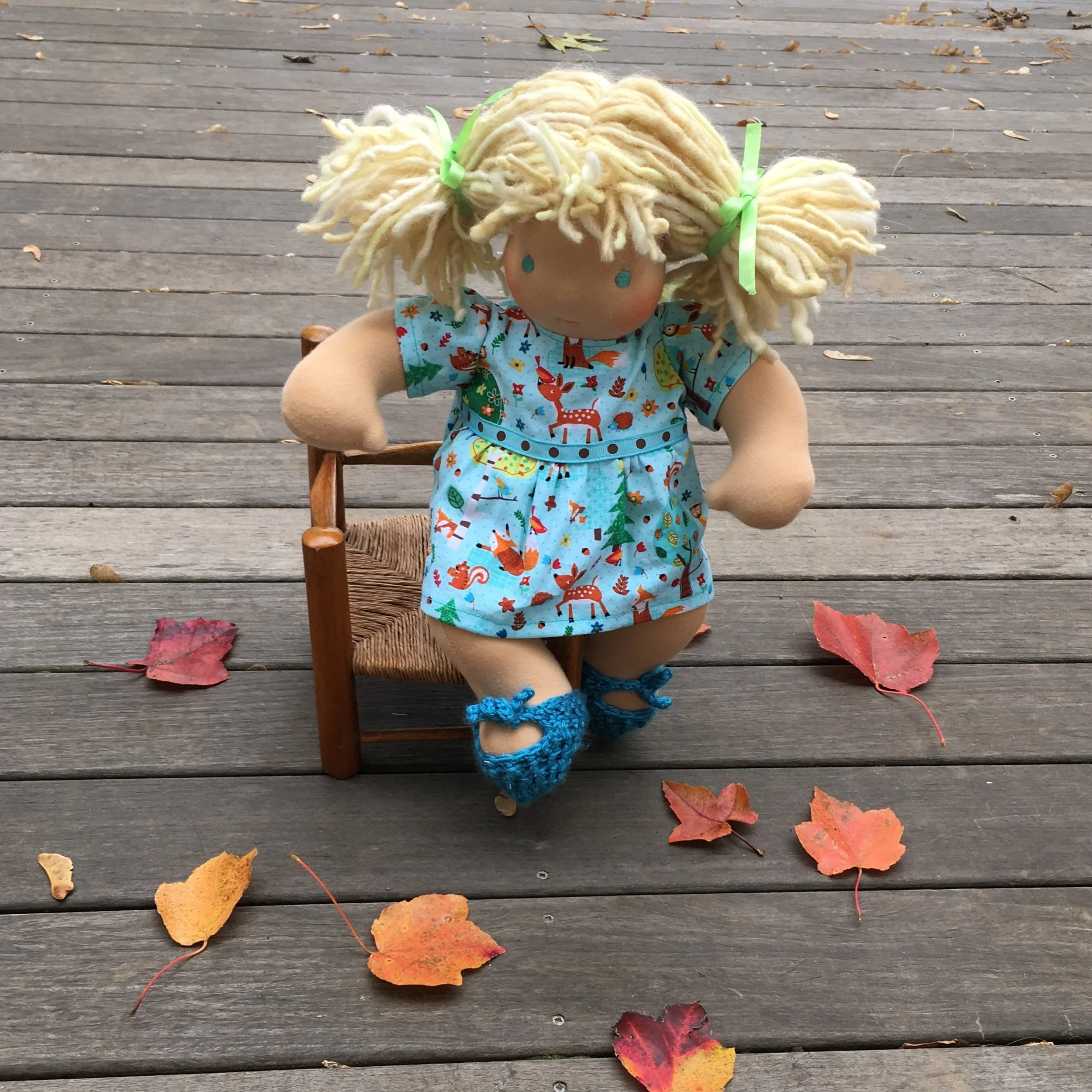
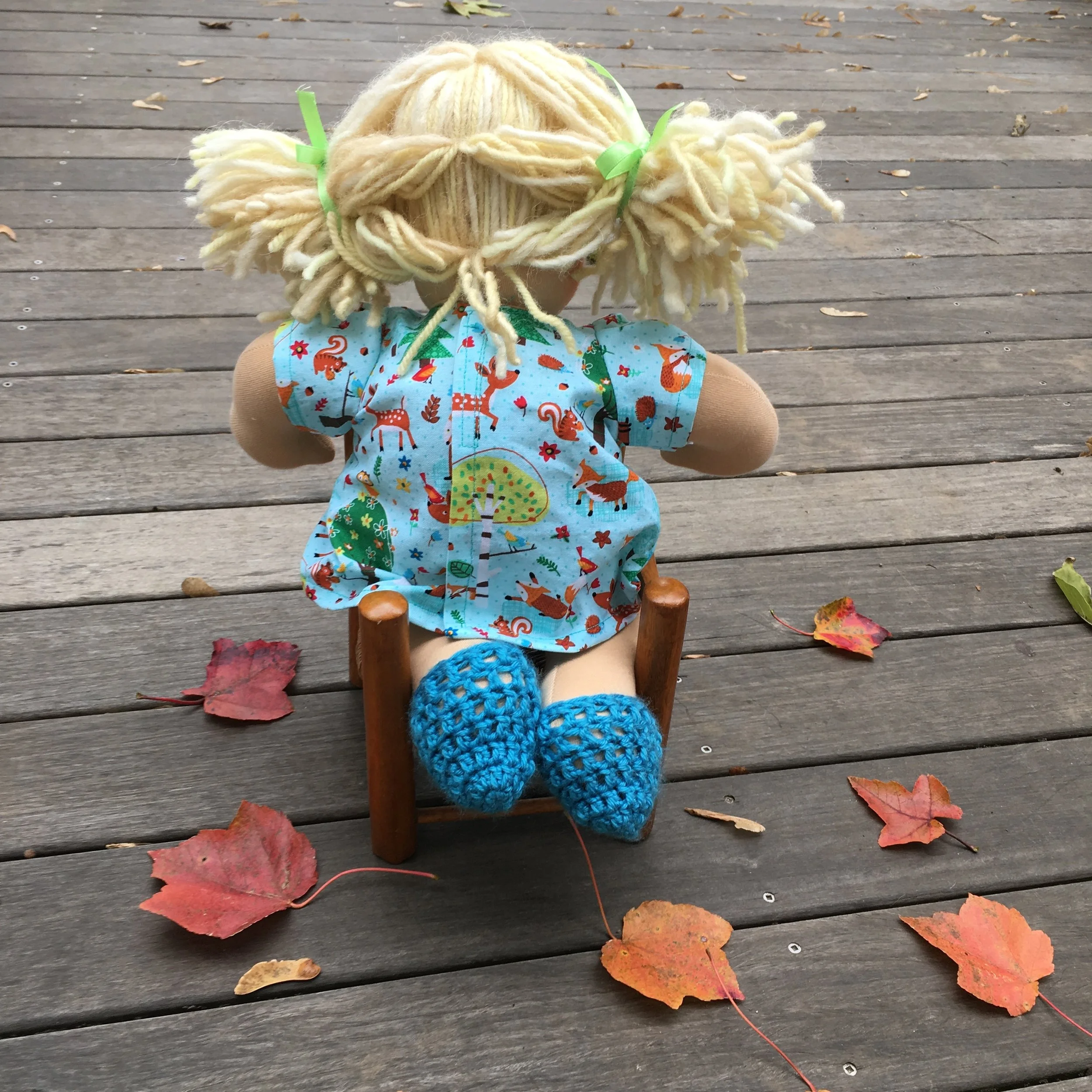
Bamboletta Baby Doll Lily, modeling her chicken dress

Bamboletta Baby Doll Lily, modeling her chicken dress

Bamboletta Baby Doll Lily, modeling her chicken dress

Bamboletta Baby Doll Lily, modeling her chicken dress

This is a tutorial to make a dress for a 12-13 inch Bamboletta Baby Doll. Bamboletta sells Cuddle Doll dresses which often fit their baby doll. But sometimes it’s a pretty tight squeeze! This dress pattern allows for a bit more wiggle room and may make it easier for a young child to dress the baby doll.

Bamboletta Baby Doll Dress Pattern

Supplies:

— 1/2 yard of woven cotton fabric. Quilting weight cotton is perfect.

— Thread to match the fabric

— 3/4 inch sew-on hook and loop tape.

— Sewing scissors and paper scissors

— Sewing pins

— Sewing machine.

— Iron and a surface to iron on

The dress is longer in the back than the front to allow for the baby’s ample bottom! The dress’s hem should look straight once on the doll.

Directions:

ALL seams are 1/4 inch.

1. PRINT the PDF pattern pieces at 100%. Once the pages are printed check the to be sure the one inch gauges on the pattern measure 1 inch.

2. Cut out the pattern pieces with paper scissors.

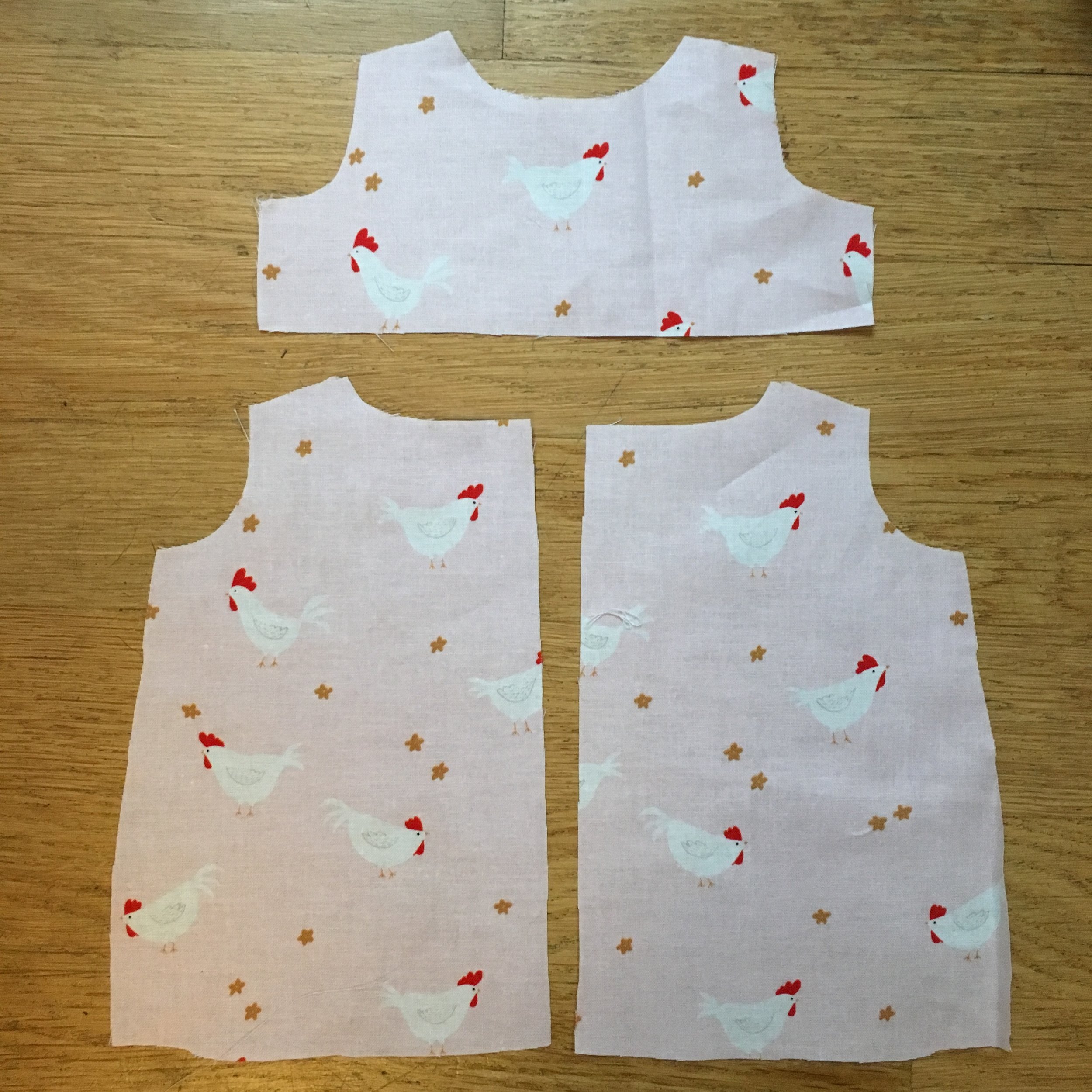
3. Pin the pattern to the fabric, making sure the long arrows on the pattern pieces are parallel with the fabric’s grain. (That’s the same as the selvedge edges). If your fabric has an interesting pattern, try to cut the bodice so that a focal point of the fabric is located at the middle of the pattern piece. Make sure that the feature you want it is at least 1/2 inch away from both the neck edge and the seam at the bottom of the bodice pattern piece. For example. Your fabric may have a cute rabbit. Position the pattern piece so that the rabbit is centered.

Note: Make sure you have enough fabric for all the other pattern pieces before you fussy cut the bodice piece.

Bodice and back pattern pieces. Note that the chicken is centered on the bodice.

Bodice and back pattern pieces. Note that the chicken is centered on the bodice.

4. Finish the raw edges of the neck on the bodice and back pieces with a zig-zag stitch or an overlock stitch if your sewing machine has one.

This is the overcast stitch on my sewing machine

This is the overcast stitch on my sewing machine

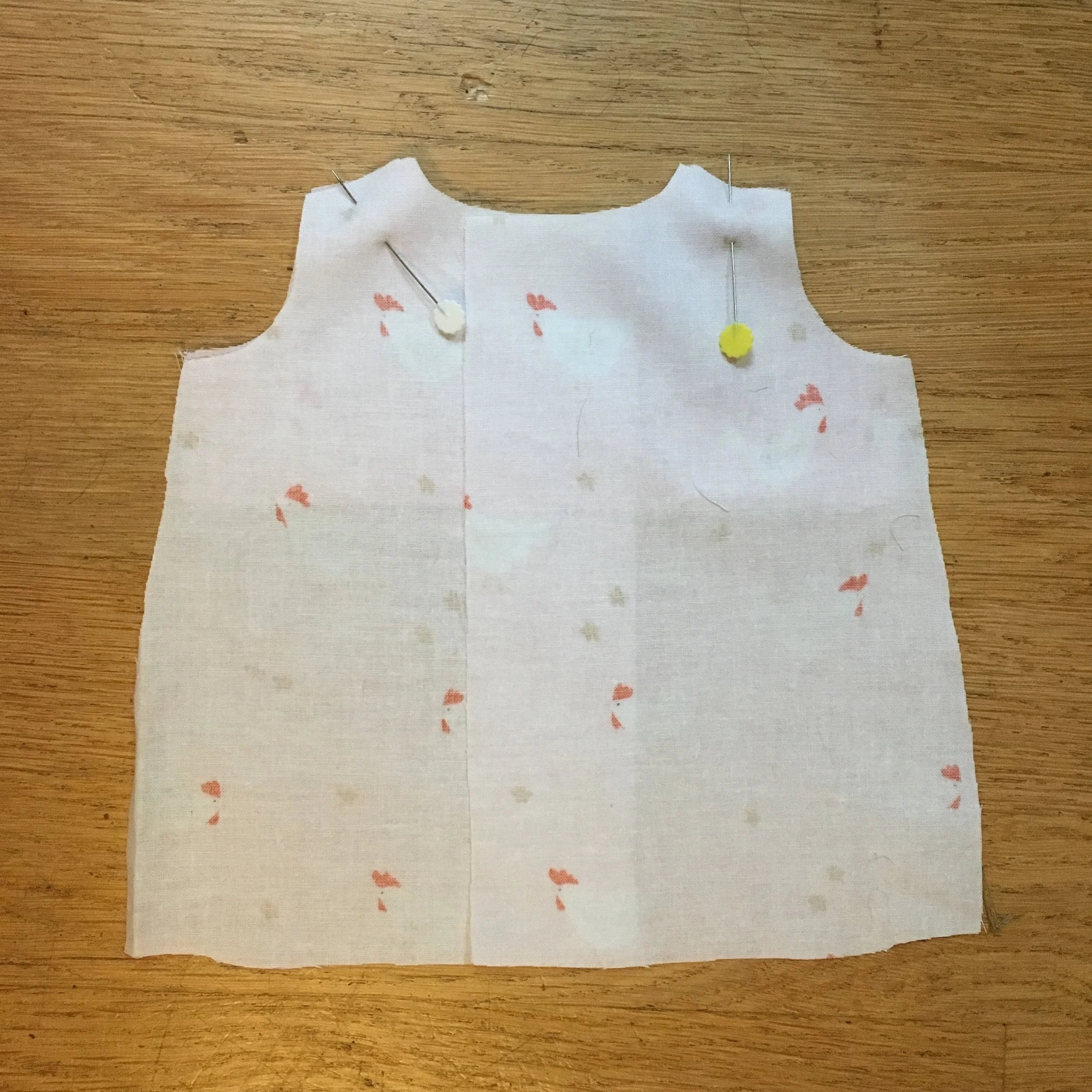
5. Pin the shoulder seams of the bodice and the two back pieces, RIGHT sides together.

fullsizeoutput_15c3.jpeg

Sew the shoulder seams using a 1/4 inch seam. Press.

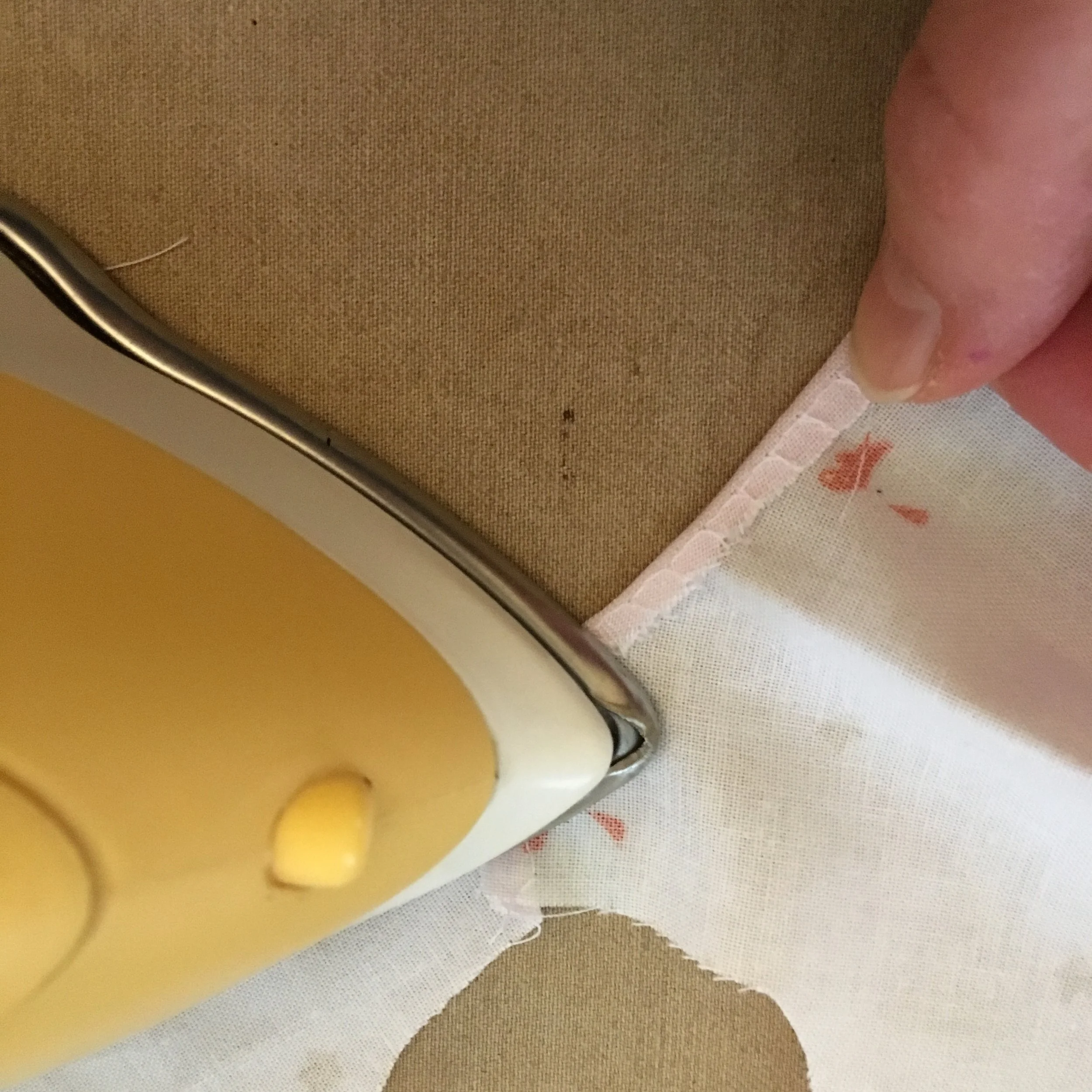
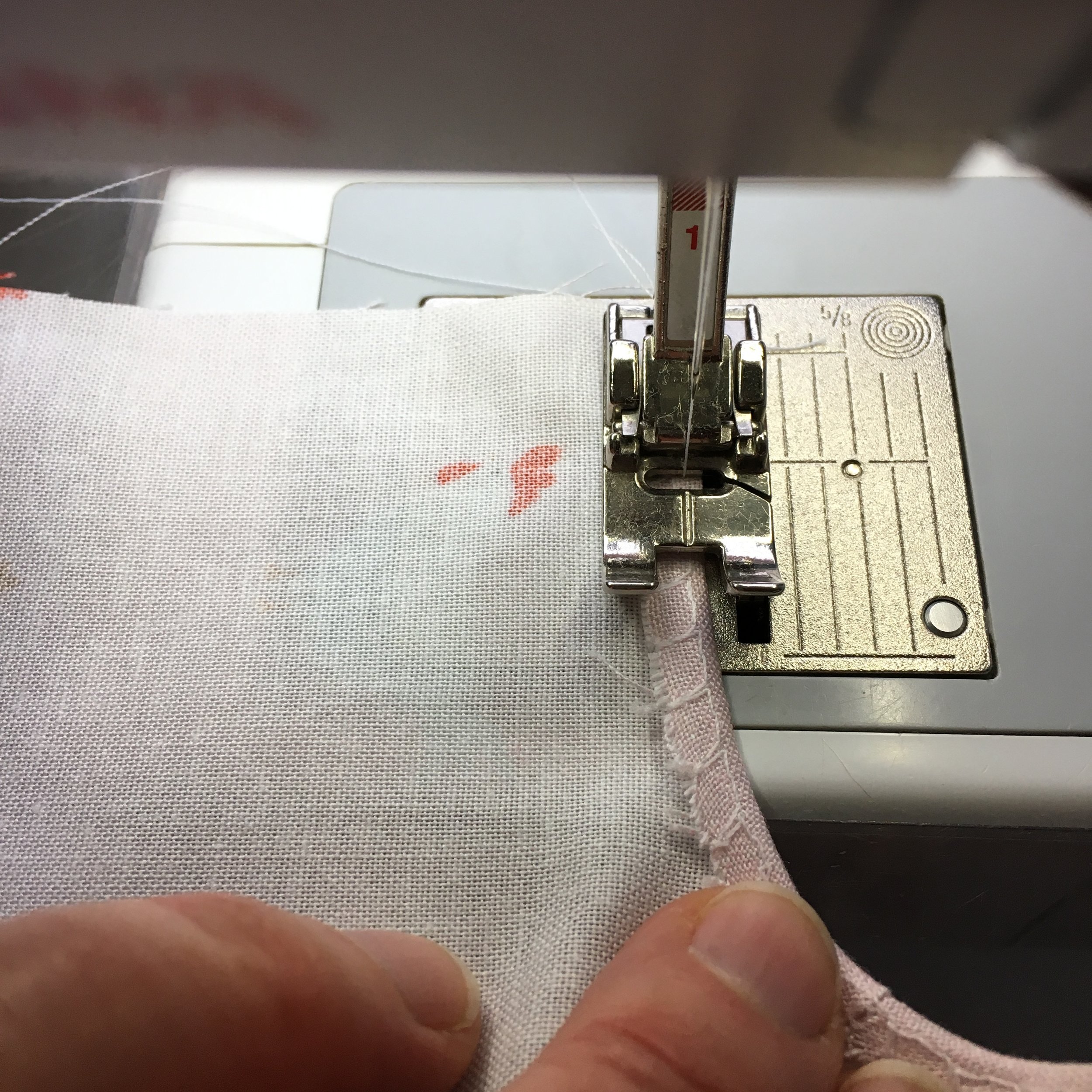
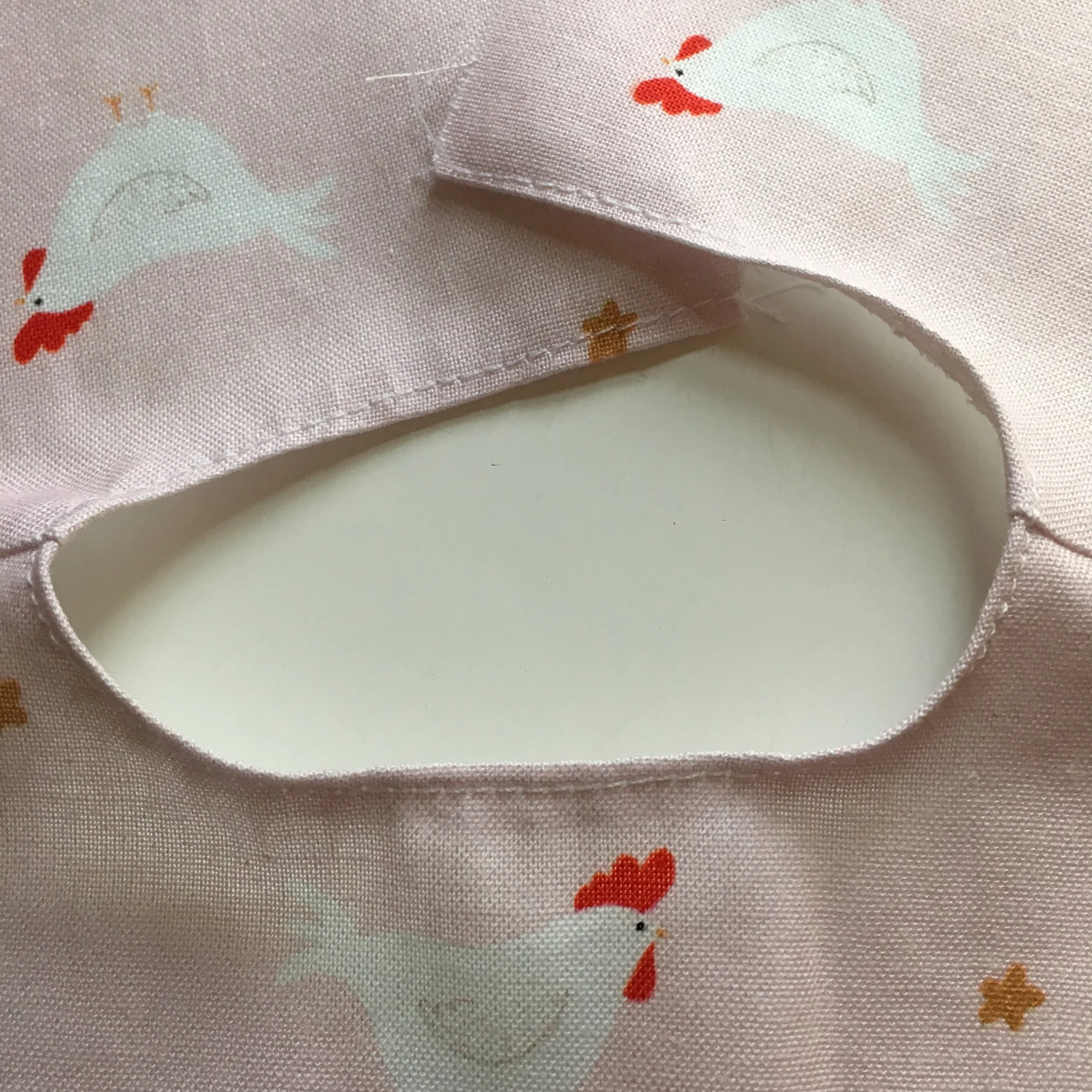
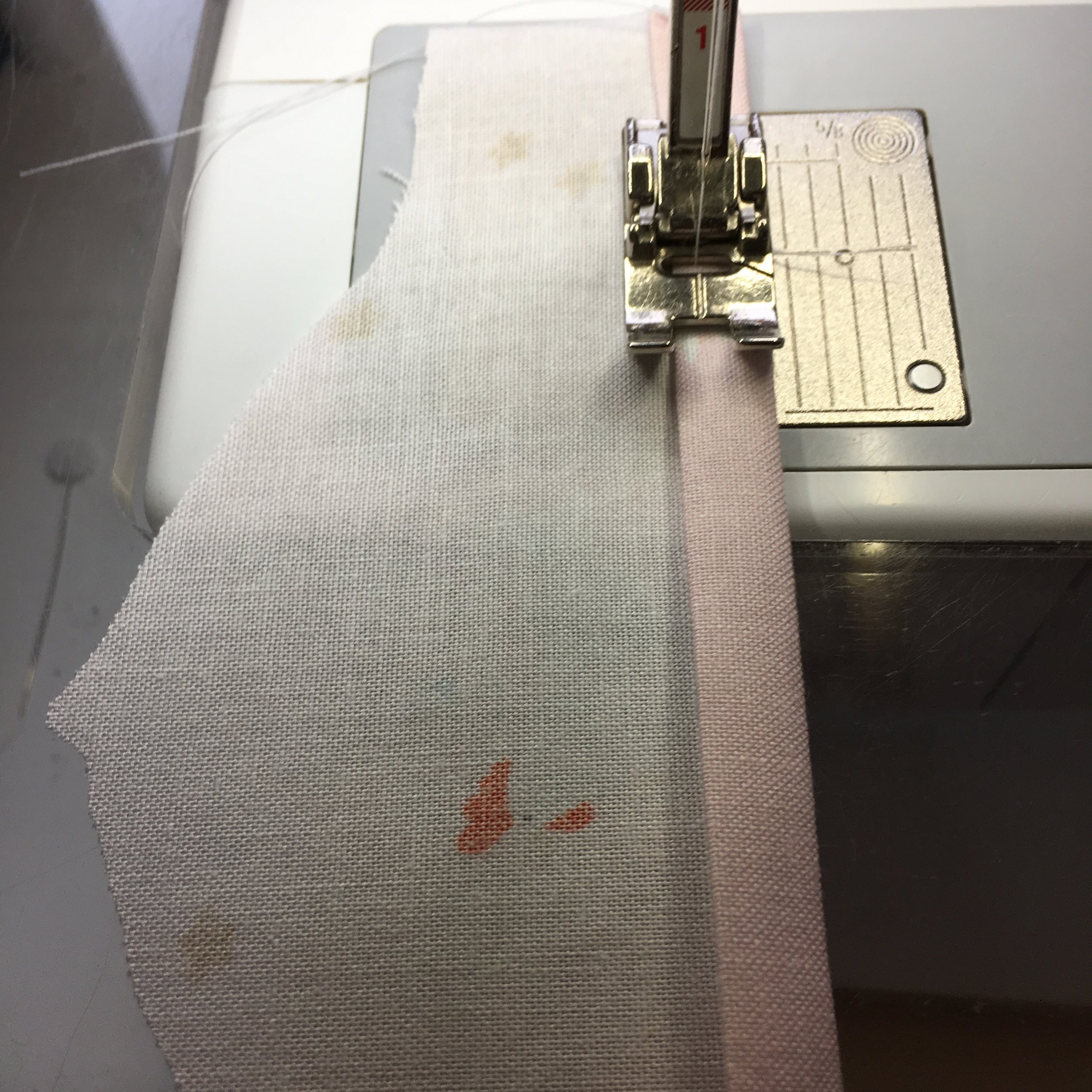
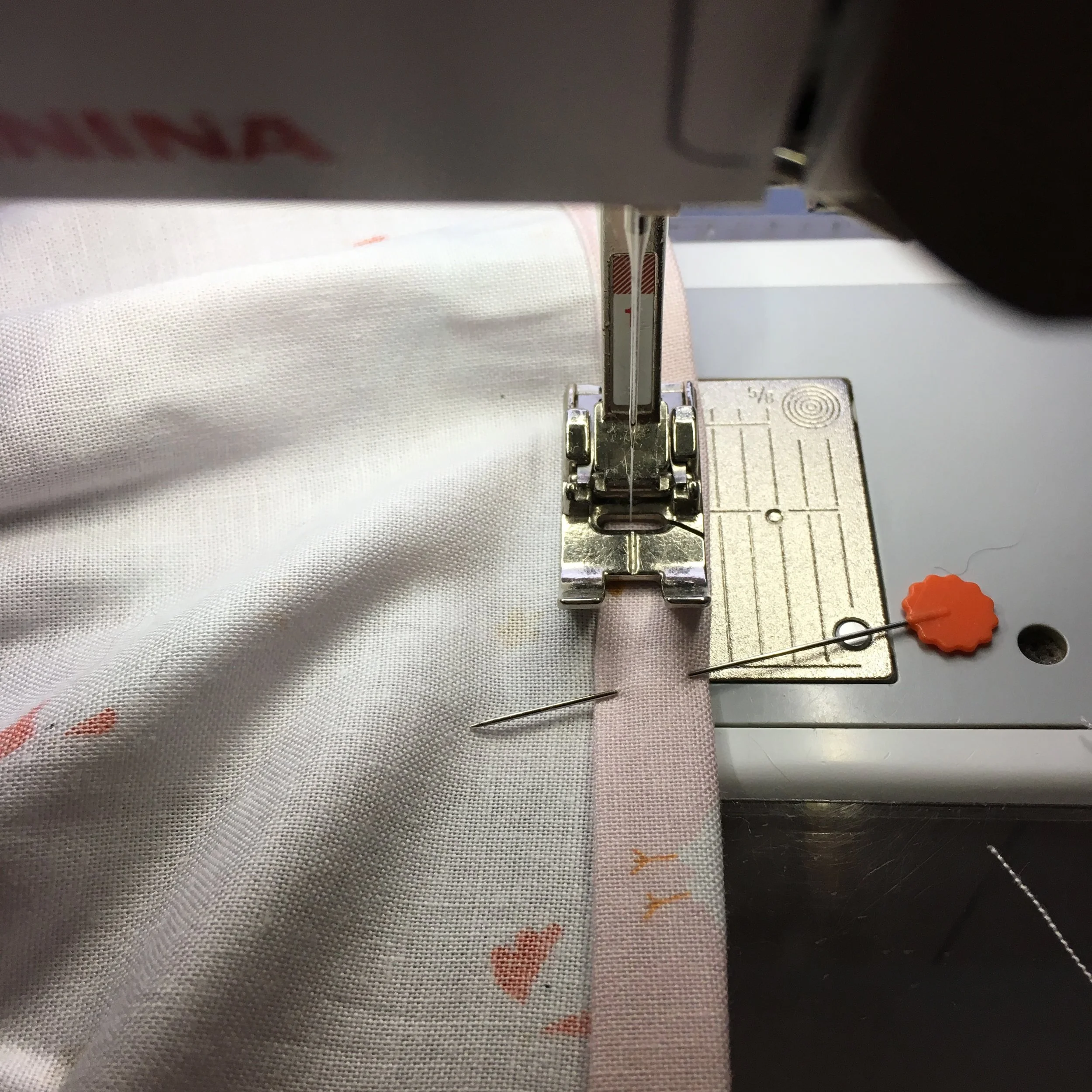
6. Turn the edges of the neck under 1/4 inch, along the dotted lines of the pattern with WRONG sides together. Press. An adult should do this pressing. Top stitch along the edge of the neck seam.

IMG_8101.JPG
IMG_8102.JPG
IMG_8103.JPG

7. Turn the hem of the sleeve under 1/4 inch. Repeat, enclosing the raw edge of the fabric. Press. On the INSIDE of the sleeve, sew along the folded edge.

IMG_8104.JPG


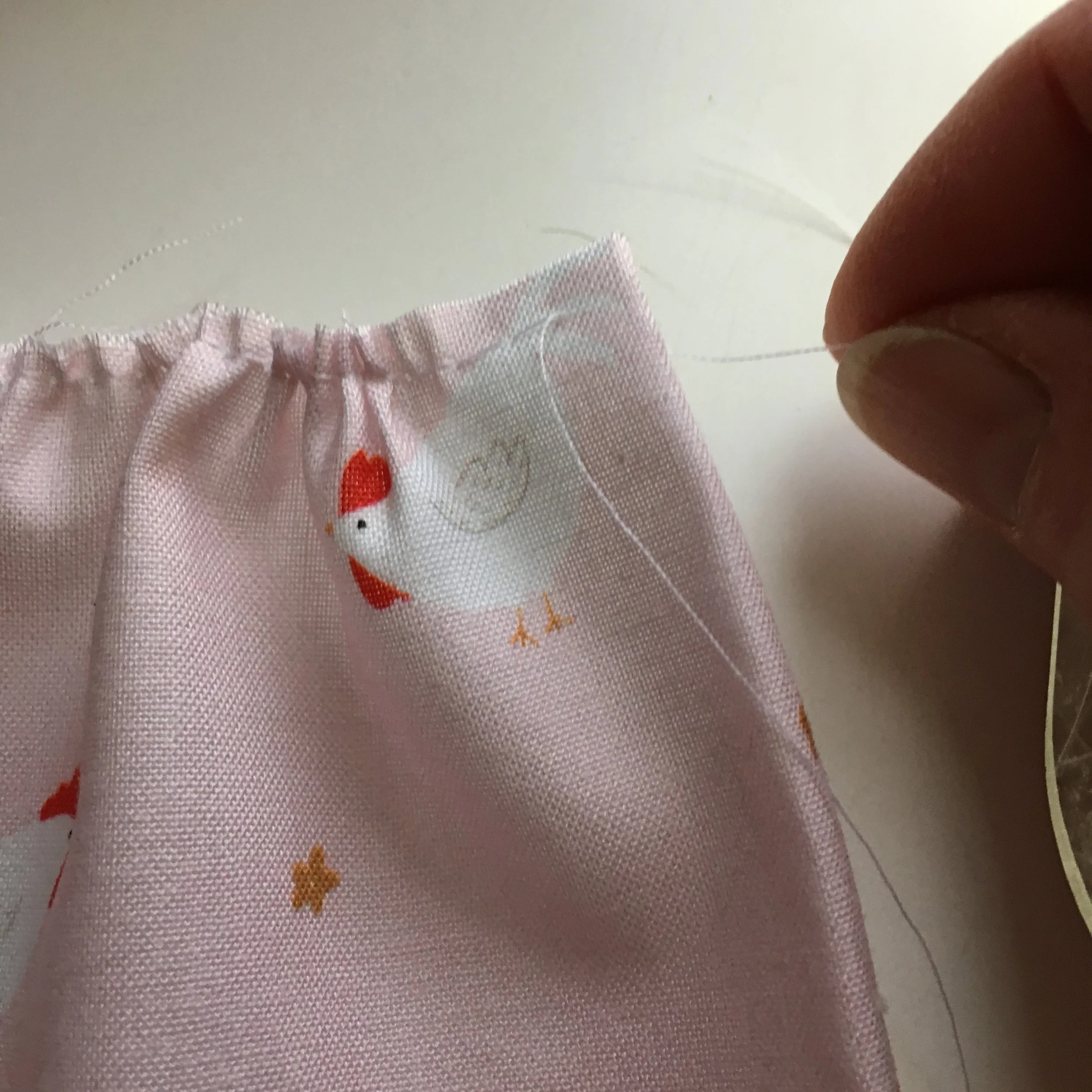
8. If you wish to gather your sleeve, set your stitch length to the longest number it has. Starting at the mark on the sleeve pattern, sew a couple stitches, then BACK STITCH 2 stitches to lock the gather stitches. Sew to the second mark on the sleeve. Do NOT back stitch here. Leave long tails on both threads when you cut them.

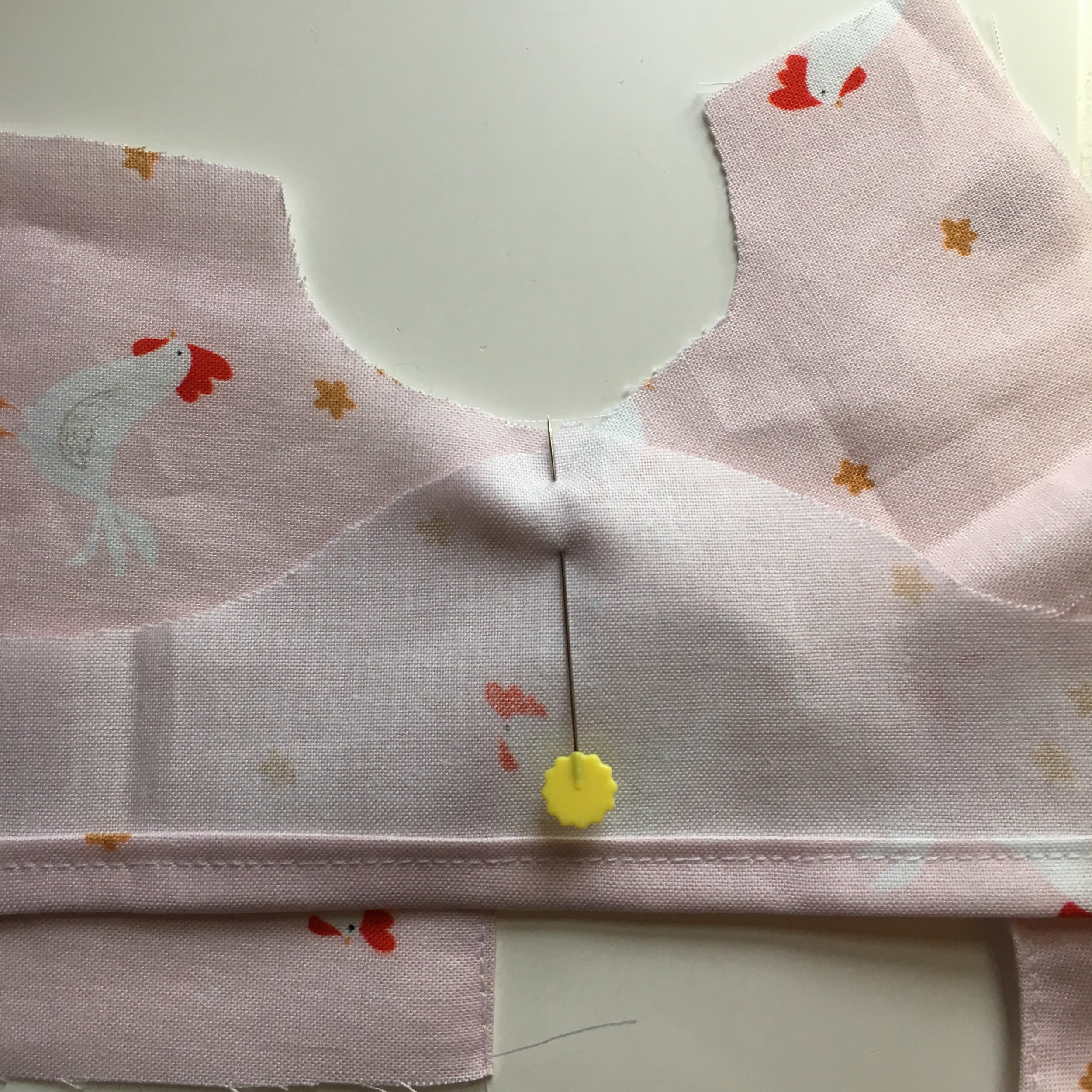
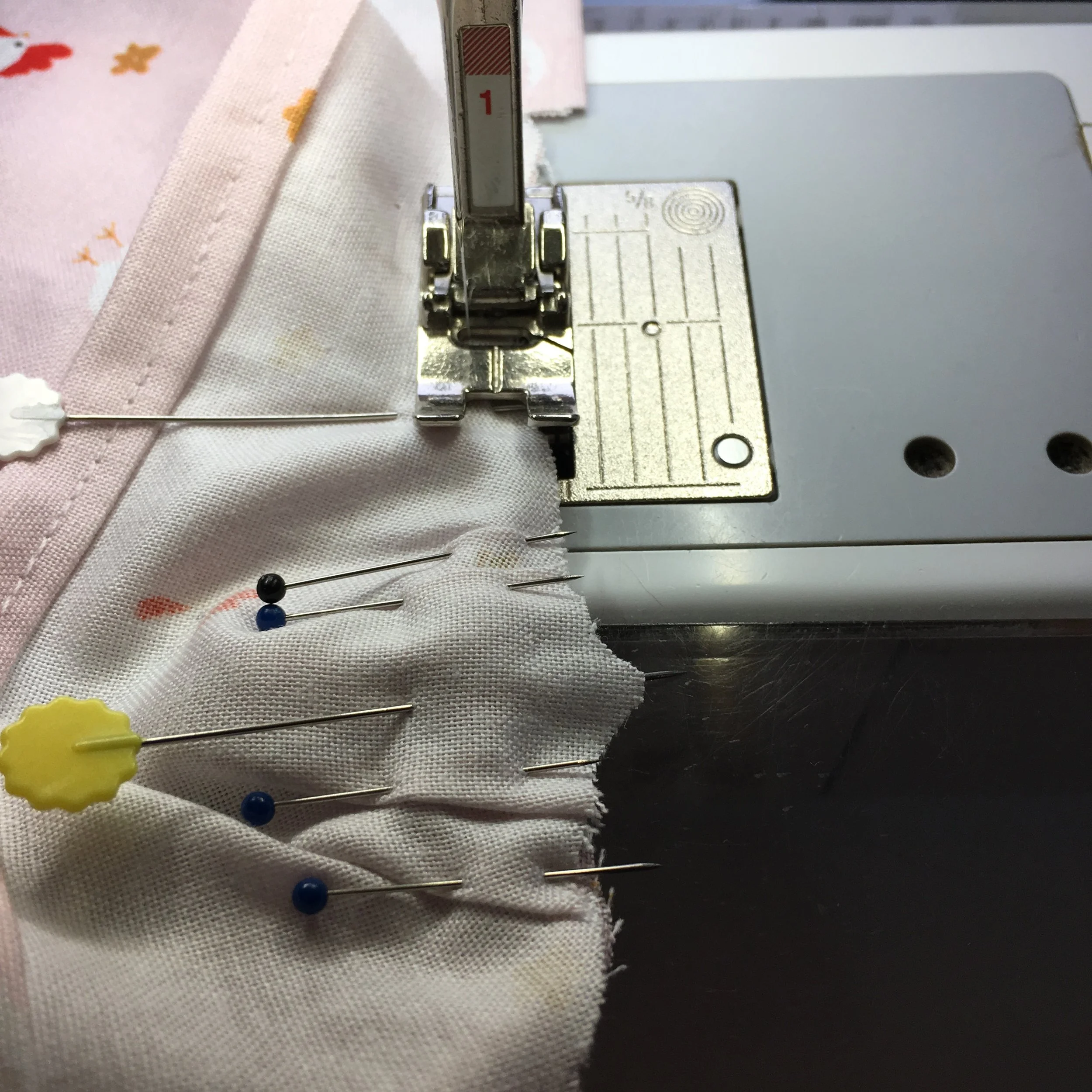
9. While your machine is set for a gathering stitch, sew along the top of the dress’s front skirt piece, starting 1/2 inch from side of the skirt and stopping 1/2 inch from the opposite side. Now set your machine back to the normal stitch length.

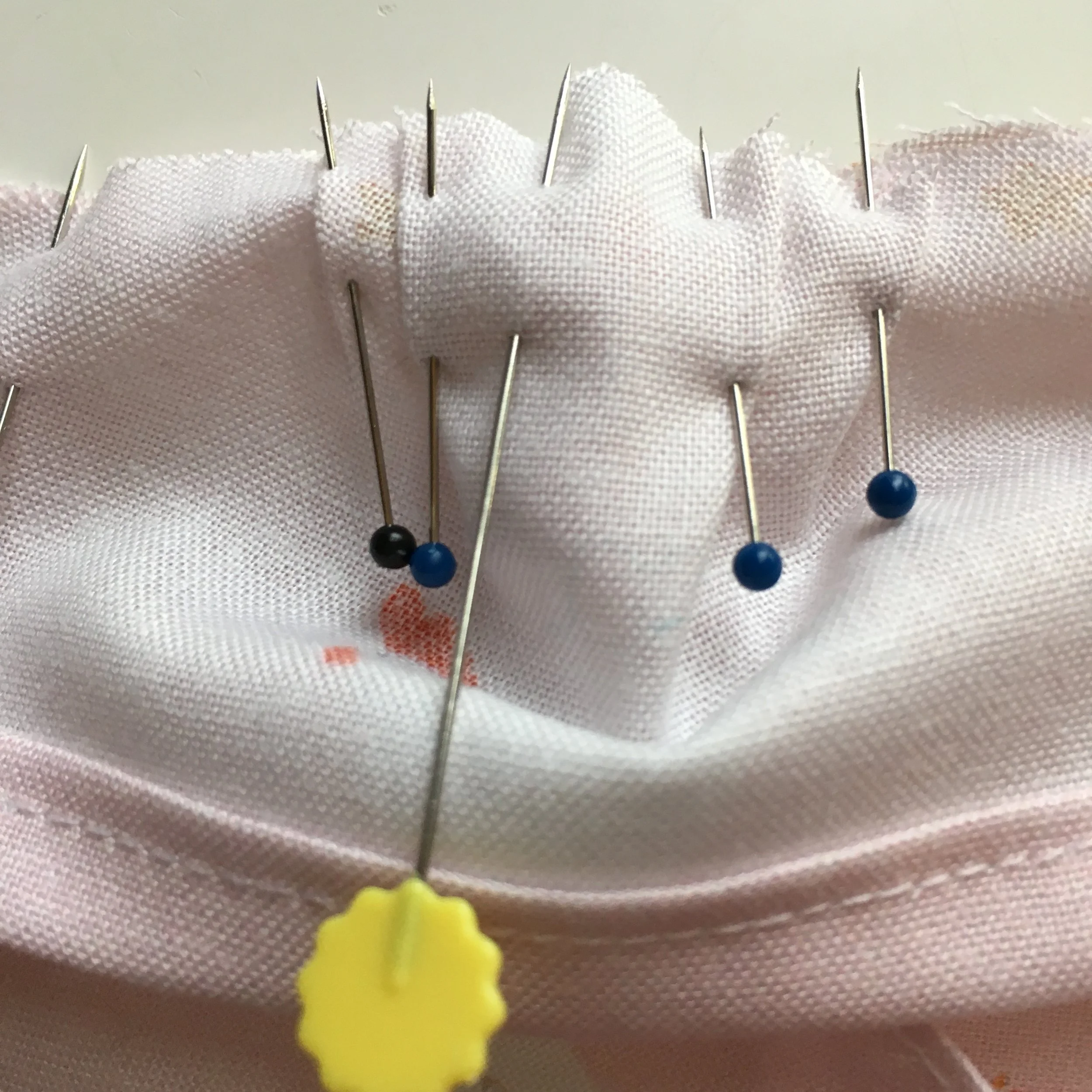
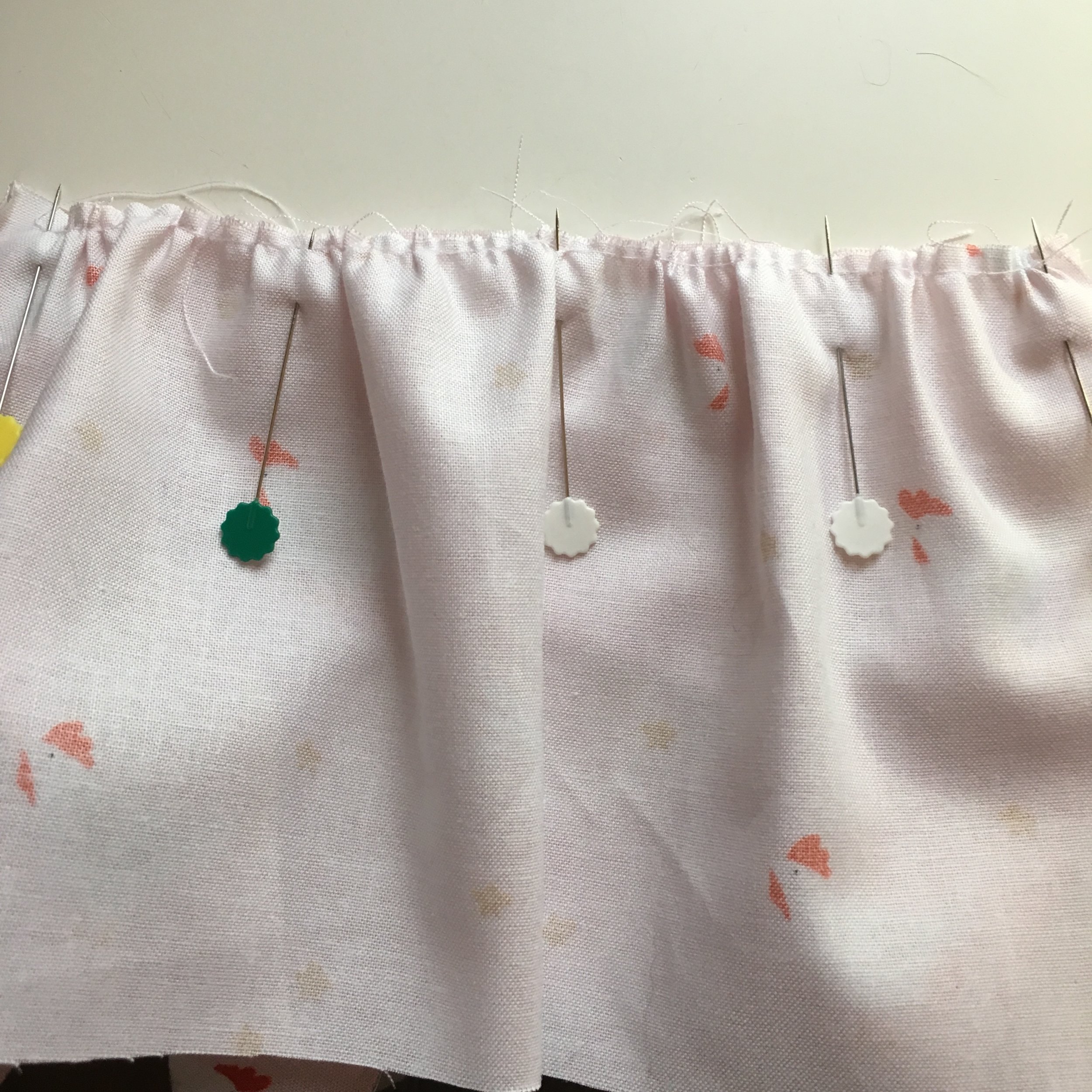
10. Attach to sleeve to the body of the dress, matching the notch on the sleeve with the shoulder seam. Pin the two pieces at the notch. Pin the short edges of the sleeves to the lower edge of the sleeve openings the body of the dress. Pin again about 1 inch from that pin. Now take the gathering thread on the WRONG side of the sleeve and gently pull it, gathering the upper edge of the sleeve until it matches the length of the arm hole of the dress. Pin those edges together. (If you prefer, you can also make several folds in the sleeve to match the sleeve opening instead of gathering it).

IMG_8105.JPG
IMG_8107.JPG
IMG_8109.JPG
IMG_8110.JPG

11. Sew the sleeve to the dress. Repeat for the second sleeve.

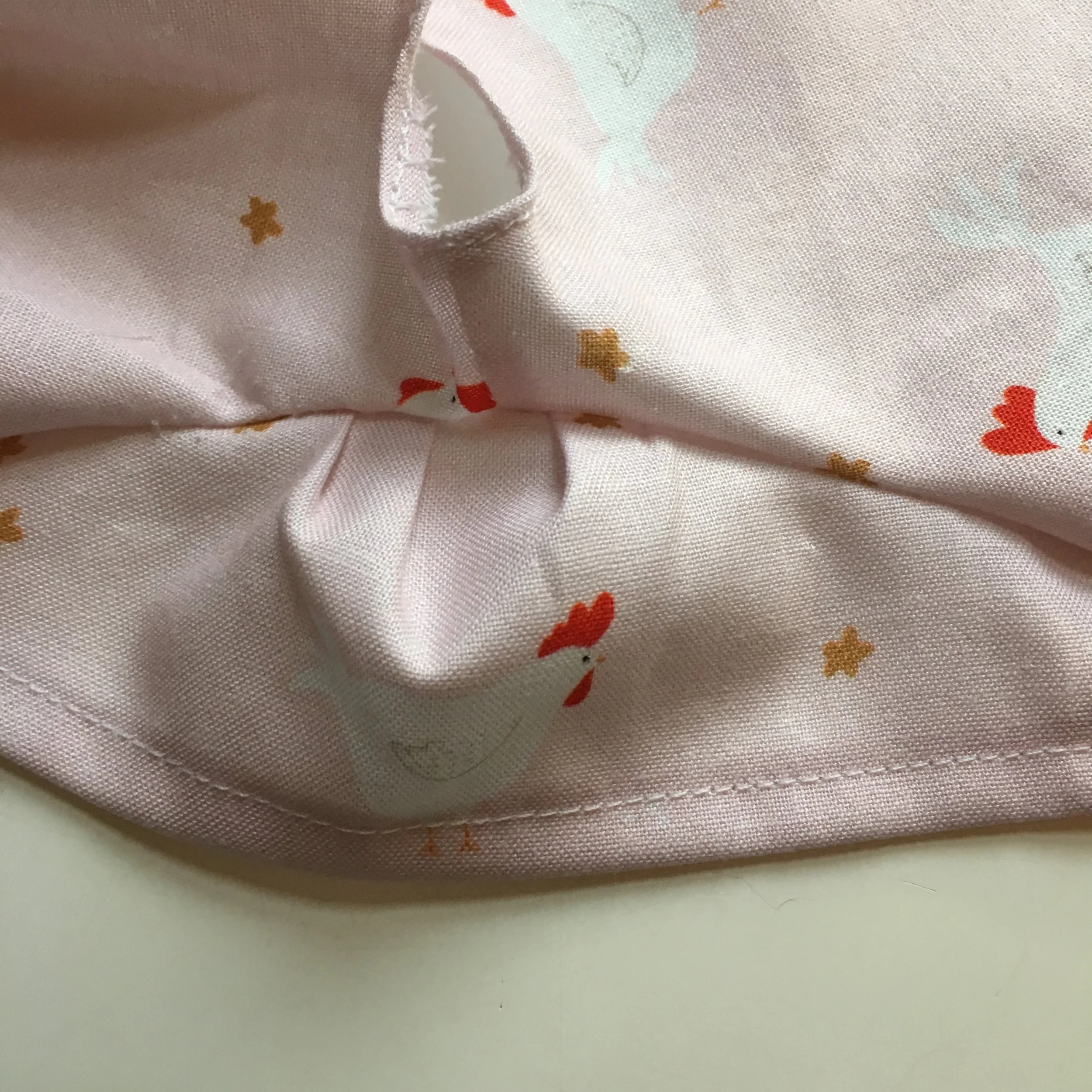
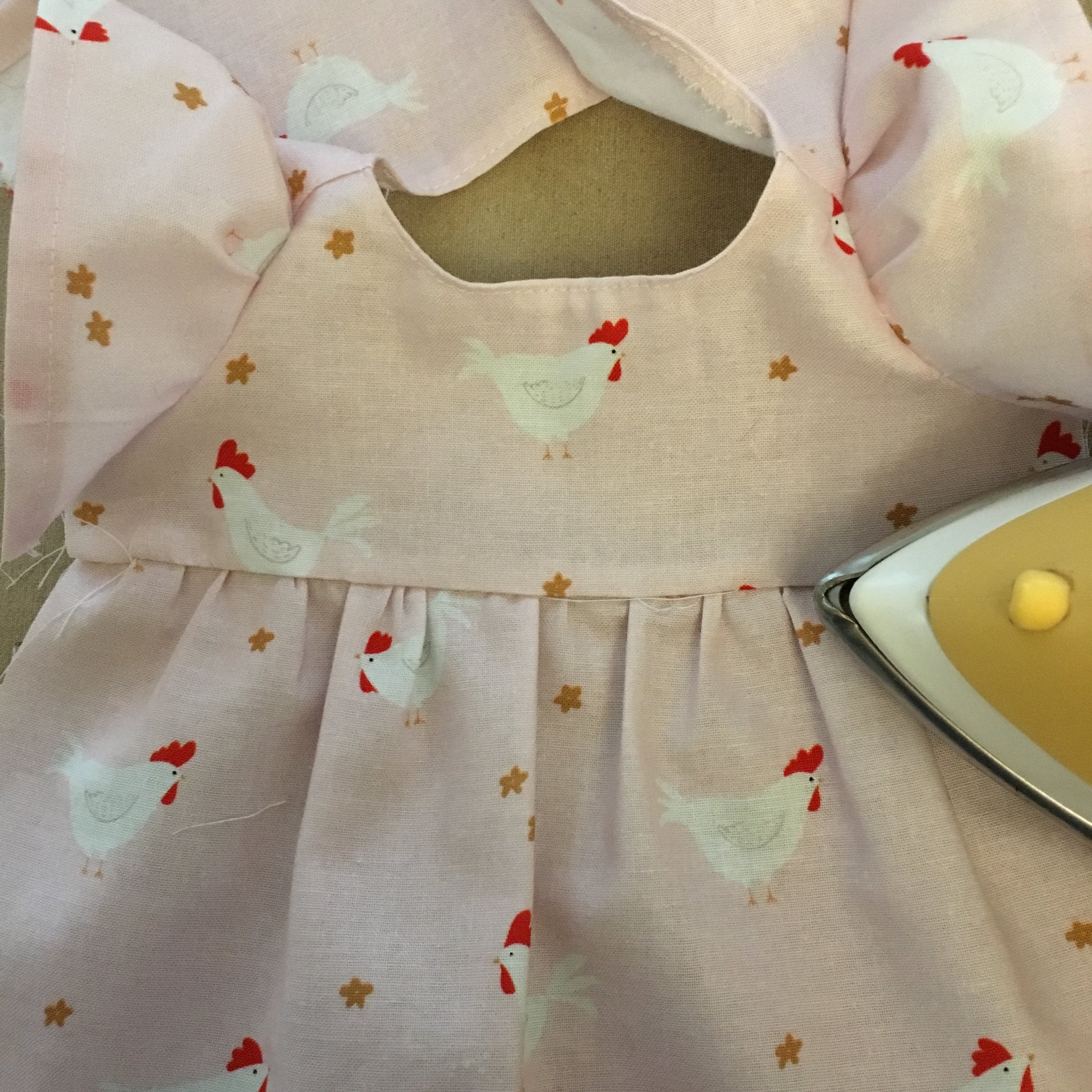
12. With RIGHT sides together, pin the front skirt to the lower edge of the bodice. Pull in gathering stitch thread on the wrong side of the skirt until the skirt measures the same width as the bodice. Even out the gathers and pin. Stitch the top the skirt to the bodice. A straight stitch is fine, but using an overlock stitch is better if your machine has one.

IMG_8114.JPG
IMG_8116.JPG
IMG_8117.JPG

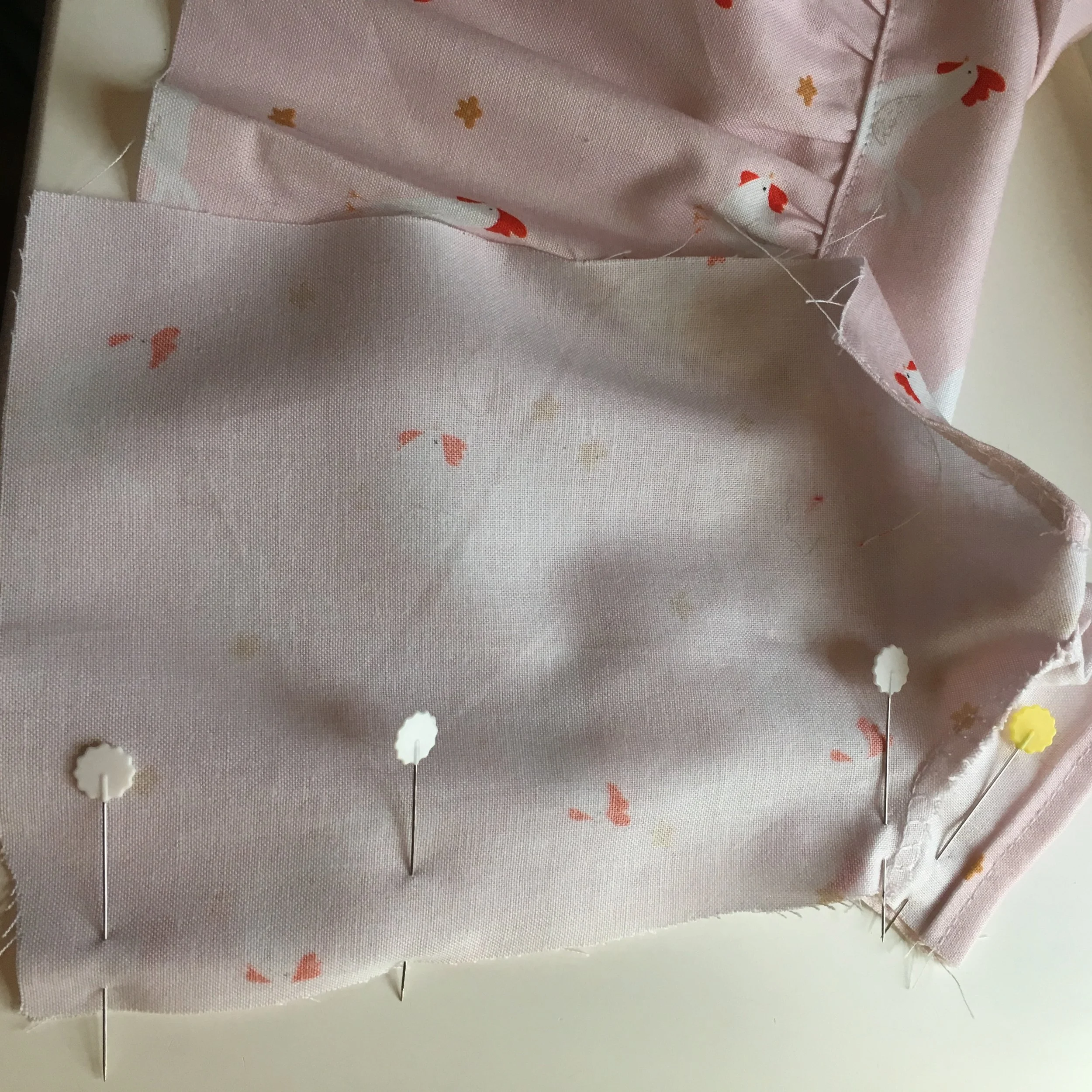
13. With RIGHT sides together, fold the sleeve in half. Pin at the sleeve edge. Match the side seams of the skirt with the side seams of the back pieces. Pin. Sew with a straight stitch or an overlock stitch.

IMG_8121.JPG

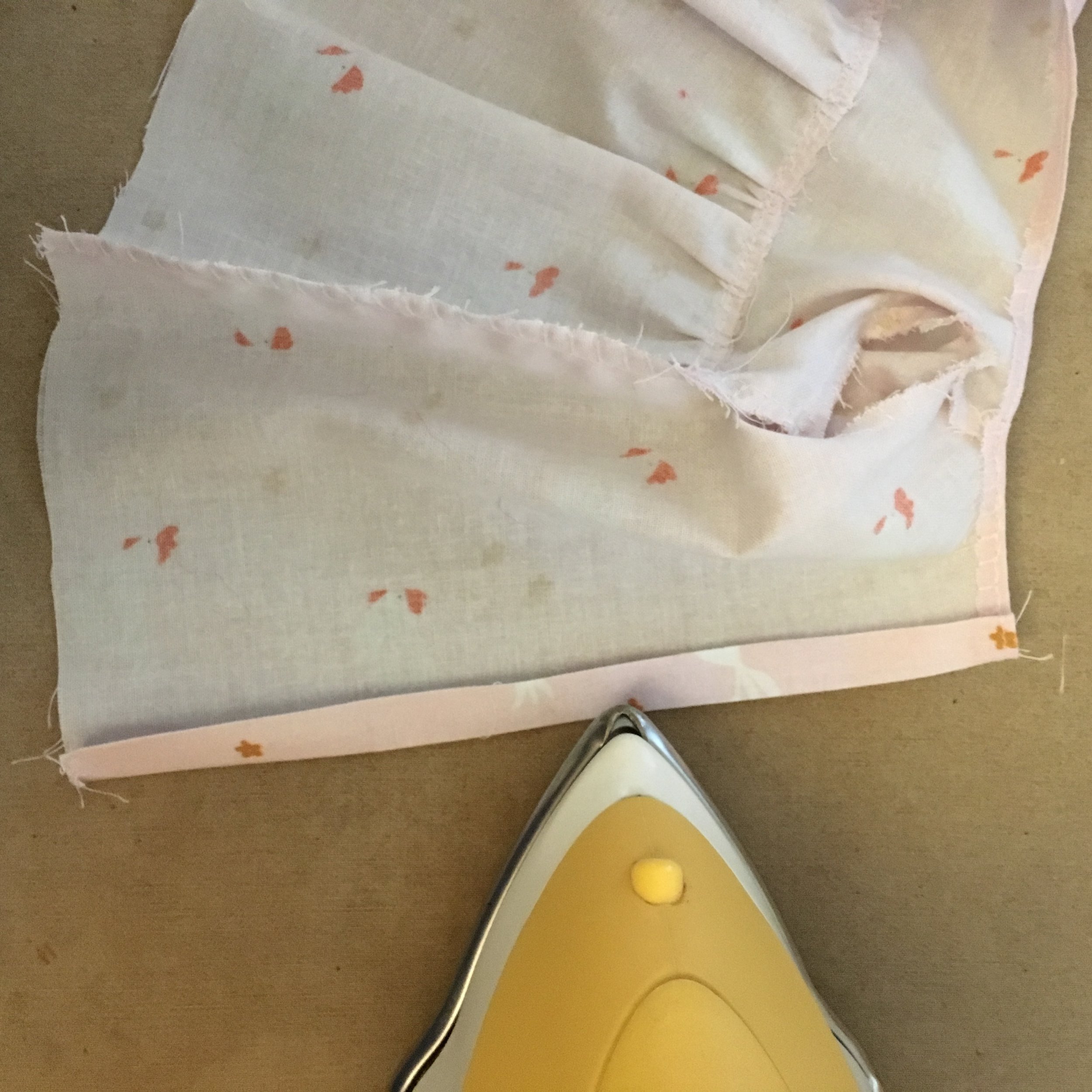
14. Fold the raw edges of the dress back under 1/4 inch, then 3/8 inch. Press. Pin. Stitch along in inner fold on both back pieces.

IMG_8124.JPG
IMG_8127.JPG

15. Turn up the hem 1/4 inch. Repeat doing another 1/4 inch fold. Press. Pin. Sew the hem along the folded edge of the hem.

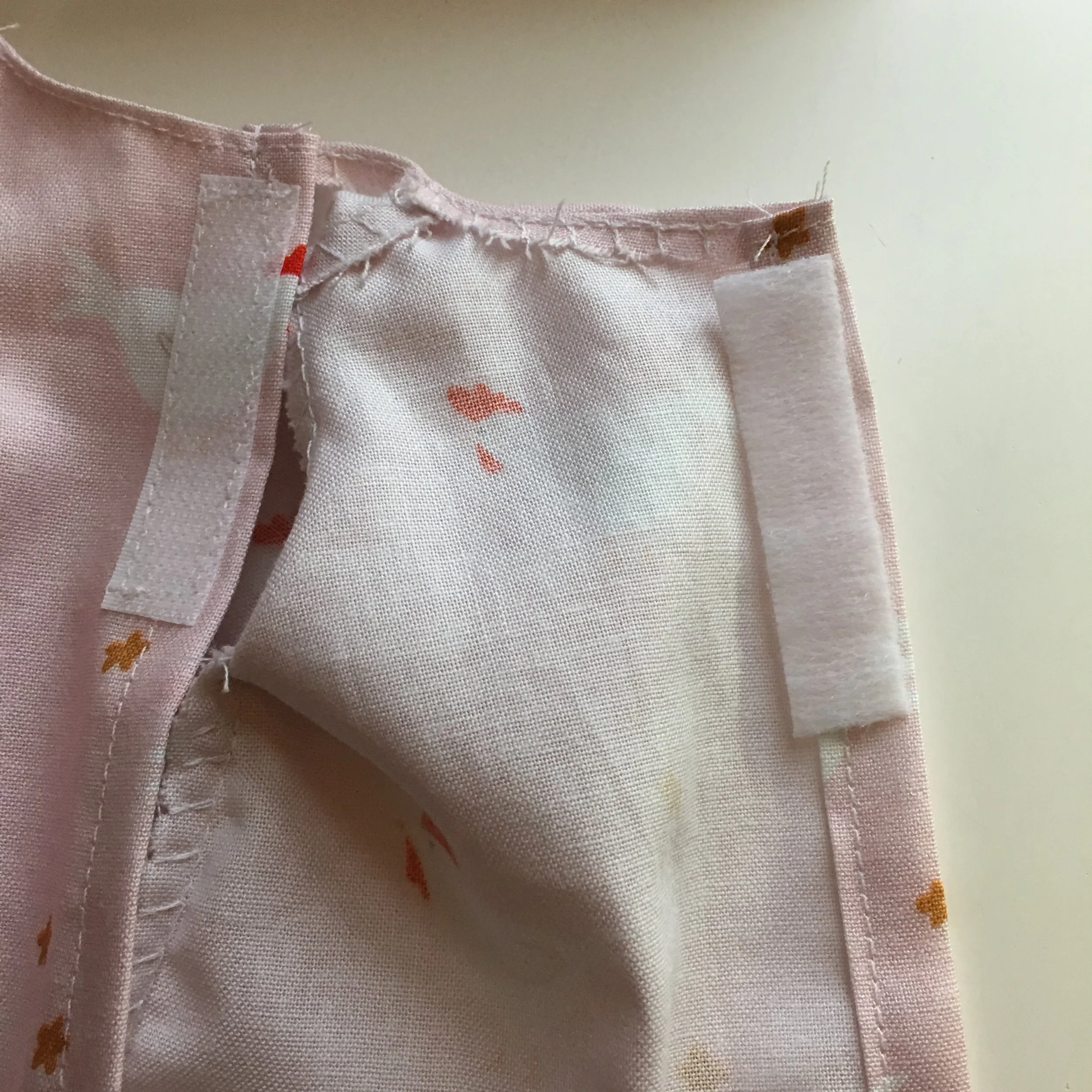
16. Cut a 1 1/2 inch piece of the 3/4 inch hook and loop fastener. Trim the WIDTH down to 1/2 inch. Sew the rough hook piece to the upper edge of the LEFT back on the RIGHT SIDE of the fabric. Then sew the soft loop piece to the upper edge of the RIGHT back on the WRONG side of the fabric. An adult should sew on the hook and loop tapes.

IMG_8130.JPG

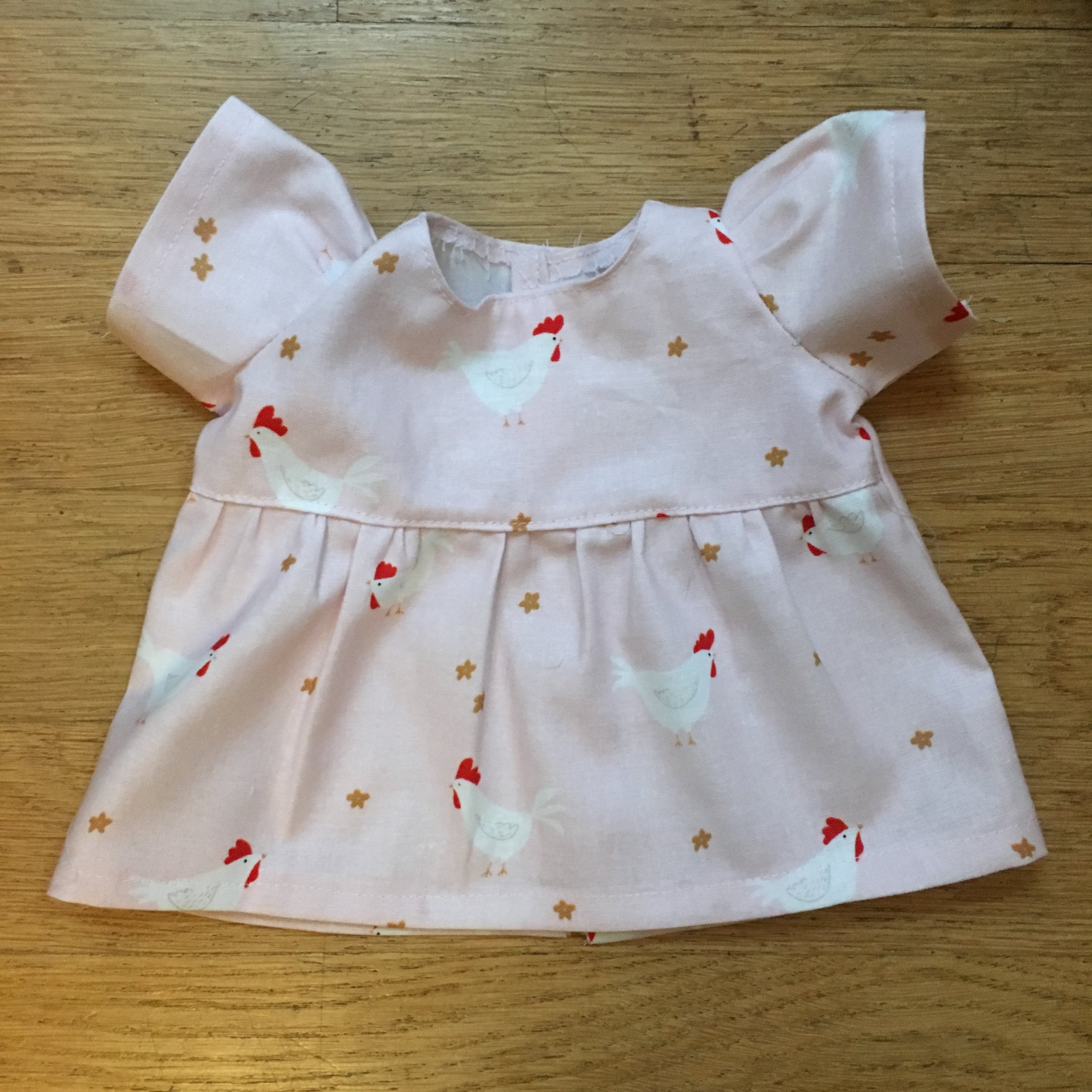
All done! Great job! Hope your Bamboletta Baby loves her new dress.

fullsizeoutput_15c4.jpeg
IMG_8140.JPG
IMG_8135.JPG

Click on this link to download a PDF of the free Bamboletta Baby Doll Dress Pattern.

NOTE: This pattern is for individual use only. Feel free to sell dresses you make at small craft fairs. Doll clothes made with this pattern are NOT for commercial use nor for sale on sites like Etsy.com without my permission. Please do NOT copy and SELL this pattern but feel free to share it with your doll friends. Thanks.

fullsizeoutput_15cb.jpeg
IMG_8012.JPG
IMG_8001.JPG
IMG_8002.JPG

This dress has a ribbon sewn on the edge of the bodice. If you wish to do this, sew on the ribbon before sewing the side seams of the dress.

Notice: This blog is not monetized: I do not use affiliate links. When there are links in a post, they are to give credit to another creative person, because I like or have used a product, or to help the reader easily find supplies for a project.


TAGS: Free Bamboletta Baby Doll Doll Pattern, Bamboletta Baby Doll Dress Pattern, Bamboletta Baby Doll, Bamboletta doll clothes pattern, Bamboletta Doll Clothes


August 8, 2019

Doll Flower Girl Outfit

by Judy Tucker


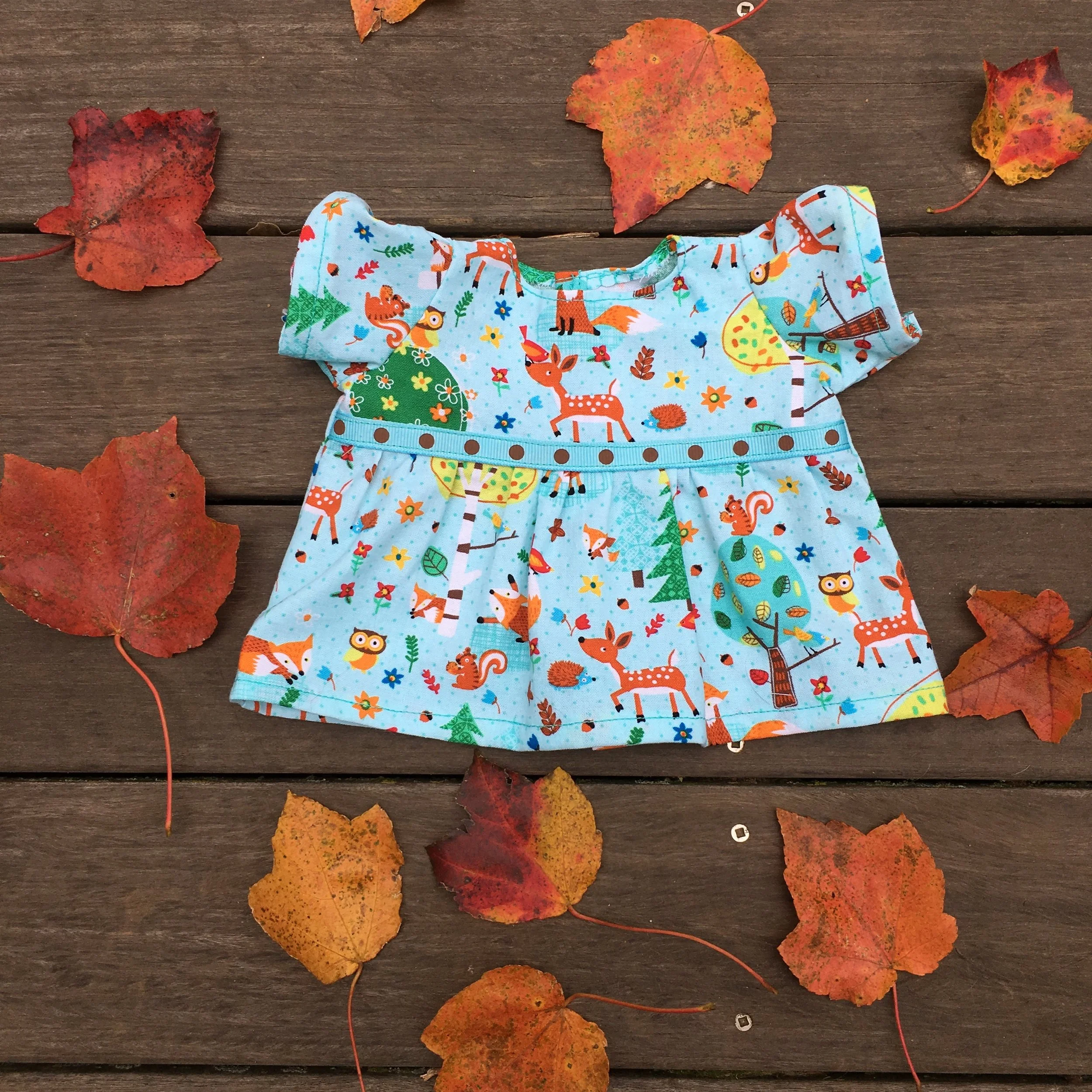
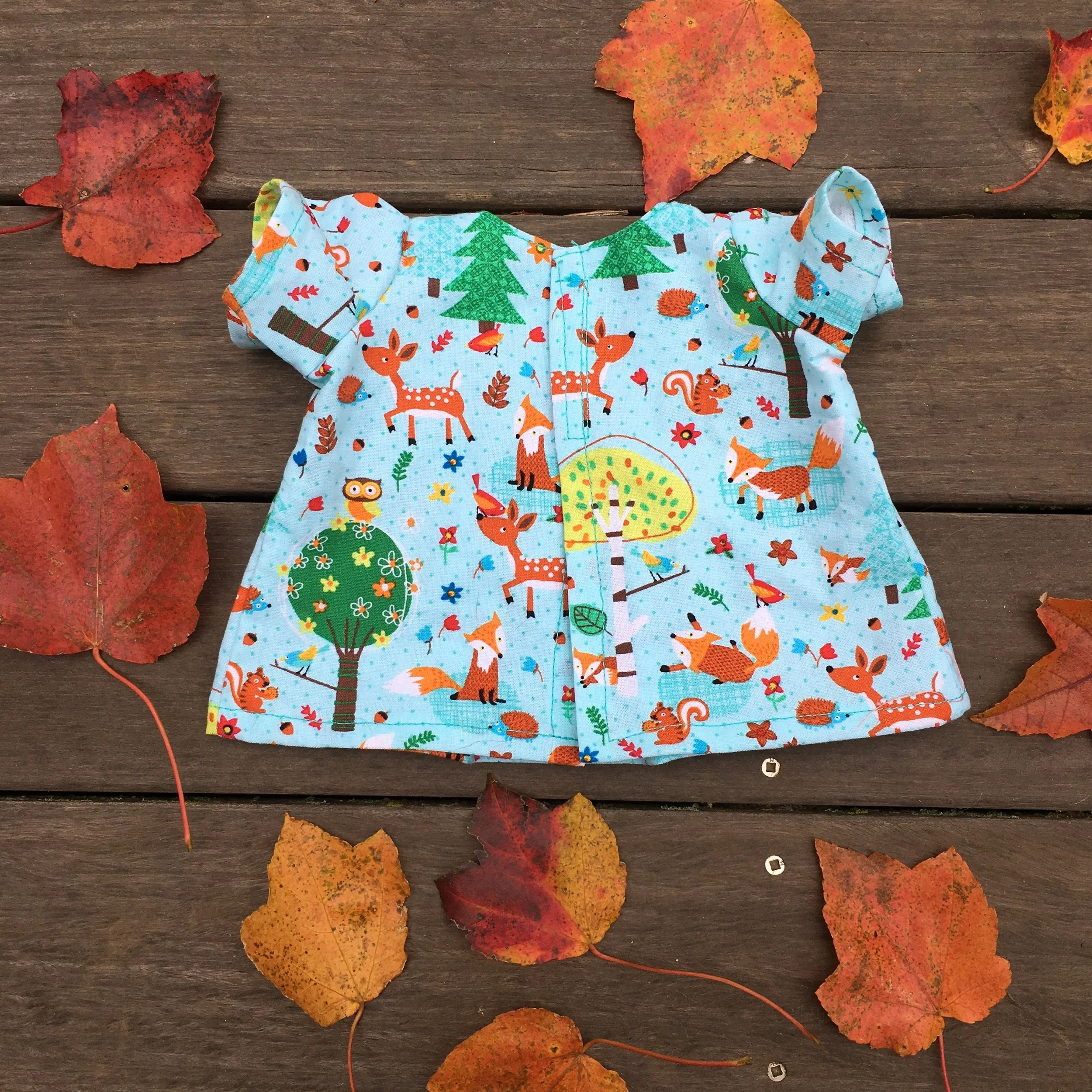
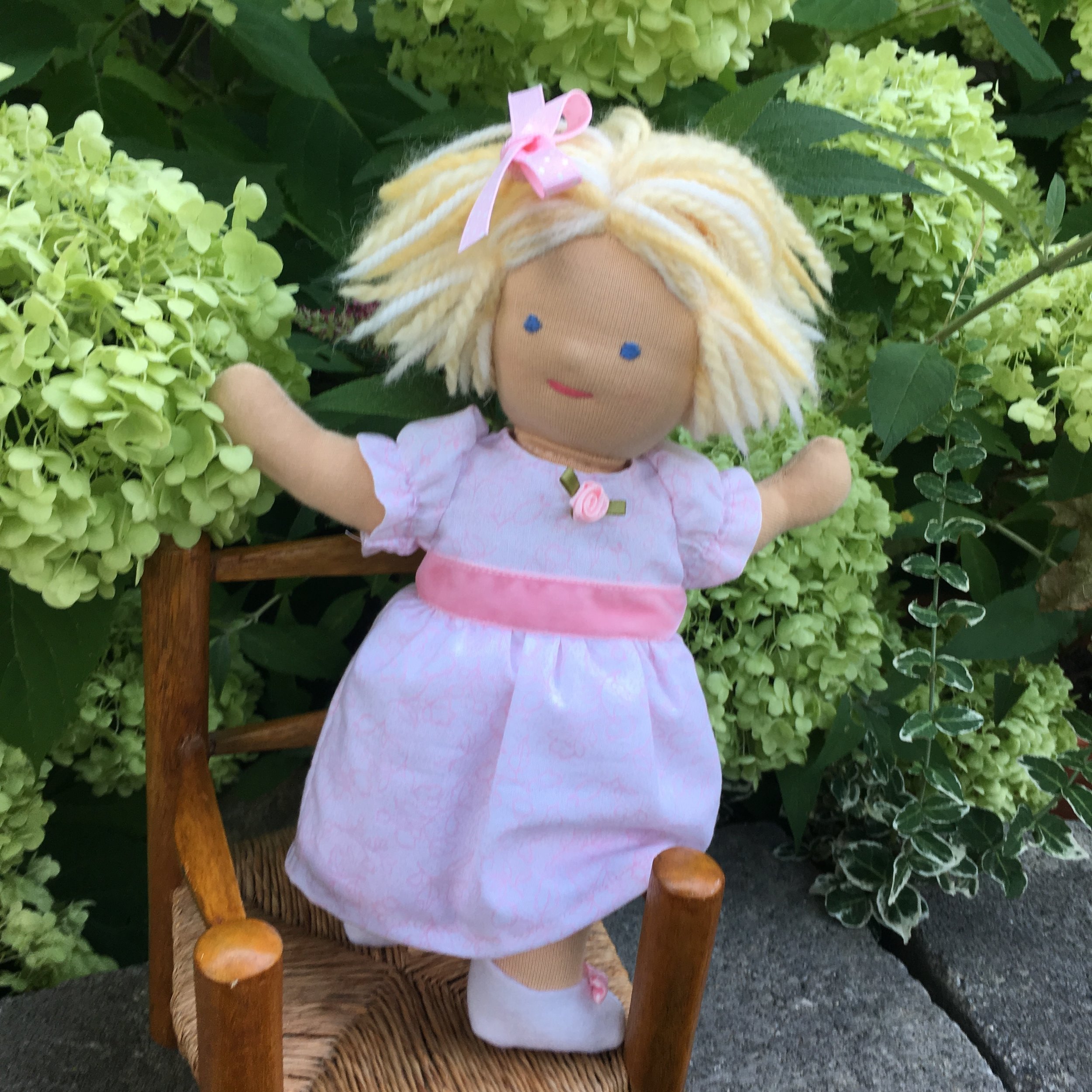
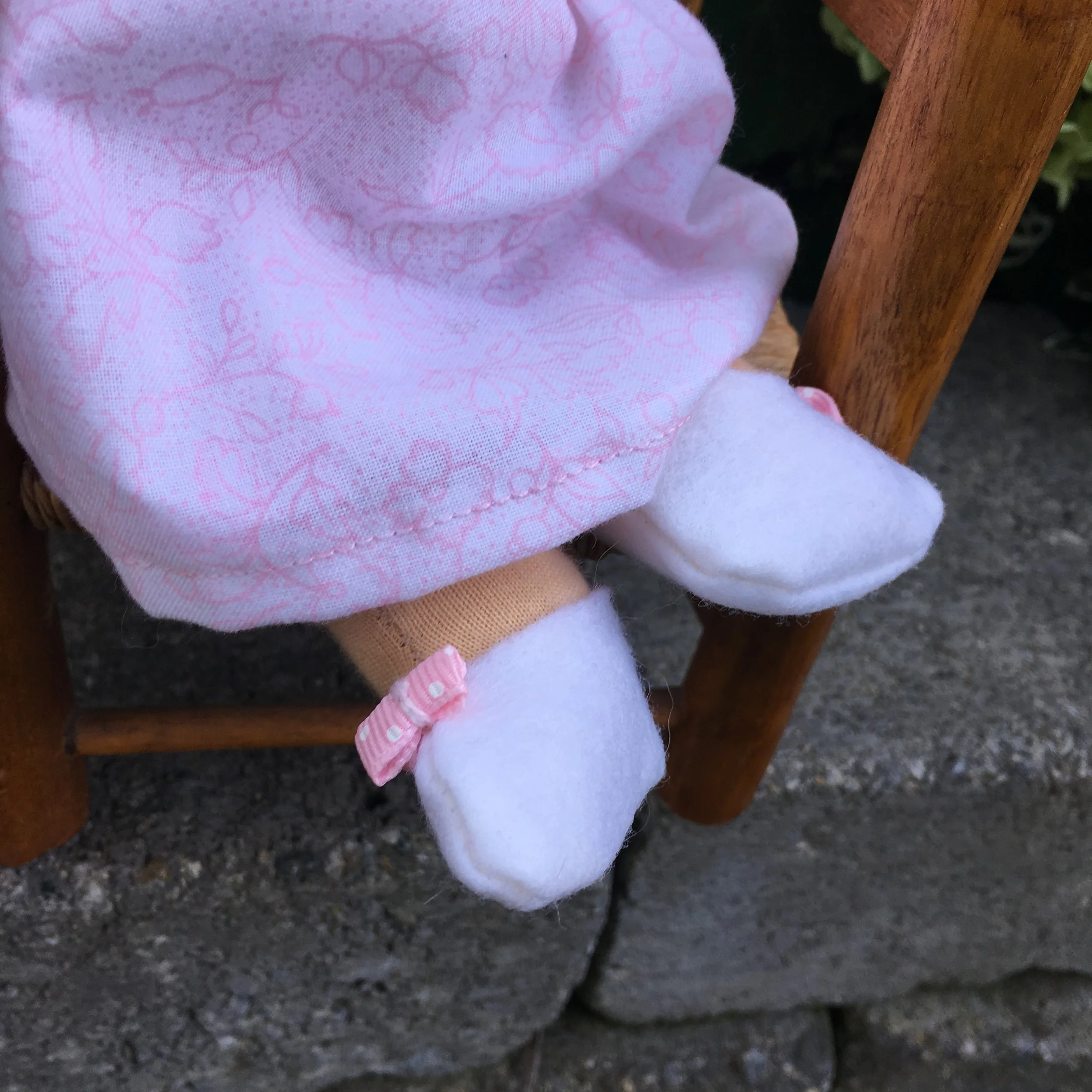
Doll  of the Flower Girl’s Outfit (without the shoes because she standing on a chair)!

Doll of the Flower Girl’s Outfit (without the shoes because she standing on a chair)!

Doll  of the Flower Girl’s Outfit (without the shoes because she standing on a chair)!

Doll of the Flower Girl’s Outfit (without the shoes because she standing on a chair)!

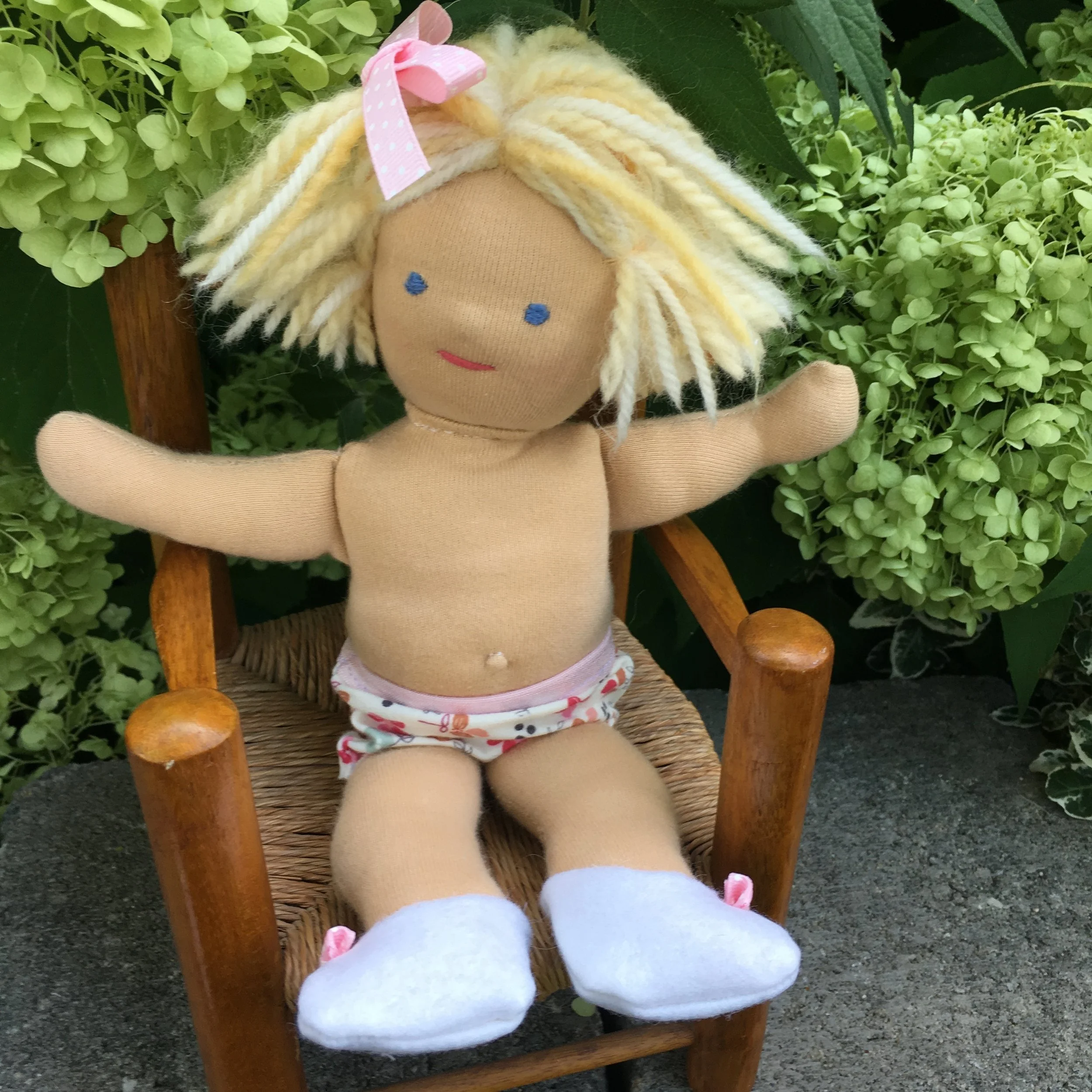
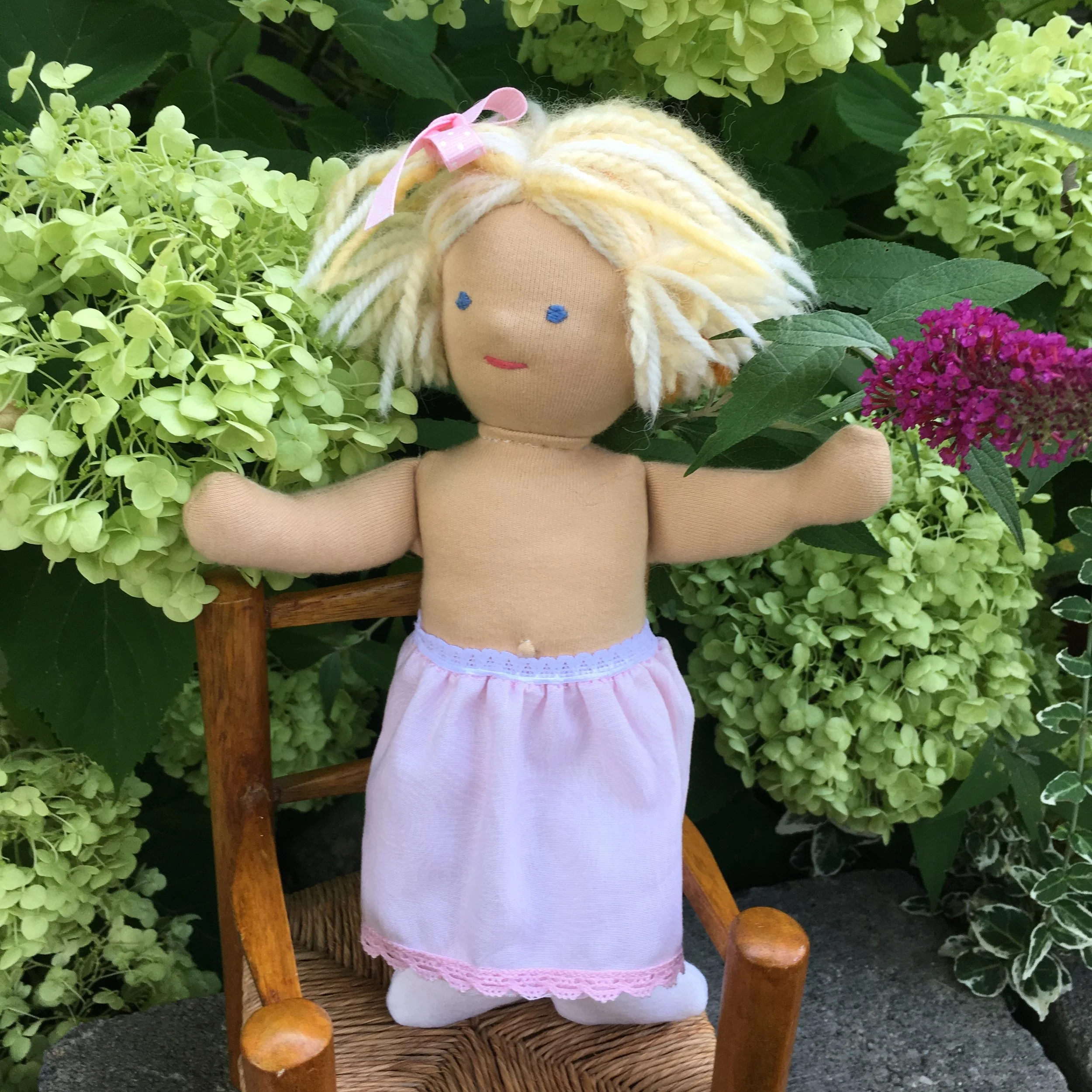
I’ve got a show-and-tell today. I made an outfit for the doll of a young flower girl. She really, really, wants to take her doll to the wedding. So of course the doll needs an appropriate outfit, including white slip-on shoes with tiny pink bows! (Modeling this outfit is my doll, a 9 inch Waldorf style baby doll. I also made the doll going to the wedding).

Here is Lucy Birch trying on all the pieces of the Doll of the Flower Girl’s Outfit. She’s a baby doll and normally wear diapers, but Lucy Birch thought she really should, (yes, I CAN!) , wear big girl pants to go to a wedding!

IMG_0351.JPG
IMG_0349.JPG
IMG_0346.JPG
IMG_0347.JPG

The wedding is still a ways off, but I can’t wait to hear how this all works out!

TAGS: Flower Girl Doll Dress, Waldorf style baby doll, Waldorf type baby doll, Waldorf doll clothes


August 1, 2019

Doll Sleeping Bag with Quilted Top and a Fleece Back

by Judy Tucker


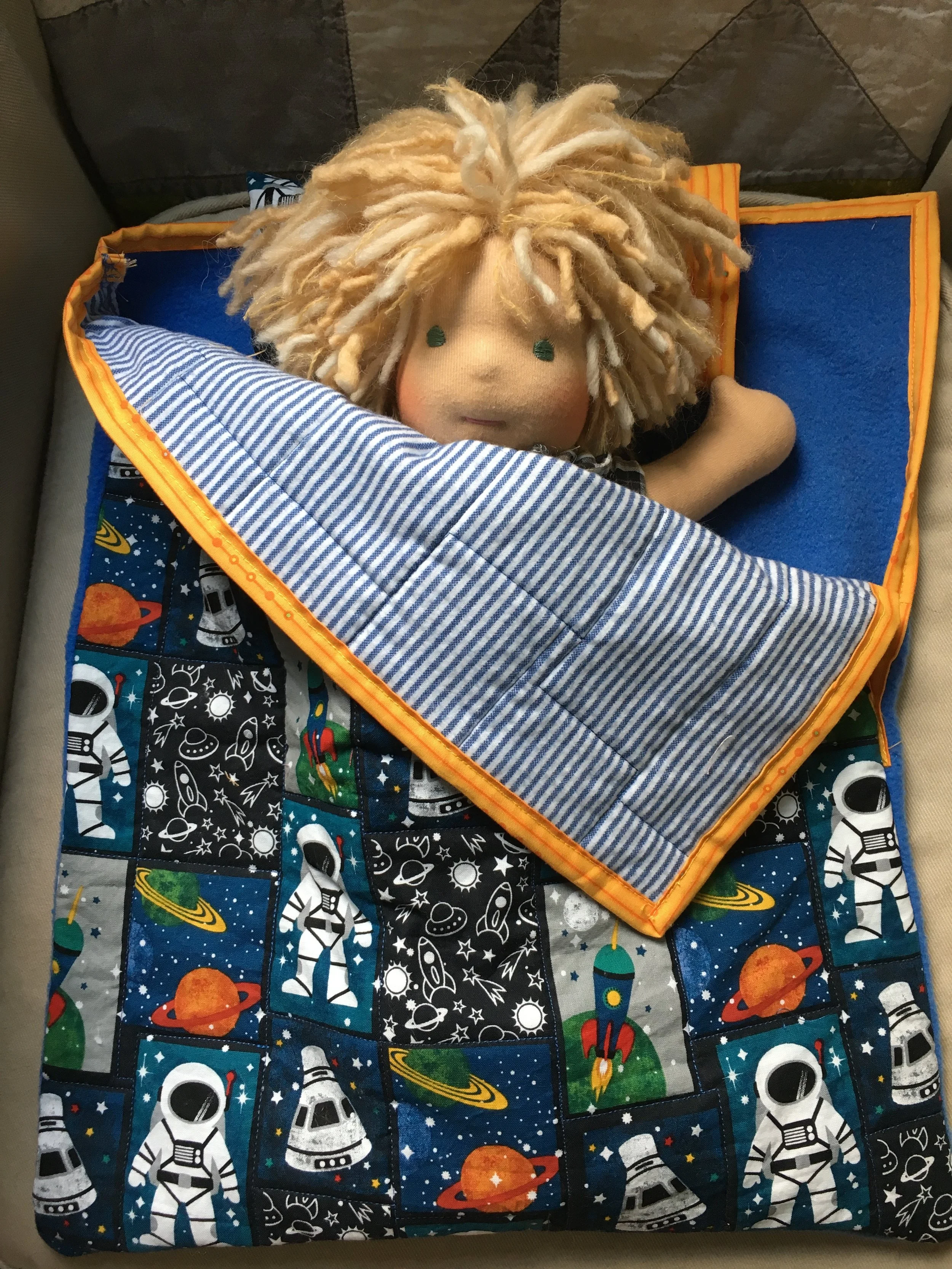
Quilted Doll’s Sleeping Bag with a Bamboletta Cuddle Doll

Quilted Doll’s Sleeping Bag with a Bamboletta Cuddle Doll

Quilted Doll’s Sleeping Bag with a Bamboletta Cuddle Doll

Quilted Doll’s Sleeping Bag with a Bamboletta Cuddle Doll

One of my young friends is having a birthday soon. He has a Bamboletta Cuddle Doll whom he loves and takes everywhere. I decided to make a quilt for him with a half yard of space-themed fabric I’d been given. The pattern of pictures in boxes was perfect for making a sort of cheater quilt.

I cut out a piece of space fabric 15 x 18 inches as well as batting and flannel backing the same size. I sandwiched the three layers and quilted along to black lines of the boxes.

About half way done, I realized that although there are at least 4 doll beds at his house, the likelihood that his doll would be sleeping in one of them was just about zilch! (He has a sister who has a lot of dolls)! I know the doll is in his room with him at night, so I decided to make it into a sleeping bag instead.

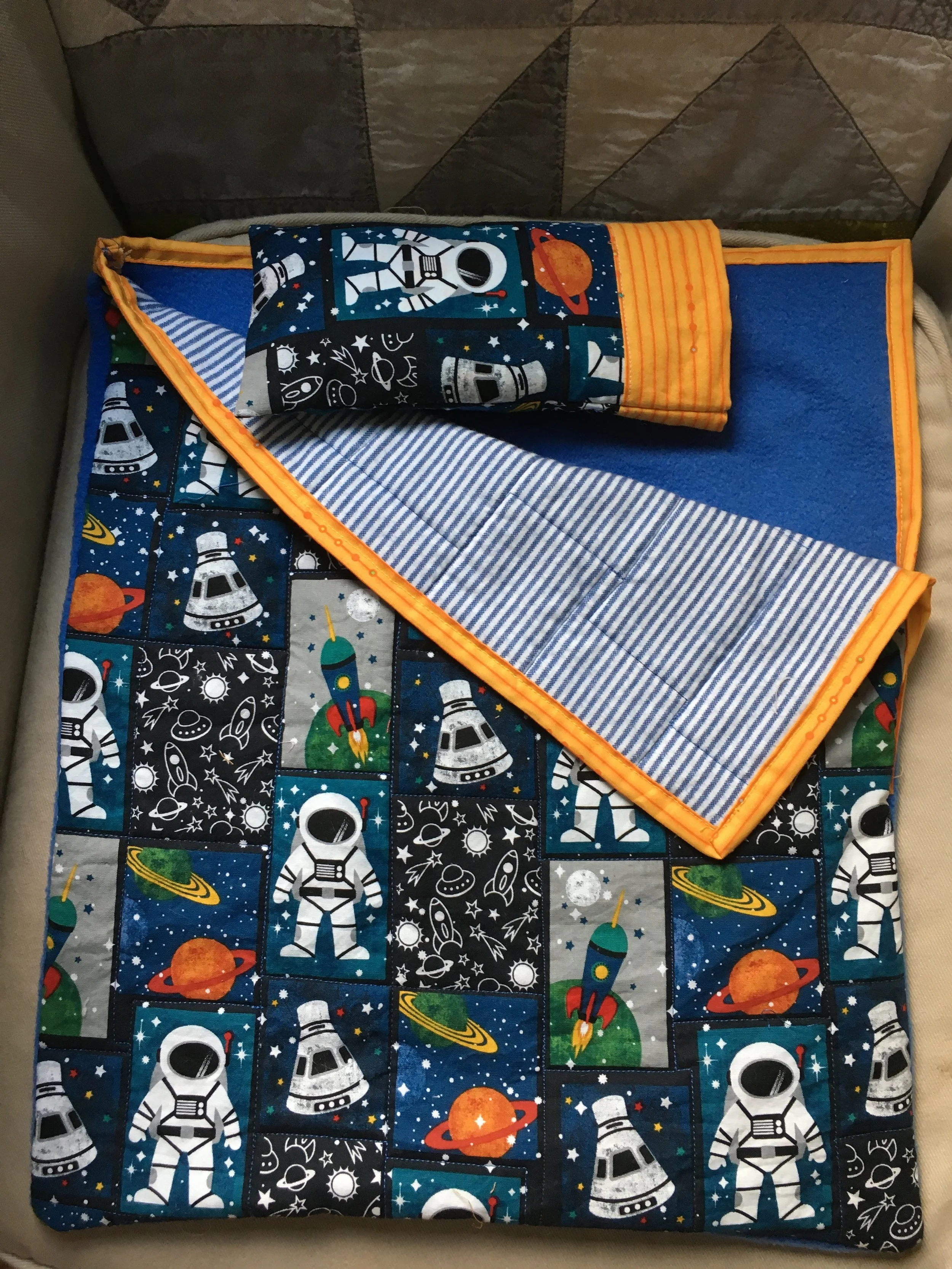
I cut out a back of blue fleece the same size as the top. Then I bound the top of both quilt and and the fleece half way down one side. Then putting the quilt and the fleece right sides together, I sewed them together using an overcast stitch along all the raw edges without the binding. Then I turned it right side out, revealing a super cute space sleeping bag!

Using some of the left over fabrics, I also made a pillow and a matching pillowcase. I think my little buddy is going to like this a lot!

This sleeping bag will fit a 12 to 15 inch doll.

Buying quilted fabric (or re-purposing a vintage quilt or quilted bathrobe) is an even easier way to make a doll’s sleeping bag with the added bonus that both the top and the bottom of the sleeping bag would be quilted.

Quilted doll sleeping bag and matching pillow.

Quilted doll sleeping bag and matching pillow.


TAGS: Doll Sleeping Bag, Quilted doll sleeping bag, How to make an easy doll sleeping bag


July 25, 2019

Water Color Salt Technique: A Tutorial

by Judy Tucker in Tutorial


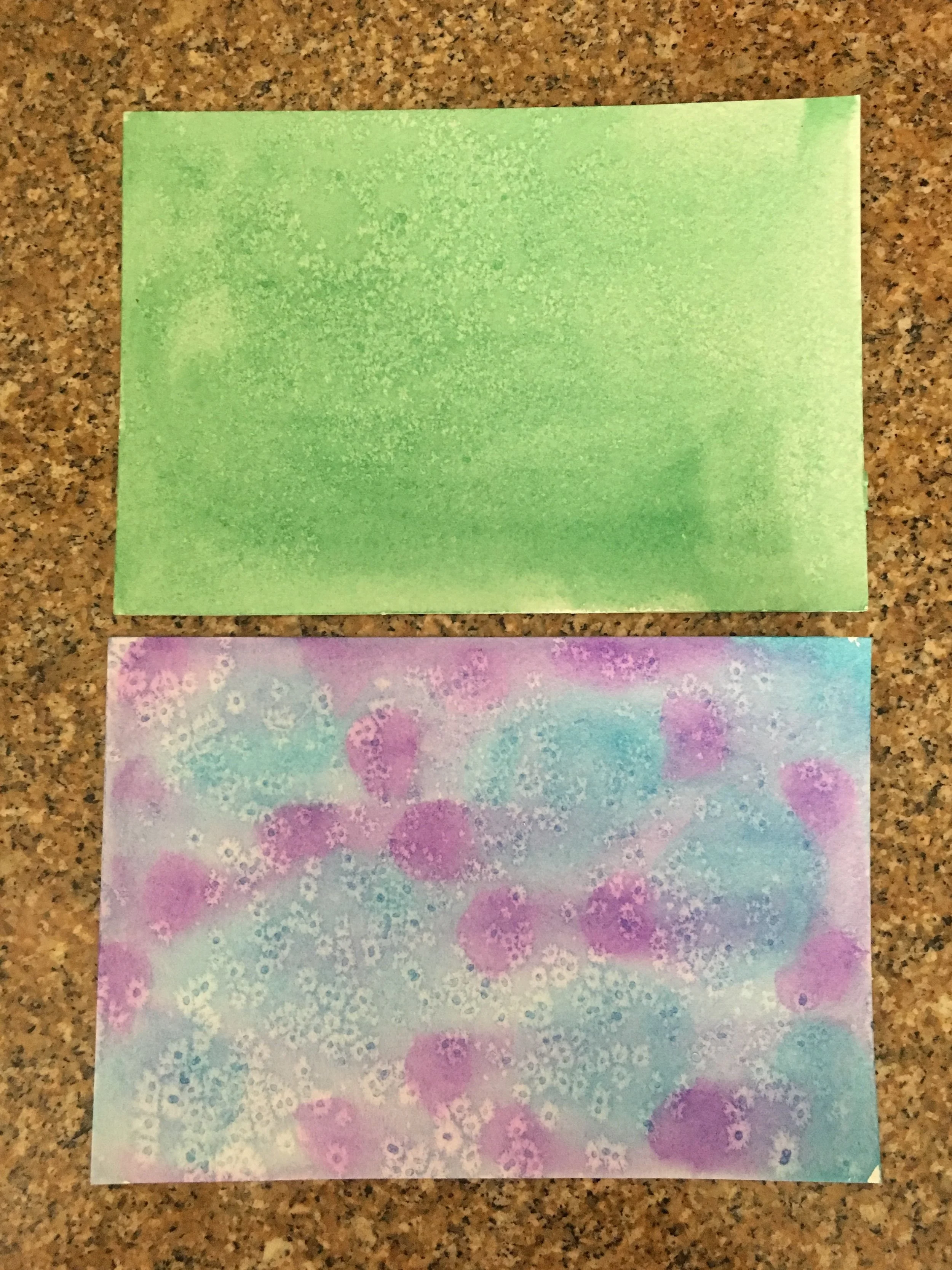
Two Papers created using a Watercolor Salt Technique

Two Papers created using a Watercolor Salt Technique

Two Papers created using a Watercolor Salt Technique

Two Papers created using a Watercolor Salt Technique

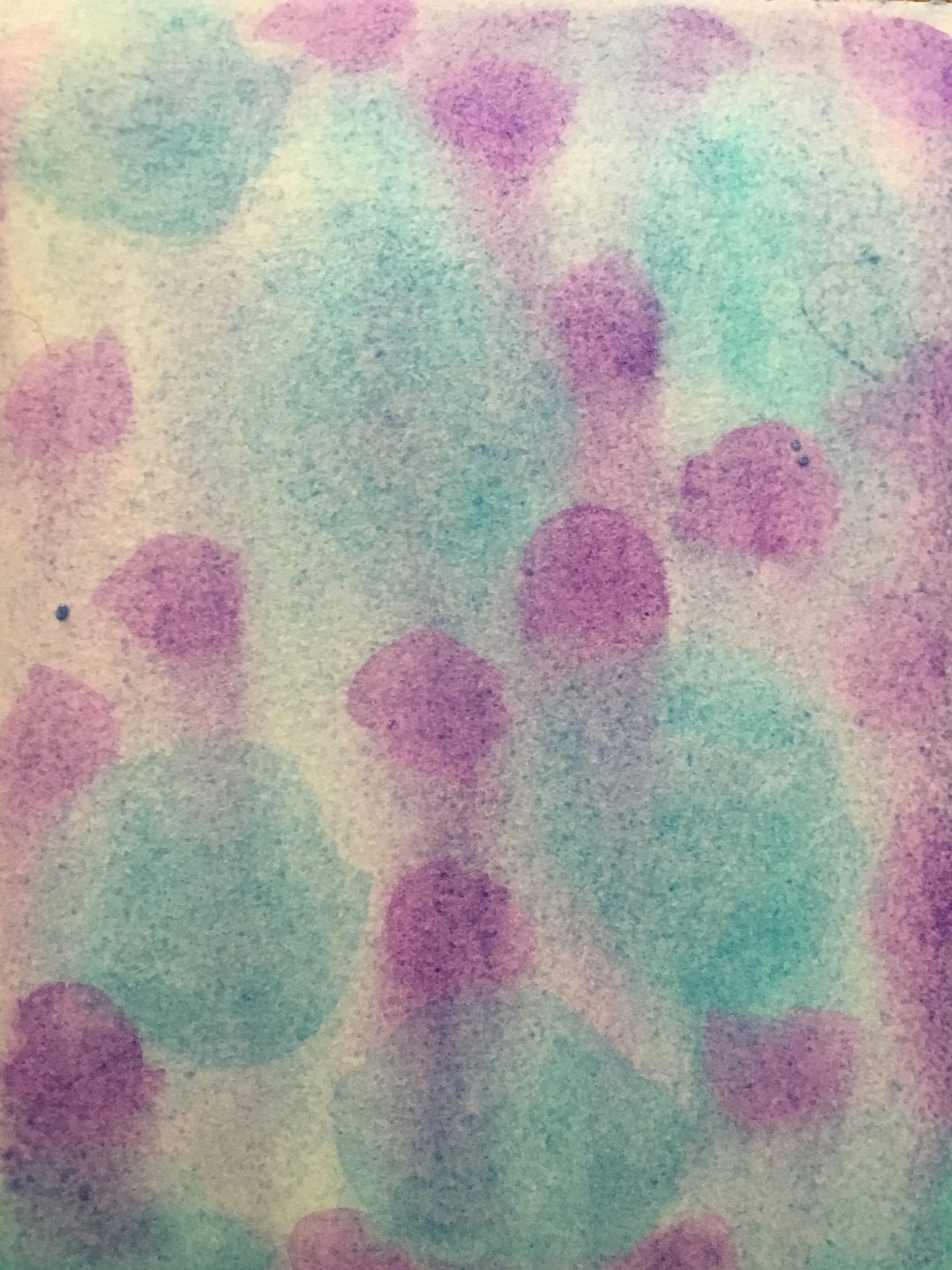
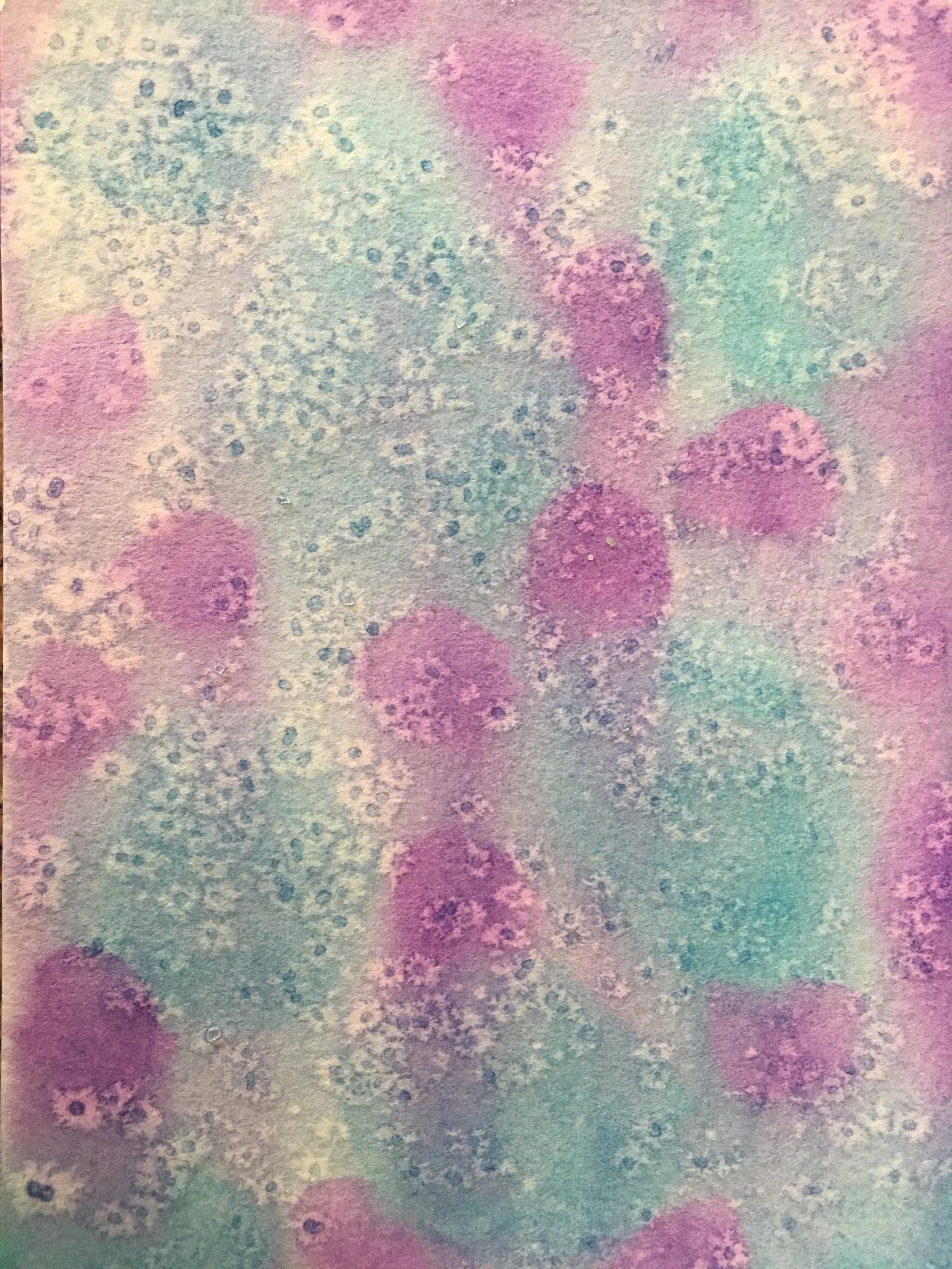
The covers of the Flag book in my last post were created using a watercolor salt technique. Watercolor salt technique is fast, fun and anyone, young or old, can do it. Here’s how I created my designs using this technique.

Supplies

  • Paper that can stand up to getting wet without buckling or rolling up. I used white watercolor paper but mixed media paper and other papers will work too.

  • Watercolor paint. Any will do, but watercolors or gouache (opaque water colors) in tubes are a easier to dilute with water.

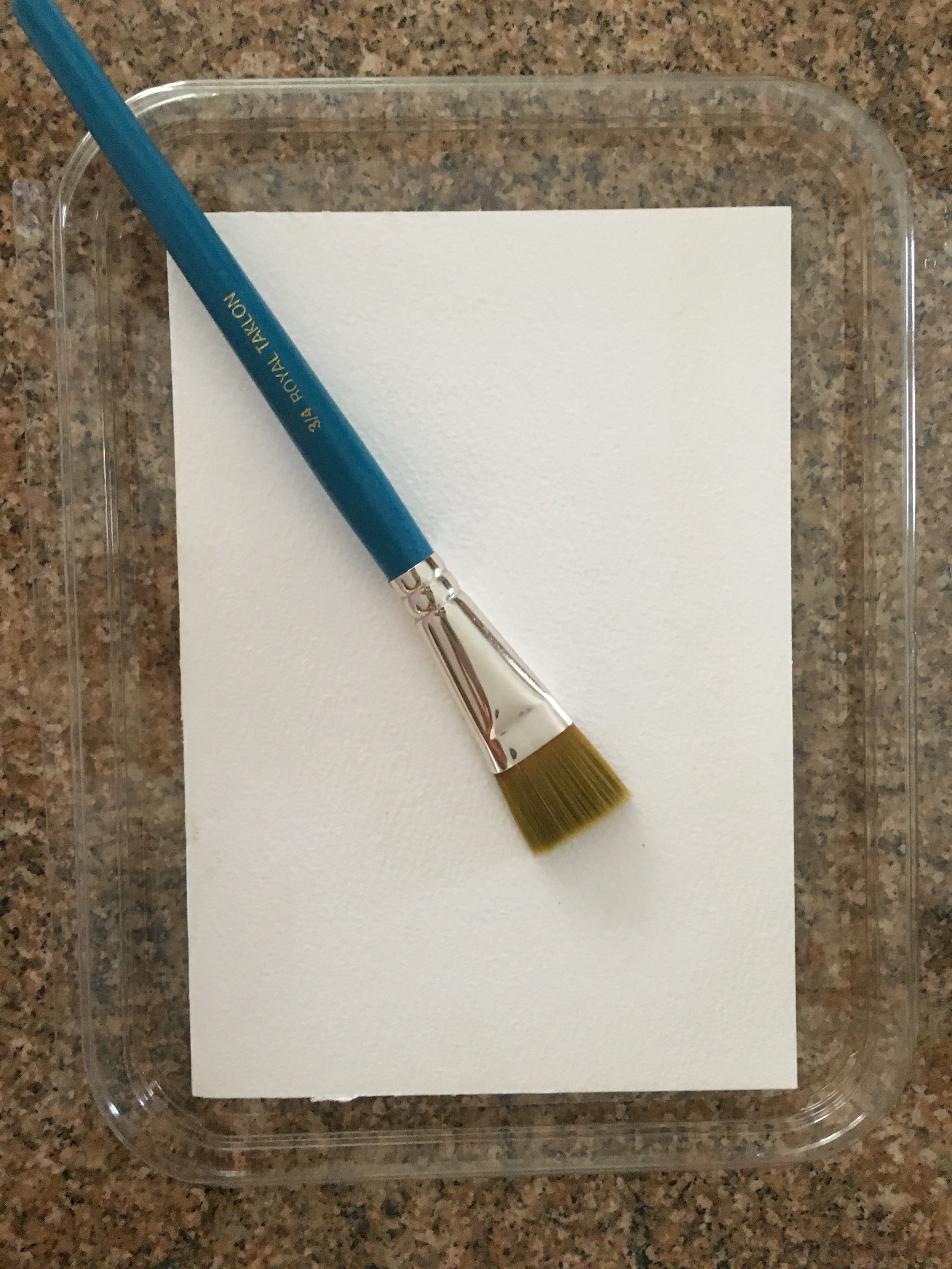
  • A paint brush and surface to dilute the watercolors—the watercolor paint box lid or a plastic or enamel palate.

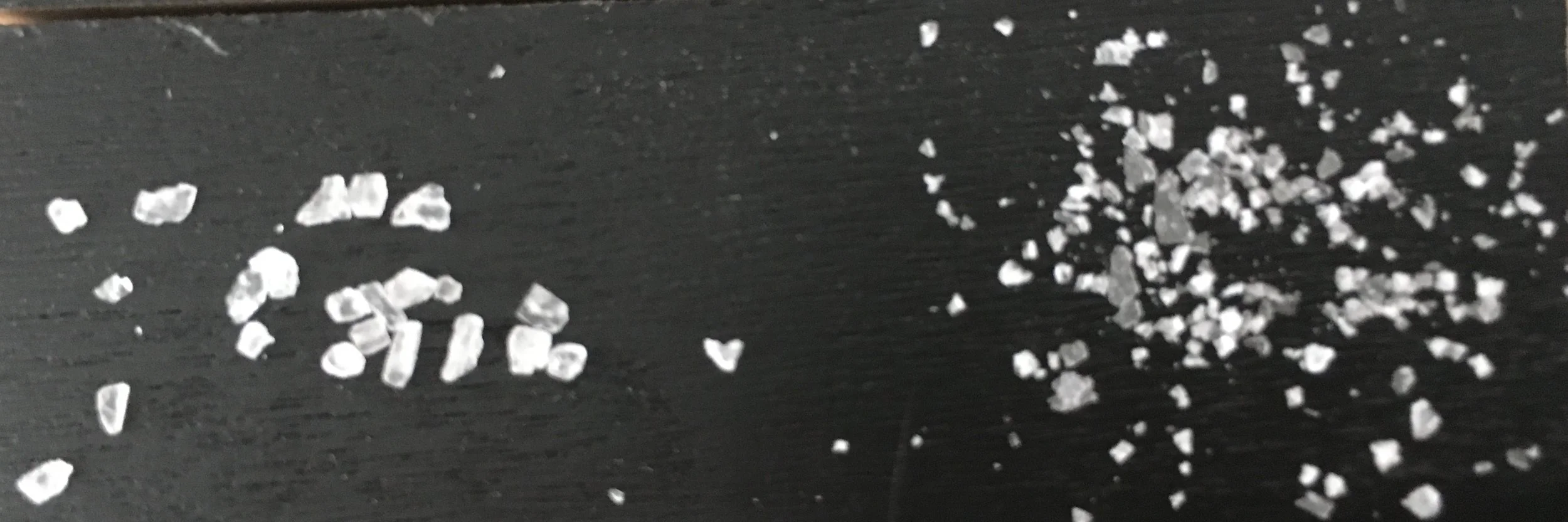
  • Salt. The coarser the salt, the bolder the resulting pattern will be. I used Diamond Kosher Crystal Salt on the green sheet and Whole Food’s 365 Coarse Sea Salt on the aqua and purple sheet.

  • A flat surface where the paper can dry completely.

Whole Food’s 365 Sea Salt—coarse Diamond Crystal Kosher Salt

Whole Food’s 365 Sea Salt—coarse Diamond Crystal Kosher Salt

Instructions:

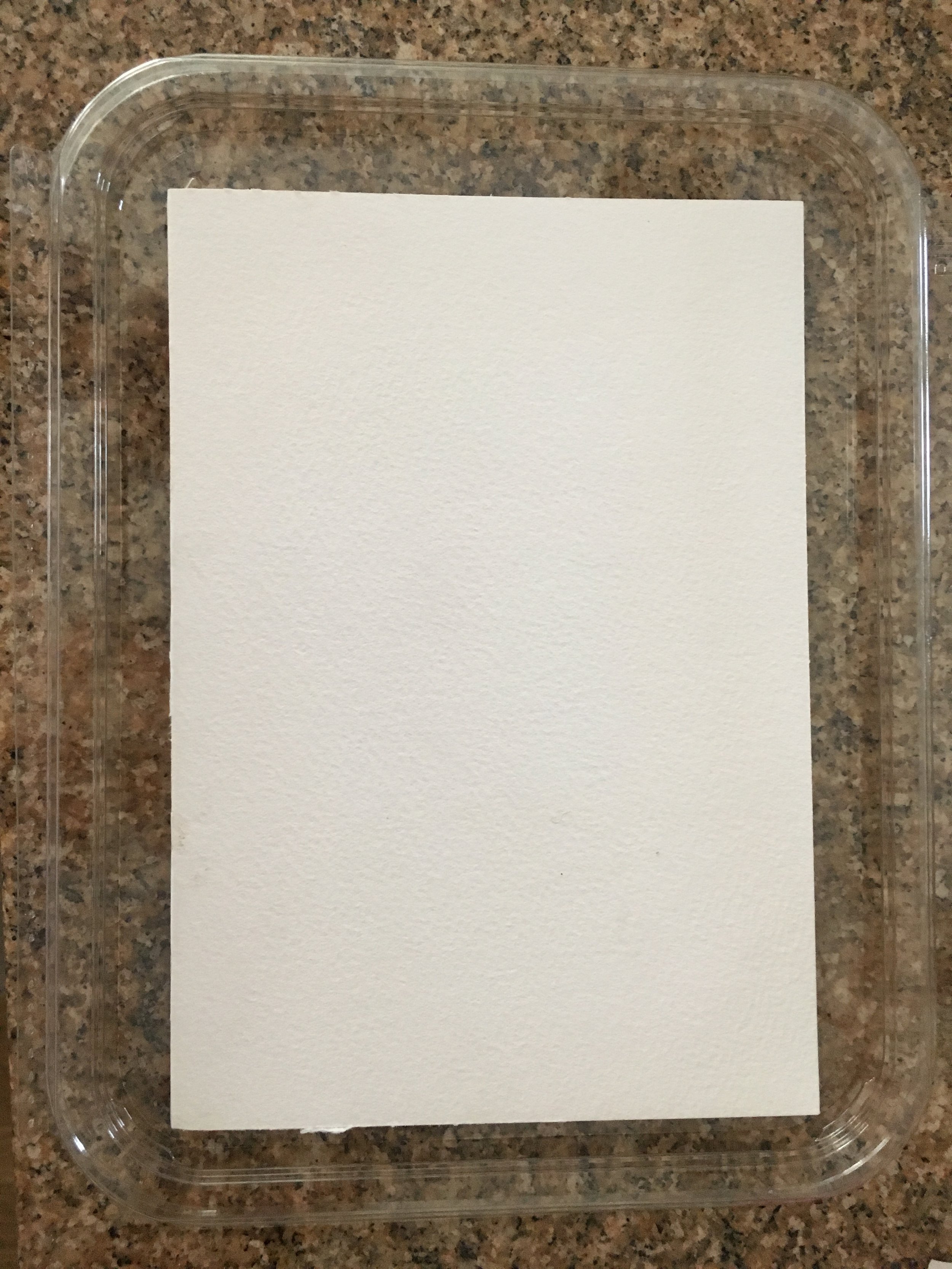
  1. Set up your work area, covering it with a protective layer of paper or plastic. My papers for this tutorial were 5 x 7 inches. I used the top of plastic lettuce box as my work area.

  2. Using clean water, dilute a color on a paintbox lid or plastic palate to the an easily spreadable consistency and the density of color you want for your design.

  3. For a solid color sheet, cover the entire piece of paper with watercolor paint. Or if you wish a design with more than one color paint or drop color on the paper anyway you wish. The sheet needs to stay wet, so it’s easier initially to just use a couple colors.

  4. While the watercolor paint is still wet on the paper, scatter salt over the paper. I covered the entire sheets but you can create an secondary design with the placement of the salt on the wet paper.

  5. Set the salted paper aside. Allow it to dry completely before preceding.

  6. Shake or gently brush the salt off the paper to reveal the design you created with the watercolor salt technique.

  7. That’s it! Enjoy your new water color designs!

IMG_0226.JPG
IMG_0228.JPG
IMG_0230.JPG
IMG_0243.JPG

Notice: This blog is not monetized: I do not use affiliate links. When there are links in a post, they are to give credit to another creative person, because I like or have used a product, or to help the reader easily find supplies for a project.

TAGS: watercolor salt technique, creating watercolor effects using salt, creating designs using watercolors and salt


July 18, 2019

Simple Flag Book

by Judy Tucker


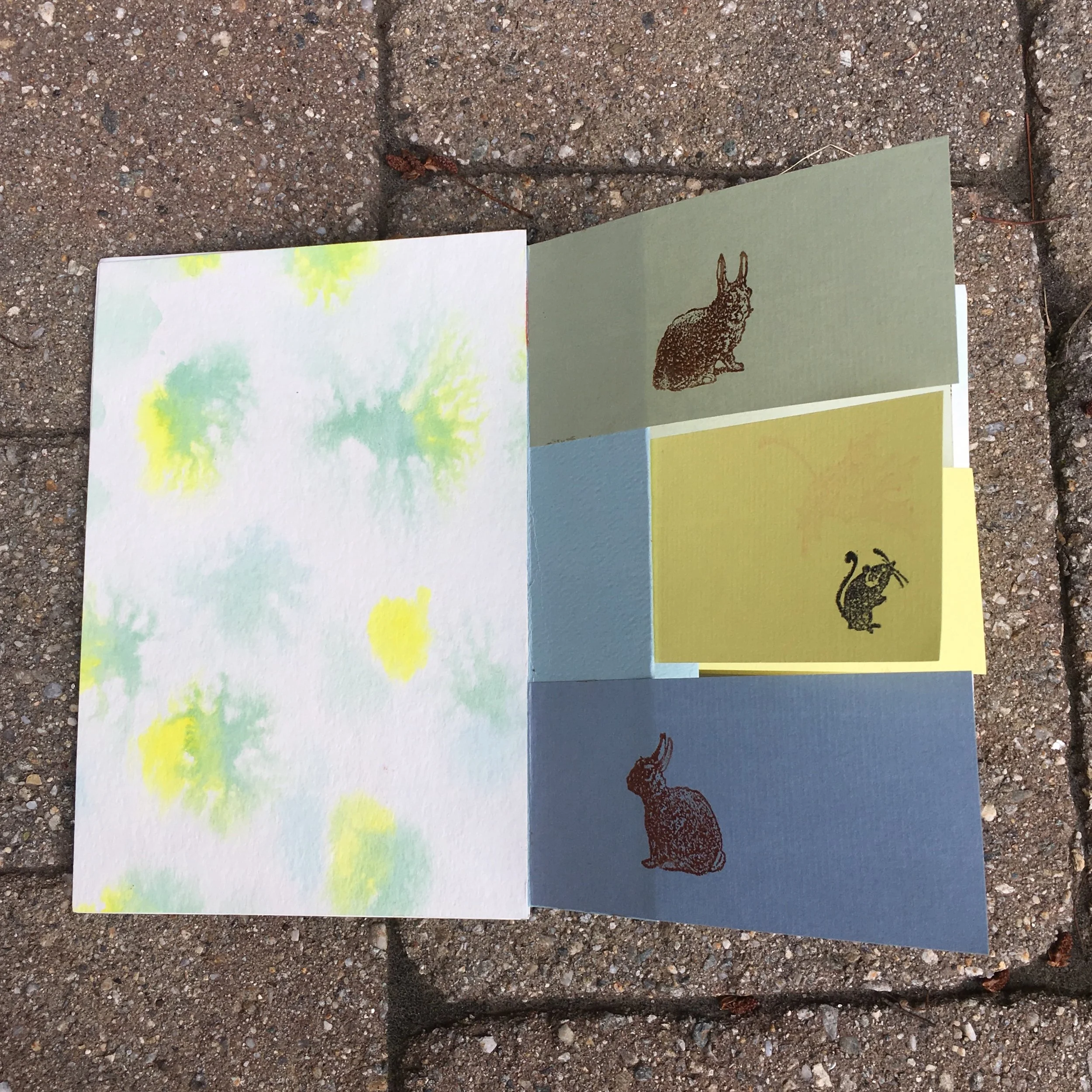
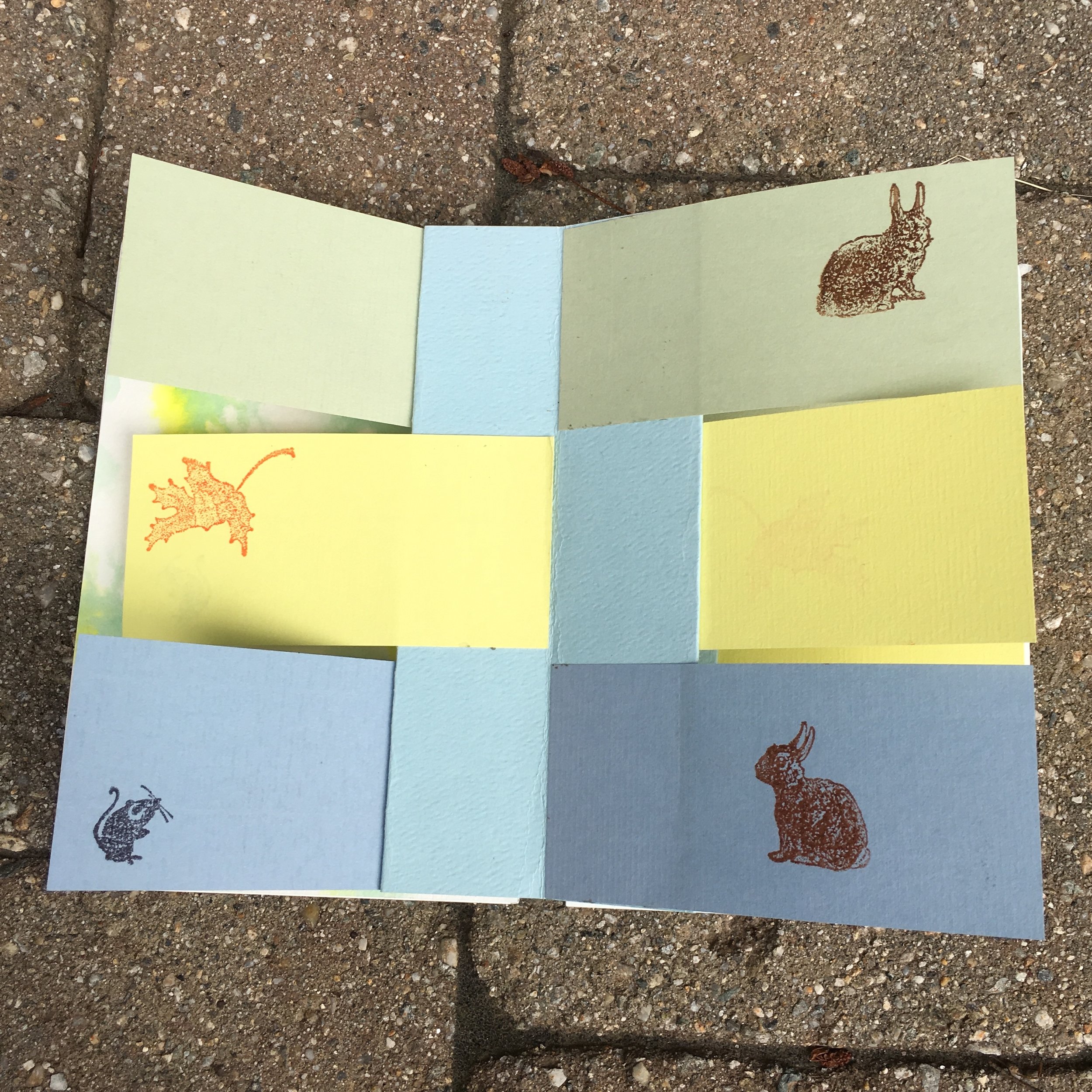
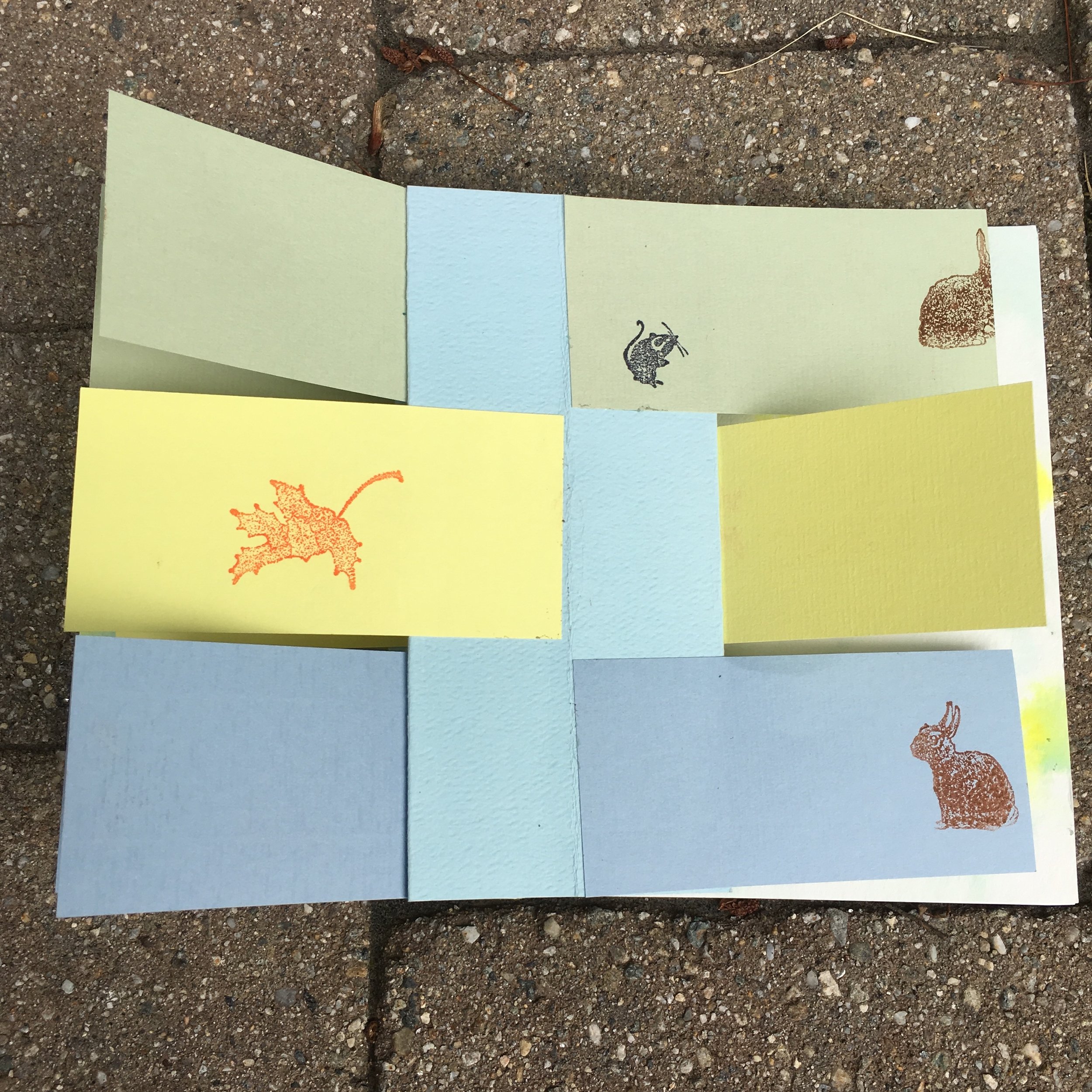
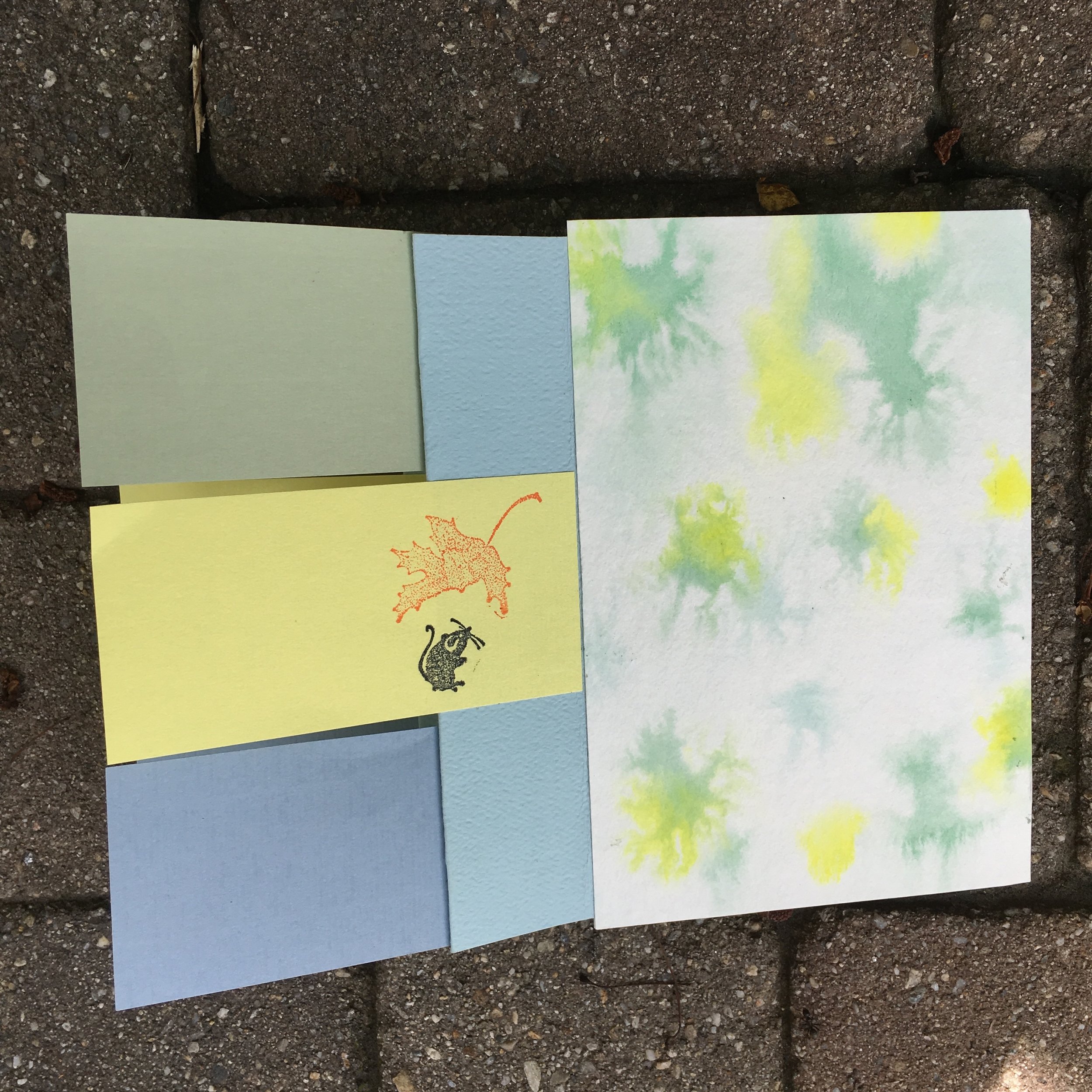
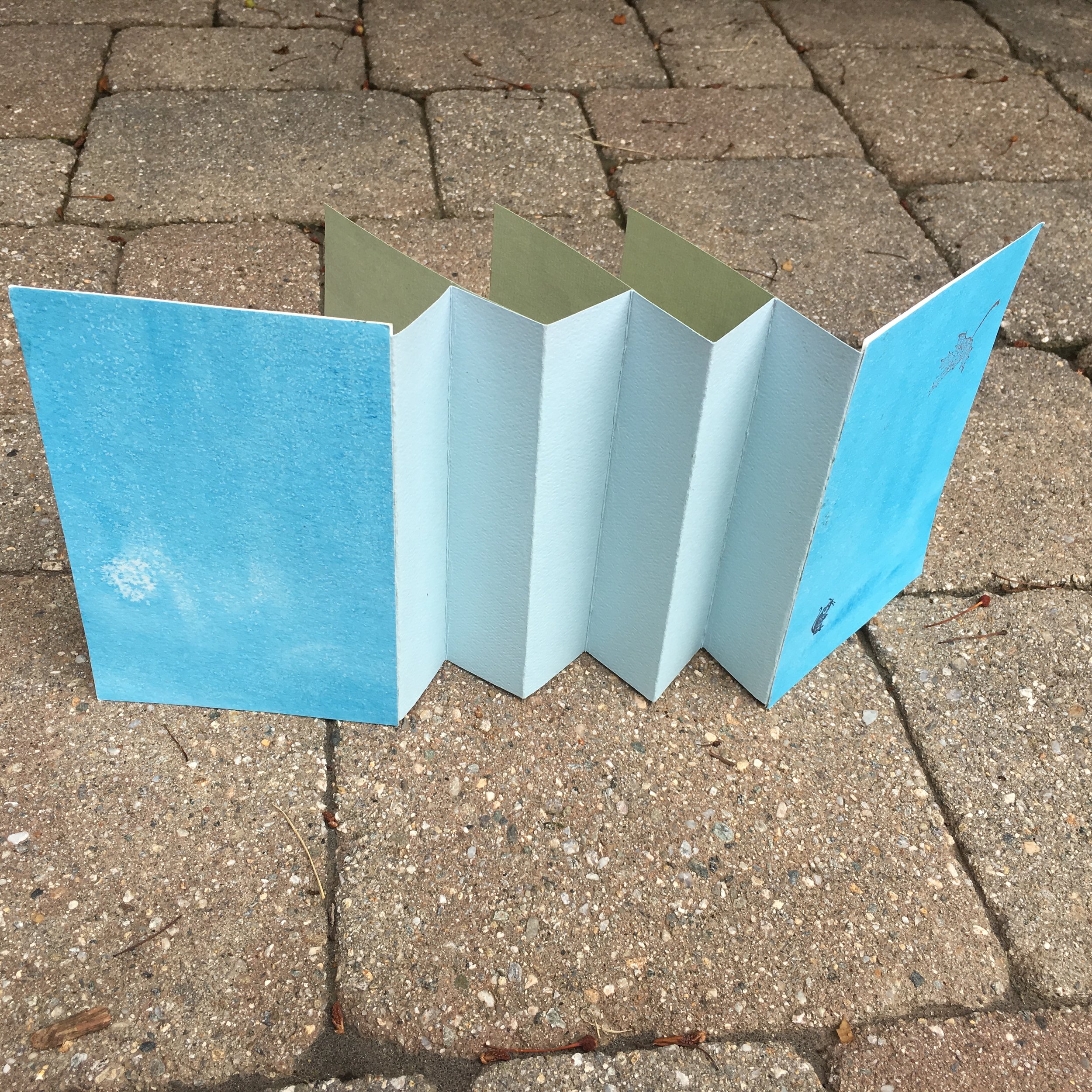
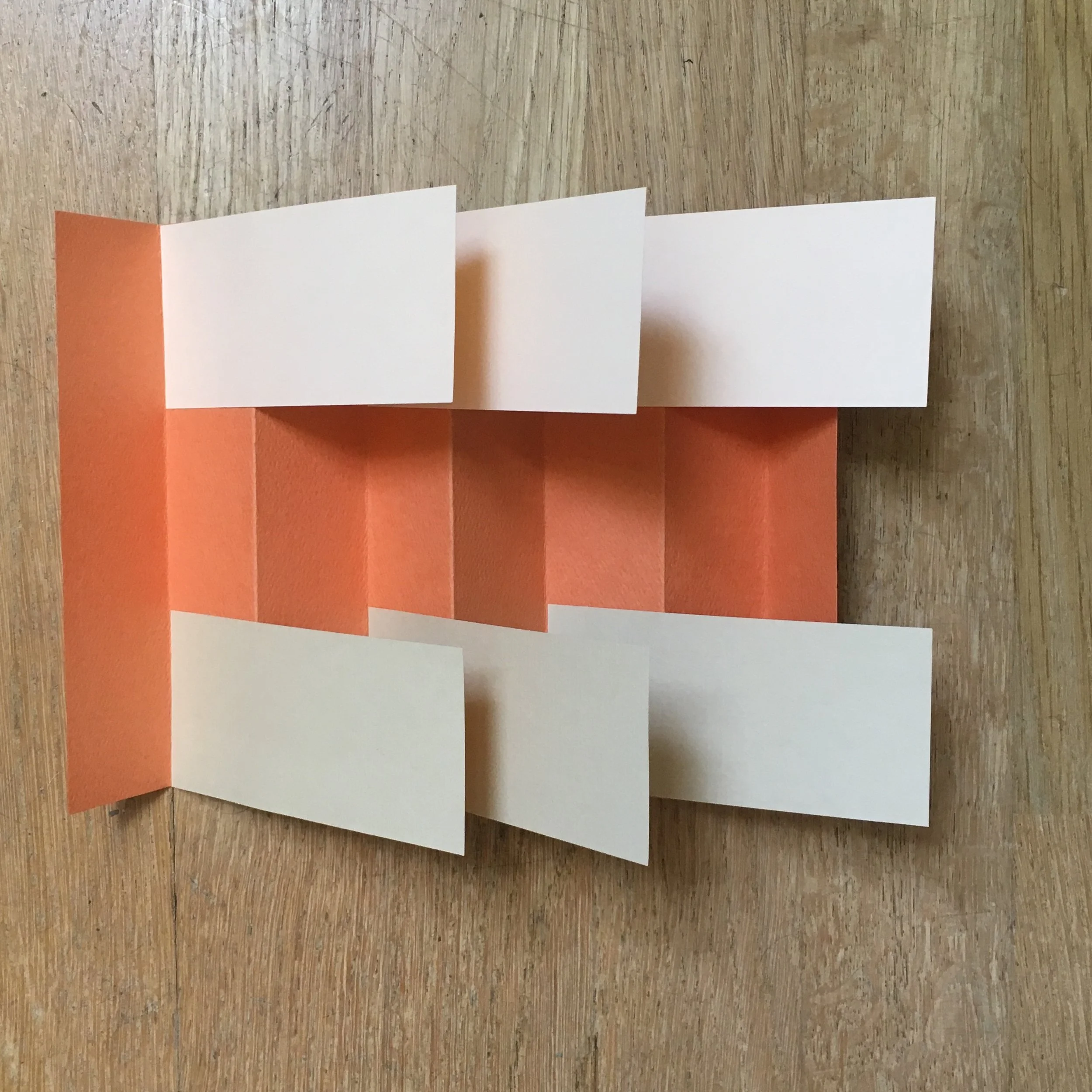
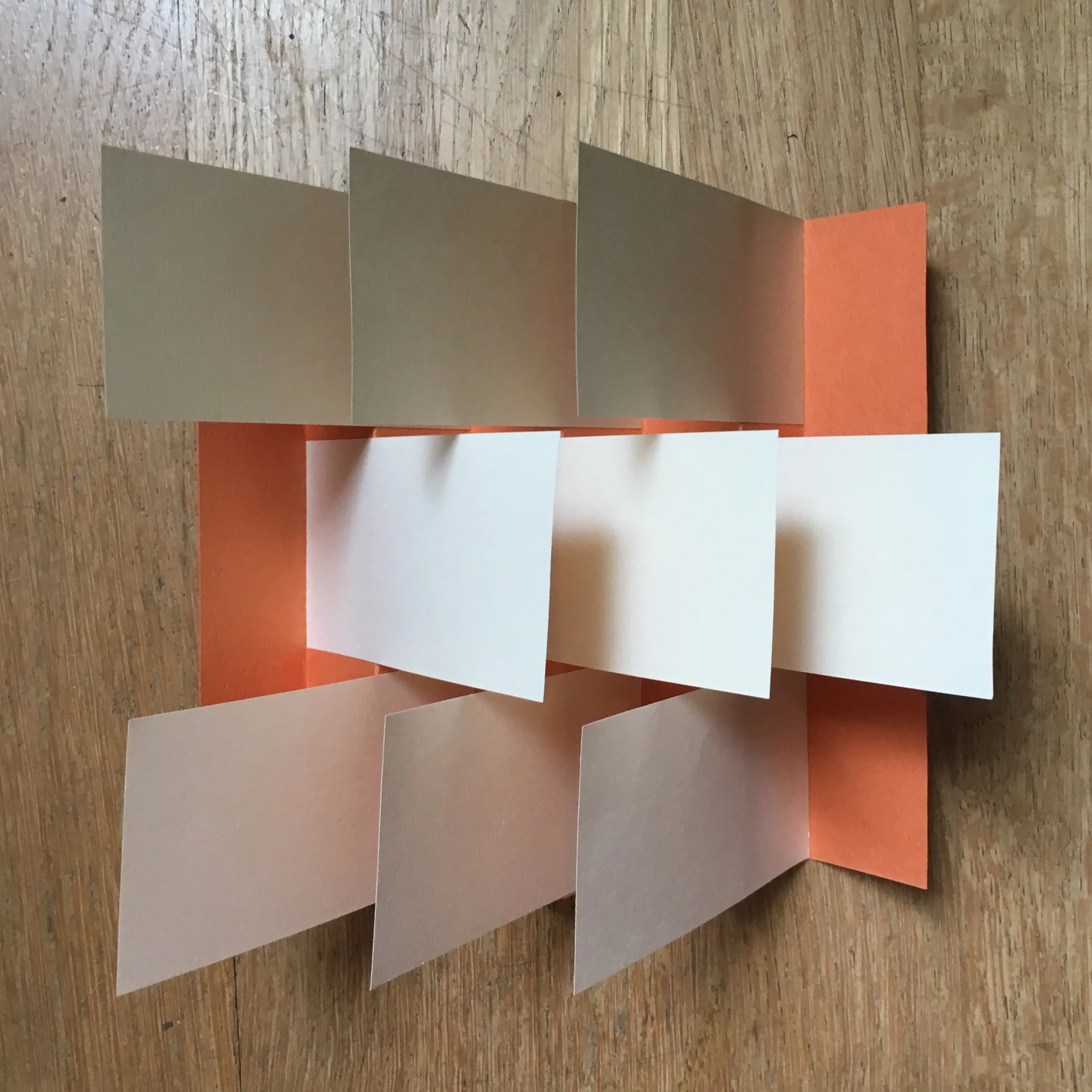
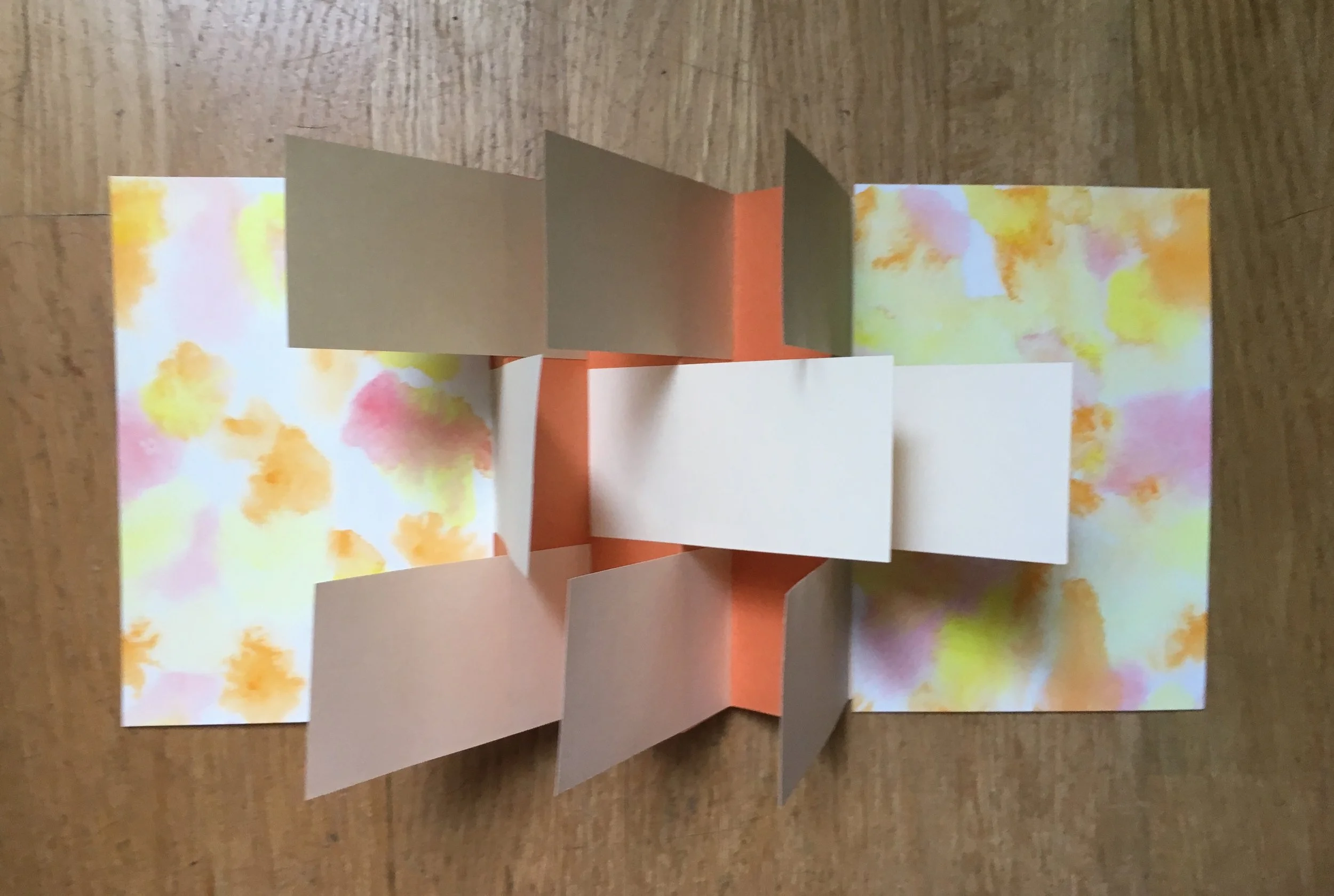
Three page flag book with soft covers

Three page flag book with soft covers

Three page flag book with soft covers

Three page flag book with soft covers

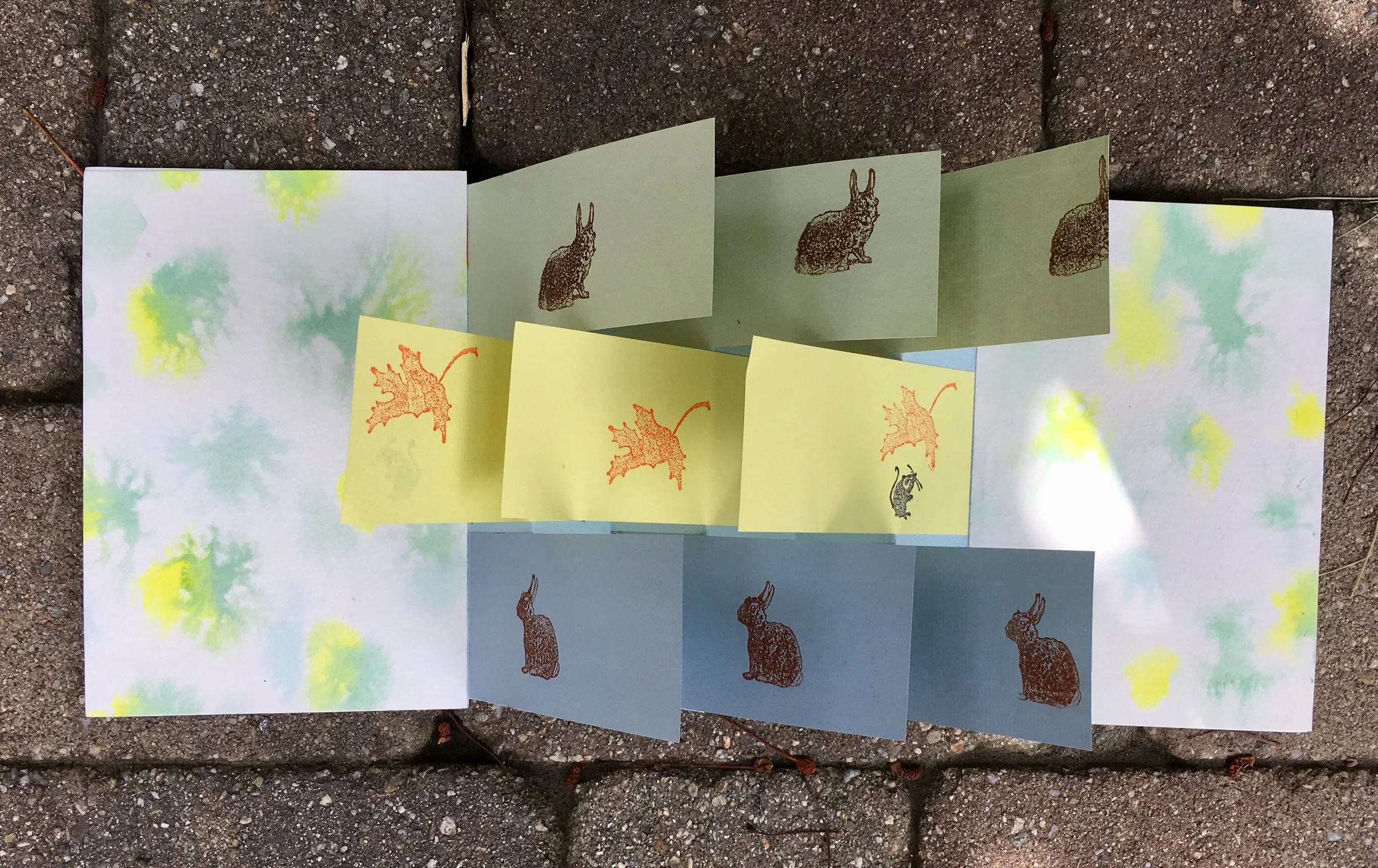
While the appliance repairman was working on my washing machine the other day, I picked up my copy of the beautiful book, The Art of the Fold - How to Make Innovative Books and Paper Structures by Hedi Kyle and Ulla Warchol. The flag book chapter caught my eye. Making a flag book has been on my project bucket list for a while. The instructions in the book are excellent. I also googled some sources online and I watched the flag book segment of Faith Hale’s “innovative Book Structures” on Creativebug.com. Faith’s demonstration is excellent and definitely worth watching.

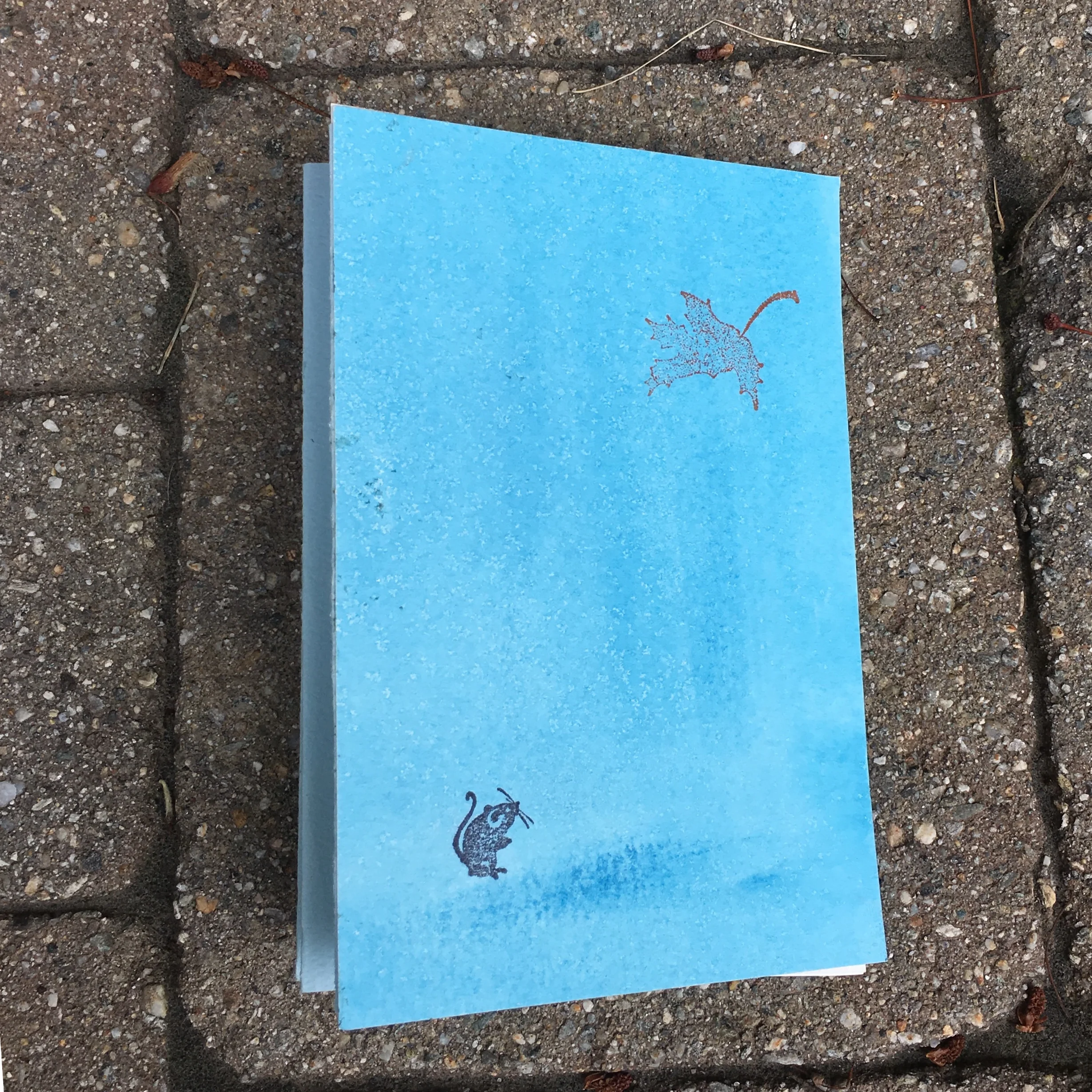
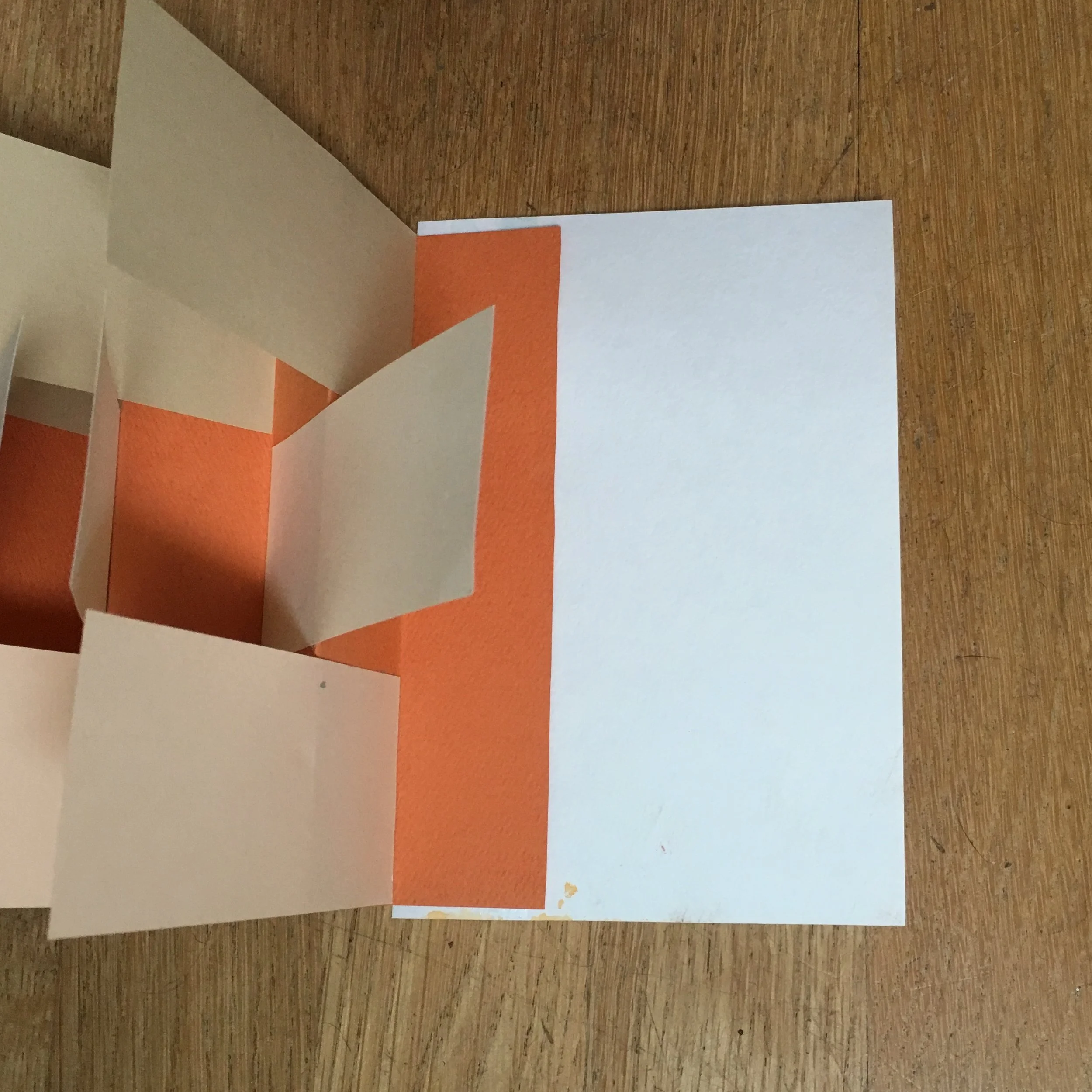
I used the book dimensions from Faith’s video but ended up modifying the flag book to have just 3 pages ( 9 flags) and soft covers. If an adult pre-cut the paper (you really need to use a paper cutter), a child could happily fold and assemble this simplified three page flag book. The final size is 6 1/4 x 4 1/4 inches.

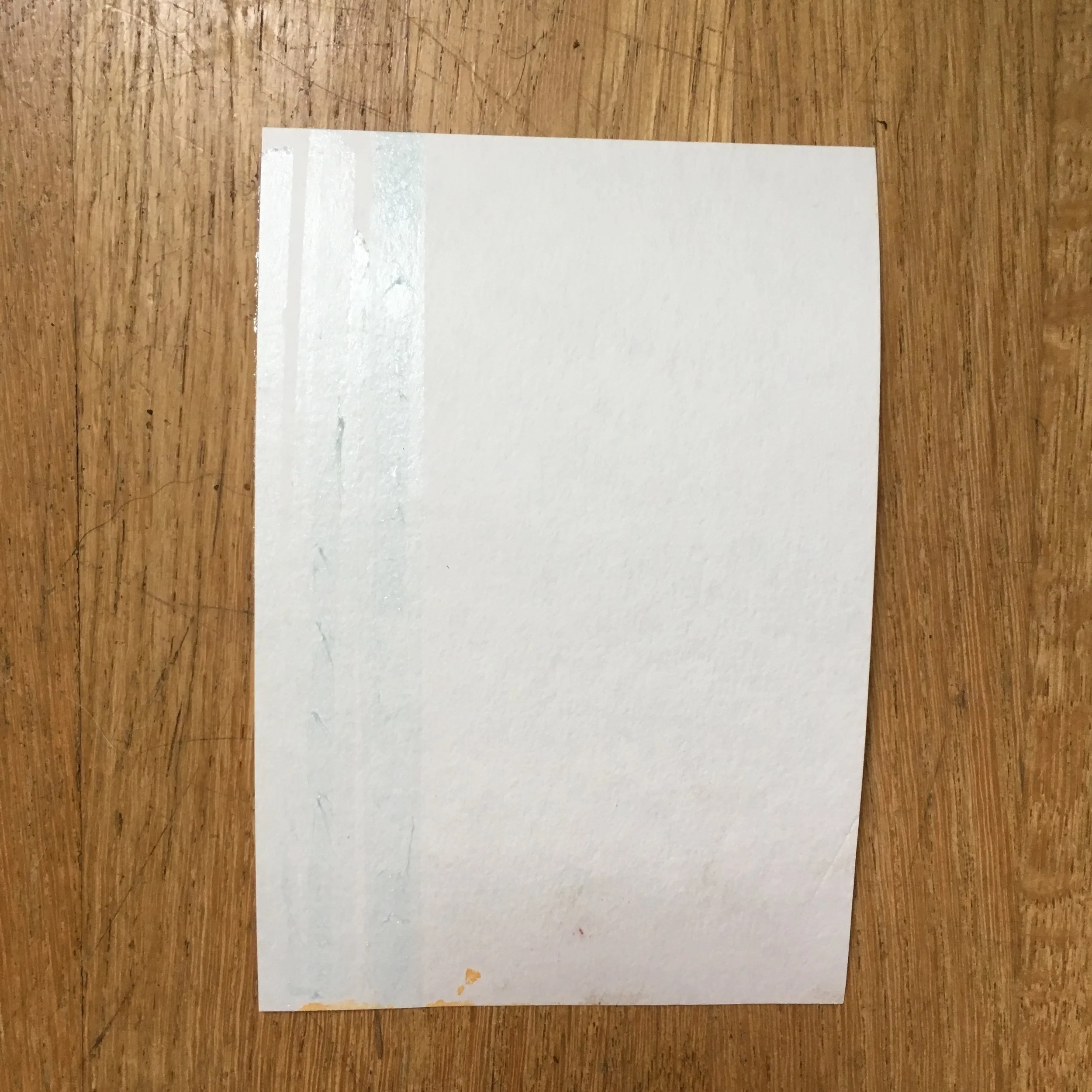
I used paper from a book of printer’s samples for the book’s pages and spine and water color paper for the covers. I used water colors treated with salt to decorate the covers and end pages. It’s so easy and really fun to make.

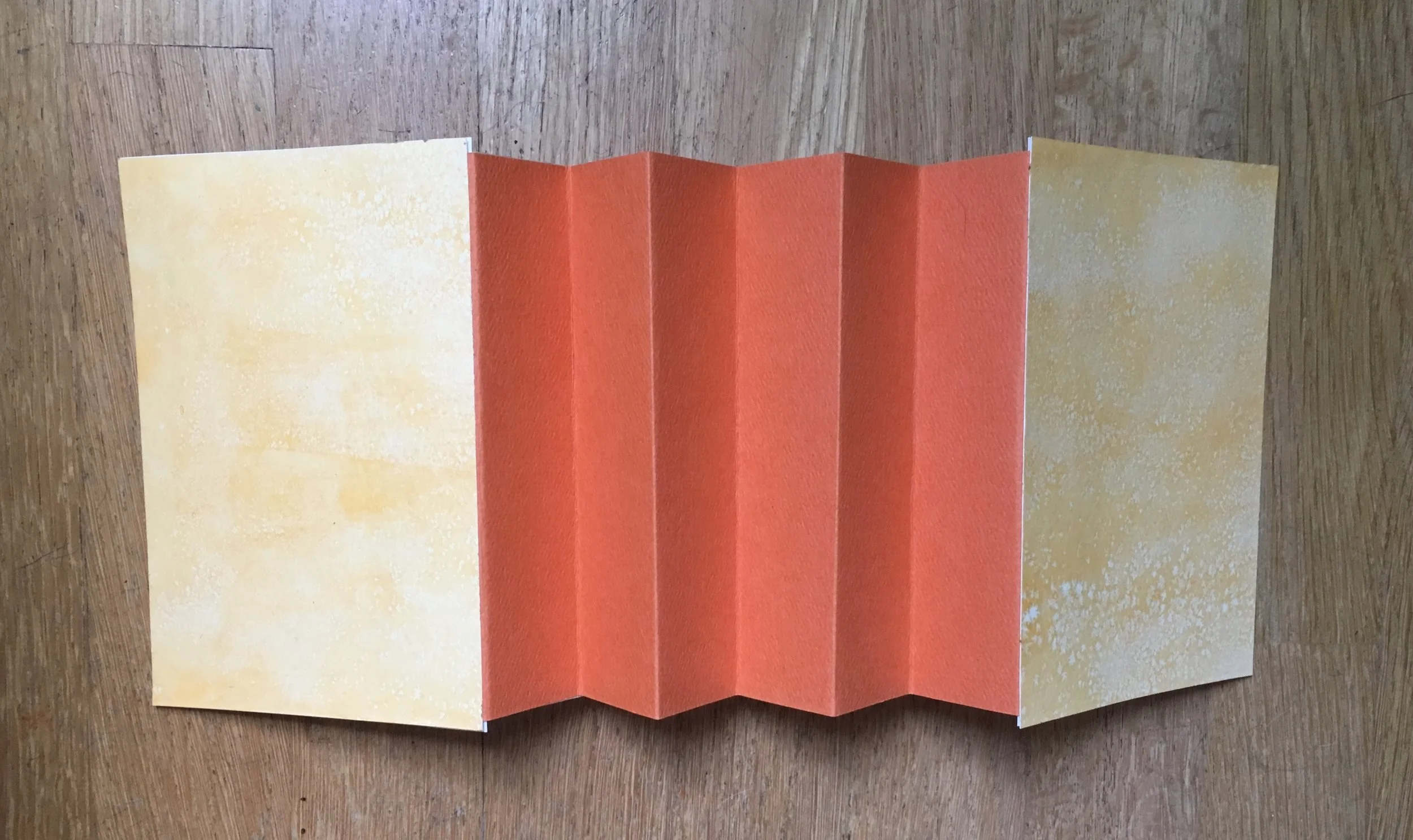
Here are the pages in the book above. The book can be read conventionally, page by page, or pulled open as seen above. I used rubber stamps to illustrate my pages.

fullsizeoutput_14f4.jpeg
fullsizeoutput_14f5.jpeg
fullsizeoutput_14ee.jpeg
fullsizeoutput_14f2.jpeg
fullsizeoutput_14f1.jpeg
IMG_0173.JPG

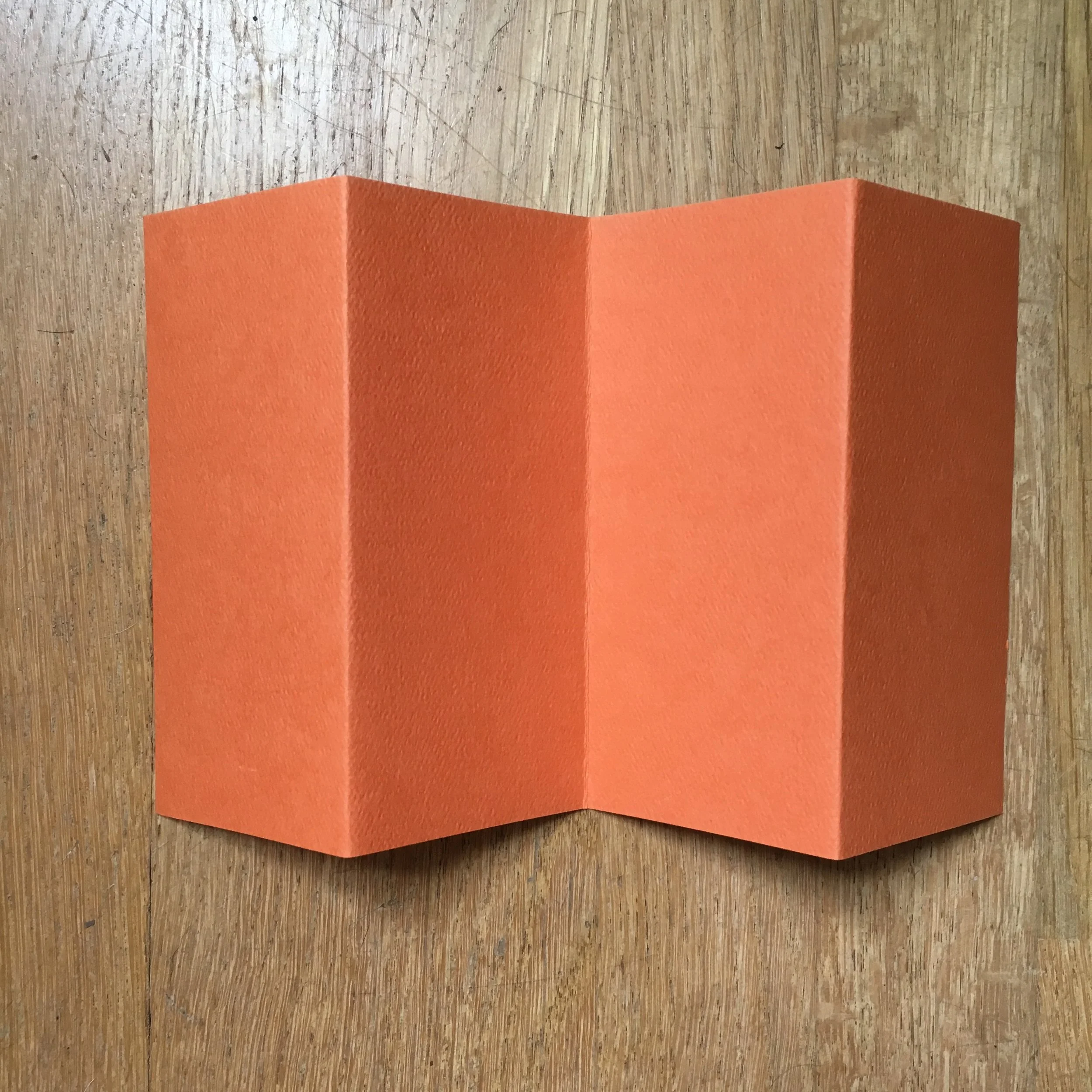
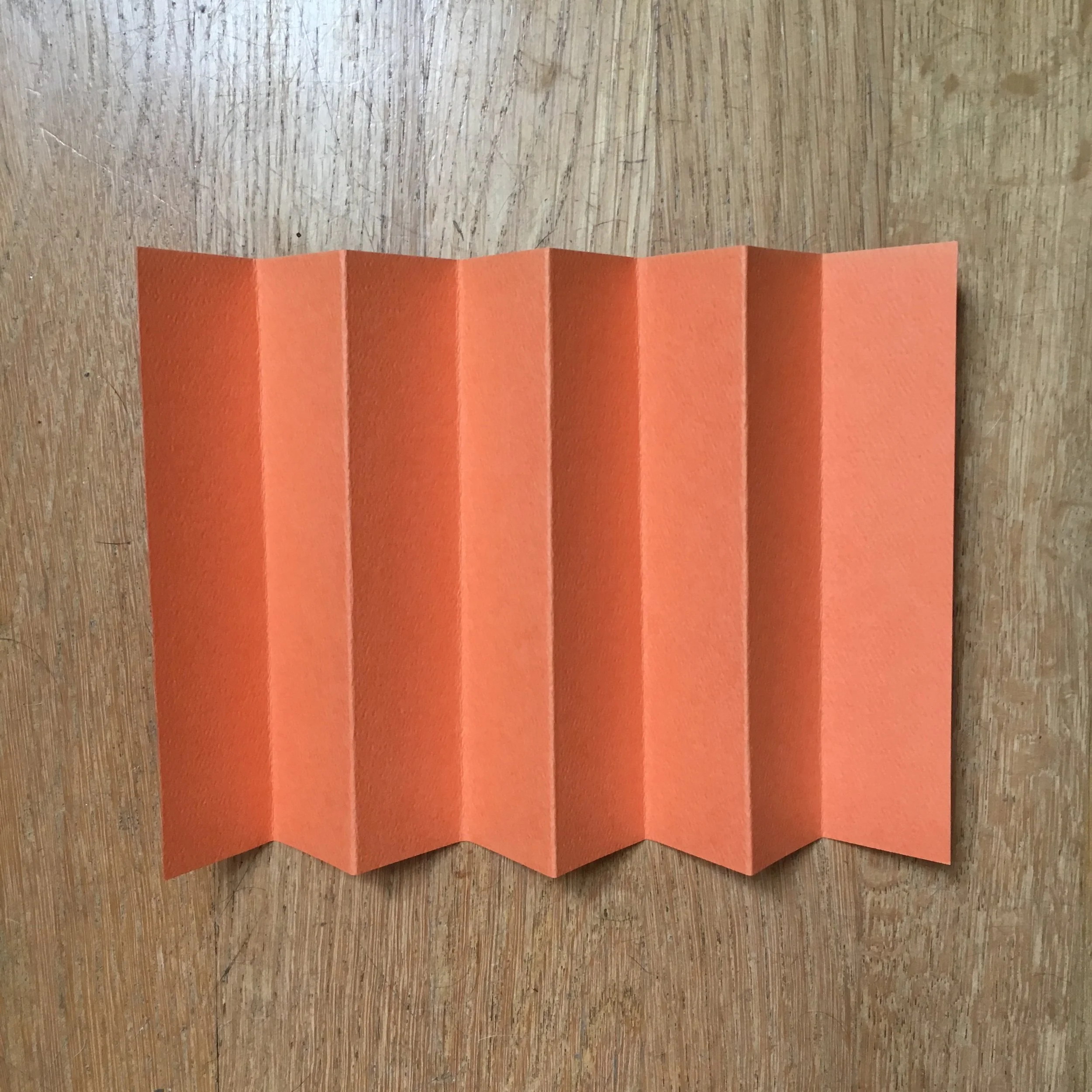
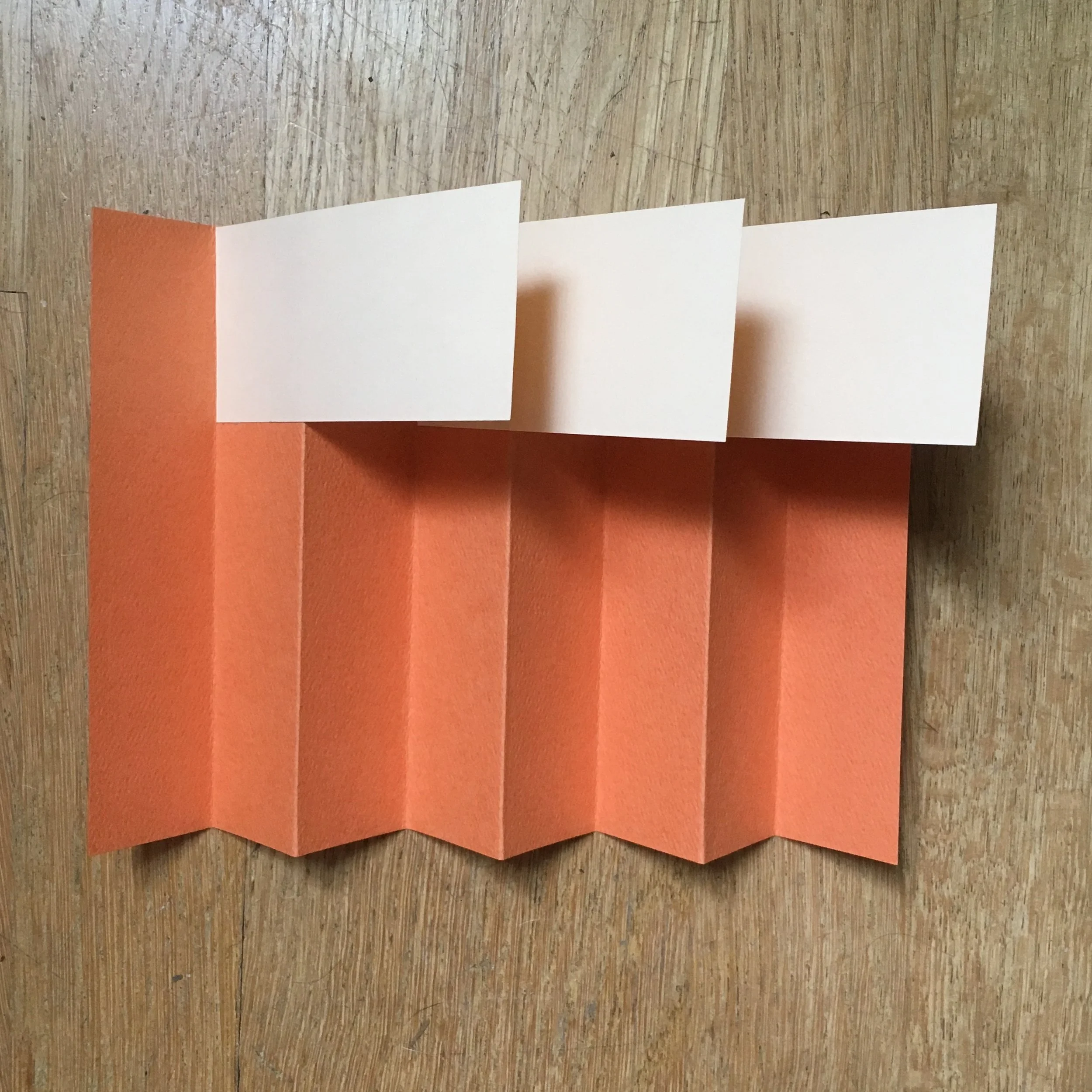
Here are photos of the process of assembling a flag book. Because I used Faith’s instructions to cut the papers for this book, I’m not going to do a tutorial. She’s already done it beautifully! But here are my variations—my spine has half the number of folds as hers so mine only 3 has pages (9 flags in total) , while hers has 7 pages (21 flags). If are making a flag book using Faith’s video, but you want to use soft covers like mine, cut 2 pieces of heavy paper 4 1/4 x 6 1/4 inches for the front and back covers, and 2 end papers of the same size. (I used the heavy watercolor paper for both). The cover is glued on first, and then the end pages are glued to the covers on the inside of the book. I find this soft cover to be totally satisfactory. It also skips the step of covering book board with paper so the project can be completed in just a couple hours.

fullsizeoutput_14ed.jpeg
fullsizeoutput_14f3.jpeg
fullsizeoutput_14f8.jpeg
fullsizeoutput_14f7.jpeg
fullsizeoutput_14f9.jpeg
fullsizeoutput_14fa.jpeg
fullsizeoutput_14fc.jpeg
fullsizeoutput_14fd.jpeg
fullsizeoutput_14ff.jpeg

The first time I illustrated my pages and then glued them into the book. That really complicated the book assembly and I found that the animals didn’t always have the best placement on a page. I actually removed the illustrated last page in the book and re-did it. What looked good as a page lying flat on the table wasn’t as great as a page in the book.

So I recommend illustrating the pages after the book has been assembled. I used rubber stamps, but drawings, photos and stickers would all make fun illustrations for a flag book.

Give it a try! It looks more complicated than it actually is. It really is such a great project.

TAGS: Flag Book, CreativeBug.com, The Art of the Fold, The Art of The Fold, The Art of The Fold by Hedi Kyle and Ulla Warchol, Simplified flag book, Flag book with soft covers, 3 page flag book


July 11, 2019

Child and Doll Skirts Featuring Another 1930s Reproduction Fabric

by Judy Tucker


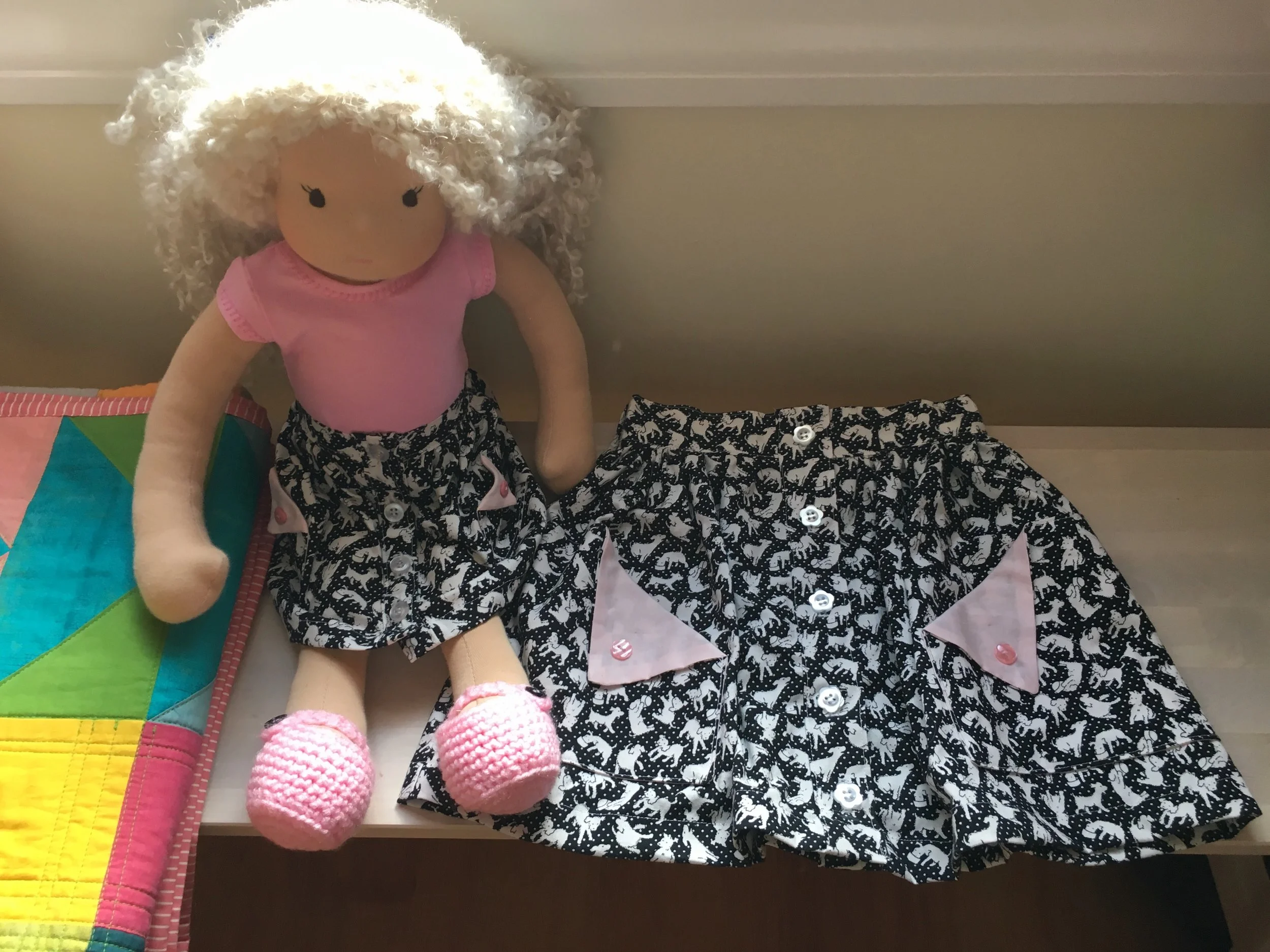
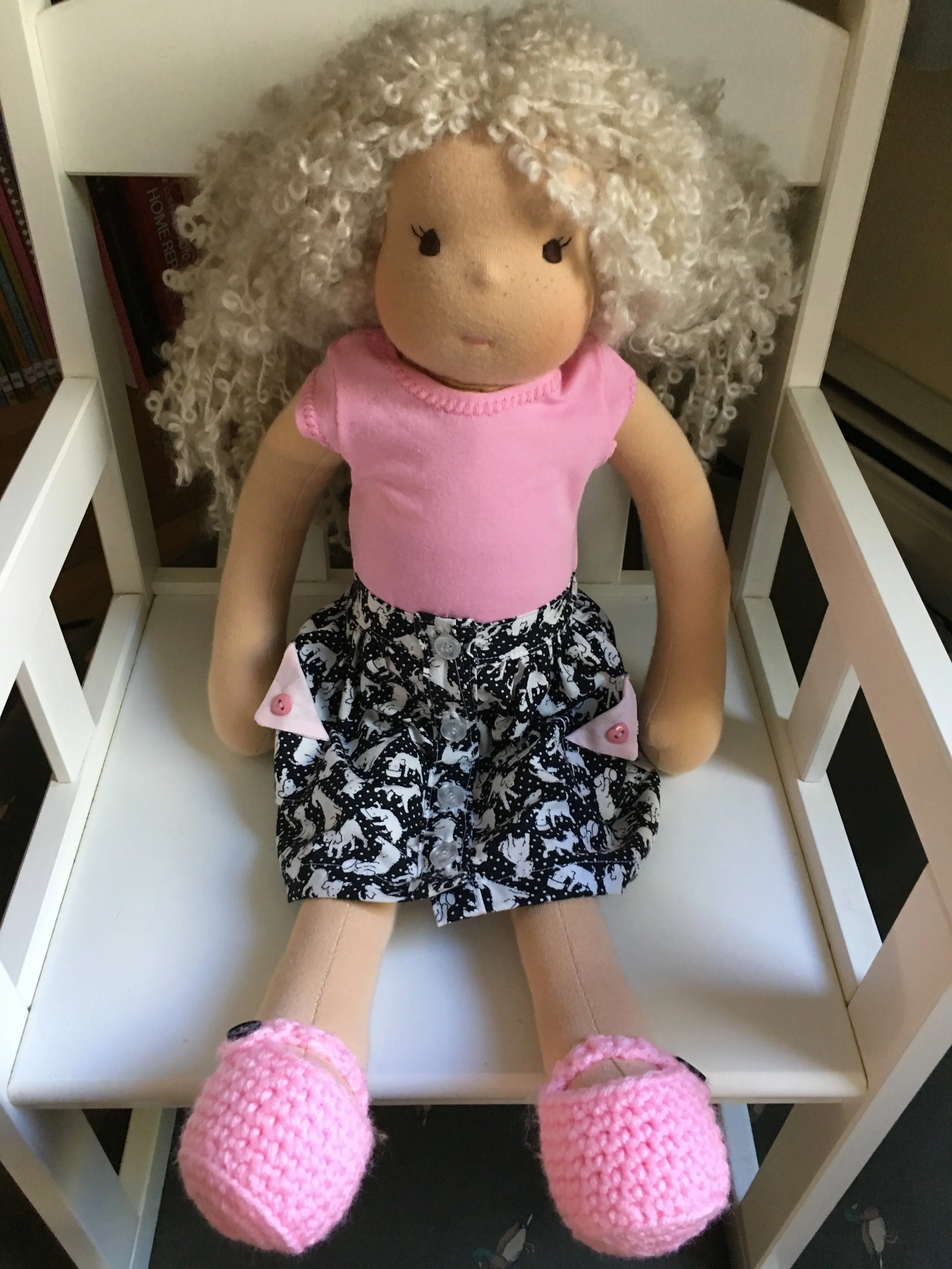
Olive ann designs Buttons Skirts and Pixie Faire T shirt. The doll is a Bamboletta Forever Friend.

Olive ann designs Buttons Skirts and Pixie Faire T shirt. The doll is a Bamboletta Forever Friend.

Olive ann designs Buttons Skirts and Pixie Faire T shirt. The doll is a Bamboletta Forever Friend.

Olive ann designs Buttons Skirts and Pixie Faire T shirt. The doll is a Bamboletta Forever Friend.

I’ve had this delightful 1930’s reproduction dog fabric for several years. It never called out to me to use it in a quilt, probably because black and white quilts are just not in my wheelhouse.

But it’s perfect fabric for a birthday present for a dog-loving neice and her American Girl Doll!

The skirt pattern is the Bubbles & Buttons Skirts and Doll Skirts, OAD 86, sizes 1-8 and an 18 inch doll, by olive ann designs. This is full skirt that has elastic in the back waistband. The child’s and doll’s skirts are made exactly the same way. Those are functional buttons on the doll’s skirt! No hook and loop tape in sight!

I added the contrasting color on the inside of the pockets. I really like the light pink accent on the black and white fabric.

I has happy to discover that even though the doll skirt is intended for an 18 inch doll, with the waistband elastic a bit looser, it perfectly fits a 20 inch Bamboletta Forever Friend. I don’t have an 18” doll, so looking around my house for a doll to act as a model, I tried it on my Bamboletta Forever Friend. It fit! So exciting because I usually have to draft patterns for clothes the Bamboletta dolls. And even more fun because I wouldn’t draft this detailed an skirt for doll.

The T shirt is a free pattern from Pixie Faire. It’s a great pattern and went together quickly and easily.

I’m so happy that this dog fabric finally found a perfect home in this twin project!

BambolettaForeverFriendModelingDollClothes.jpg


TAGS: olive ann designs Bubble and Buttons Skirt pattern, Child/doll matching skirt patterns, Matching child and doll dresses, Pattern that fits a Bamboletta Forever Friend doll, Reproduction 1930s fabrics, 1930s fabrics for clothing


  • Newer
  • Older

Powered by Squarespace 7