Search
  • Information
    • About
    • Contact
    • Privacy Policy
  • Blog
  • Subscribe
  • Tutorials
    • Tutorials
    • Doll Clothes: Photos and some Patterns
  • Suggested Reading
  • Quilts: My Original Designs
  • Gallery: Color Studies
  • Gallery: Quilts I've Made
  • Doll Making Blog Posts
  • Recent blog posts
  • Quilts Based on The Improv Handbook for Modern Quilters
Close
Menu
Search
Close
  • Information
    • About
    • Contact
    • Privacy Policy
  • Blog
  • Subscribe
  • Tutorials
    • Tutorials
    • Doll Clothes: Photos and some Patterns
  • Suggested Reading
  • Quilts: My Original Designs
  • Gallery: Color Studies
  • Gallery: Quilts I've Made
  • Doll Making Blog Posts
  • Recent blog posts
  • Quilts Based on The Improv Handbook for Modern Quilters
Menu

Sleeping Dog Quilts

SLEEPING DOG QUILTS

January 20, 2022

Sampler Quilt using Australian Aboriginal Prints

by Judy Tucker


12 in block

12 in block

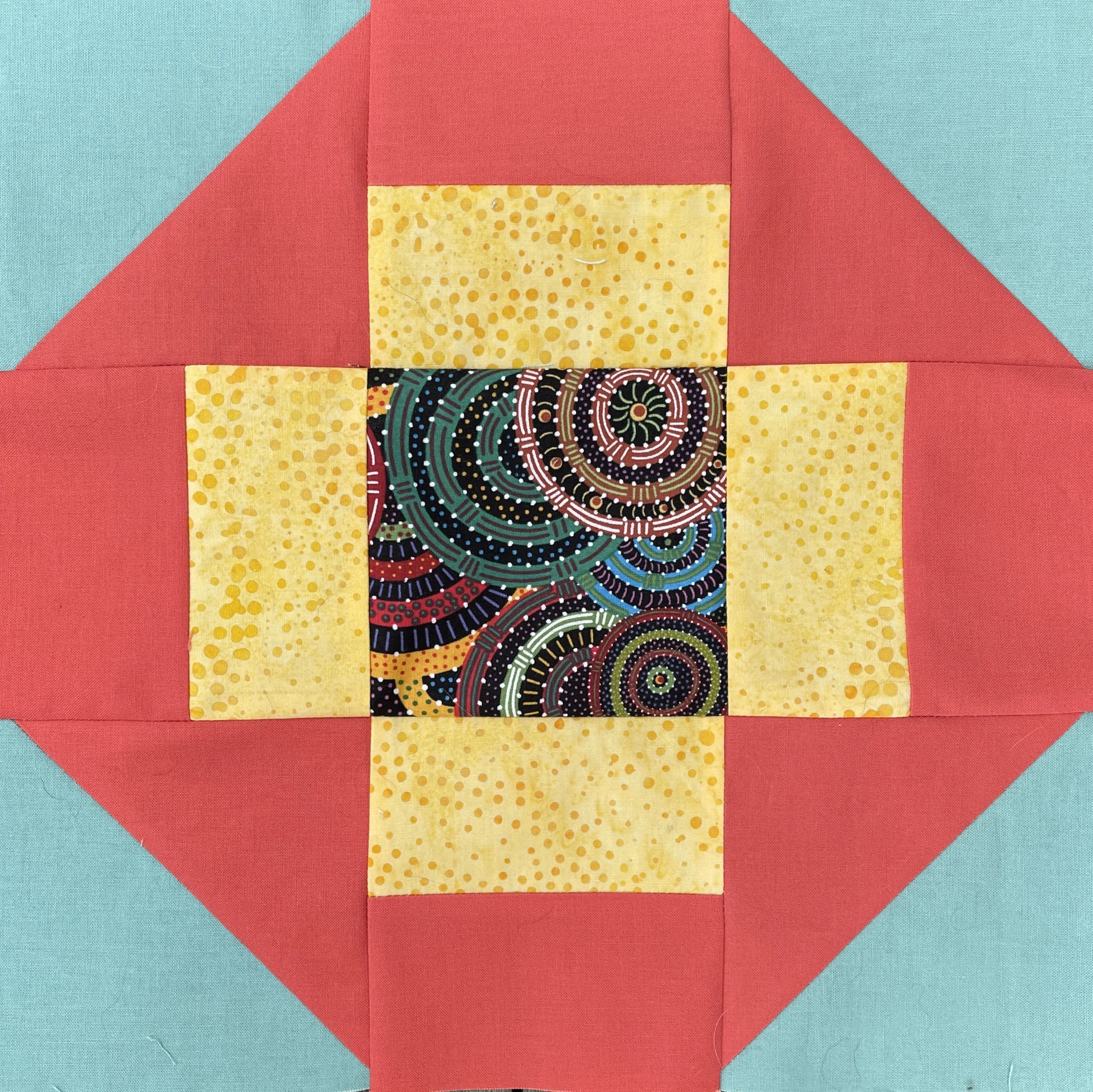
On January 6, I did a post with a block using Australian Aboriginal fabric. I was going to participate in our guild’s Quilt-in-a-Box project, but have subsequently decided to make my own sampler quilt using these special fabrics, plus some solids and other complimentary fabrics.

Here is block #2. The Aboriginal print is the center square. I love all the colors and the overlapping circles. The fabric is named “Women’s Body Dreaming” and was designed by Cindy Wallace for M & S Textiles Australia.

I can’t decide if this is going to be Monday Block Project, with my making a new block each week, or whether I will just add blocks more randomly. We’ll see what happens!

TAGS: Australian Aboriginal Print Fabrics, Sampler Quilt


January 20, 2022

Four Friends Mystery Quilt

by Judy Tucker


Fabric for the Four Friends Mystery Quilt

Fabric for the Four Friends Mystery Quilt

It’s looking like 2022 is going to be the year of quilts made in steps with groups of other folks online.

The owners of 4 quilt shops, from Vermont to Oregon, got together to host a mystery quilt. The only qualification for participation was the purchase of a 2 1/2 inch strip roll from one of the four shops.

I picked this Riley Blake Gem Stones roll from Sew Creative Ashland, in Ashland Oregon, which the hometown of the Oregon Shakespeare Festival. After consulting with them and giving some suggestions, I asked the staff in the shop choose my background fabric (Moda yellow Grunge) . They also picked out red Dit Dot Evolution (In the Beginning Fabrics) for a “pop” accent color (see the very top of the photo) that I’ve decided to use the red fabric as the binding for the quilt. I’m going to use the mushroom fabric from my stash as my accent.

Because I purchased this fabric roll online, I really had no idea about the fabric. I thought what I was seeing with the strips in the roll was what I was getting—subtle earth tones, each strip the color I was seeing in the roll. I was wondering if I had made too “safe” a choice.

HA!! Was I surprised when I undid the roll of strips. They are anything BUT safe or boring! At first I thought they were ombré, but then realized that they aren’t. The strips really are like chameleons. They are one color at one end of each strip, dotted with tiny diamonds of another color and then transform over the width of the strip to the color of the diamonds at the other end of the strips, with the tiny diamonds on that end, the color from the first end. There are an amazing number of gradated colors in the strip roll!

Here are just a few of the strips which I have started to sew together.

Riley Blake “Gem Stone” fabric strips

This is a mystery quilt, so I won’t know what this pattern is going to be until the last step is released at the beginning of February. Because of my choice of fabric roll, this quilt really is an adventure!

Because it’s a mystery, I can’t share the steps in as I sew them. But I will definitely be back to share this project when it’s a completed quilt top, sometime next month!

TAGS: Four Friends Mystery Quilt, Mystery Quilt, 2 1/2 inch strip roll quilt


January 13, 2022

"Scandi Village" Quilter's Playcation Wall Hanging

by Judy Tucker


Scandi Village Wall Hanging, 23 1/2 x 36.5 inches

Scandi Village Wall Hanging, 23 1/2 x 36.5 inches

Last November I took a zoom class, officially known as a Playdate, given by Cheryl Arkison as part of hert Quilter’s Playcation series. In the class Cheryl taught us how to make these simple house and tree blocks.

It took me a long time to decide how big to make this project. These blocks are little, about 5 inches tall and varying widths. It would take a whole lot of them to make even a throw and I wasn’t sure I wanted to make dozens of them.

As the Christmas season ended, I realized I had a perfect place to hang it. I had a quilted Advent calendar hanging in my hallway. I used a small wooden dowel threaded through a small sleeve (cloth channel) to display it. The wooden dowel rested on 2 thumbtacks in the wall. Last year I just left the thumbtacks there. Sort of silly to have 2 green thumbtacks in the wall doing nothing for 11 months of the year!

Ah-ha! That was the answer—I decided to give those 2 thumbtacks something to do! They were just calling out for a Scandi-Village wall hanging!

This wall hanging is just the right sized village for me!

We got at least 12 inches of snow last week and a blast of arctic cold this week, so this is the perfect time of year to be enjoying this snowy scene!

Here it is, in situ, keeping those 2 green thumbtacks occupied!

Scandi Village, happy to be at home on the hall wall!

TAGS: My "Scandi Village" in a snow storm blocks, Wall Hanging


January 6, 2022

Our New Quilt-in-a-Box Guild Project for 2022

by Judy Tucker


My 12 1/2 inch blocks, “Hexagon Star” for our Quilt Guild’s 2022 Quilt-in-a-Box project

My 12 1/2 inch blocks, “Hexagon Star” for our Quilt Guild’s 2022 Quilt-in-a-Box project

The Proper Bostonian Quilt Guild’s 2020-21 Quilt-in-a-Box was so successful, that we have voted to do it again this year. For this project, we each commit to sewing the block of our choice using the fabrics chosen by 8 other guild members. The fabric collections are kept in plastic craft boxes which we exchange at our bi-weekly meetings. Click the link above to go to see all the quilts our guild members made in our first Quilt-in-a-Box.

This time I have picked a block that isn’t technically difficult but does take a couple hours to make. It’s the Hexagon Star block.

The fabrics in this block are an Australian Aboriginal print (the dark floral called “Flowers in the Desert” by Lauren Coolan for M&S Textiles Australia), and Tula Pink’s “Mineral” from True Colors (orange) and Dragon’s Breath solid (purple).

My box of fabrics 8 Aboriginal print fabrics, more Tula Pink fabrics, Blank Quilting Corp. “Lower the Volume” and a few odds and ends I’ve pulled out of my stash. I’ve written a note asking my fellow quilters to try to avoid using the “Lower the Volume” Topography design, a soft grey print on white fabric which actually beautifully complements the box fabrics, and to strive to use the brights in the box as the background in their blocks. It’s a tall order. It’ll be interesting to see what they do!

I learned in our last Quilt-in-a-Box project that it was wise to make a test block before committing to making a block 9 times! My first choice last year just refused to consistently size up to 12 1/2 inches unfinished. So I switched to a similar block which did behave itself!

Here’s this year’s test block…a lot of the fabrics are actually left over from my last box! I added some Christmas fabric and turned it into a little 12 inch Christmas pillow, which kept it from ending up as an orphan block.

Test Hexagon Star Quilt Block

I’m looking forward to getting the first box in the project at our meeting next week!

TAGS: Quilt-in-a-Box, Hexagon Star Quilt Block, Quilt Guild Project


December 23, 2021

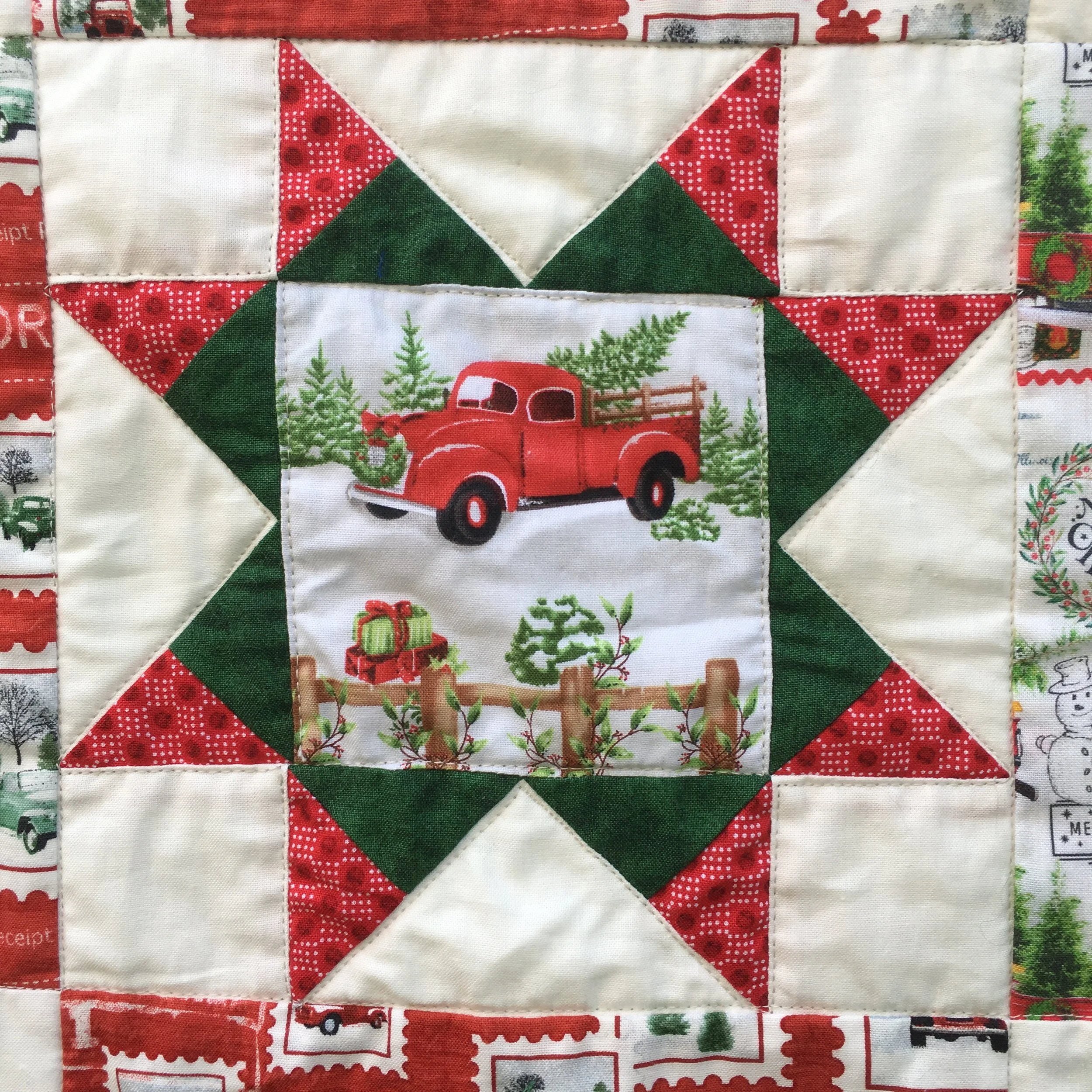
Red Trucks, Stars and Stamps Christmas Quilt

by Judy Tucker


Red Trucks, Stars and Stamps Christmas Quilt

Red Trucks, Stars and Stamps Christmas Quilt

Ahh, finally I can reveal the “secret sewing” project I’ve alluded to several times this year. I finished it last summer, but it’s going to the home of one of my faithful blog followers. Not wanting to spoil the surprise, it’s been tucked out of sight until now!

I purchased this fabric collection last December and then earlier this year I used Electric Quilt 8 to create this quilt pattern. It’s a busy design, but hey, it’s Christmas!

It was really fun fussy cutting the trunks that are in the center of most of the star blocks. I didn’t have quite enough trucks in the fabric I purchased so I used the sled fabric which was part of the collection of fabrics I purchased. It’s on-theme and I do like the variant blocks.

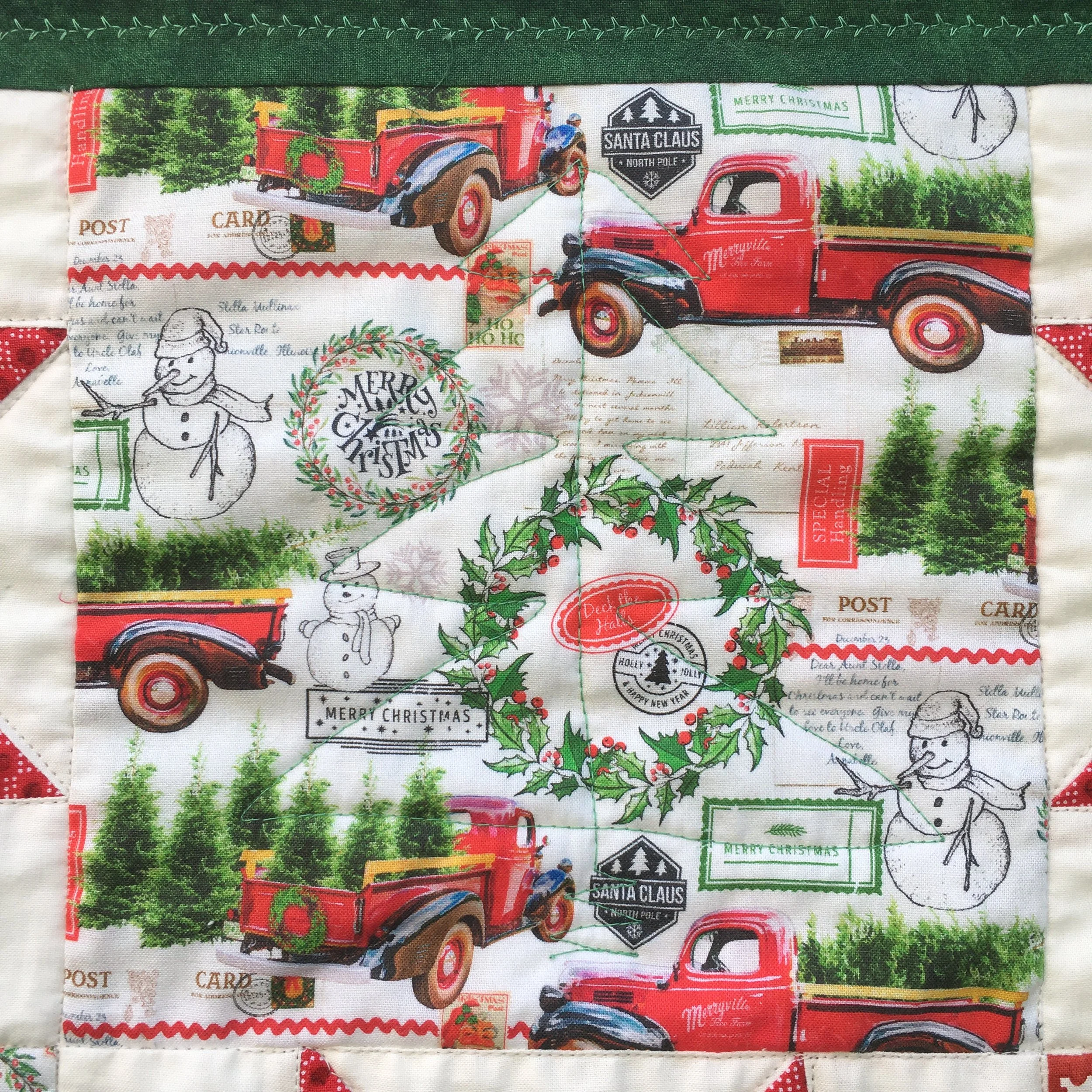
Here are some details of the quilting in the blocks. For more information about the free motion trees quilted in the alternate blocks, see my tutorial on September 2, 2021. You see the tree quilting better in the tutorial link.

250769E9-0393-403A-A57B-E9E43ADE69A0.jpeg
D2798525-EFE8-4F6A-A79D-4E55EF48158D.jpeg
53F35515-D767-4A51-9A4E-A66B26D807AA.jpeg

This quilt was such much fun to make.

I’m taking a week off from blogging so there won’t be a post next week. I hope you all enjoy your holiday season! See you in 2022!

TAGS: Christmas Star Quilt, Red Truck Christmas Quilt, Red Truck, Red Truck Star Stamps Christmas Quilt, Free Motion Quilting a Christmas Tree


December 16, 2021

Show and Tell: Christmas Batik of Amahl and the Night Vistors

by Judy Tucker


Batik of Amahl and the Night Visitors

Batik of Amahl and the Night Visitors

Found this batik I made years ago in one of the boxes of Christmas decorations in the cellar. I brought it upstairs and really looked at it and had one of those “Huh! I’m amazed I made this” moments. That made me laugh.

This batik wall hanging really makes me happy. It’s a depiction of the final scene from the opera “Amahl and the Night Visitors” by Gian Carlo Menotti. These are the 3 Kings, or Wise Men. In the foreground is a lad called Amahl. He was a poor peasant boy who was lame and needed a crutch to walk. The Wise Men stop at his home on the way to Bethlehem and during their visit, his faith miraculously heals him. Amahl asks if he can go along with the Kings on their journey so he can give his crutch he no longer needs to the Child they are looking for. He is carrying the parrot who belongs to one of the Kings. There is a really funny moment in the opera when the King shows Amahl the parrot and Amahl asks “Does it bite?” with just the perfect intonation of fear and curiosity.

This opera was a staple of our family’s Christmas season. These days it would have been playing on a continuous loop, but back then, we were listening to a vinyl record which needed to be flipped over half way through. We really loved this record.

So just a Show and Tell. I wanted to show this piece to you and share a bit of our family’s Christmas tradition. Go find a recording of this opera…it’s in English and it’s really a lot of fun.

TAGS: Batik Christmas Hanging


December 9, 2021

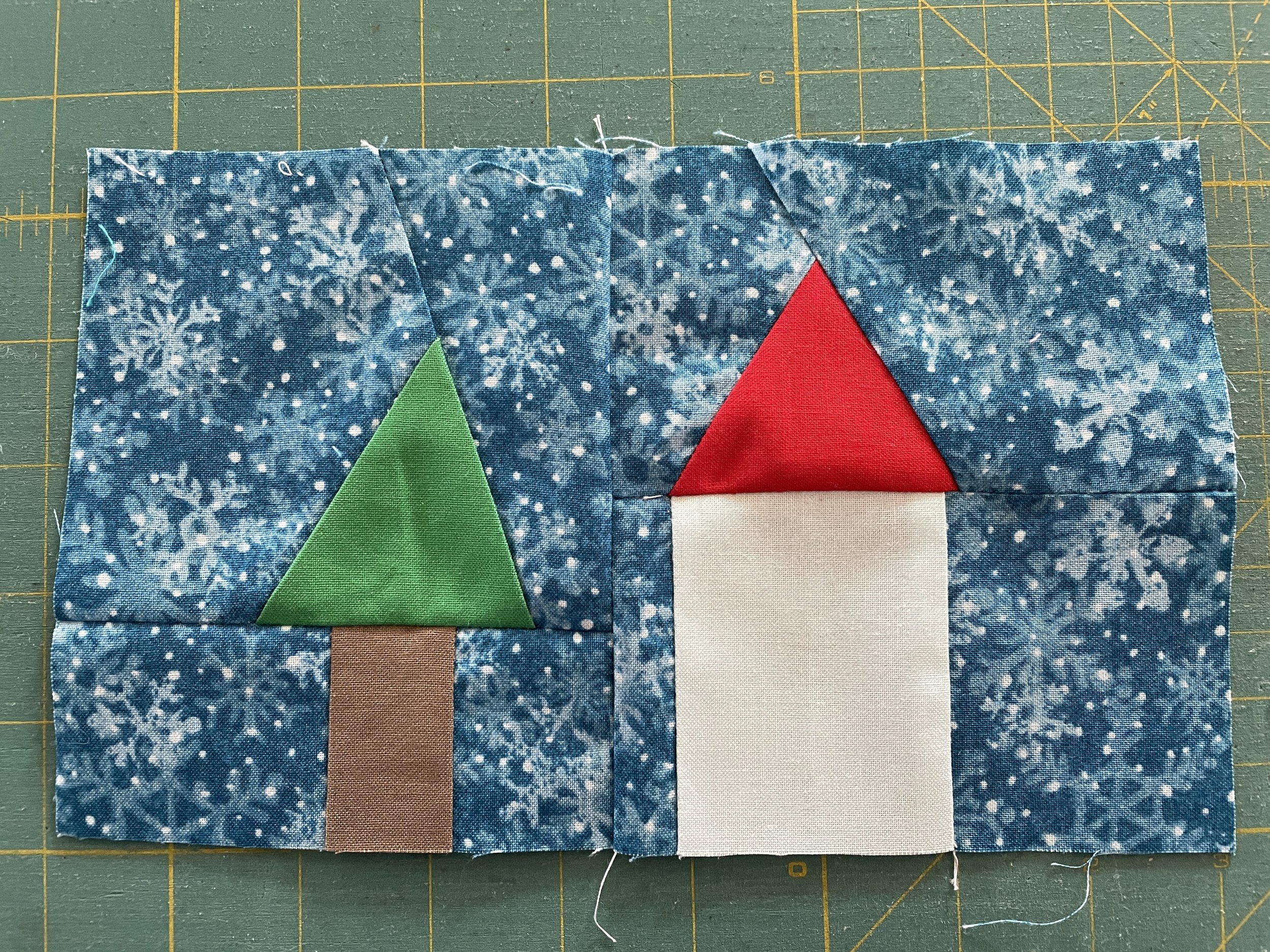
Sewing "Scandi Village" Blocks by Cheryl Arkison

by Judy Tucker


“Scandi Blocks—Tree and House” from A Quilter’s Playcation Playdate with Cheryl Arkison

“Scandi Blocks—Tree and House” from A Quilter’s Playcation Playdate with Cheryl Arkison

Last month Cheryl Arkison offered a zoom playdate as part of her Quilter’s Playcation series. The playdate I attended was learning to make blocks for her “Scandi Village” design. These are improv blocks and they are great for using scraps.

Ideally the background should be a light solid. But this non-directional snow fabric in my stash was calling me. And why not use a fabric that is less than ideal? After all, this is improv and the whole idea of Cheryl’s series is just to have fun playing with quilting. (Just really DON’T use a directional print. Seriously)!!!’

Since I have a dark background, I pulled out a selection of pastels for my houses. Here is part of my village, so far…

A few more Scandi Village Blocks

I’m trying to decide if I want to make a whole lap quilt with the snowy fabric, or pull some other fabrics and make this a 4 seasons quilt. Might just depend on what is IN my stash!

I’m also tempted to do some simple embroidery on the houses. But maybe I could achieve a similar look by doing some Big Stitch quilting. Hmmm.

I’ll let you know when I decide what direction I want to go next with my version of Scandi Village!

Anyway, this is lots of fun.

Cheryl is a fun, relaxed teacher. Do sign up for a playdate if she offers some more in the upcoming months. Check the link above to see what she is currently offering.

TAGS: My "Scandi Village" in a snow storm blocks, From "Scandi Village" Playdate with Cheryl Arkison


December 2, 2021

Santa Hat Pillows

by Judy Tucker


Santa Hat Pillow, from pattern by The Quilt Company, Designs by Karen Montgomery with my Cloudberry gnome

Santa Hat Pillow, from pattern by The Quilt Company, Designs by Karen Montgomery with my Cloudberry gnome

Last month I watched two virtual shop hops on Facebook. In each shop hop, quilt shops located across the US each spent an evening selling items in their shops online.

This Santa’s hat pattern showed up in a couple of the shop’s presentations. It is the “Santa Hat Pillow” from The Quilt Company, designs by Karen Montgomery. I tried to find this pattern from its primary source, but haven’t succeeded. It looks like the original shop may no longer be in business. But you can find the pattern for sale if you search for it. The pillow insert is a 14 inch square pillow—a nice size.

I almost didn’t buy it when I realized that the pattern has a zipper. Yes, I can DO zippers. I just don’t enjoy sewing them. But not to fret…this pattern uses an over size zipper which gets cut off after it’s been sewn in. So it is just 2 straight seams, with none of the bother of setting a zipper into a defined space. Easy-peasy!

After I made one, I couldn’t stop! I’m up to 4 so far and debating using a vintage zipper that’s not quite long enough for another pillow—but might just work.

The Waldorf-type gnome in the child’s rocker with the Santa pillow is Cloudberry. You can read about him and his cousin Dewberry in my post from December 20, 2018.

There’s still time for you to sew your own before Christmas!

TAGS: "Santa Hat Pillow" from pattern by Karen Montgomery, Waldorf type gnome, Christmas Santa Pillow


November 25, 2021

A Ducky Hachi Quilt Top

by Judy Tucker


DuckDuckGoose Quilt Top

DuckDuckGoose Quilt Top

I’m having fun sewing the Hachi Quilts I learned about reading Patricia Belyea’s book East-Meets-West Quilts. (See also my post on November 4, 2021).

This ducky fabric has been in my stash for years. The selvedge says this fabric was printed by Andover Fabrics back in 2006! It really is called “Duck Duck Goose!”

How many of you played Duck Duck Goose on the playground in elementary school?

I’ve pulled this fabric collection out of the bin a number of times when I wanted to make a baby quilt. Each time I chose something else and the ducks went back into the bin.

But when I was looking in the stash for fabrics to make a new Hachi Quilt, I was drawn to the tall ducks and geese. These fowl are really a linear design and I realized they would look great in these strip blocks.

Each Hachi Quilt needs an “unexpected visitor”. The sock monkey/number fabric is a perfect addition to a baby/toddler quilt. The bright red fabric is definitely a welcome pop of color.

I also added some of Karen Lewis’s Blueberry Park fabric which was printed commercially a few years ago by Robert Kaufman Fabrics.

I needed to piece two fabrics to make the backing for this quilt. That used up the remaining Duck Duck Goose fabric in the stash.

I’m thinking a rippling or wavelet quilting design might be perfect for this quilt. Look for a completed quilt sometime in early 2022! And an orange binding, for sure!

TAGS: DuckDuckGoose Hachi Quilt, Hachi Quilt design


November 18, 2021

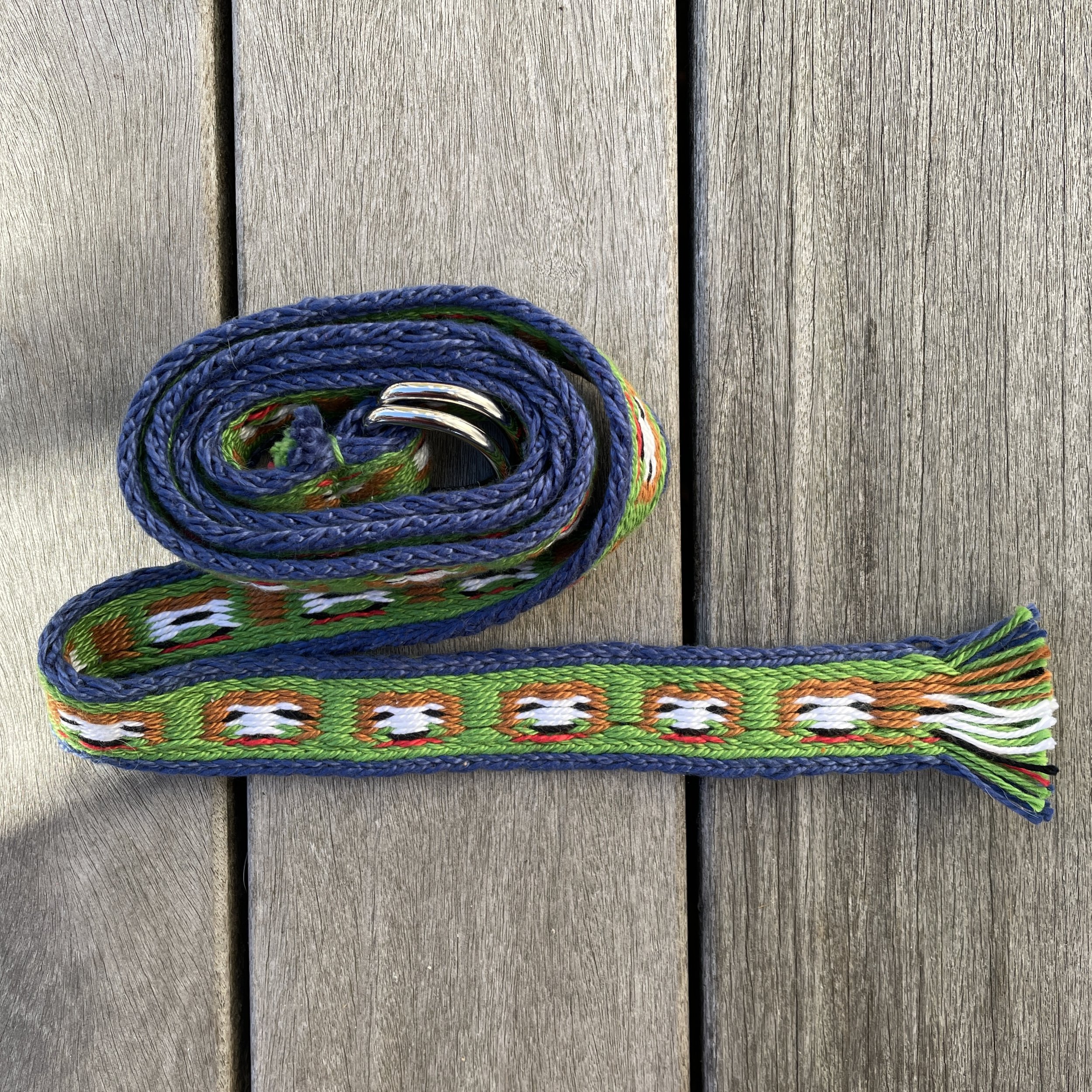
Drafting a Pattern for Tablet Weaving

by Judy Tucker


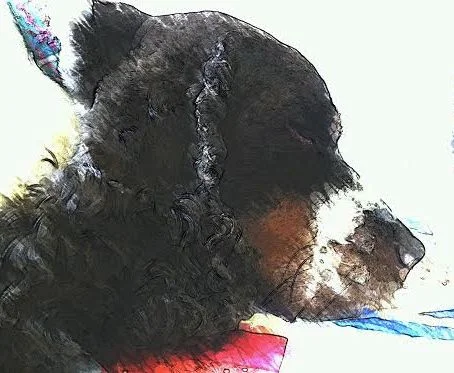
When I discovered the Tablet Weaving Draft Designer online, I thought it would be fun to give it a try. I had made a owl from a pattern in a book, so I had an idea about how to design the face of an animal. Could I design a Spring Spaniel?

The answer turned out to be yes…and no!

I watched a great YouTube video on using the Tablet Weaving Draft Designer. It still took me a bit of trial and error to create my dog design. Once I understood how to use the deisgnThe design looked pretty good on paper.

My springer spaniel warping pattern

I warped the loom with #3 Crochet thread. What looked good on paper didn’t translate into the weaving the way I expected. They dog’s eyes are too big and his face got a lot wider. I think my design would have looked a whole lot better if I had used size 8 pearl cotton which is a lot thinner thread.

On the bright side, using #3 crochet thread makes a great weight for a belt. The design leaves something be be desired, but I will still happily wear it!

I had some ideas about how to improve this design, but I’m not sure I really like it enough to spend anymore time on this particular pattern.

TAGS: designing a tablet weaving pattern, tablet weaving


November 11, 2021

Peg Doll Gnome Sweater Pattern

by Judy Tucker


Peg Dolls in their new knit sweaters

Peg Dolls in their new knit sweaters

I purchased some ThreeSuns wooden peg gnomes but wasn’t sure what to do with them. Then I started seeing these pegs showing up on social media with all sorts of great decorations. I wanted to do something totally different. So I designed a sweater pattern for them.

While these are robust 3 inch tall gnomes, their sweaters still are teeny tiny! They are about 1 inch long.

Peg gnome sweaters

Want to knit your own? Here’s the pattern I designed. This is for individual use only. You may sell these at craft fairs but this pattern may not be used for commercial production.

PEG DOLL GNOME SWEATER PATTERN

Supply list

  • Fingerling weight yarn. Ask a friend who knits socks for left overs. You won’t need much to knit a sweater.

  • #1 US knitting needles (2.25mm)—Set of 5 inch long double point knitting needles (Be gentle if you are using wood or bamboo needles. They can snap in half like toothpicks)!

  • Scissors, yarn needle. (Maybe some reading glasses)!

Instructions

  • Cast on 24 stitches on one needle

  • Row 1: Knit 1, purl 1 stockinette. Divide the stitches as you knit. Put 6 stitches on each of 4 needles so that you are now knitting in the round.

  • Rows 2-3: Continue to knit K1 P1 stockinette for a total of 3 rows

  • Row 4-8: Begin knitting. Knit a total of 5 rows

  • Row 9: Knit two stitches together (TOG) on the first 2 stitches of each needle

  • Row 10: Knit. (There will be 5 stitches on each needle in this row)

  • Row 11: Knit 2 stitches together (TOG) on each of the 4 needles

  • Row 12: Begin stockinette. K1 P1. There will be 4 stitches on each needle now

  • Row 13: Cast off in stockinette, Continue to K1 P1 as you cast off. Knit this row loosely—don’t tug on your stitches as you cast off or you’ll have difficulty pulling the sweater over the gnome’s cap.

  • Secure and weave in the piece of yarn at the bottom edge of the sweater and at the neckline.

  • Well done! Go dress your gnome for winter!!

Gnome sweater in progress on the 4 needles. The 5th needle, used to knit isn’t visible in this photo.

Notice: This blog is not monetized: I do not use affiliate links. When there are links in a post, they are to give credit to another creative person, because I like or have used a product, or to help the reader easily find supplies for a project.


November 4, 2021

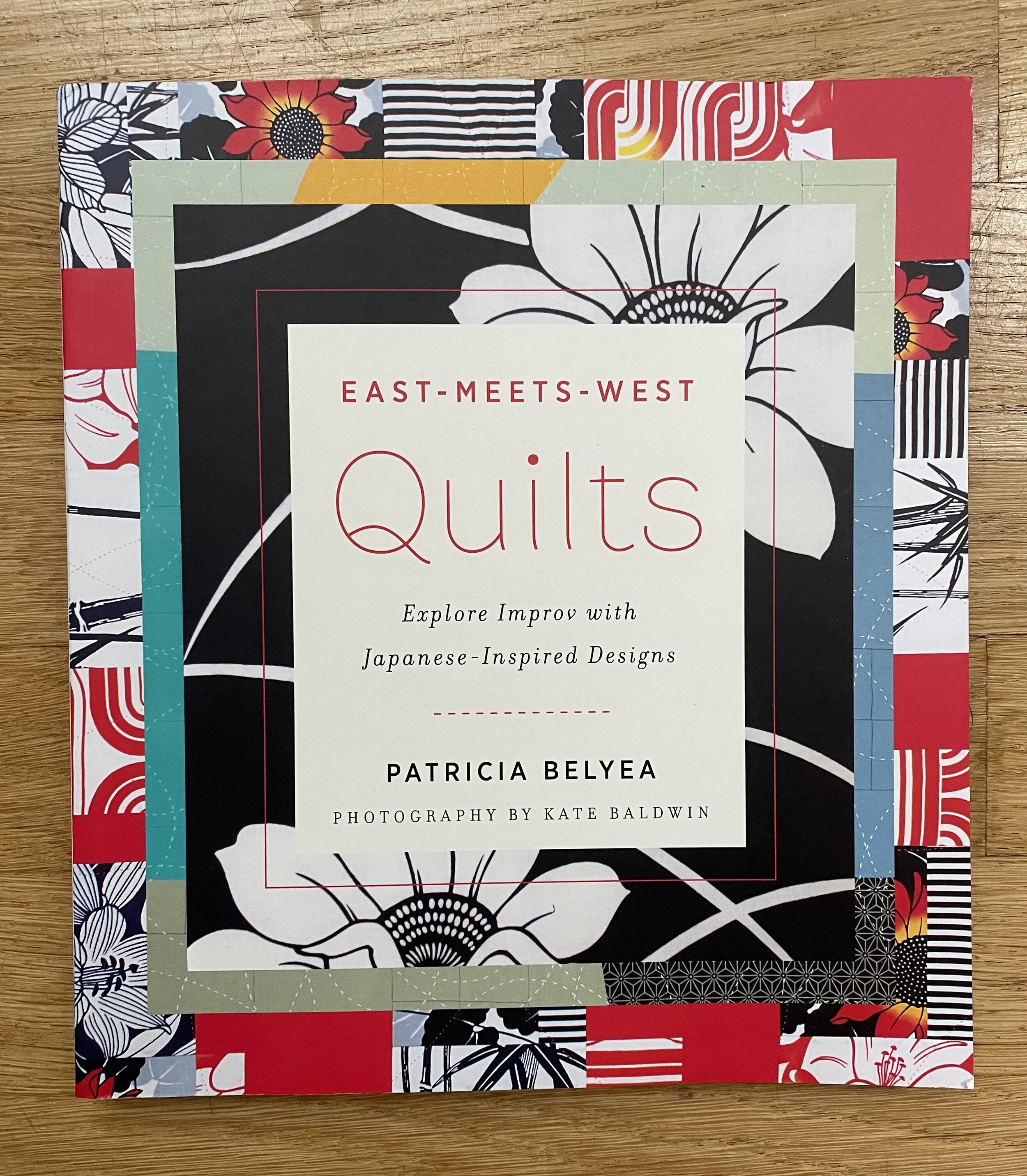
Making a quilt using the book "East-Meets-West Quilts" by Patricia Belyea

by Judy Tucker


Book Cover

Book Cover

Book Cover

Book Cover

East-Meets-West Quilts is a book which I just discovered. It’s not new, having been published by abramsbooks.com in 2017. The author, Patricia Belyea, has a shop, Okan Arts, which sells imported vintage Japanese yukata fabrics. She created this book using these lovely yukata fabrics.

All the blocks in her book finish at 8 inches, based on the Kanji character hachi. The main pieces in each block are fractions of 8…2s and 4s. The concept is simple but the possibilities are endless. One of the design concepts that Patricia introduced is the “unexpected visitor”—one block or several, which are completely different that all the other blocks in the quilt. This adds a element of surprise and delight to the quilt.

I went hunting through my stash looking for a floral fabric which would work in these blocks. Most of my fabrics are small scale, but I did find “Busy Lizzie”, a Kaffe Fassett print. I paired that print with the newly released solids by Tula PInk, Unicorn Poop and Dragon’s breath. All these fabrics are from FreeSpirit Fabrics. That’s an added bonus, as I expect they will all continue to play well as the quilt gets used.

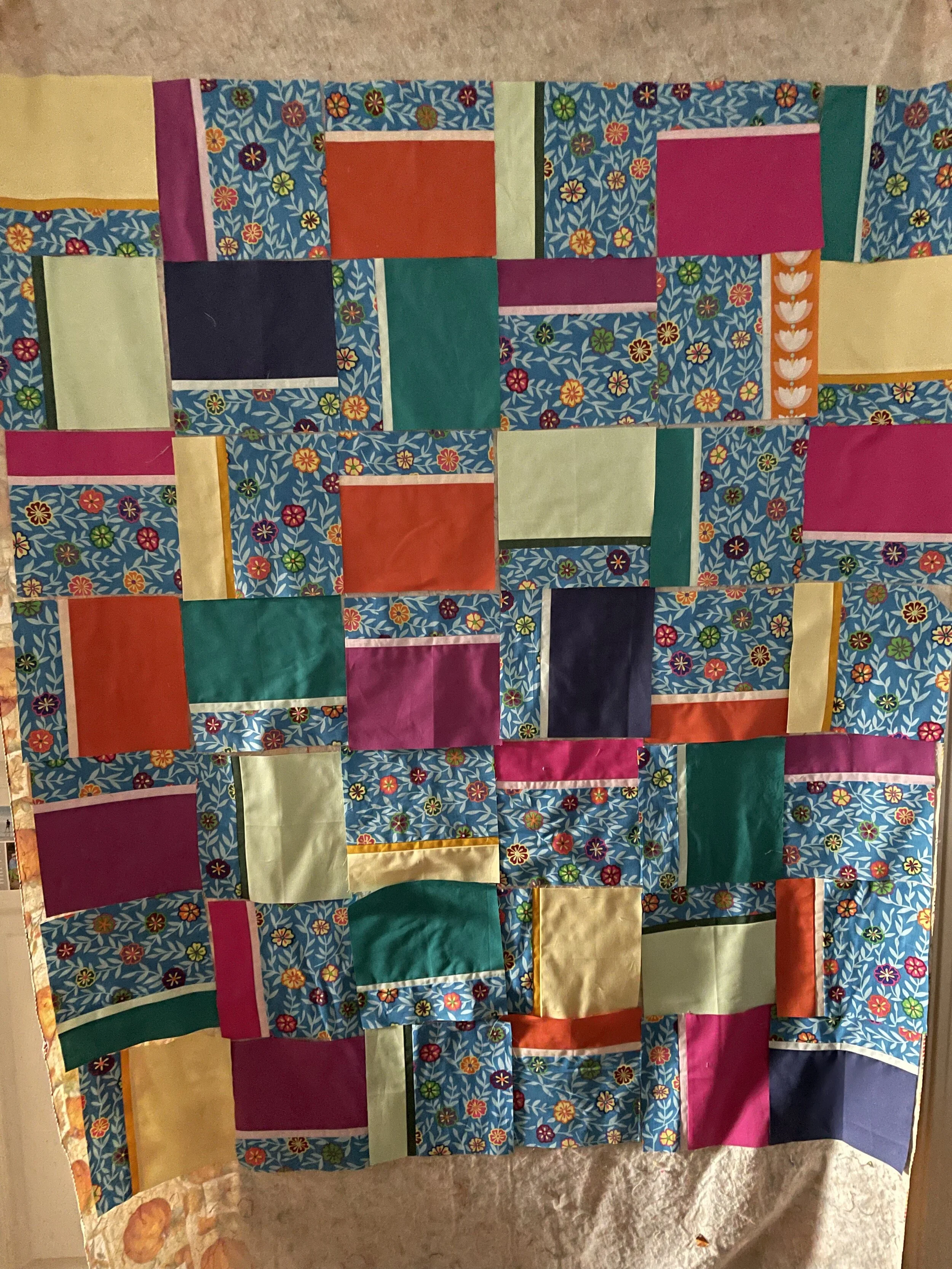
Here are the blocks on my design wall. I used the pattern, “Hidden Wonders” from the book. However, my added strips were cut at 1 inch wide, so my strips are a tad wider than those in the pattern.

Part of my new quilt using a pattern from “East-Meets-West Quilts”

Part of my new quilt using a pattern from “East-Meets-West Quilts”

I was so glad that I took several pictures of this quilt before I pulled the blocks off the design wall to sew the quilt top together. Even though I had the blocks in order by row, I kept looking back to the photo to make sure i wasn’t turning the orientation of a block. (Even so, I still had to do a bit of “un-sewing”)!

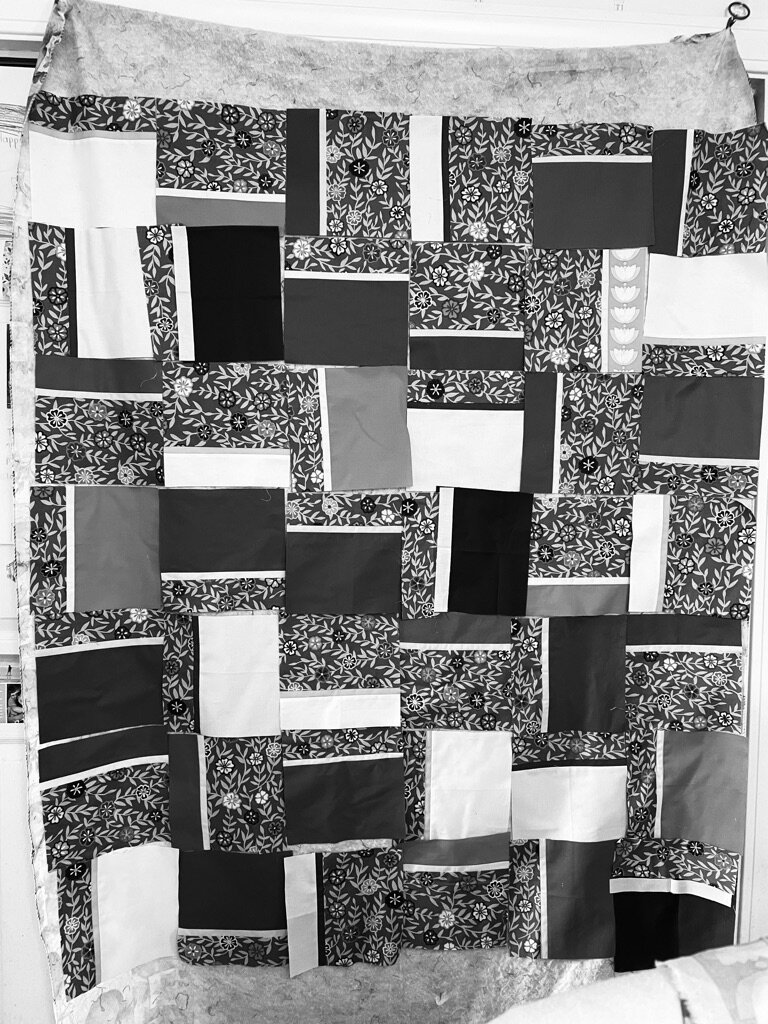
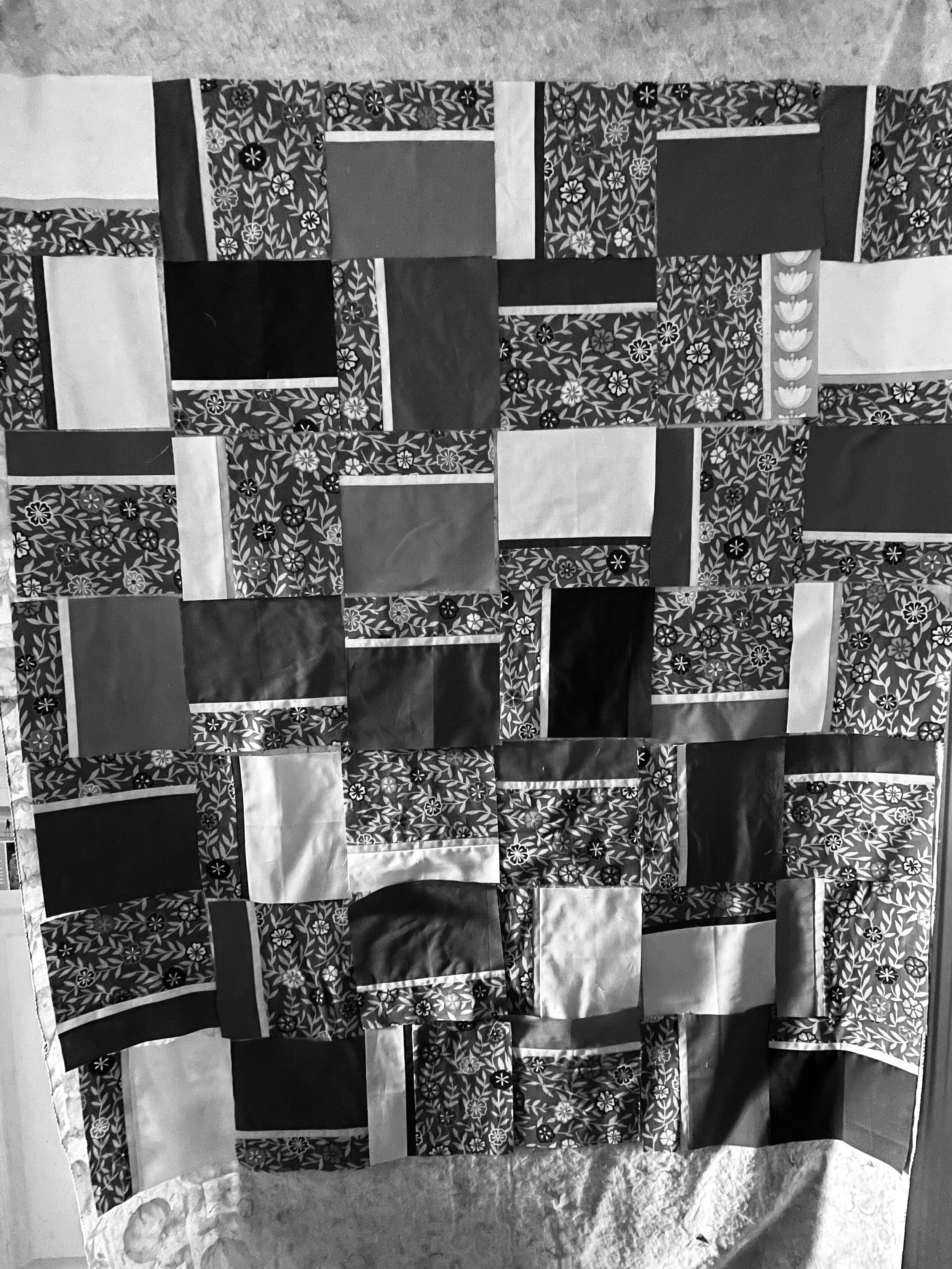
While I was choosing a final layout, I also edited several photographs of possible layouts to grey scale to see if the colors were actually balanced throughout the quilt. There a few problems I can see in the layout below in the quilt on the left side. (It probably loads first if you are reading on a phone). First, the 2 large light patches in the upper left hand corner, I thought I could do better with several of the very dark blocks. I moved some blocks around and ended up with a much better balance. If you have a pattern that is variable, it really is worth taking the extra time to check the layout in grey scale.

E0FEE60A-E4BB-401B-BC51-1AB34AB69021_1_105_c.jpeg
IMG_0010 2.jpg

So much fun! I’ll have the completed top for you to see in my post next week.

TAGS: Quilt made using the book "eas-Meets-West" by Patricia Belyea, Hachi Quilt design, Improv quilt


October 28, 2021

Card/Tablet Weaving: My Weave Along with Elewys

by Judy Tucker


The band on my loom

The band on my loom

The band on my loom

The band on my loom

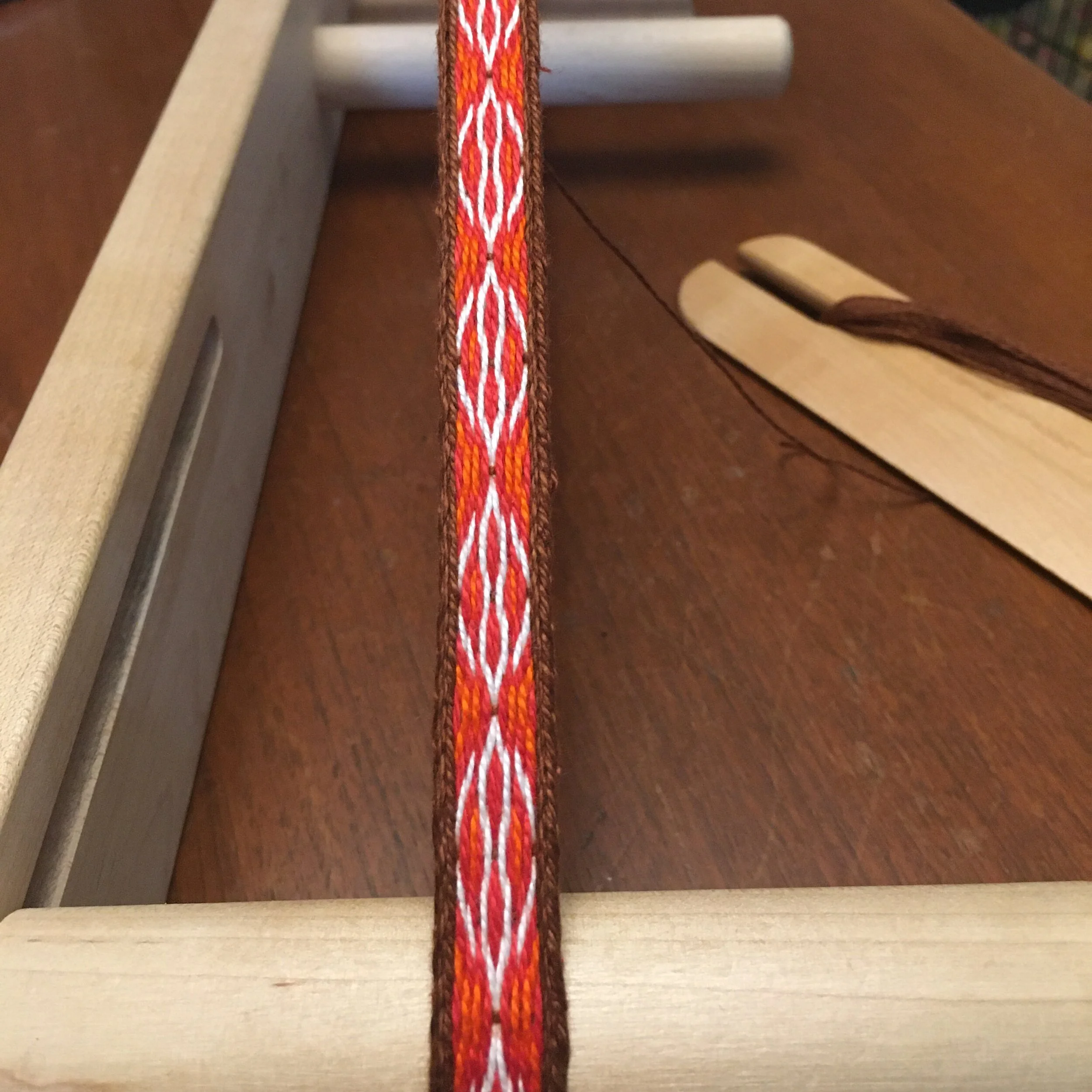
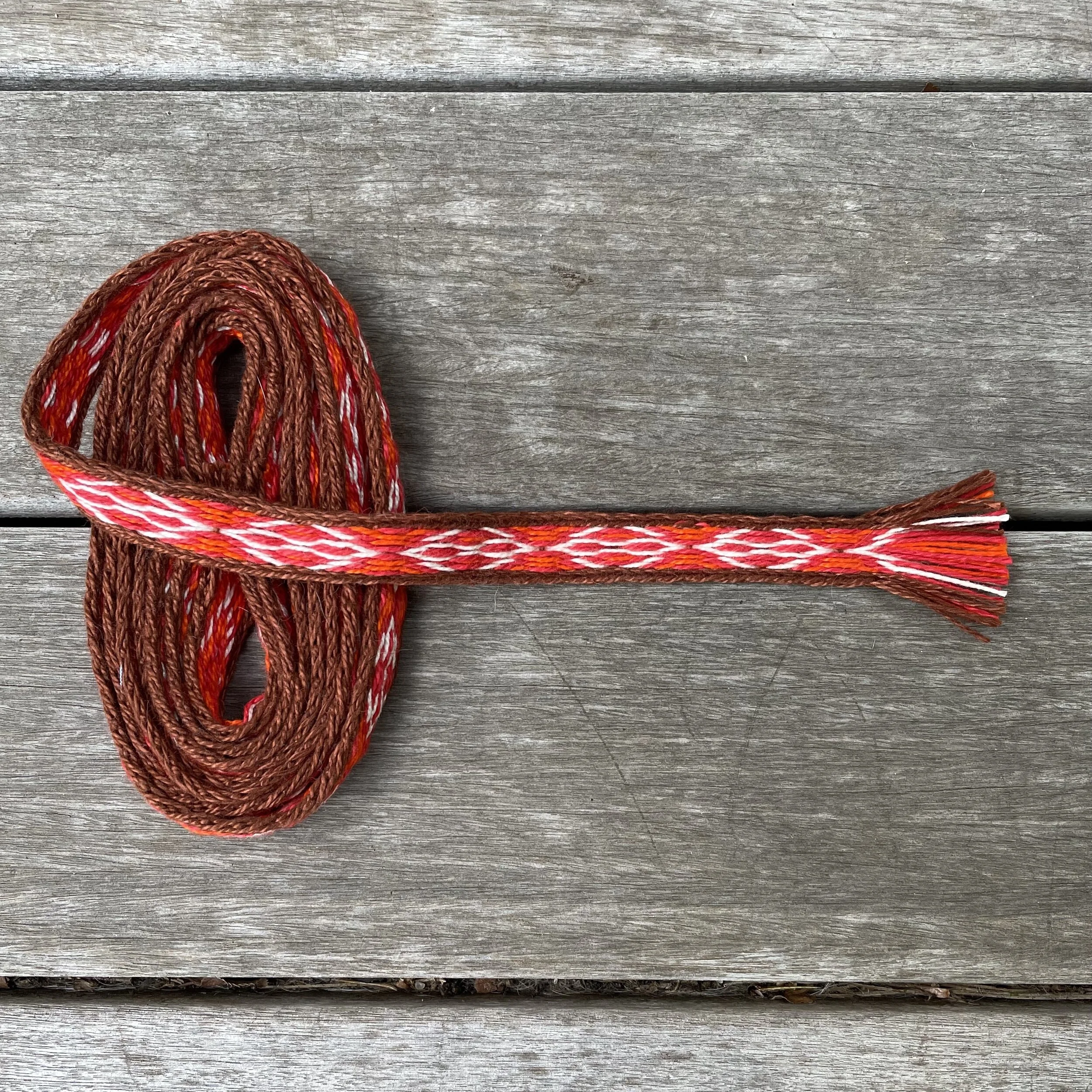
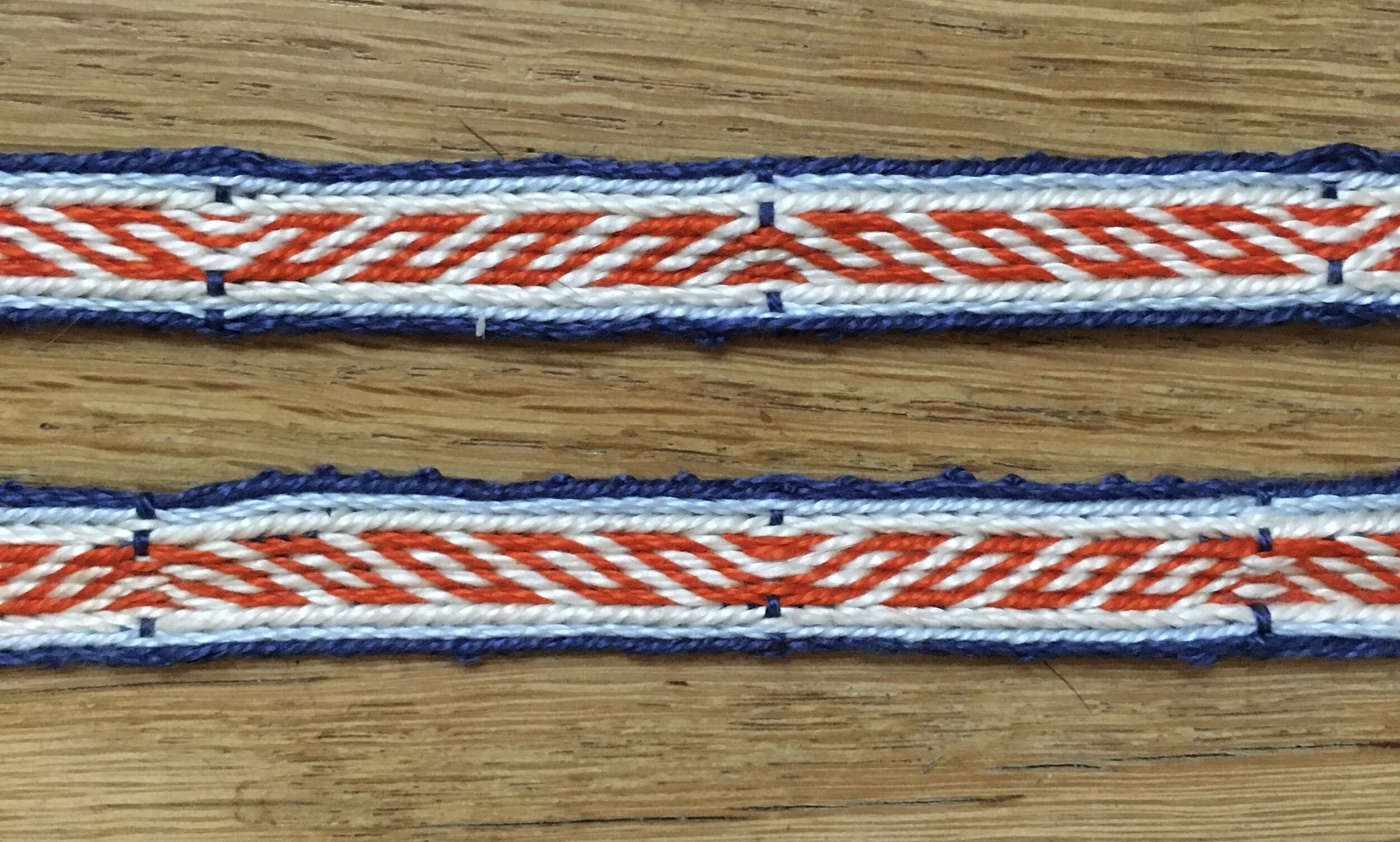
I’m slowly continuing my Weave Along with Elewys project. This newest band pattern is Hallstatt 152 and is the Weave Along with Elewys Episode 5. (I skipped a couple bands). Elewys tells us that the band that this pattern is based on was found in a salt mine in Austria and date from between 400-800 BCE. That’s totally amazing. To learn more about this band, check out Elewys’s blog.

My band is 1/2 inch wide. All the yarns in this band were purchased and commercially dyed. I chose brown, white, a deep orange and red. The spools were pretty all lined up, but in retrospect, my orange and red are just too close in color and so some of detail in the band’s pattern has essentially been lost. However, I still think this is a beautiful band.

I used the 4 hole pattern. That’s simpler than the skipped hole pattern but I still really struggled with this design. I had find time to weave without any distractions initially…not even music. I spent a lot of time in the first couple feet of weaving, unpicking my errors. There was error that was so egregious that I was never completely able to unpick it. That couple inches of weaving was pretty enough so that even though it was wrong, I left it.

But after several feet on weaving, I finally got it, and was able to weave without making mistakes listening to music or even with the evening news on in the background. I needed to develop the motor memory and mental memory to reliably weave this pattern.

My version of Hallstatt 152

My version of Hallstatt 152

I’m really pleased with this band and i definitely learned a lot weaving it!

TAGS: My Weave Along with Elewys Episode 5, Tablet weaving, My version the Hallstatt 152 band pattern


October 21, 2021

Tablet Weaving a Viking Era Wool Band: An Attempt at a Re-Creation of a Dublin Band

by Judy Tucker


15 inch long x 5/8 inch wide, wool tablet woven band

15 inch long x 5/8 inch wide, wool tablet woven band

15 inch long x 5/8 inch wide, wool tablet woven band

15 inch long x 5/8 inch wide, wool tablet woven band

I have fallen down a whole series of rabbit holes, looking at posts and YouTube videos on tablet weaving and natural plant dyes.

One of the rabbit holes lead me all the way to Australia!! That is, via the YouTube Channel of Ylva the Red, a Australian reenactor of the Hibernian Viking Era in Ireland. Tablet weaving queries lead me to her lovely video, Tablet Weaving: Dublin Wool Band.

Unlike my first tablet woven band (see my September 9, 2021 post) which had a beautiful pattern, this plain wool band just has a subtle chevron design. It looks a lot like knitting but it is tablet woven and not at all stretchy like knitting would be.

ECABC5F6-0C84-48A8-9207-CFEFD4D56814_1_201_a.jpeg

Ylva the Red has excellent instructions about how to weave this belt on her video, so I’m not going to repeat them here. Rather I’ll tell you about my adventures, and how I jury-rigged a set up to weave this band. Spoiler alert: I stepped seriously out of the Viking period.

6C2D93A5-7AD6-40AE-B12A-66CAA828B85F_1_201_a.jpeg
8DAA575B-8581-45E9-813E-60FCE78B76D8_1_201_a.jpeg

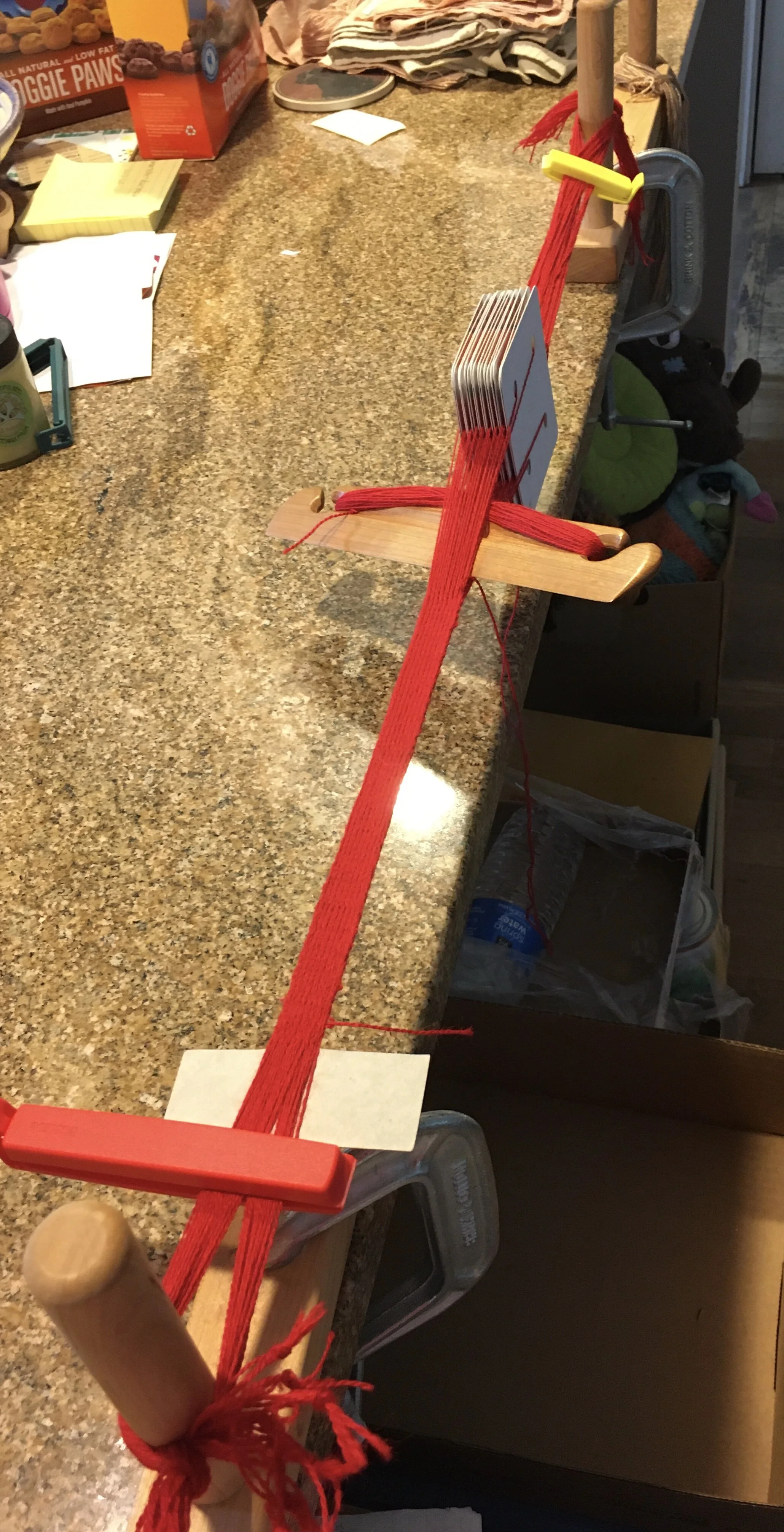
Inkle looms are a fairly modern invention (and I had a plain weave band loaded on mine) so I needed to find another way to do this card weaving. A back strap loom would be historically appropriate but so is a loom consisting of to upright round rods anchored in either end of a narrow flat board that sits on the floor. I didn’t have a back strap set up nor a medieval loom, so I created a combination of the two looms.

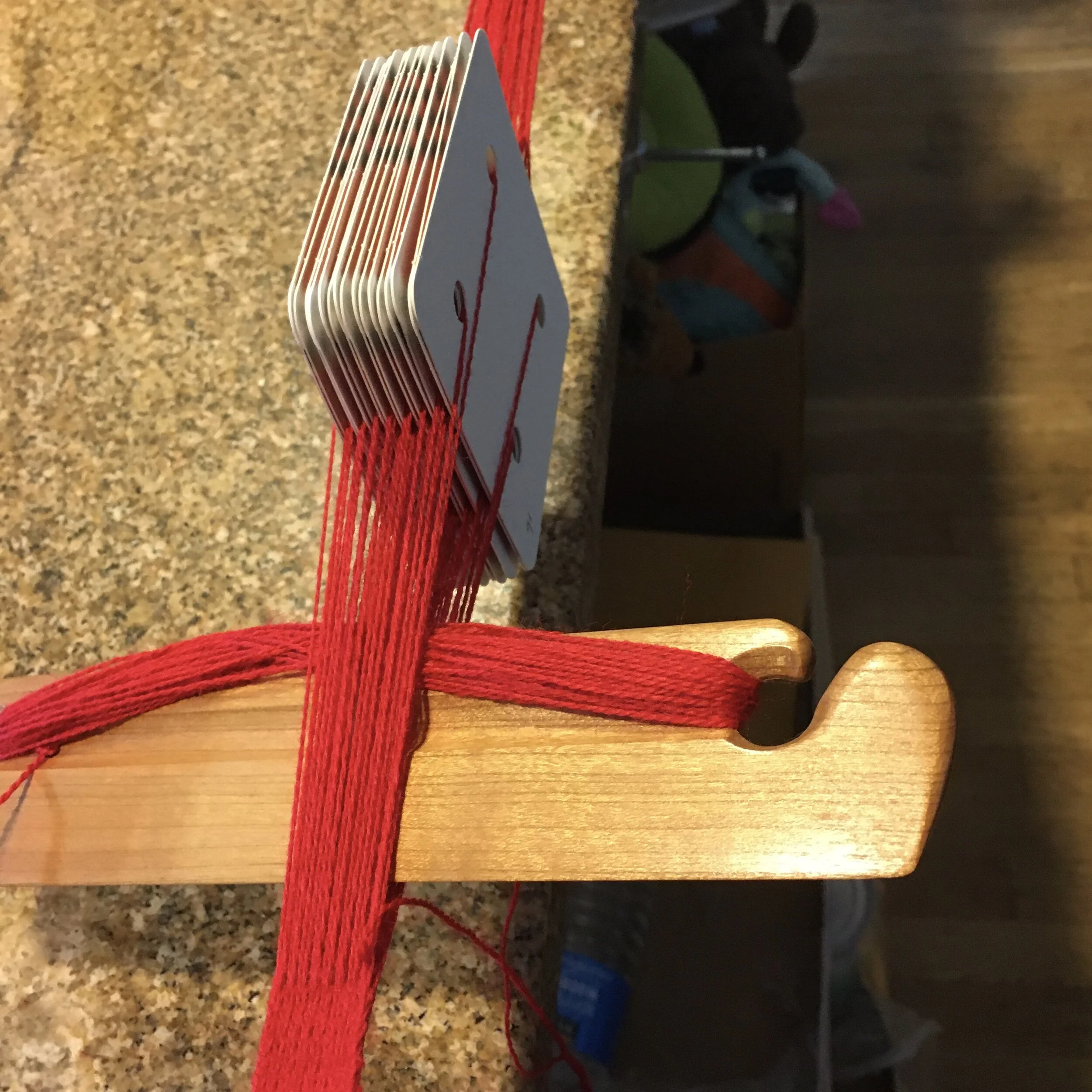
I used my Schacht warping pegs bolted onto my kitchen island (please excuse the clutter on the counter) . That put it a bit about waist height and the two upright pegs sort of simulated the two upright poles of a medieval loom. The back strap set ups I’ve seen have two wooden boards, bolted together to hold the weaving at one end. I decided that might be helpful and so I used an IKEA bag clip to hold the warp flat at both ends near the pegs. This set up actually worked very well.

Ylva the Red states that the Dublin wool band was woven with the cards only turning forward. That I just couldn’t do. My wool was on the coarse side (the Viking wool must have been coarse too) and the yarns in warp kept trying to grab the adjacent warp. I started off just turning the cards forward, but after about 2 inches, I was starting to have serious problems with twist beyond the tablets.

I suppose I could have untied the far end of the weaving and manually released the twist in the warp thread of each card. That may be how the Vikings solved that problem. I took the easy route instead, and opted to reverse direction, turning the tablets back until the twist was released, and then switched back again to forward turns. I had to do this every 2 to 3 inches along the woven band.

It does create visible intersection in the band. But that really doesn’t bother me.

Note the twists in the warp threads in the center of this band where I reversed the turning direction of the tablets.

Note the twists in the warp threads in the center of this band where I reversed the turning direction of the tablets.

As I got to the far end of my band, the twist beyond the cards eventually became insurmountable. It was time to stop weaving..

This picture shows how much twist there is behind the tablets when I reached to end of my warp. It almost looks like it has been woven too!

This picture shows how much twist there is behind the tablets when I reached to end of my warp. It almost looks like it has been woven too!

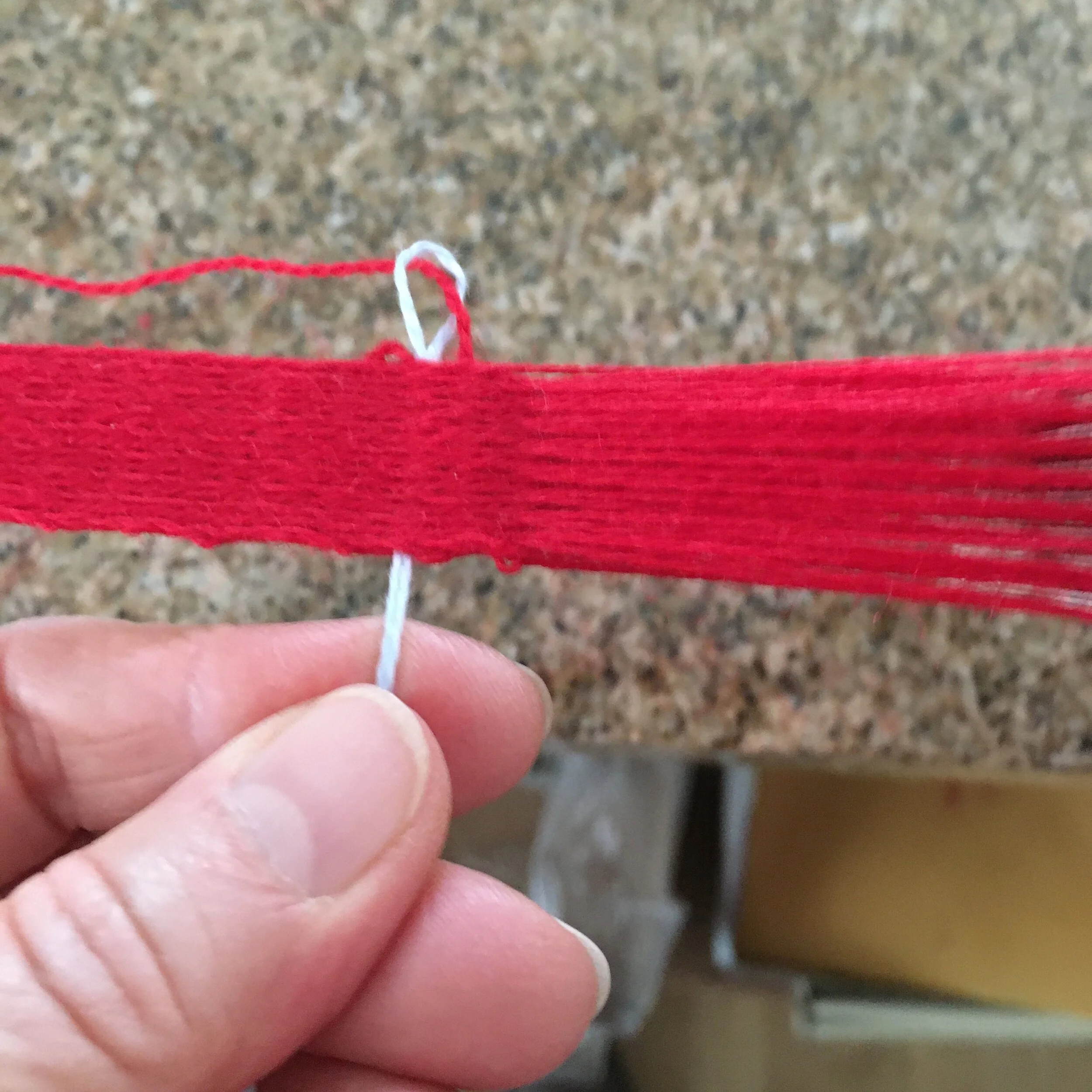
In order to lock the tail of my weft thread, I slipped a loop of thread into the shed. Then I passed the shuttle through, turned the cards and repeated with a second loop. Then I turned the cards and and passed the shuttle through the shed two more times. Then I cut the weft thread, leaving a tail about about 6 to 8 inches long.

I put the weft’s tail though the loop on the side where I had finished weaving and used the loop to pull the weft thread through the band. Then I repeated that on the far side. This firmly locks the weft thread into the band. The band just isn’t going to ravel apart. Then I trimmed off the excess weft tail and the edge of the band and cut the band off the warping pegs.

F830A451-D0CC-4CA5-B8F0-DF53FBC87FD8.jpeg
B7D7D491-6AED-4092-AF64-AB33A29A62DD_1_201_a.jpeg

Ylva the Red has links to primary source information about this Viking Dublin Wool Band in her YouTube video notes, including a black and white photo of the original Dublin band. Go check them out!

I’m not a reenactor and I don’t belong to any historical groups. I wasn’t trying to create an historically accurate band. I was just plain curious and thought it would be fun to see if I could weave a band that was just a bit like the original Viking band. It’s a bit wider than the original by about 1/8 inch, but otherwise, it’s not too bad!

I had a lot of fun making due with the implements I had on hand, and I’m actually really pleased with my historically inaccurate tablet woven band!

TAGS: Viking Wool Tablet Woven Band--attempting a make a similar band, Tablet weaving, Following Ylva The Red's Dublin Band Weaving Instructions


October 14, 2021

Naural Dyeing With Fall Flowers: Marigolds and Asters

by Judy Tucker


Cotton yarn dyed with yellow marigolds

Cotton yarn dyed with yellow marigolds

Cotton yarn dyed with yellow marigolds

Cotton yarn dyed with yellow marigolds

There was a lull in during the hot days of summer when there weren’t many flowers blooming in my little yard. But in September, suddenly I had a lot of blossoms. I’d read that marigolds can make a lovely yellow natural dye. And indeed, they do!

The flat of marigolds I planted around by kitchen garden last spring had a mix of yellow, orange and red/gold variegated flowers. Only 2 of them were yellow, which is the color I keep trying to achieve with my natural dye experiments. I never want to strip a plant of all it’s flowers—the plant and the pollinators need them! So I was able to harvest about 10 blossoms which I figured might be enough to dye my small hank of #3 cotton crochet yarn. Using a soy milk mordant I did indeed get a soft yellow. This one makes me happy.

All summer I waited patiently for my large patch of pink and purple asters to bloom. By mid September they’d created a riot of color.

Purple and pink asters

Purple and pink asters

Would the purple asters give me a pink, purple or some other color dye? I used the whole flower, not just the petals.

Dyeing with purple aster

Dyeing with purple aster flowers

Yellow green?? It’s actually a lovely color, but so not what I was hoping for from those deep purple flowers. I took two aliquots of the dye solution and added vinegar to one and baking soda to the other. I thought that the baking soda brightened the color, so that the color you see is above is aster natural dye with alkali.

This was fun, but now I understand why there isn’t much out there about natural dyeing using aster flowers!

TAGS: Natural dyeing, Natural dyeing with asters, natural dyeing with marigolds


October 7, 2021

Card/Tablet Weaving: My Weave Along with Elewys Episode 2

by Judy Tucker


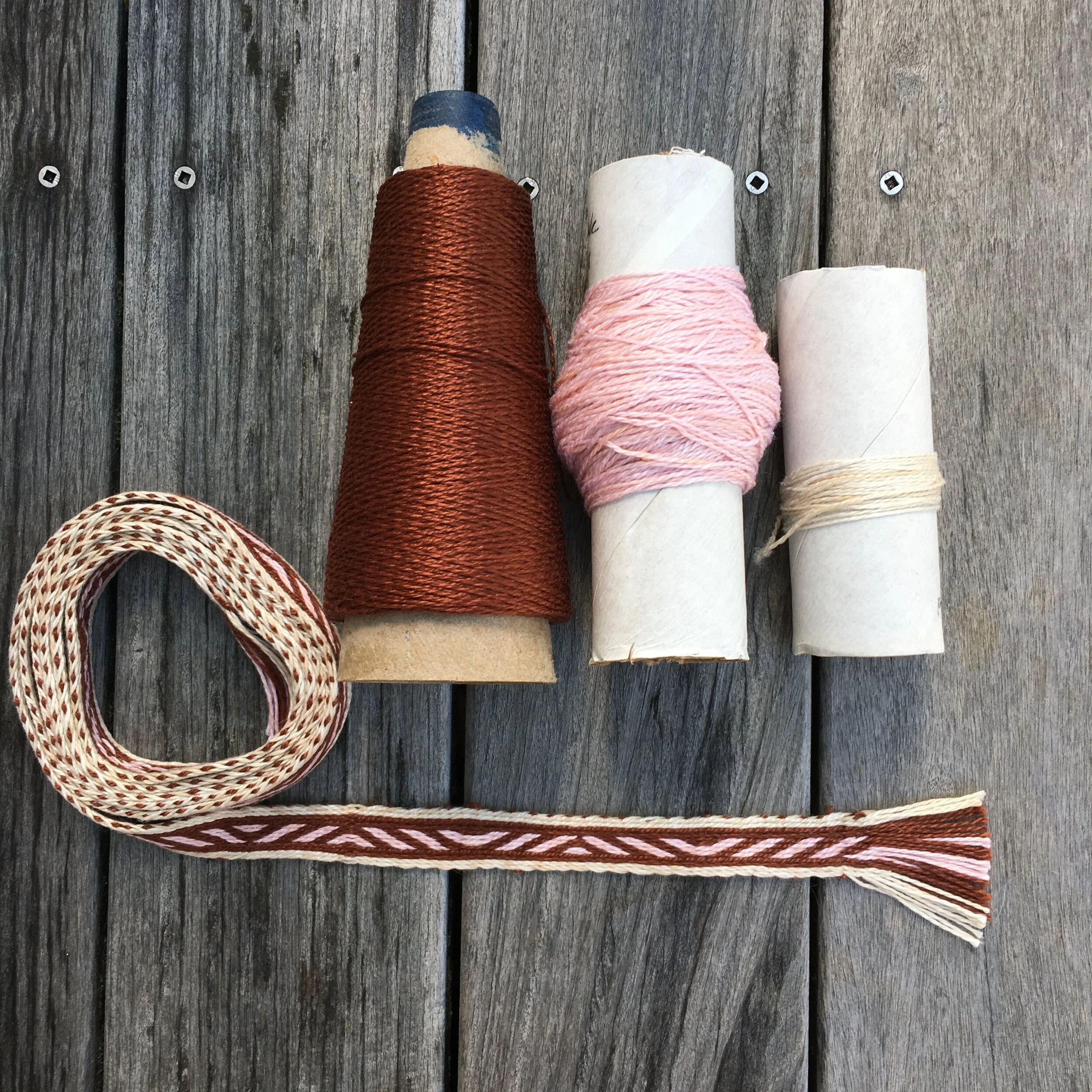
Lagoda Band using my crab apple leaves dyed yarn (pink) and peppermint/marigold (cream) cotton yarn. The brown is a commercially dyed cotton yarn

Lagoda Band using my crab apple leaves dyed yarn (pink) and peppermint/marigold (cream) cotton yarn. The brown is a commercially dyed cotton yarn

Lagoda Band using my crab apple leaves dyed yarn (pink) and peppermint/marigold (cream) cotton yarn. The brown is a commercially dyed cotton yarn

Lagoda Band using my crab apple leaves dyed yarn (pink) and peppermint/marigold (cream) cotton yarn. The brown is a commercially dyed cotton yarn

I was so excited to weave this Lagoda band with the yarns I had dyed with items from my own yard! The beautiful pink is from the leaves of a crab apple tree and the soft cream was dyed using peppermint leaves and marigold flowers. The mordant for all my dyeing is a soymilk/water mixture.

This tablet weaving pattern is the second tablet woven band in the Weave Along with Elewys series. The first link is to her blog post about this band and this one is to the YouTube Video showing how to warp and weave the Lagoda band.

This is a Norse influenced pattern from between the 10th to 12th century and was found in a burial mound near Lake Lagoda, which Elewys says is 170 miles east of St. Petersburg, Russia.

The central pattern reverses, which undoes the twist which builds up as you weave. However, the borders are all woven forward. I eventually got a twist in those border threads which were a problem, so I started weaving them in reverse. This works, but causes a bump in the border. It doesn’t bother me a lot, but after I finished it, discovered another video by Elewys that explains that you can simply flip the border cards from S to Z or Z to S, depending on which they way they were intially threaded, that that solves the problem without any bumps! Here’s the link to her Tablet Weaving Tutorial: Untwisting Warp Threads.

I used a dark weft thread. I rather like the pattern on the borders of the band. It reminds me of Springer Spaniels. There is a way to hide a dark weft thread in a border, minimalizing the dots on the edges but I haven’t tried it yet.

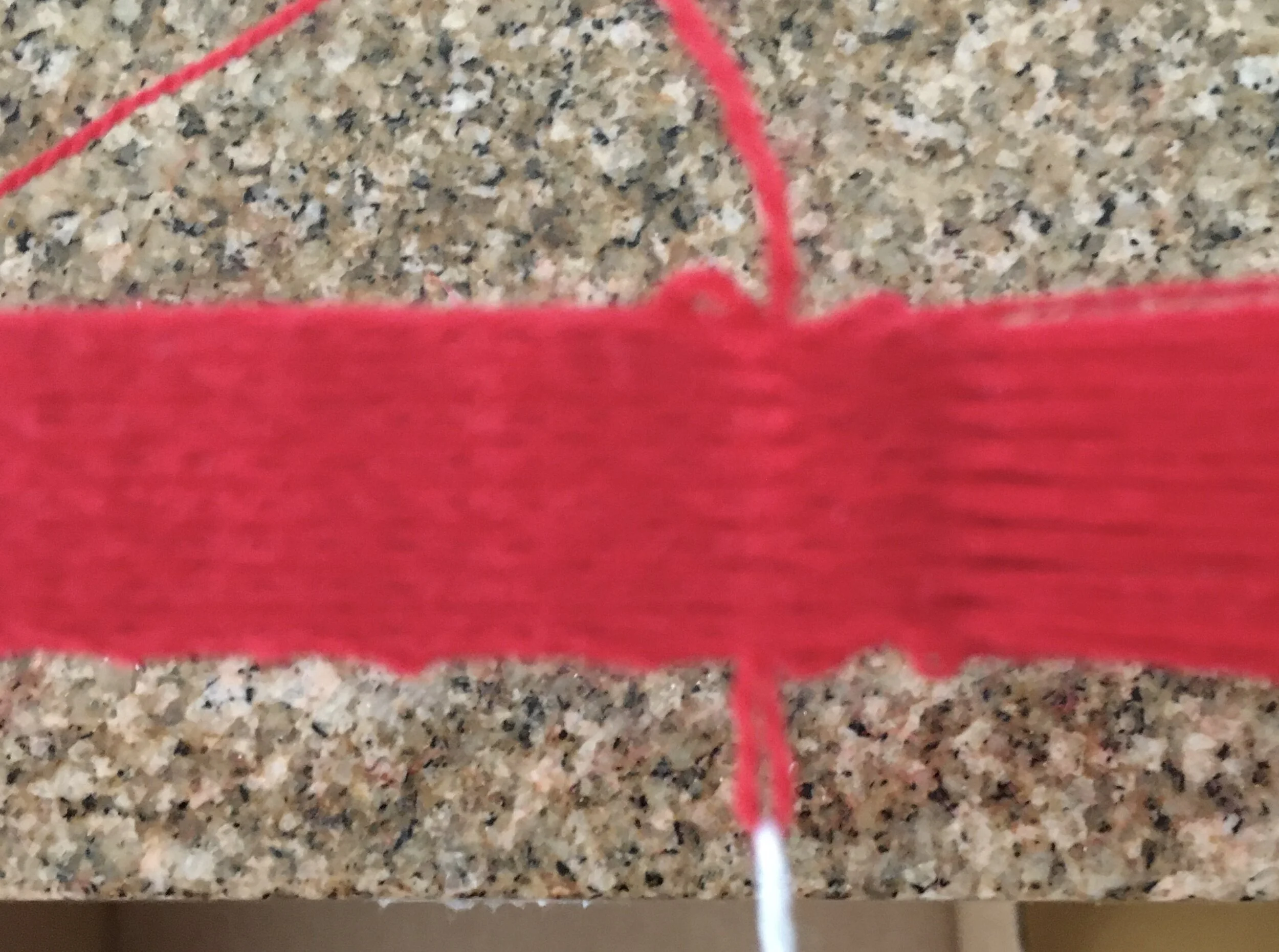
And I learned one more very important thing weaving this band. When they tell you to warp your loom with the tension bar at the furthest, loosest place, do it! Tablet weaving bands cause the warp to get shorter as you weave. I never noticed that when I was doing straight weaves on the inkle loom. I warped this band with the tension bar approximately in the center of the slot. I realized about have way through the band, that this was going to be a problem. As I advanced the band, the tension bar got closer and closer to the end end of the slot. Finally it did reach the end of the slot, which meant I was done weaving. I couldn’t advance the band any further. It wasn’t horrible…I probably sacrificed about 8 inches of warp thread. But since this was hand dyed yarn, it was a rather painful to lose it!

I will say that there are a lot of different types of inkle looms in videos I’ve watched, and the location of the loose end of the tension bar is looks different on different looms. So I was a bit puzzled about where it was on my Schacht Inkle Loom. The answer is that it is at the end of the slot that is closest to you when you are weaving, and furthest away from the pegs.

I learned a lot weaving this band and am starting to feel more comfortable doing tablet weaving. It’s really fun and I love the finished product!
Oops. Here you can see the tension bar as arrived the end of the slot that is closest to the pegs on my Schacht Inkle Loom.  I can’t advance the band any further. so I  can’t weave anymore of my warp. This is a rookie error.

Oops. Here you can see the tension bar as arrived the end of the slot that is closest to the pegs on my Schacht Inkle Loom. I can’t advance the band any further. so I can’t weave anymore of my warp. This is a rookie error.

TAGS: Tablet weaving, My Weave Along with Elewys Episode 2


September 30, 2021

Natural Dyeing: Crab Apple Leaves

by Judy Tucker


Crab Apple Leaf Natural Dye

Crab Apple Leaf Natural Dye

Crab Apple Leaf Natural Dye

Crab Apple Leaf Natural Dye

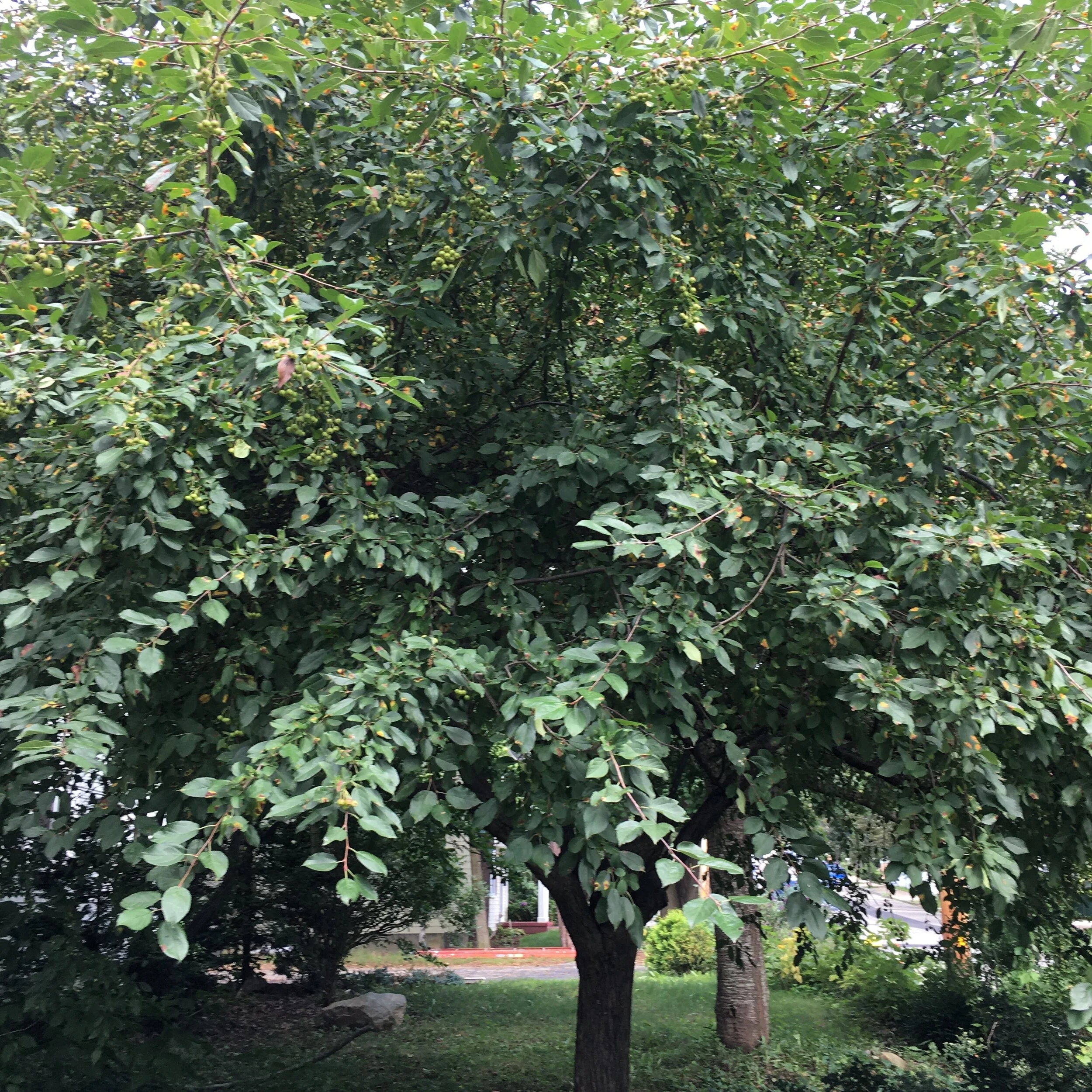
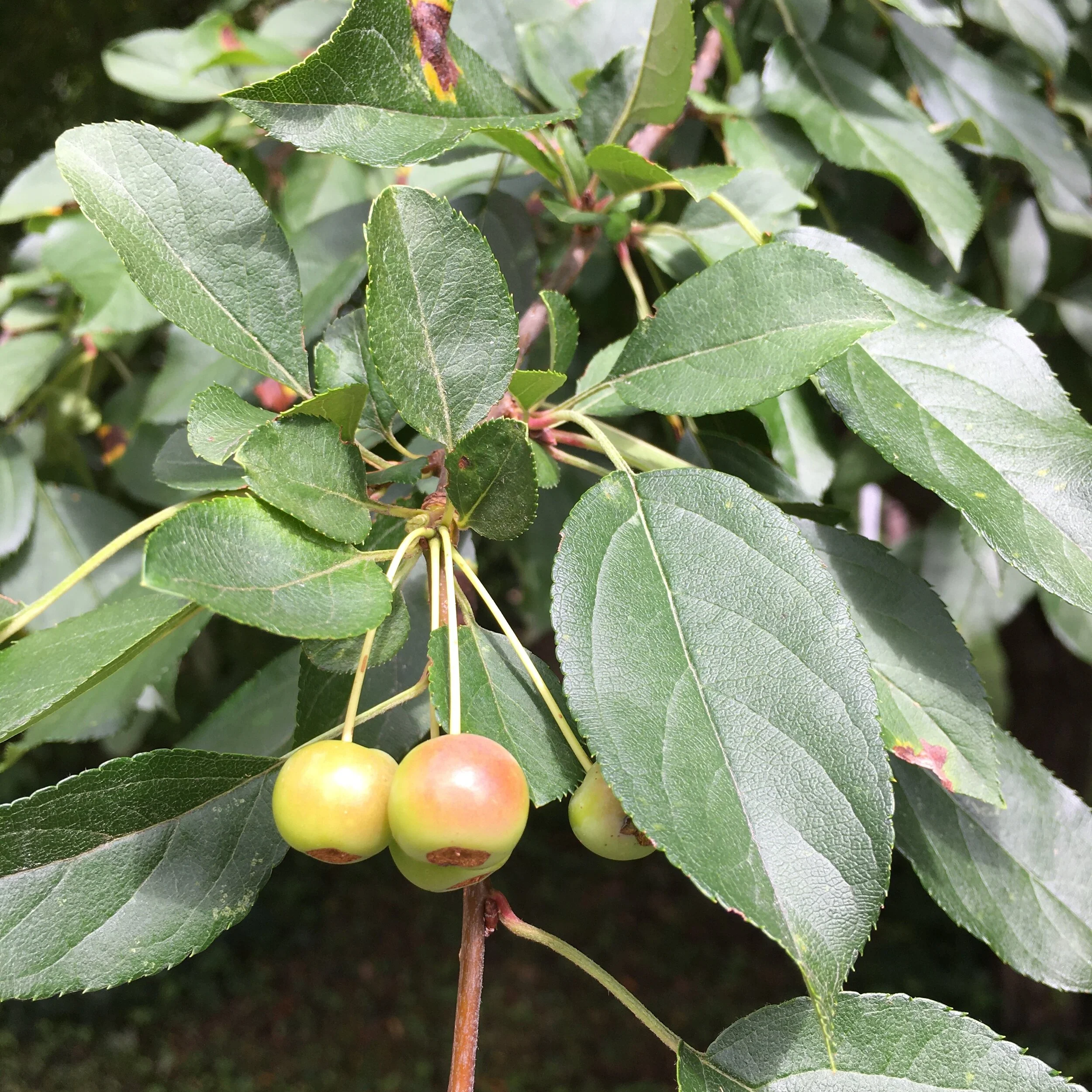
As mentioned in my previous post, my newest experiment in natural dyeing was using leaves from the crab apple tree in my front yard.

IMG_6390.JPG
IMG_6393.JPG

I got this idea from a natural dyer who lives in the United Kingdom and has a blog named Imagine Jem. A friend of mine here is the US is a friend of this blogger and sent me the link to the blog when she saw my posts on natural dyeing! Love it!
Any way, this UK dyer had dyed yarn using an assortment dyes she made from an apple tree—bark, leaves and core + skin. She had gotten a beautiful yellow dye using the leaves from her apple tree. I haven’t made and yellow dyes yet, and I needed to do some pruning of my crab apple tree, so I decided to see if I could make a yellow dye bath.

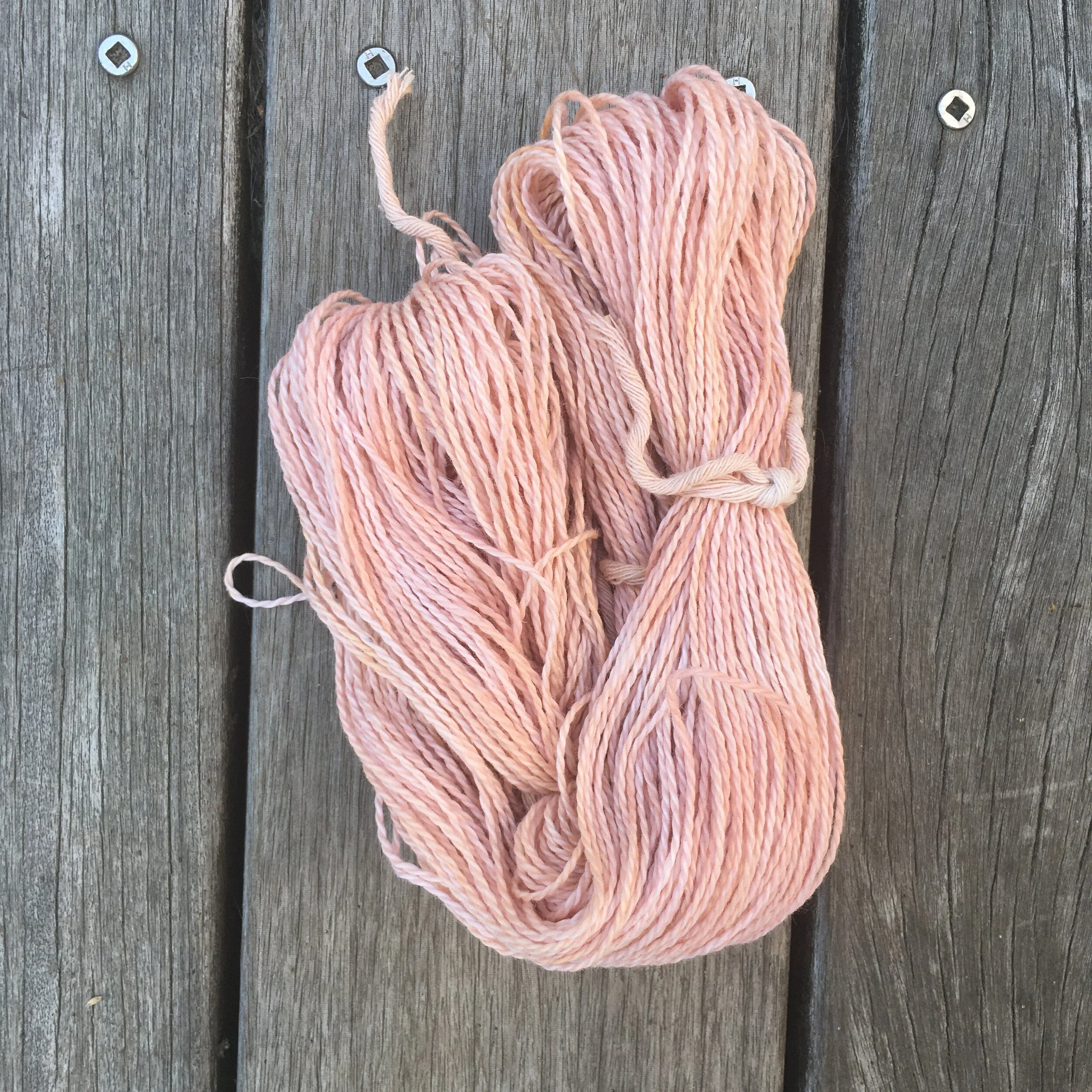
Well, no. I didn’t get a yellow dye. But I did get a beautiful warm pink dye which is my favorite pink natural dye so far!

Just for comparison, here is a piece of fabric dyed with avocado pits and one with the crab apple leaves.

Avocado pit at the top and the slightly warmer pink crab tree dye at the bottom

Avocado pit at the top and the slightly warmer pink crab tree dye at the bottom

And for the first time, I’ve dyed some natural cotton pearl cotton yarn which I plan to use for my next tablet weaving project. This yarn was a bleached white. As with my fabric dyeing, I soaked the yarn in a diluted soy milk bath overnight and let it dry. My dye bath was already 3 days old, so I didn’t let they yarn cure for a week after the soy bath. That my affect the color fastness of the dyed yarn, but that’s ok. This is all an experiment.

Cotton yarn dyed with leaves from my crab apple tree

Cotton yarn dyed with leaves from my crab apple tree

The best thing about this warm pink dye is that half of the year I have access to crab apple tree leaves! Or at least I should. The leaves have some sort of nasty scab on them this year. Time to call the arborist to see if they know what it is and if it will cause any long term damage to my tree. (It turned out to be cedar apple rust and which my aborist tells me doesn’t harm the tree).

TAGS: Natural dyeing with crab apple leaves, Natural Dyeing


September 23, 2021

Making Leaf Peg Dolls: A Tutorial

by Judy Tucker in Tutorial


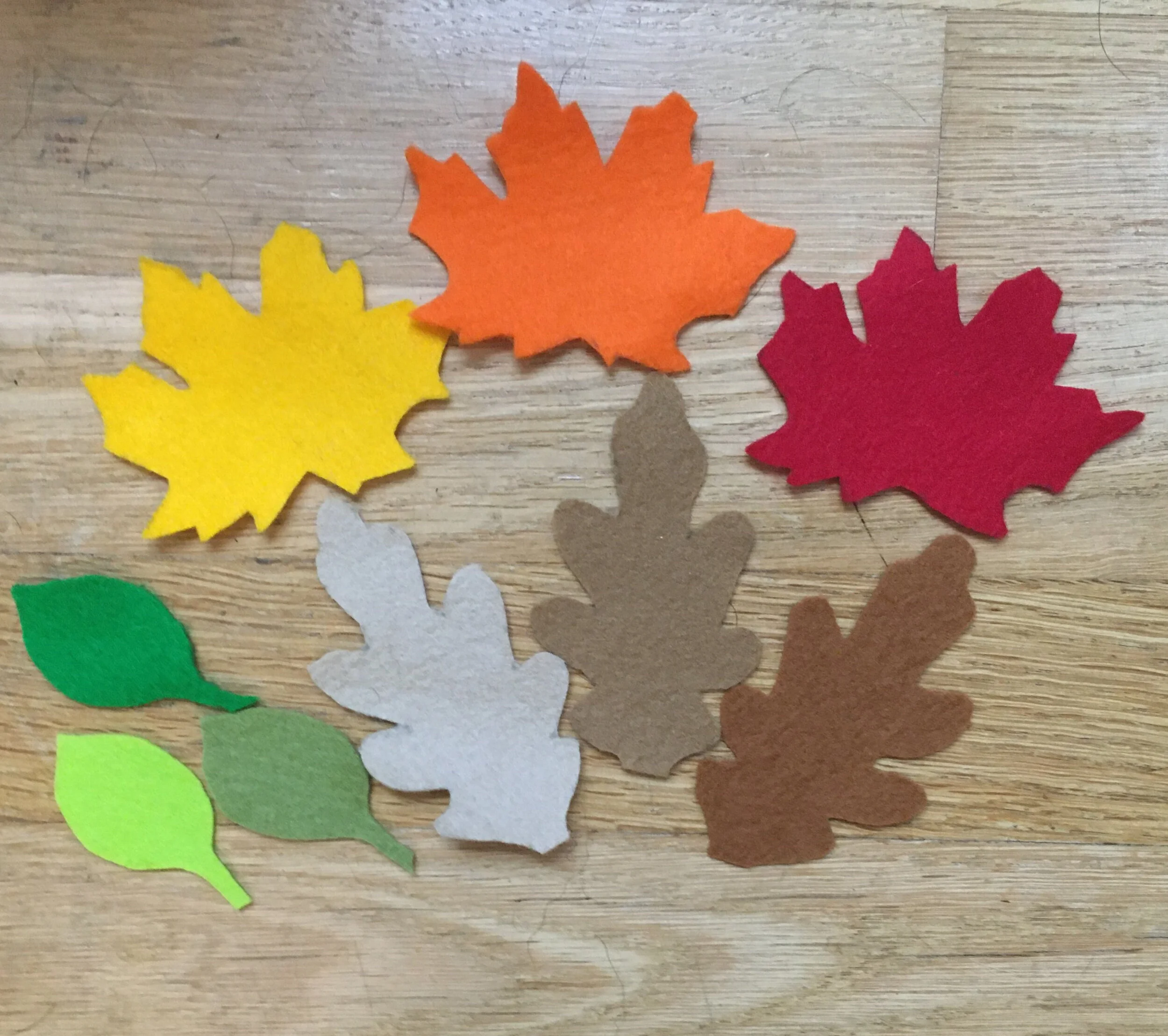
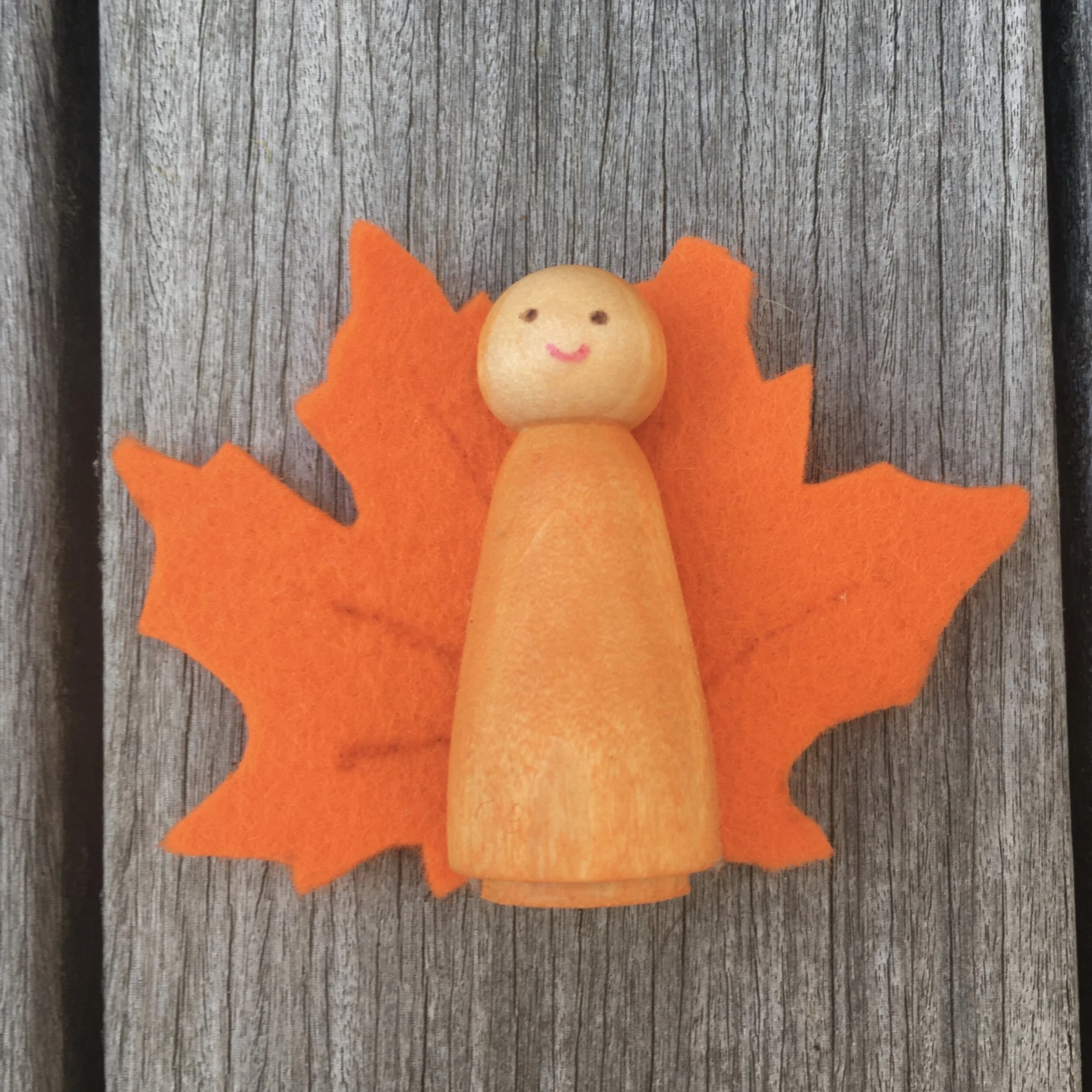
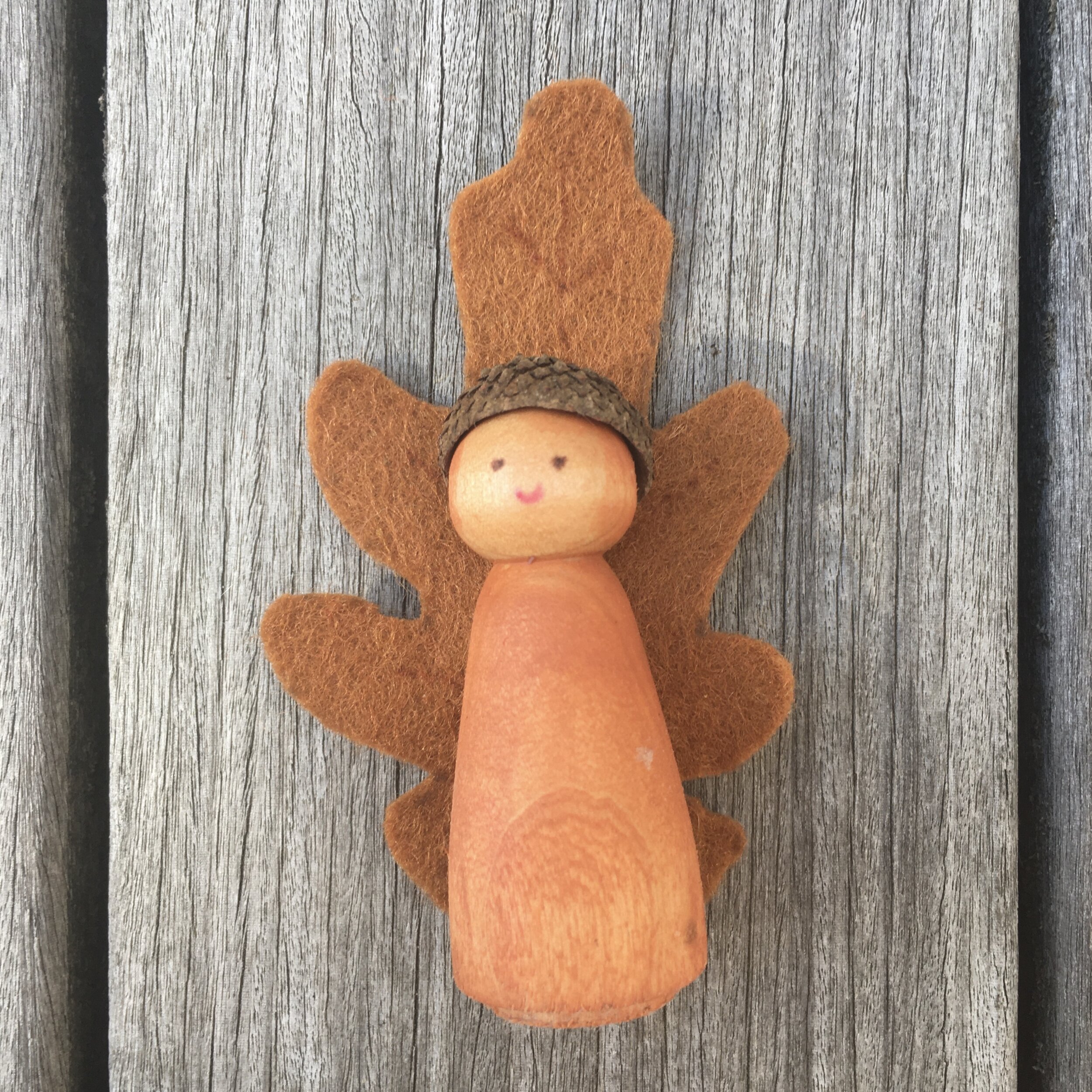
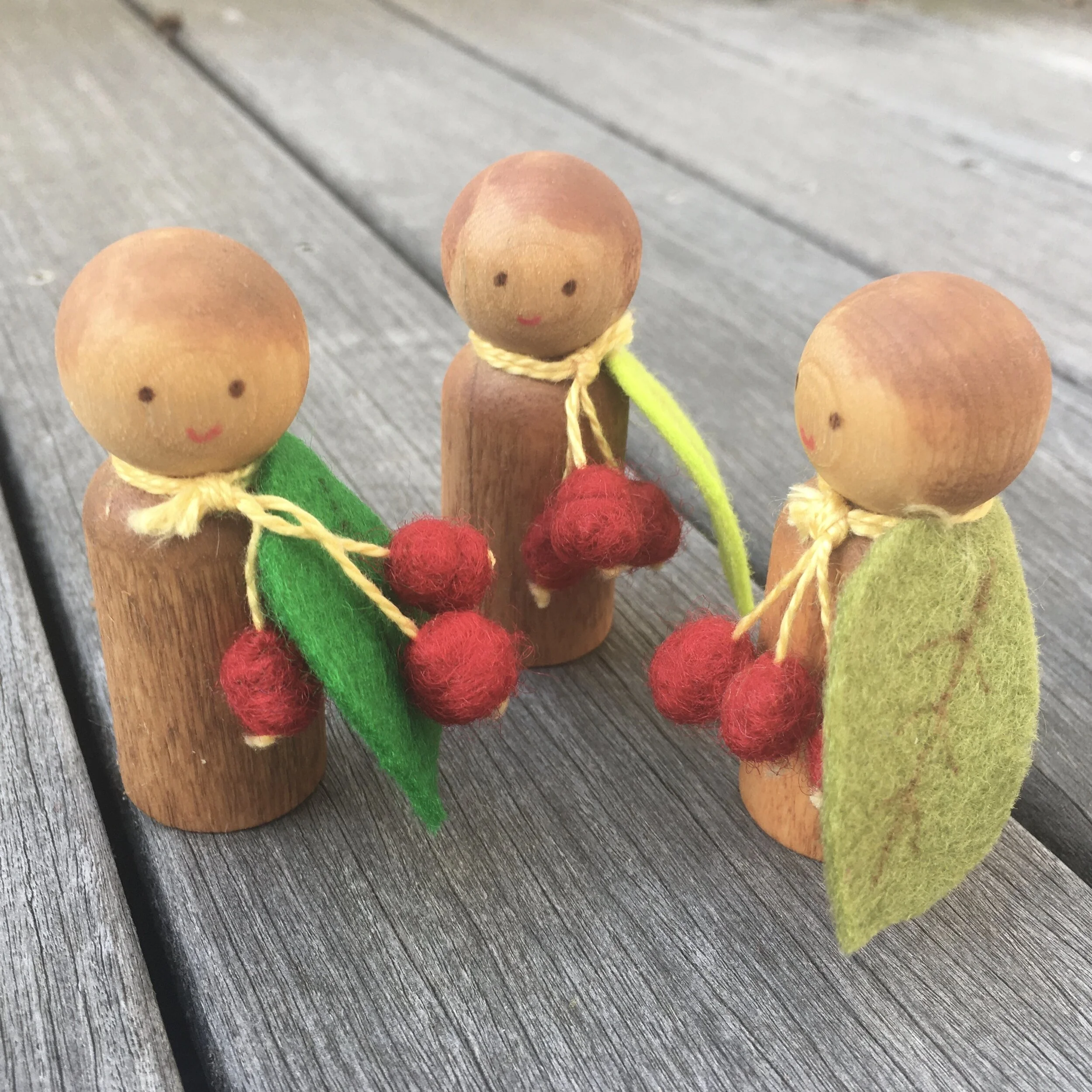
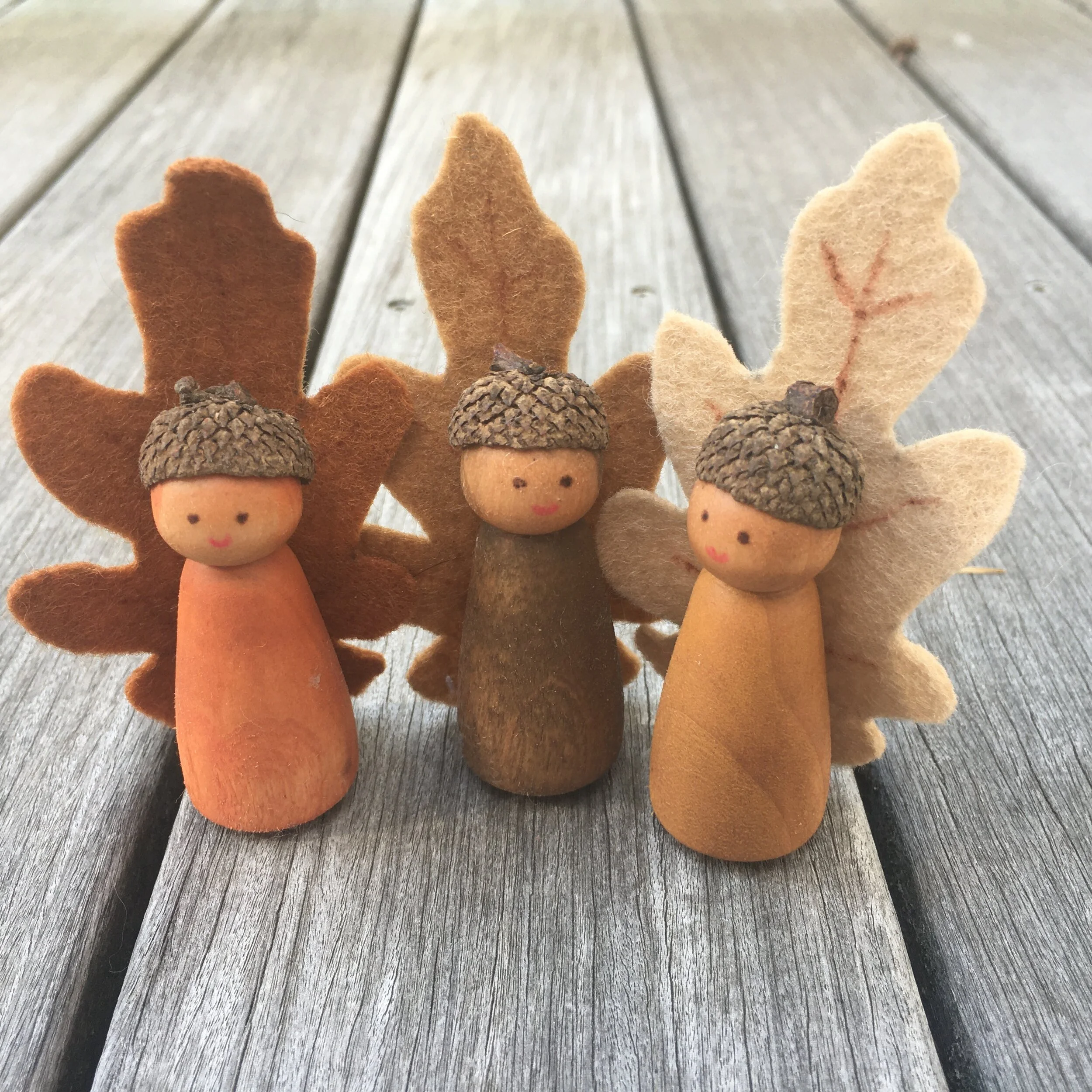
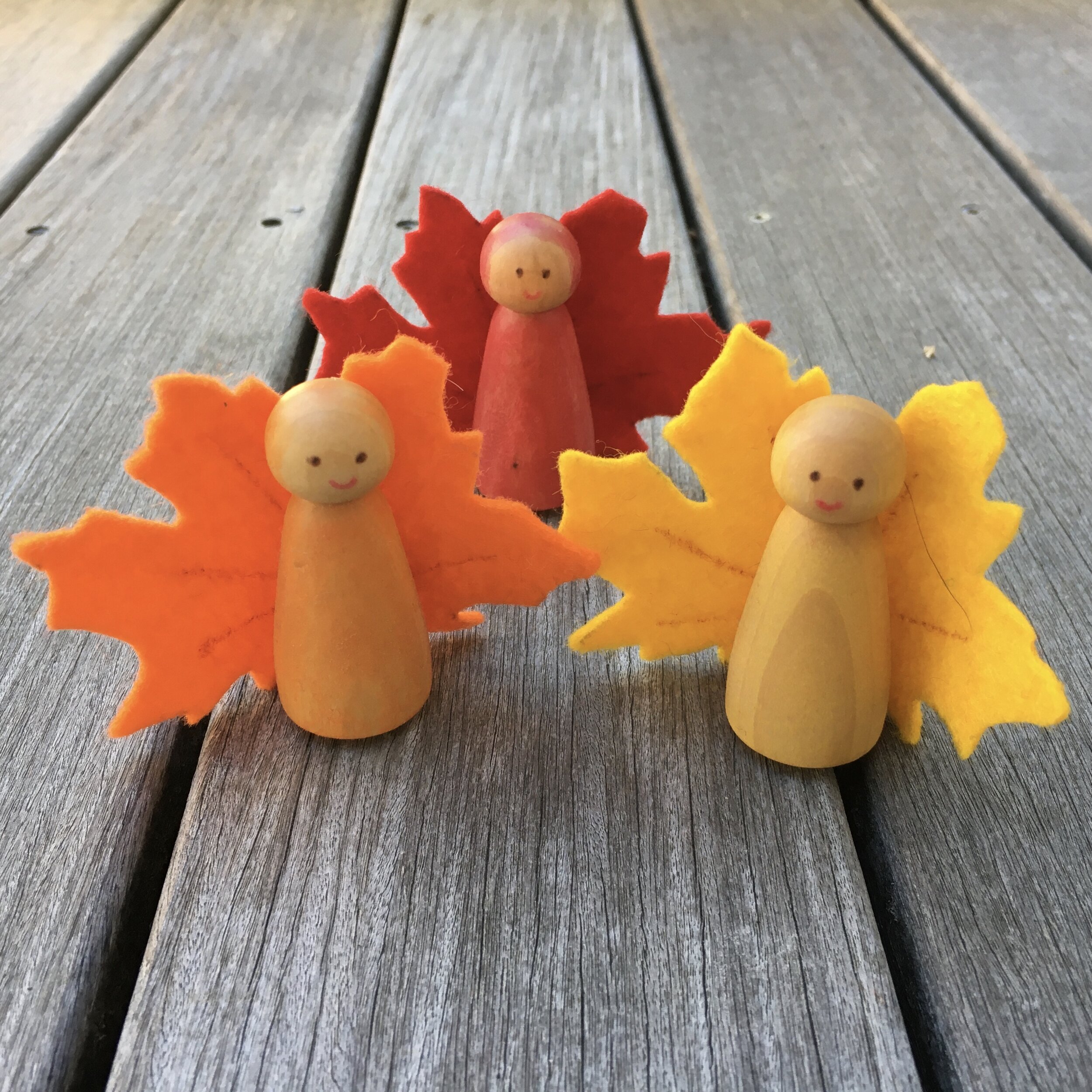
Autumn Leaf Peg Dolls. Left to right: Maple, Oak, Crab Apple

Autumn Leaf Peg Dolls. Left to right: Maple, Oak, Crab Apple

Autumn Leaf Peg Dolls. Left to right: Maple, Oak, Crab Apple

Autumn Leaf Peg Dolls. Left to right: Maple, Oak, Crab Apple

If you have leaves to trace, it’s not hard to make leaf peg dolls like those shown above. This is a tutorial you can follow to make your own!

NOTE: These peg dolls are intended to be used for decorations, not as toys. They should NOT be given to any child under age three, as they have small parts which are a choking hazard.

Supplies:

  • Wooden peg dolls. Medium to large size. They need to be large enough that the leaf you are choosing to trace doesn’t overwhelm the doll.

  • Leaves, acorn caps which fit your peg dolls head if using oak leaves (acorn caps are optional)

  • Wool felt

  • Non-toxic watercolor paint

  • Beeswax polish

  • Markers

  • Wool roving, pearle cotton embroidery thread and a sewing needle with a large eye if you wish to make the crab apples

Making the leaf peg dolls:

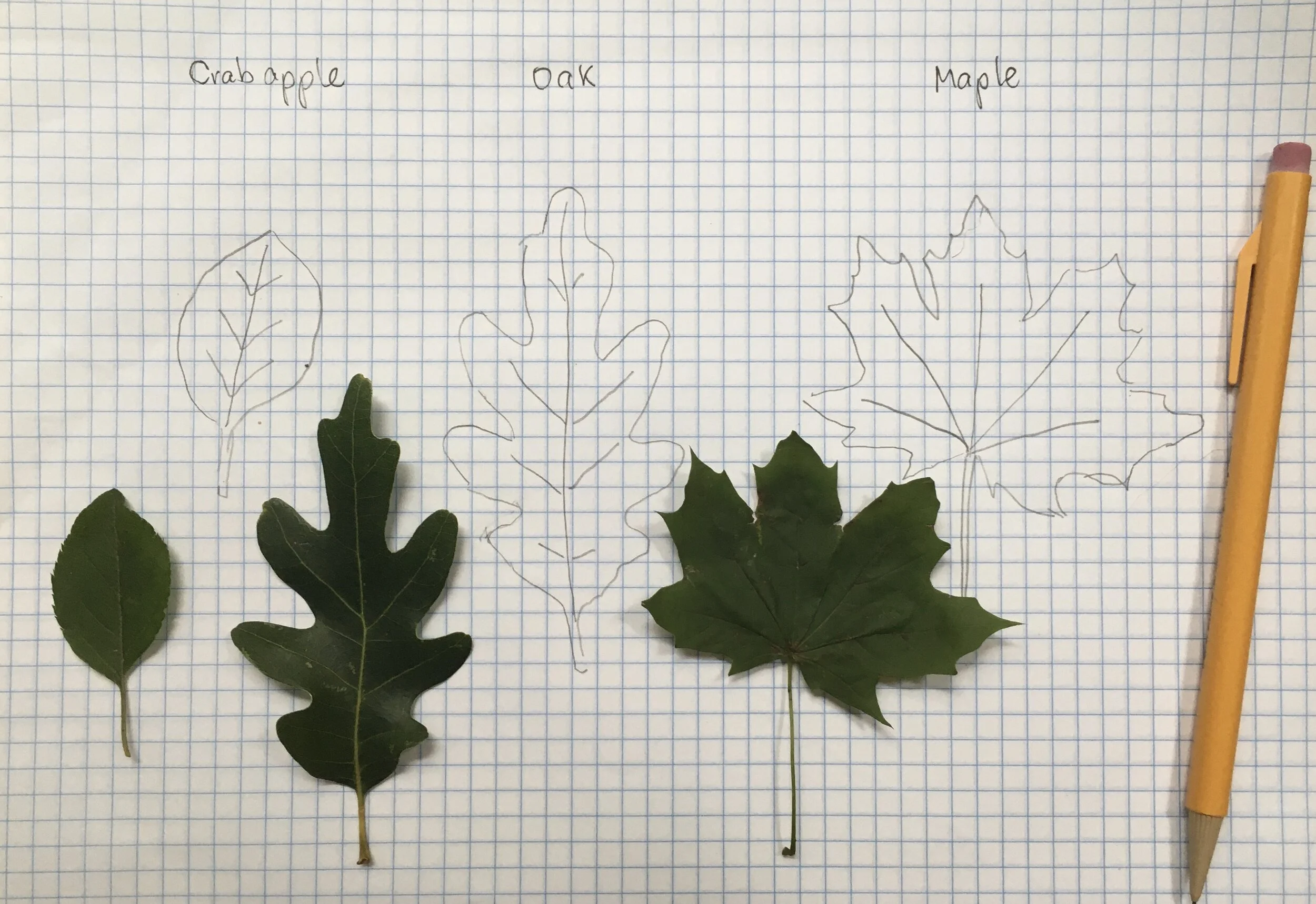
  • Make patterns for the leaves by placing them on a sheet of paper and drawing around each leaf with a pencil. Leave enough room between them so you can cut out each pattern.

    If making a crab apple, be sure to give the leaf a stem.

  • Using the paper pattern, trace the leaf shape onto a sheet of wool felt.

  • Cut out the leaves. You may leave them plain, or draw the veins on them with a fine tip marker.

  • Paint the peg dolls to match the leaves you just cut out. You can paint the entire peg a color, or leave the face unpainted. Allow to dry.

  • Once the peg dolls are fully dry, seal them with beeswax polish. Allow to rest overnight. Then polish with a soft rag.

  • Assemble the leaf doll by applying craft glue down the center of the leaf. Put the peg doll down on the glue and press firmly. Allow to dry.

  • For the crab apple, just apply glue to the stem of the leaf and attach it on the back of the peg at the neck.

  • Add facial details with a marker if desired.

  • Your leaf doll is complete!

B3F7B913-9DB4-456C-825A-0CA3050EB2B6_1_201_a.jpeg
FD48D325-EA23-4F15-AF25-8B4BBCA8A843.jpg
EB03D664-0238-4976-BBE3-20B97CEC269B_1_201_a.jpeg
42A3200A-8338-4340-93B3-B45F2DA70378_1_201_a.jpeg
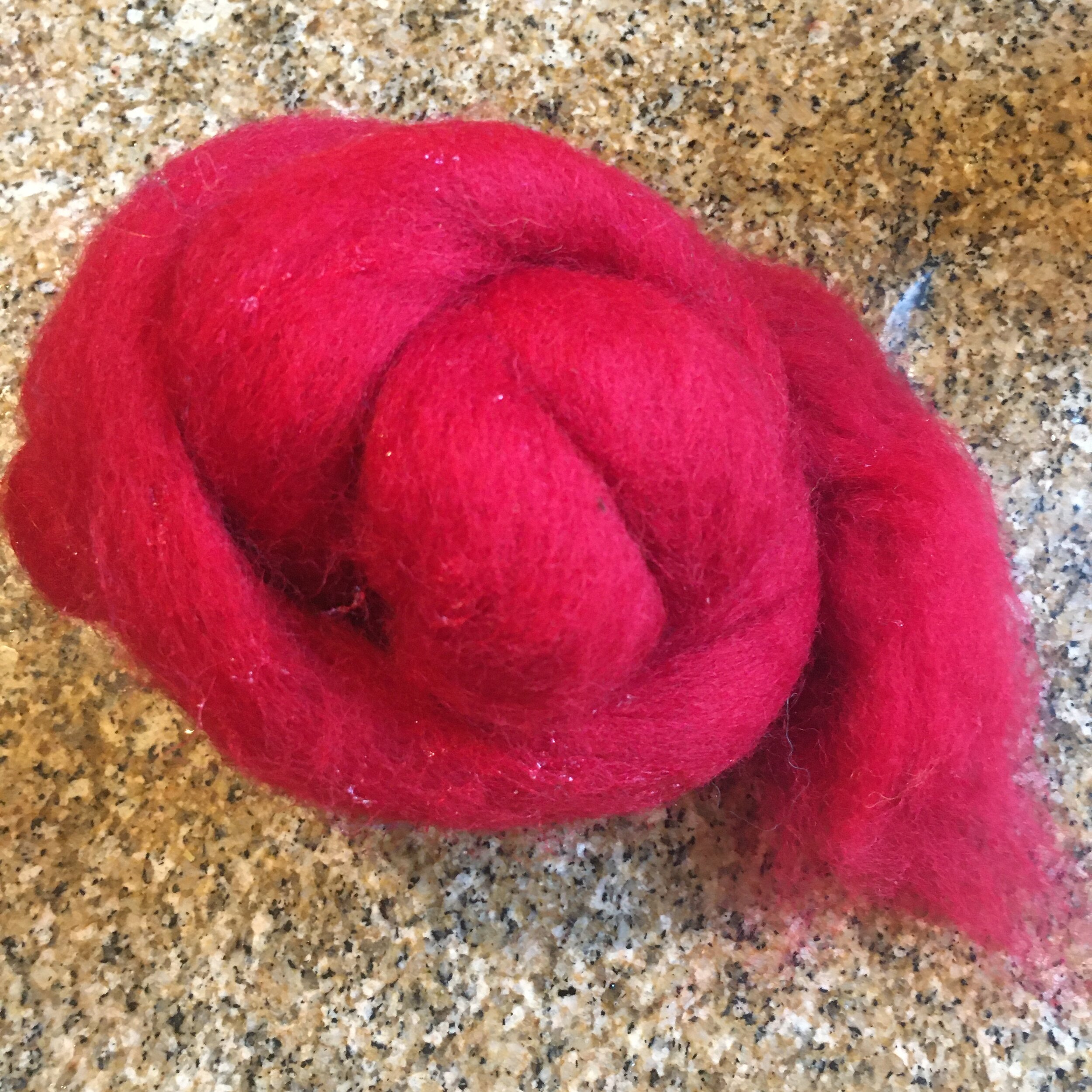
  • To make the felted crab apples, you will need some red or yellow wool roving.

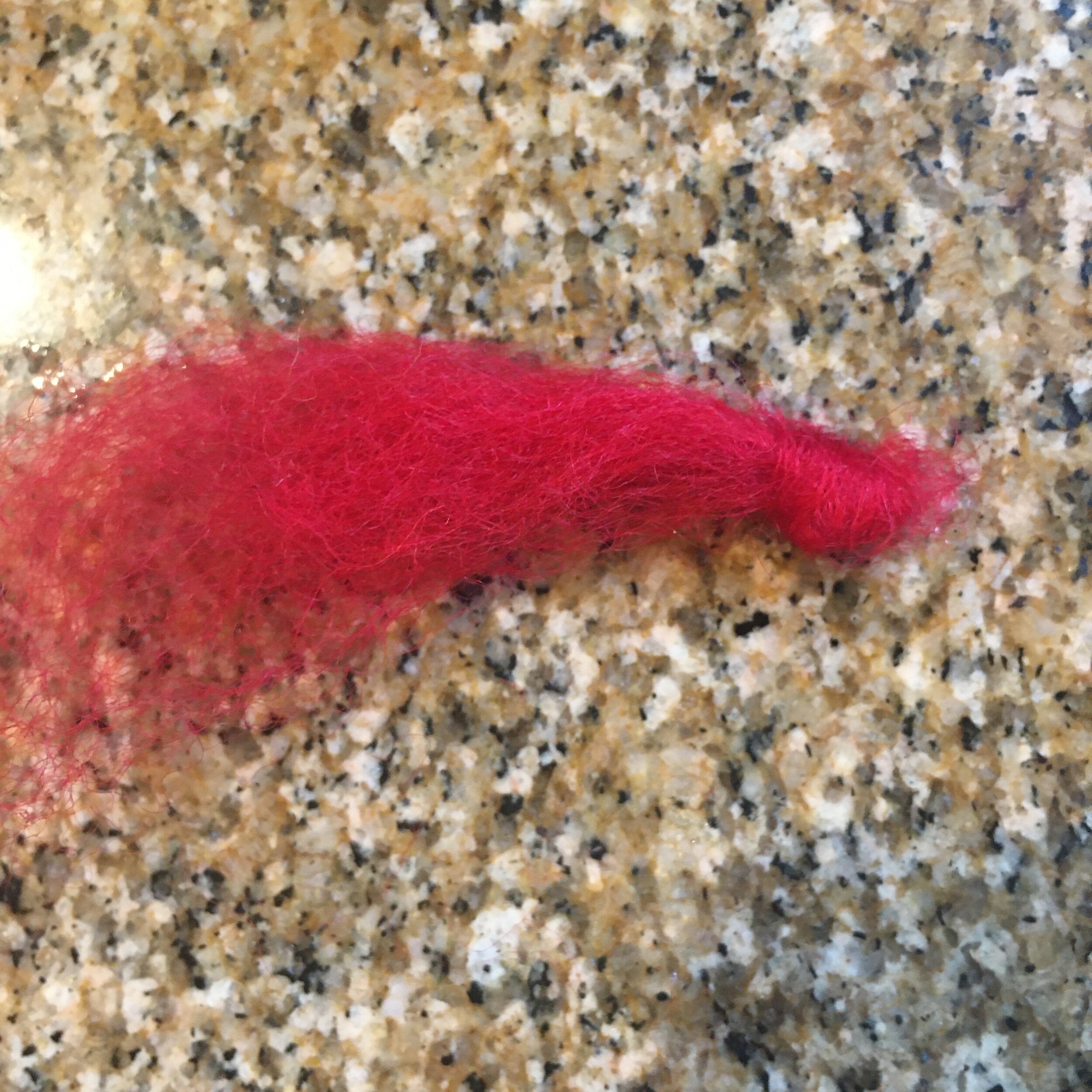
  • Pull off a small wisp of roving. Tie a knot in one end. Now roll the piece of roving into a little ball shape.

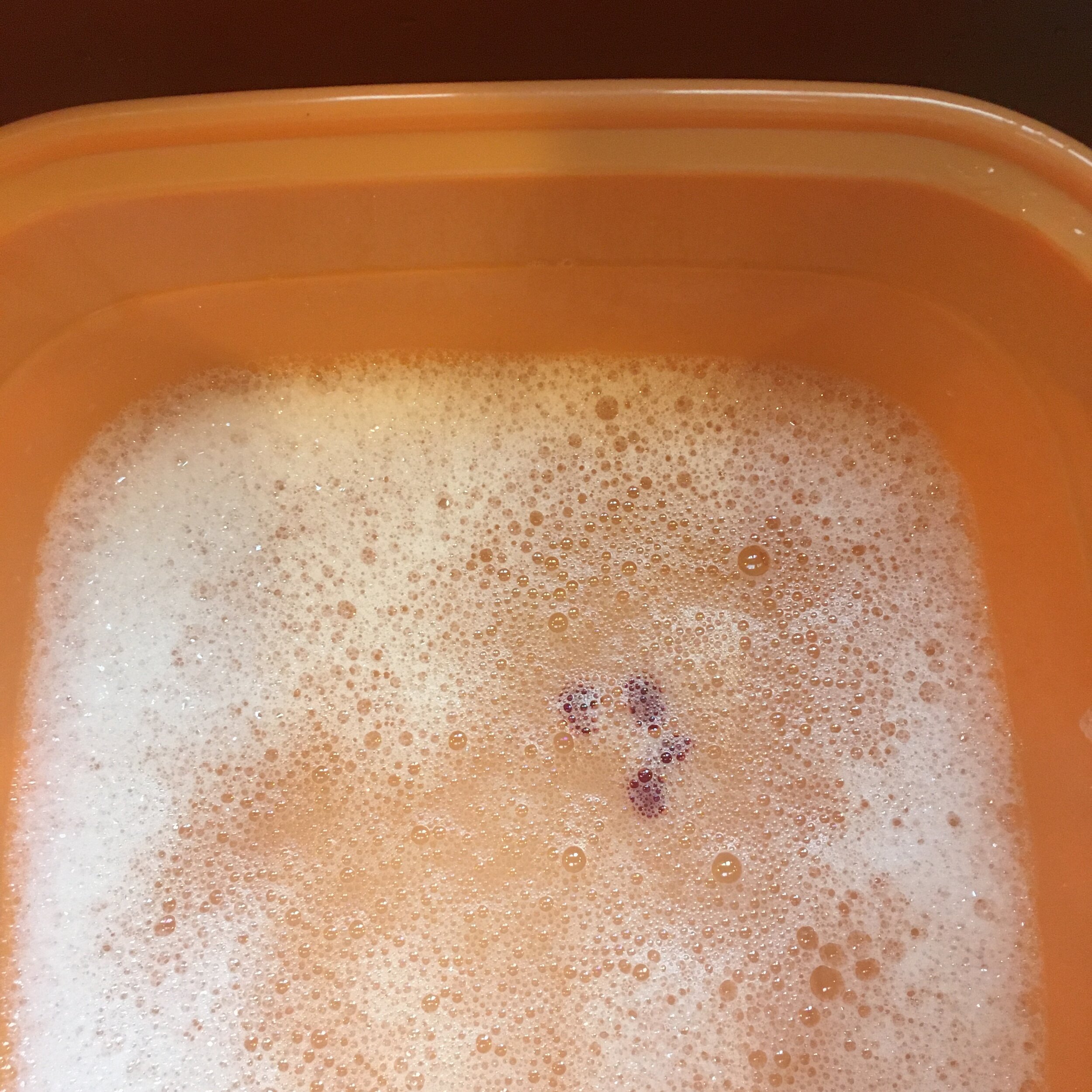
  • Wet the roving ball with hot sudsy water. Rub it firmly, around in circles, between your palms, as if making a clay ball. Continue wetting and rolling until the wool is a tight little ball.

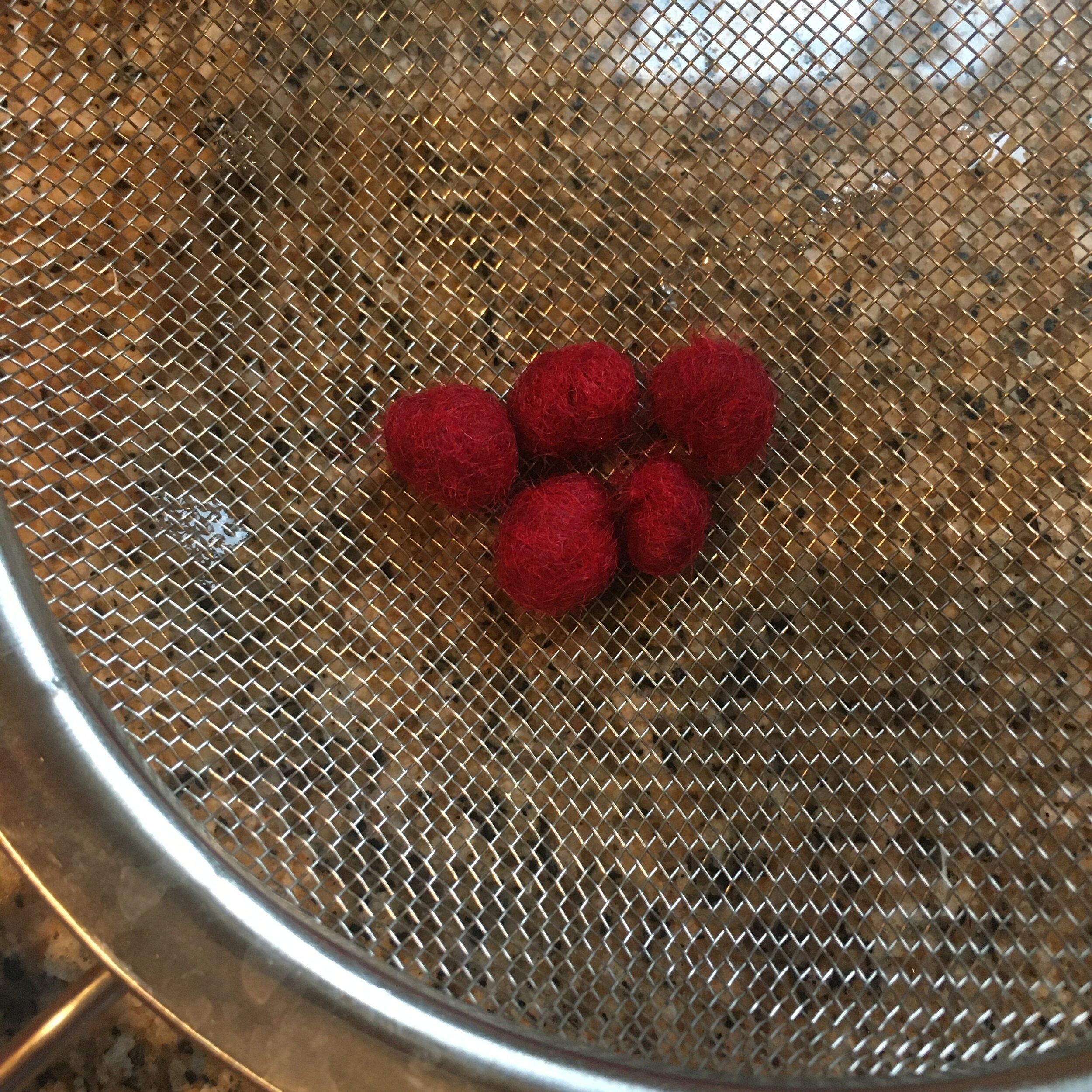
  • Drop the wool ball in the soapy water until you have made all the balls.

  • Allow the wool crab apples to dry.

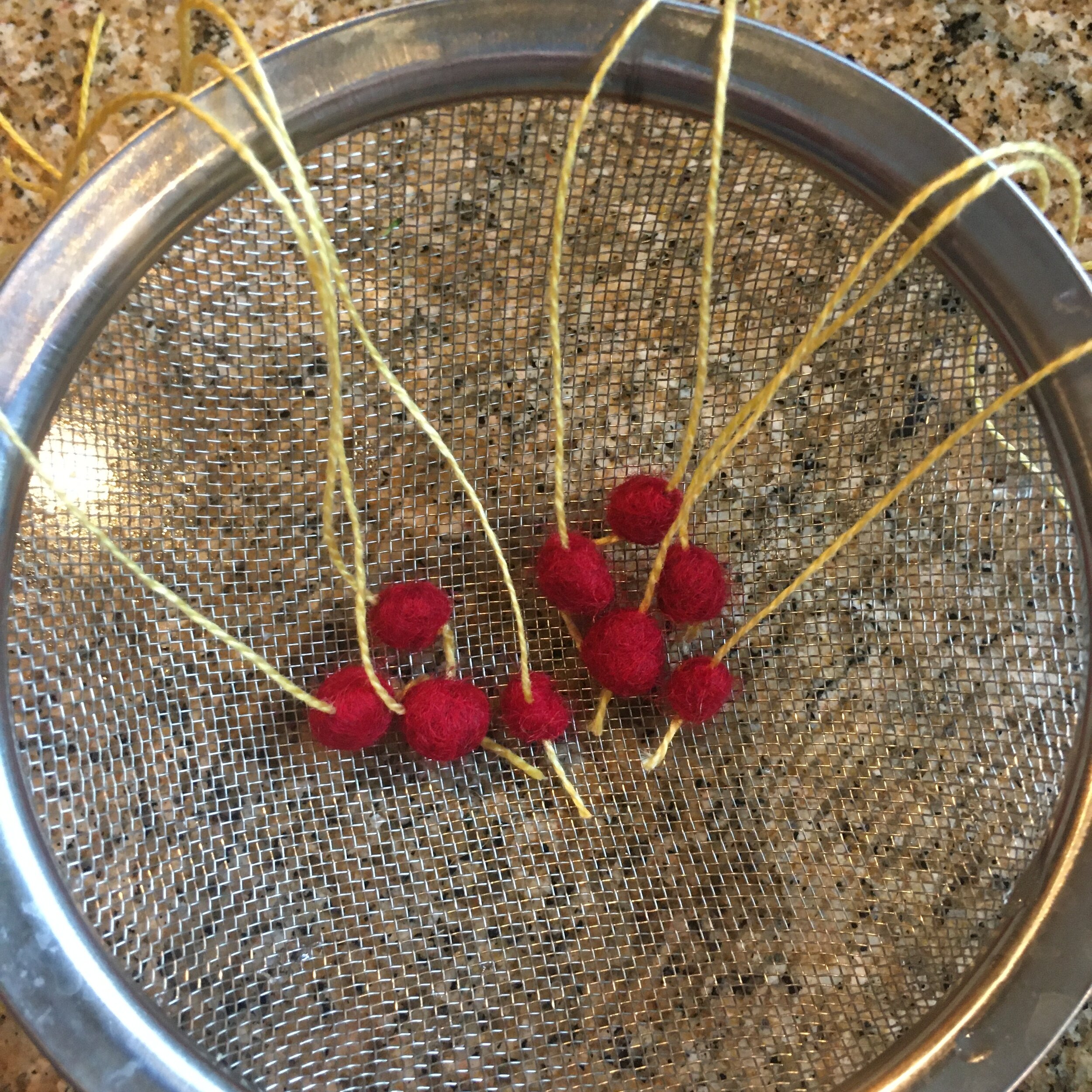
  • Cut a piece of pearle cotton thread about 6 inches long. Tie a knot at one end.

  • Using a sewing needle with a large eye, thread the pearle cotton on the needle and run it through the center of a felt crab apple. Repeat for all your carb apples.

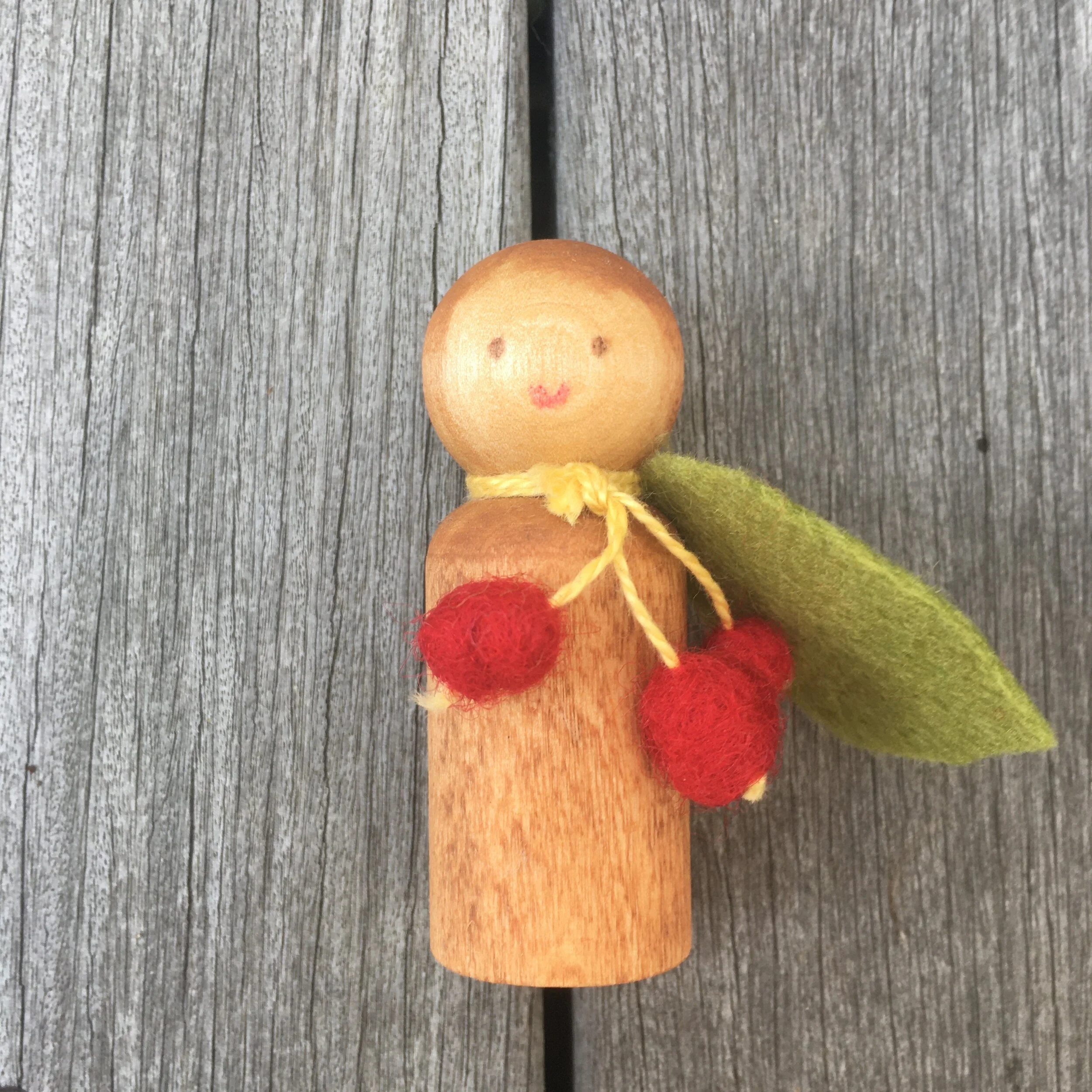
  • Take 3 completed apples and tie them around the neck of the peg doll. Trim off the extra thread.

77AA3AE7-444A-471C-9D75-0C20BC8487D1.jpeg
10D23F6F-DCF6-4363-B0DD-C6FB33D6232C.jpeg
F34C05BD-C3DF-455D-B9E6-8670DBEE1D79.jpeg
C692E0FE-36E1-4476-A28A-697DCF6FF889.jpeg
191FA079-FF48-46ED-B626-44FC6D229846.jpeg
02E5A66B-4357-4EC3-B217-EB5CAD99A21E.jpeg

Enjoy your new friends!

B0AB8B55-90A5-460B-B508-4AF40D1690B8_1_201_a.jpeg
069F587D-692B-48C8-89FF-A634F1F15F49.jpeg
8BBBEED8-4885-49C8-B293-0CBF811F73B1_1_201_a.jpeg

TAGS: Leaf peg dolls, Maple leaf peg doll, Oak leaf peg doll, Crab apple peg doll, Fall leaves peg dolls


September 16, 2021

Natural Dyeing Wood Using "Botanical Dyes on Wood"

by Judy Tucker


Left to right in pairs;  Yarrow, Sage, Crab Apple Tree Leaves. Sealed with beeswax polish.

Left to right in pairs; Yarrow, Sage, Crab Apple Tree Leaves. Sealed with beeswax polish.

Left to right in pairs;  Yarrow, Sage, Crab Apple Tree Leaves. Sealed with beeswax polish.

Left to right in pairs; Yarrow, Sage, Crab Apple Tree Leaves. Sealed with beeswax polish.

Rebecca Desnos, who wrote the book and zine I have been using for natural dyes for fabric and yarn, has just published a new book. Botanical Dyes on Wood. Since I love making peg dolls, I decided to see what happened when I dyed the pegs with natural dyes.

The new book on natural dyes

The new book on natural dyes

I thought of idea in time to use the dyes baths I had made from yarrow, sage and the fabulous crab apple leaves. And hands down, the crab apple leaf was as interesting and as beautiful on wood as it was on fabric and cotton yarn!

Here are the dyes on wood before I sealed them with bees wax polish. As you can see, the yarrow and sage, which dyed fabric light tan, didn’t add a lot of color the the wooden flower pots. There is a difference, but it’s not a lot. It takes the bees wax polish to really bring out the dye colors. (See photo at the top of the post).

Left to right, un-dyed flower pot, yarrow, sage, crab apple leaves

Left to right, un-dyed flower pot, yarrow, sage, crab apple leaves

This was fun. I may add a couple pegs to future dye baths to see what happens, but I don’t expect I will be making up natural dyes expressly for dyeing wood pegs.

IMG_6402.JPG
IMG_6404.JPG

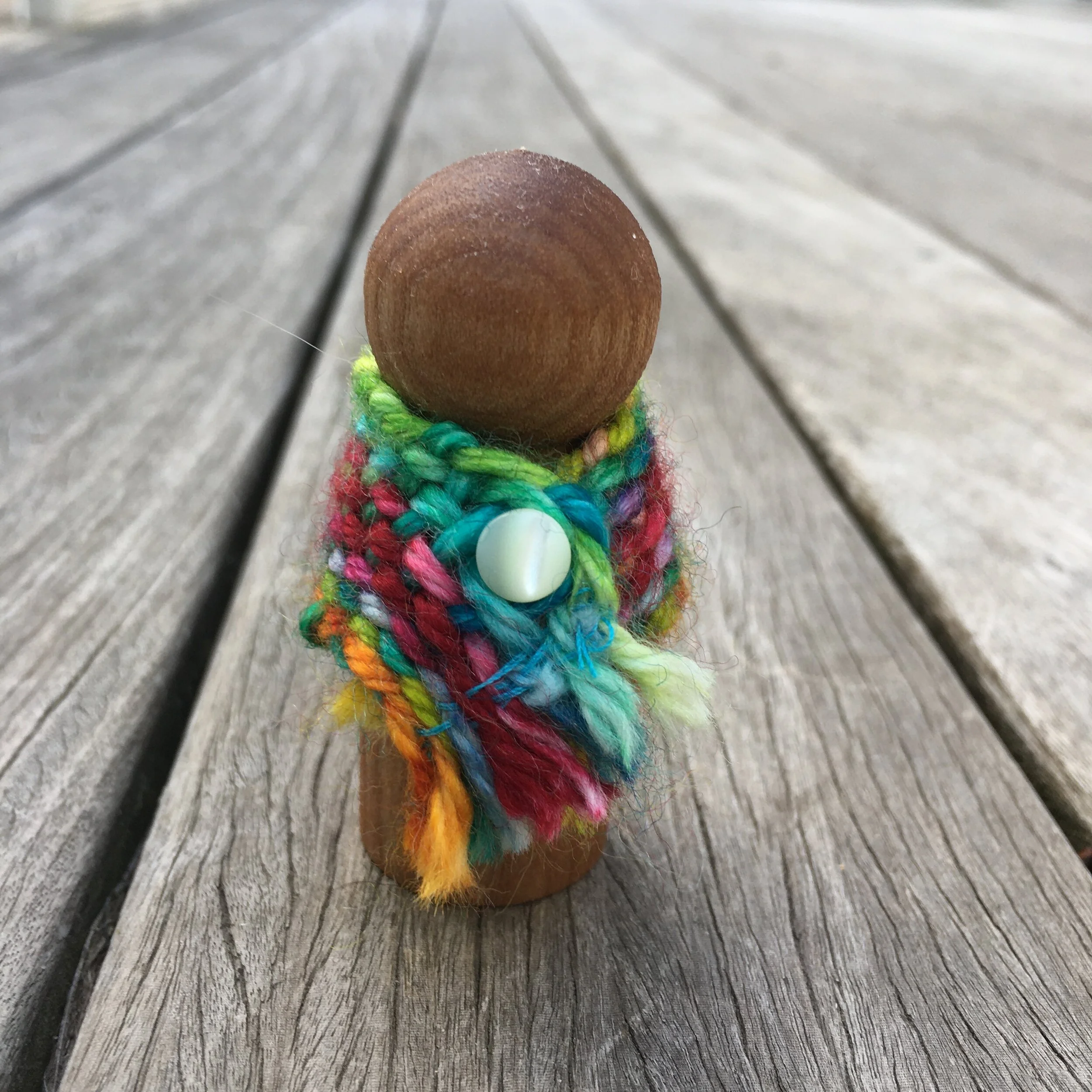
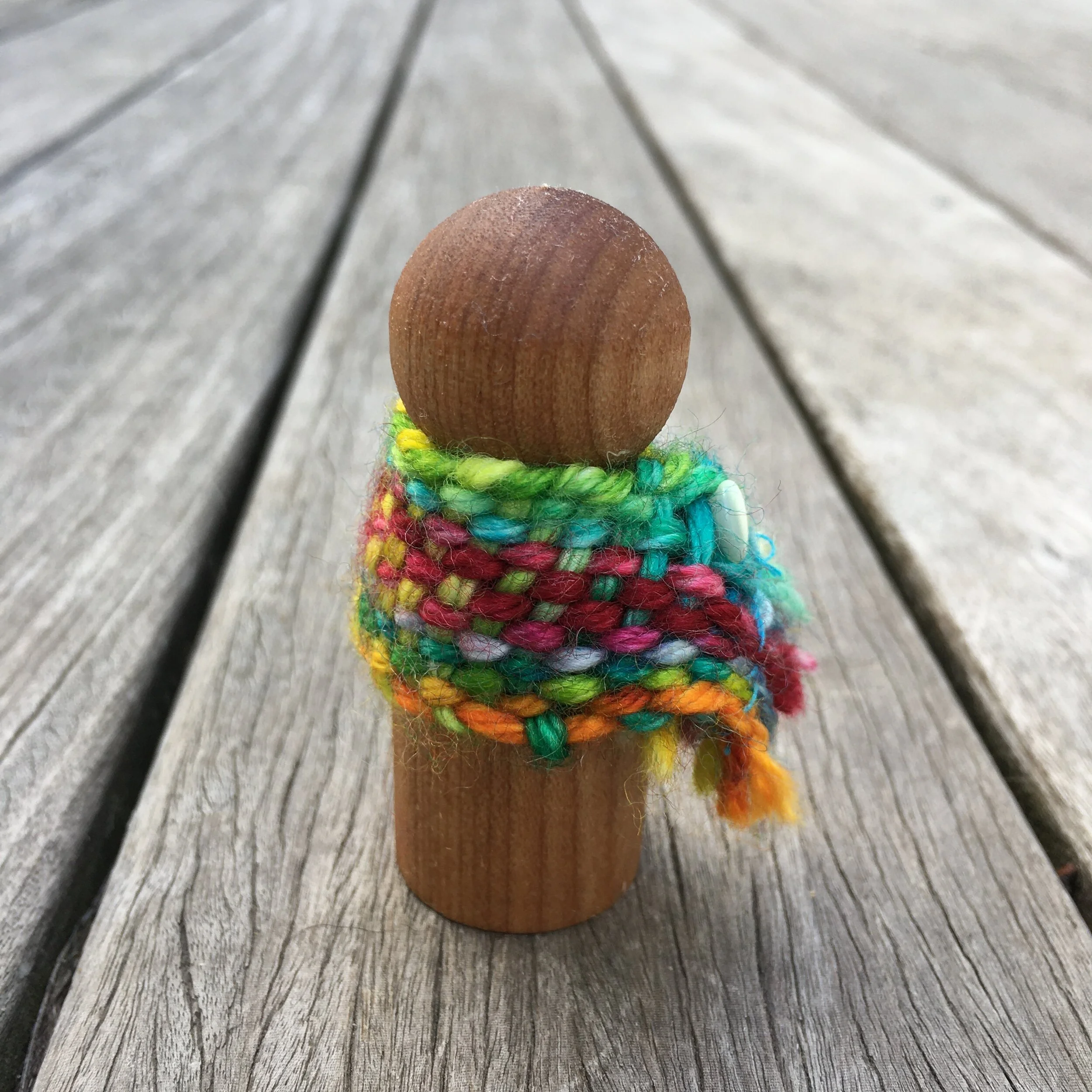
On the other hand, this Sage Fellow, in his hand woven serape, is a mighty cute peg person!

TAGS: Using "Botanical Dyes on Wood" book, Natural Dyed Wood, Natural Dyed Wood Pegs


September 9, 2021

Card/Tablet Weaving on an Inkle Loom: My Weave Along with Elewys - Episode 1 Project

by Judy Tucker


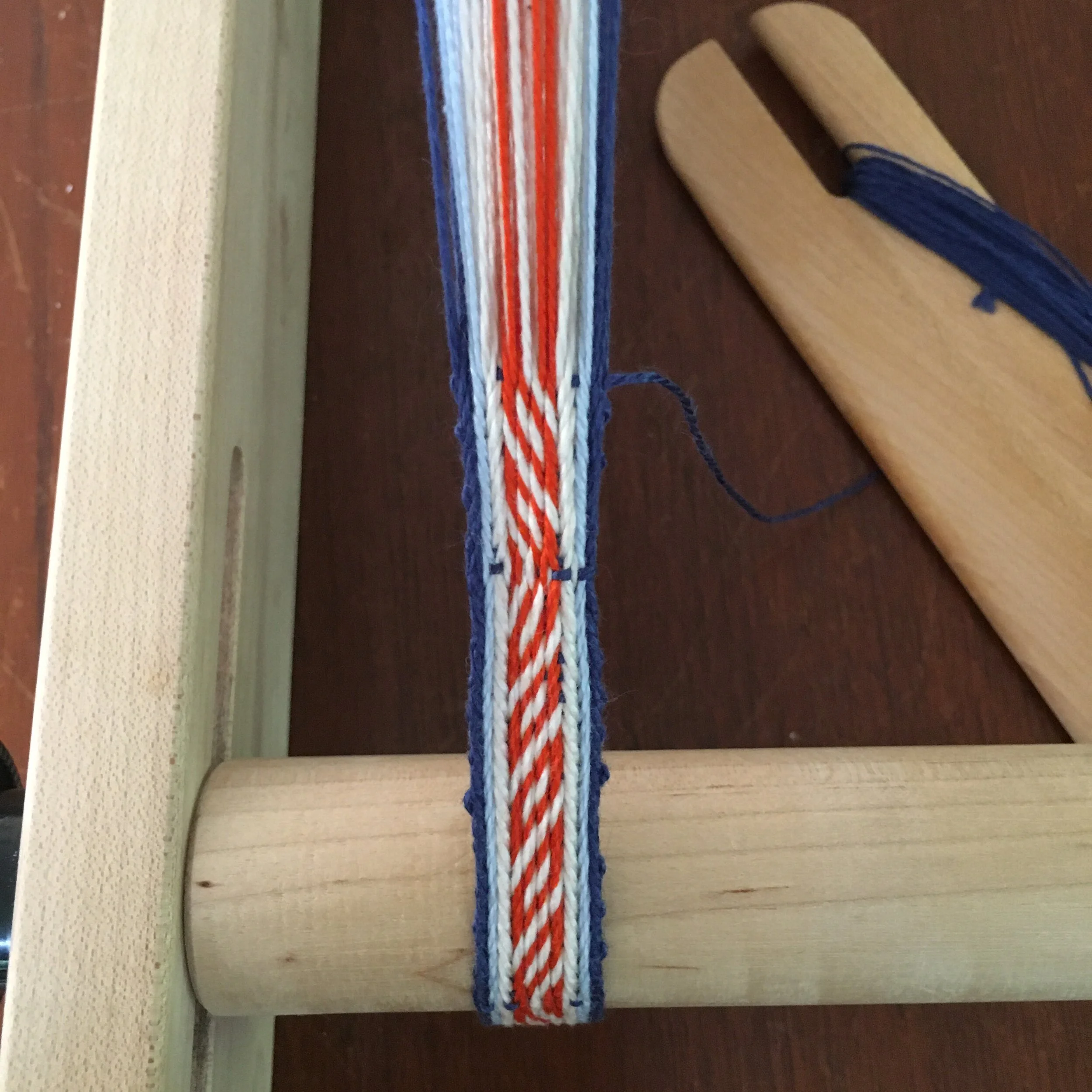
Card weaving on an inkle loom, this is an Oseberg band from episode 1 of Weave Along with Elewys

Card weaving on an inkle loom, this is an Oseberg band from episode 1 of Weave Along with Elewys

Card weaving on an inkle loom, this is an Oseberg band from episode 1 of Weave Along with Elewys

Card weaving on an inkle loom, this is an Oseberg band from episode 1 of Weave Along with Elewys

I have to say, the Schacht inkle loom that a couple of my friends gave me, was one of the best birthday presents ever! During the recent August heat and humidity, I pulled out my inkle loom and warped it for a plain weave band.

You hear folks talking about falling into “rabbit holes” on Instagram and PInterest but I fell down a rabbit hole in looking in my own box of weaving supplies!! Looking for a new colorway of cotton yarn for another band, I happened to pull out a set of Schacht Weaving Cards. (Weaving cards are often called Tablets too. The terms are interchangeable). Hmm. I've had them for a number of years but never figured out how to use them. They seemed complicated. But like many complicated things, they turn out to be easy with a good teacher.

I headed right over to YouTube and typed card weaving into the search. Little did I know I was about to fall into another “rabbit hole”—in the best sort of way! I found Tablet Weaving for the Absolute Beginner by
Elewys of Finchingefeld. Elewys is a member of the Society of Creative Anachronism. (In case you are wondering, “The Society for Creative Anachronism (SCA) is an inclusive community pursuing research and re-creation of pre-seventeenth century skills, arts, combat and culture. The lives of participants are enriched as we gain knowledge of history through activities, demonstrations, and events.” ) Elewys decided to use her Covid-19 Pandemic lock down time to created a “Weave Along” series, making 20 bands, one for each of the kingdoms of the SCA, and creating YouTube videos and blog posts for each of the bands she was going to tablet weave.

In addition to the 20 bands videos, Elewys also created the how-to video (and blog posts ) I found and a number of other videos related to tablet weaving.

Not only is Elewys a fine tablet weaver, she is also an excellent teacher. I highly recommend all her videos of you want to start card/tablet weaving or even if you are just curious about it. Her videos are really fun to watch.

Anyway, Elewys’s videos got me started. Her Weave-along project is brilliant. She assumes you know nothing about card/tablet weaving. The first band in the series is an easy, straightforward weave. As the series progresses, the weaves get more complex as she is counting on the participants to be learning skills with each band woven.

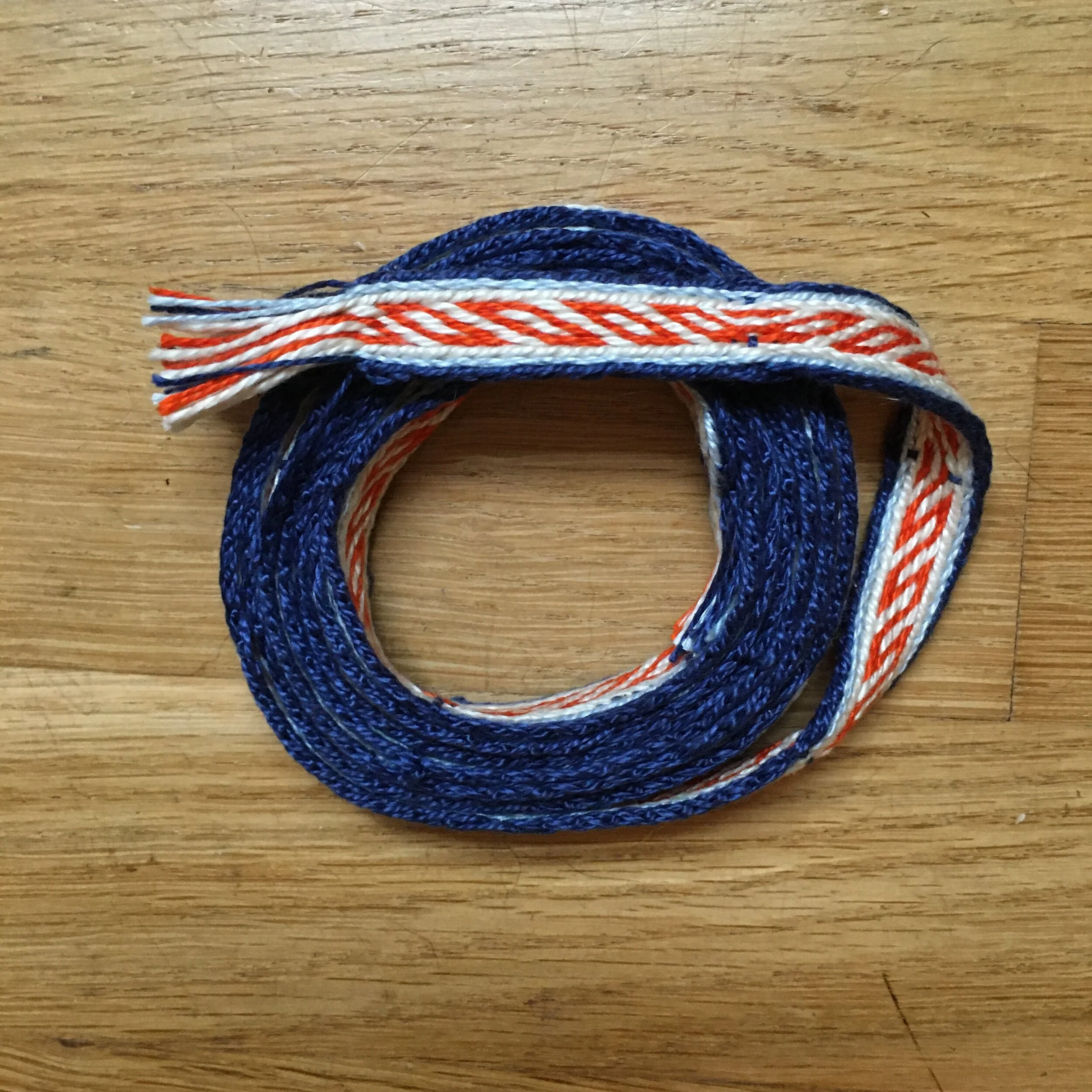
I watched her how-to video and then the first video in the Weave-along, Weave Along with Elewys - Episode 1: The Oseberg Weave. You can see my inkle loom warped for the Oseberg band in the photo above. Here are a couple more photos—one of the band on the loom and one of the completed band.

878D0989-94AC-4CAC-BA82-3D066A37EB60.jpeg
80CFA5D6-7EE4-40D4-93A5-0B363DF45422.jpeg

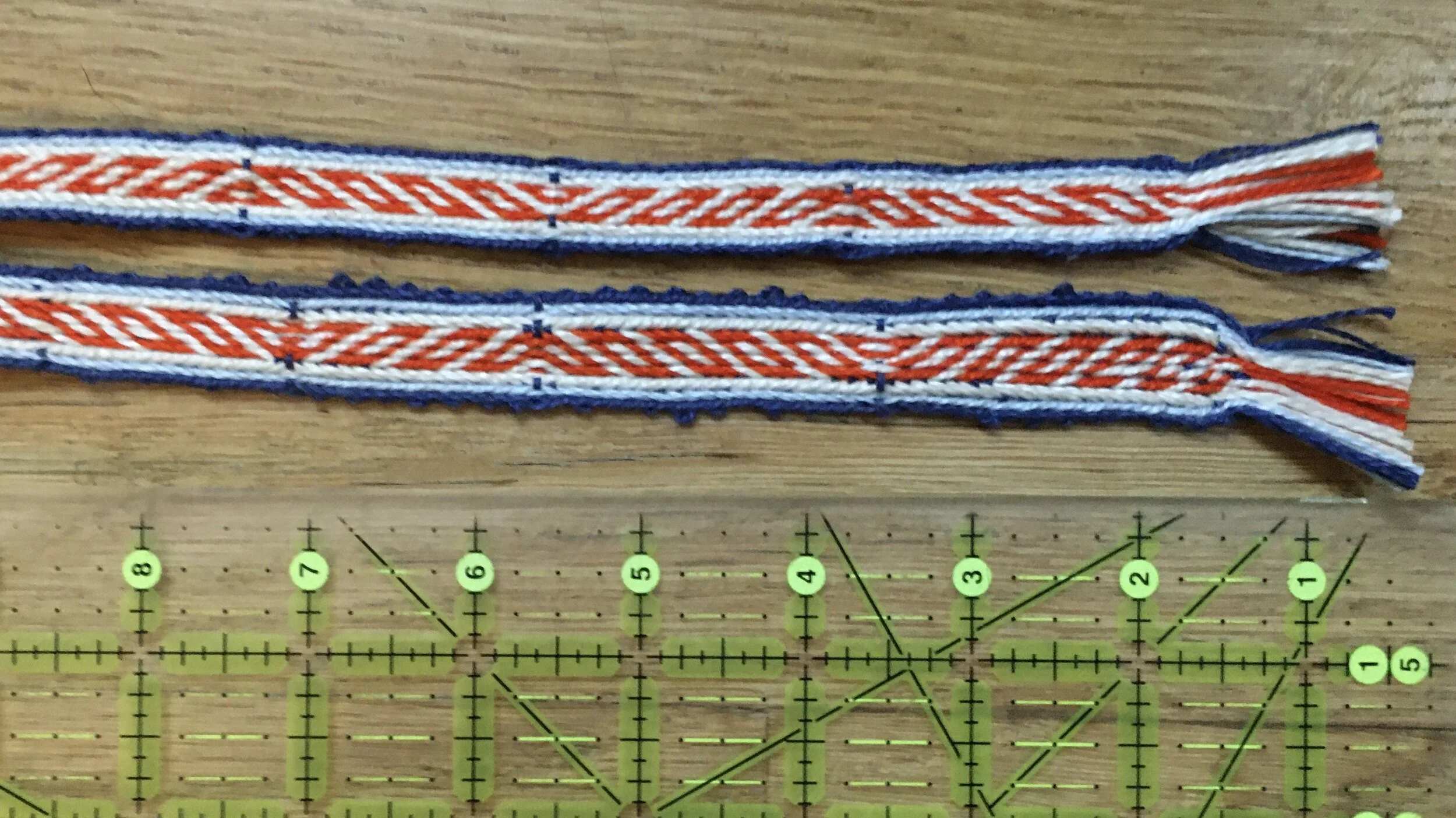
I think I threaded the card backwards because this box pattern is supposed to be on the back side of the weaving, and a zig-zag on the front. (See the photo below, right, to see both side of the band). There is also supposed to be an orange dot in the center of each of the boxes and that’s missing on mine. I don’t know if that was part of my backwards card threading or if I mis-threaded one of the cards….I’d guess it was a mis-threaded card. So not quite historically accurate, but I still love it!

5472FB70-8CCA-430E-9EC2-5C4A2AB66E8D_1_201_a.jpeg
F54B79D7-3C94-443B-842C-6531A7C3F65D_1_201_a.jpeg

This was my first card/tablet woven band, but not my first time weaving bands on the inkle loom. Elewys tells you that the first bit of weaving is going to look a mess. But it took me a full 6 inches to get the weaving tight and a longer more before I finally started feeling happy about my selvedges! Band 2 will look better!

Speaking of which, right now there is a skein of cotton thread in a dye vat of crab apple leaves dye. I had just dyed some fabric (see my next post) and I realized that if I was going to weave an historical pattern, I might just as well use thread dyed with a natural dye! (Falling deeper into that rabbit hole! But I also totally fell into a variety of rabbit holes looking at the posts and activities of the SCA! Fun to read about, though I doubt I’ll be sewing up a medieval costume and joining the group. But then, I’ve learned to never say never)!!

Notice: This blog is not monetized: I do not use affiliate links. When there are links in a post, they are to give credit to another creative person, because I like or have used a product, or to help the reader easily find supplies for a project.

TAGS: Card weaving, Tablet weaving, Tablet weaving on an Inkle Loom, My Weave Along with Elewys Episode 1 project


  • Newer
  • Older

Powered by Squarespace 7