Search
  • Information
    • About
    • Contact
    • Privacy Policy
  • Blog
  • Subscribe
  • Tutorials
    • Tutorials
    • Doll Clothes: Photos and some Patterns
  • Suggested Reading
  • Quilts: My Original Designs
  • Gallery: Color Studies
  • Gallery: Quilts I've Made
  • Doll Making Blog Posts
  • Recent blog posts
  • Quilts Based on The Improv Handbook for Modern Quilters
Close
Menu
Search
Close
  • Information
    • About
    • Contact
    • Privacy Policy
  • Blog
  • Subscribe
  • Tutorials
    • Tutorials
    • Doll Clothes: Photos and some Patterns
  • Suggested Reading
  • Quilts: My Original Designs
  • Gallery: Color Studies
  • Gallery: Quilts I've Made
  • Doll Making Blog Posts
  • Recent blog posts
  • Quilts Based on The Improv Handbook for Modern Quilters
Menu

Sleeping Dog Quilts

SLEEPING DOG QUILTS

August 27, 2020

Using "Tula's True Colors" in Fabric Café's® Pattern "Attraction"

by Judy Tucker


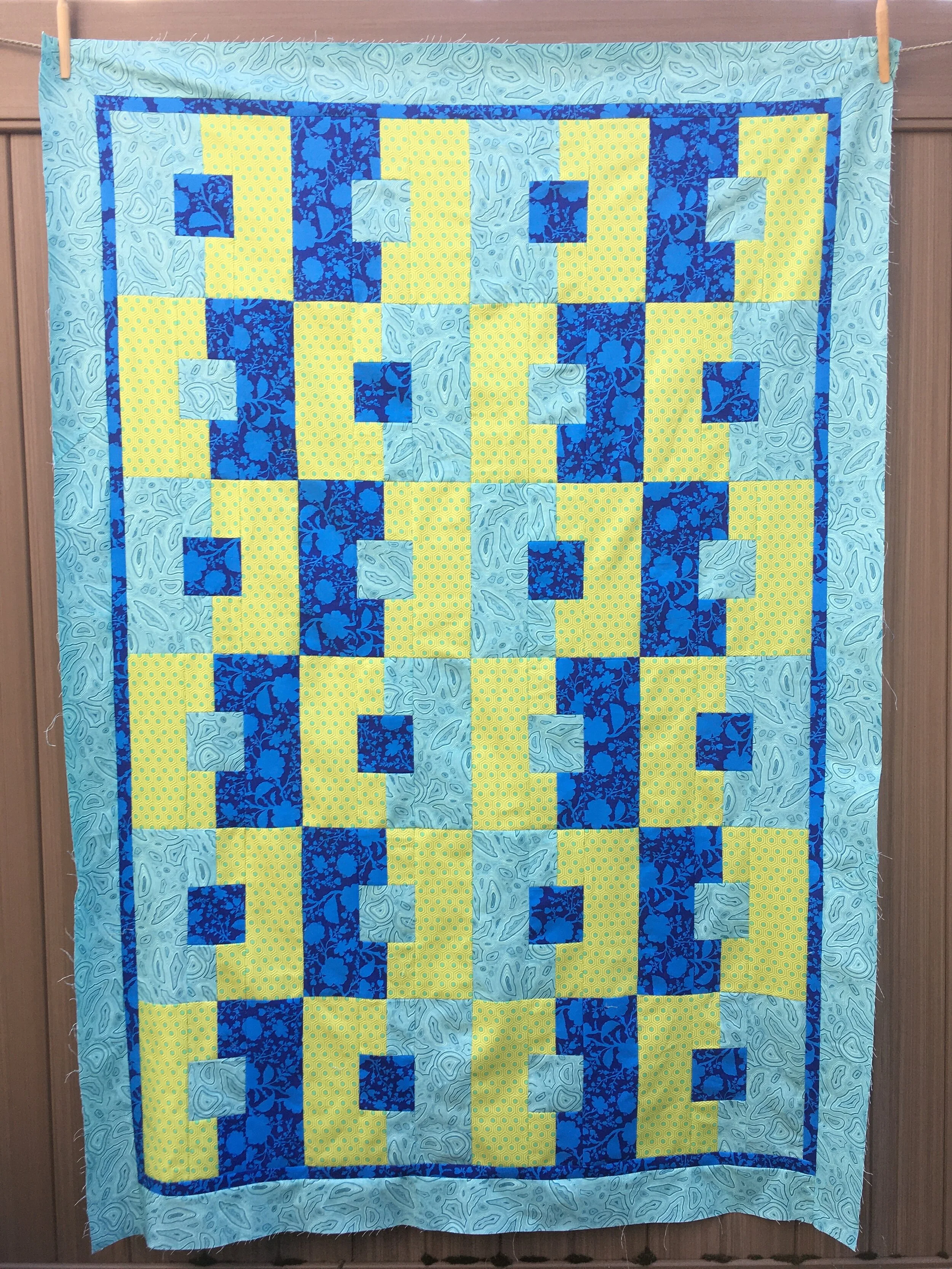
Quilt Top using Fabric Cafe’s  “Attraction”  Pattern

Quilt Top using Fabric Cafe’s “Attraction” Pattern

Quilt Top using Fabric Cafe’s  “Attraction”  Pattern

Quilt Top using Fabric Cafe’s “Attraction” Pattern

Last week I showed you a quilt using all the fabric’s in Tula Pink’s new line “Tula’s True Colors” by Free Spirit. For this quilt pattern, “Attraction” from Fabric Café, I chose 1 yard of 3 different fabrics in Tula’s line. (All of Fabric Cafe’s quilt patterns use just 3 one yard cuts).

I picked a blue, an aqua and a yellow green. These are analogous colors on the color wheel—they are positioned right next to each other. It’s a guarantee that the colors will all play well together!

This is a great pattern and it sews up super fast. I found I had a free hour one morning and that was all I needed to cut out the fabric. Then it just took an afternoon to put it together.

I like how the small squares seem to dance across the design.

i think it would look just as great using the hot colors in “Tula’s True Colors”. And I’d love to see this quilt with 2 analogous colors on the color wheel, and one complimentary color from the opposite side of the color wheel. I think that would make a spectacular quilt!

TAGS: Fabric Café quilt pattern "Attraction", Quilt Using "Tula's True Colors" by Free Spirit, 3 yard quilt pattern, Quick Quilt, Easy quilt


August 20, 2020

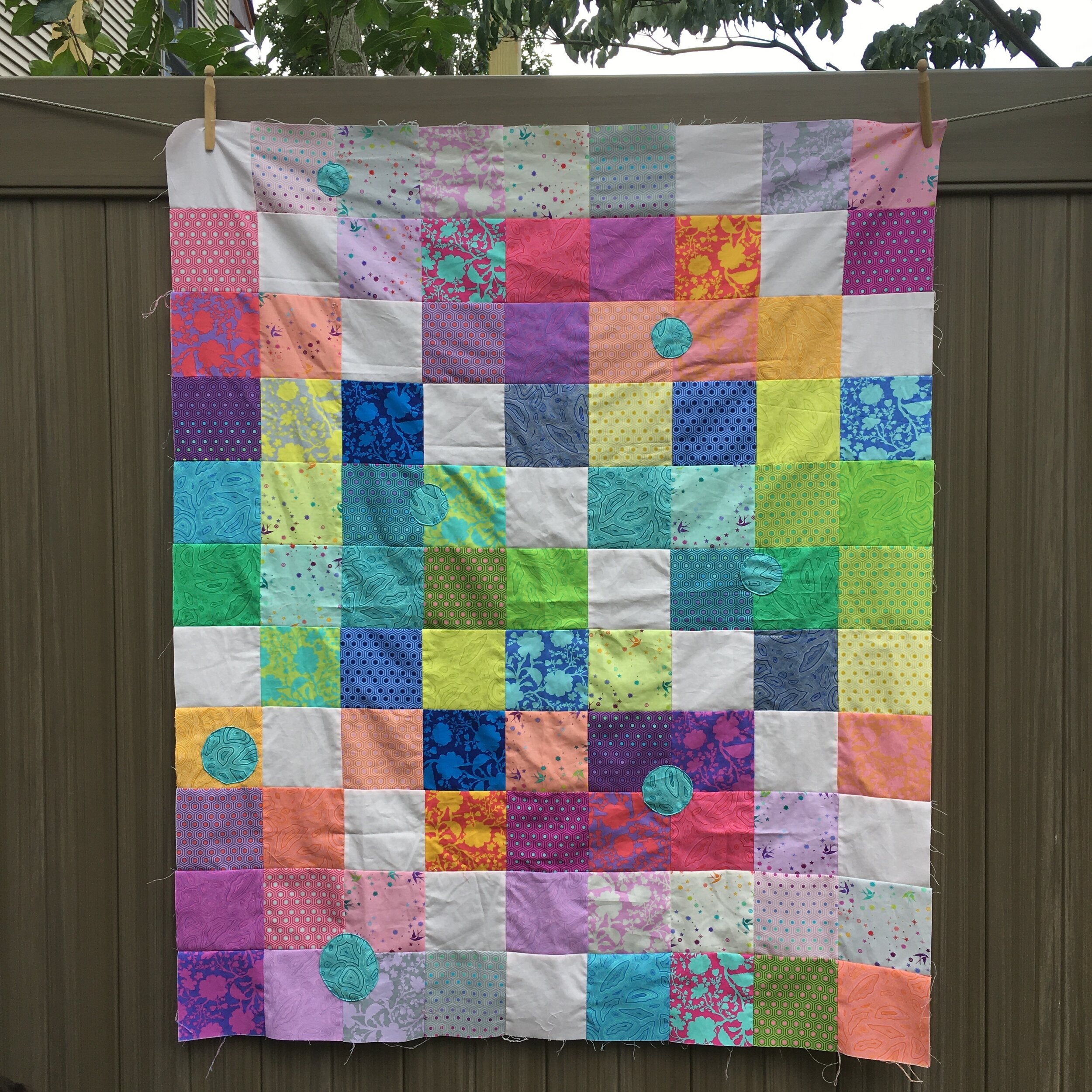
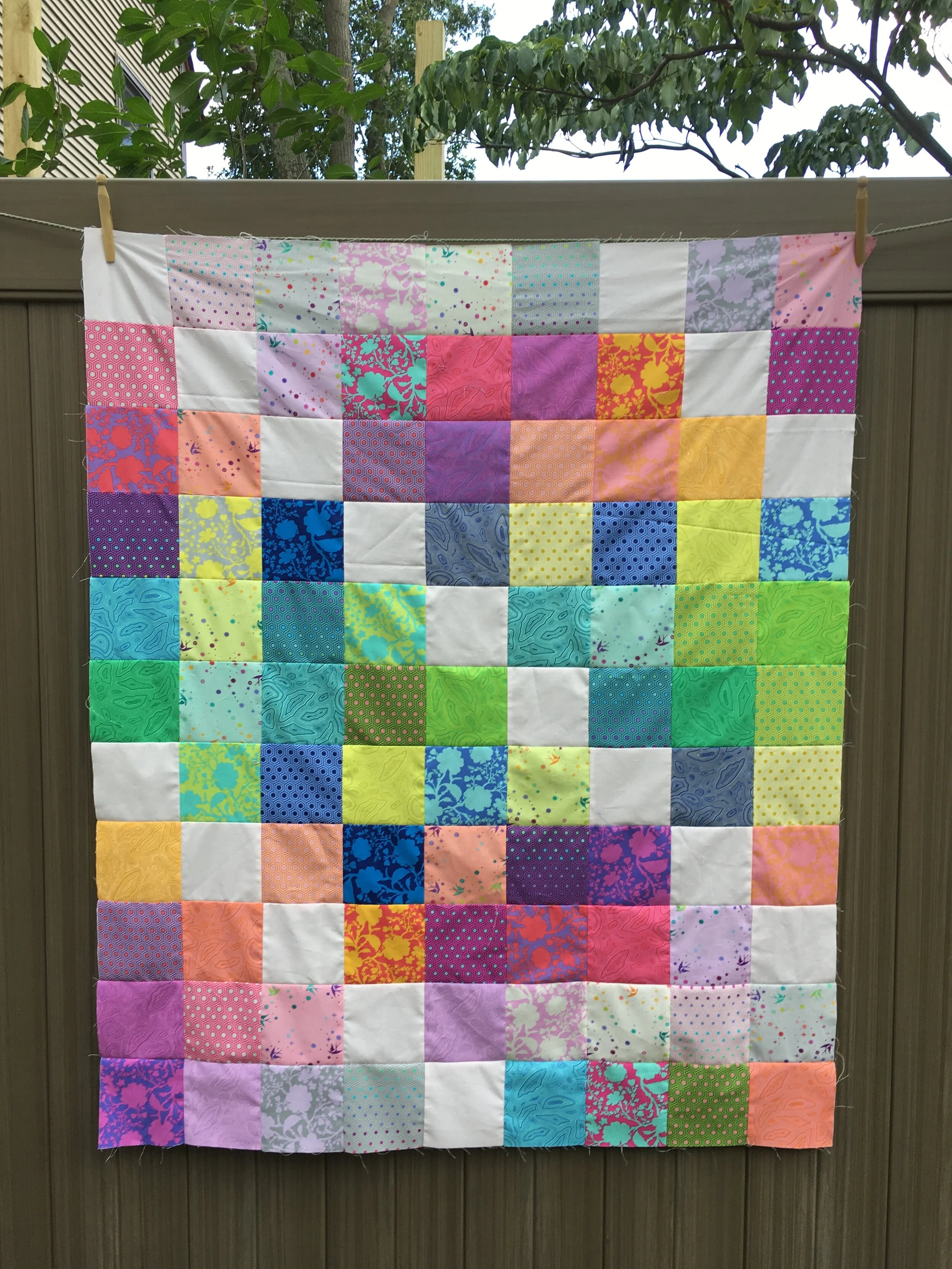
"Tula's True Colors" 5 Inch Charm Square Simple Quilt Top

by Judy Tucker


Small Lap Quilt top

Small Lap Quilt top

Small Lap Quilt top

Small Lap Quilt top

Tula Pink’s new line by Free Spirit, “Tula’s True Colors” was recently released. When Bits ‘n Pieces, a favorite quilt shop in Pelham, NH, showed the fabrics at one in one of their regular unboxing videos, I ordered 2 packs of 5 inch charm squares. (Charm Packs: A stack of 5 inch, or sometimes 10 inch, squares of every color in a fabric line).

I was up for an simple experiment. I decided to see what happened if I put one stack of charm squares right side up and the other upside down and just sew them together as I picked the fabrics up from each stack. I did add a 5 inch square of a very pale Kona® cotton after 5 blocks of the charm pack. The diagonal lines look white, but they really are pink.

The stacks met in the greens! I did swap around a few blocks so that I didn’t get identical squares next to each other. I had fun sewing up this simple quilt, but when I got done and looked at it, my reaction was—-Hum.

Here’s the quilt right after the sewed all the squares together.

Tula'sTrueColorsCharmQuiltPriortoAddingCircles. jpg

It just wasn’t cohesive. I was hoping the plain diagonals would give the random blocks some definition, but the light color didn’t do that. Considering how bright most of Tula’s fabrics are, i’m not sure what color would have worked better.

So I thought about it for a week. The “Fairy Dust” design in this line has tiny circles, concentric circles and stars. (If you look back at last week’s post, The Sleepy Dragon Baby© is lying on this fabric in the top photo). I decided to pick up one of those elements and using that to create some appliques. So I added 7 circles of varying sizes from fabric I had left over from another quilt I’d just made using “Tula’s True Colors.”

This project reminded why I usually don’t enjoy using every color in a fabric line. But the circles definitely make the quilt more interesting.

I think quilting this piece has to potential to add more interest to this quilt.

Next week I’ll show you a quilt I made from this fabric line where I made very deliberate decisions about my choice of fabrics.

TAGS: Charm square quilt, "Tula's True Colors" 5 inch charm square quilt


August 13, 2020

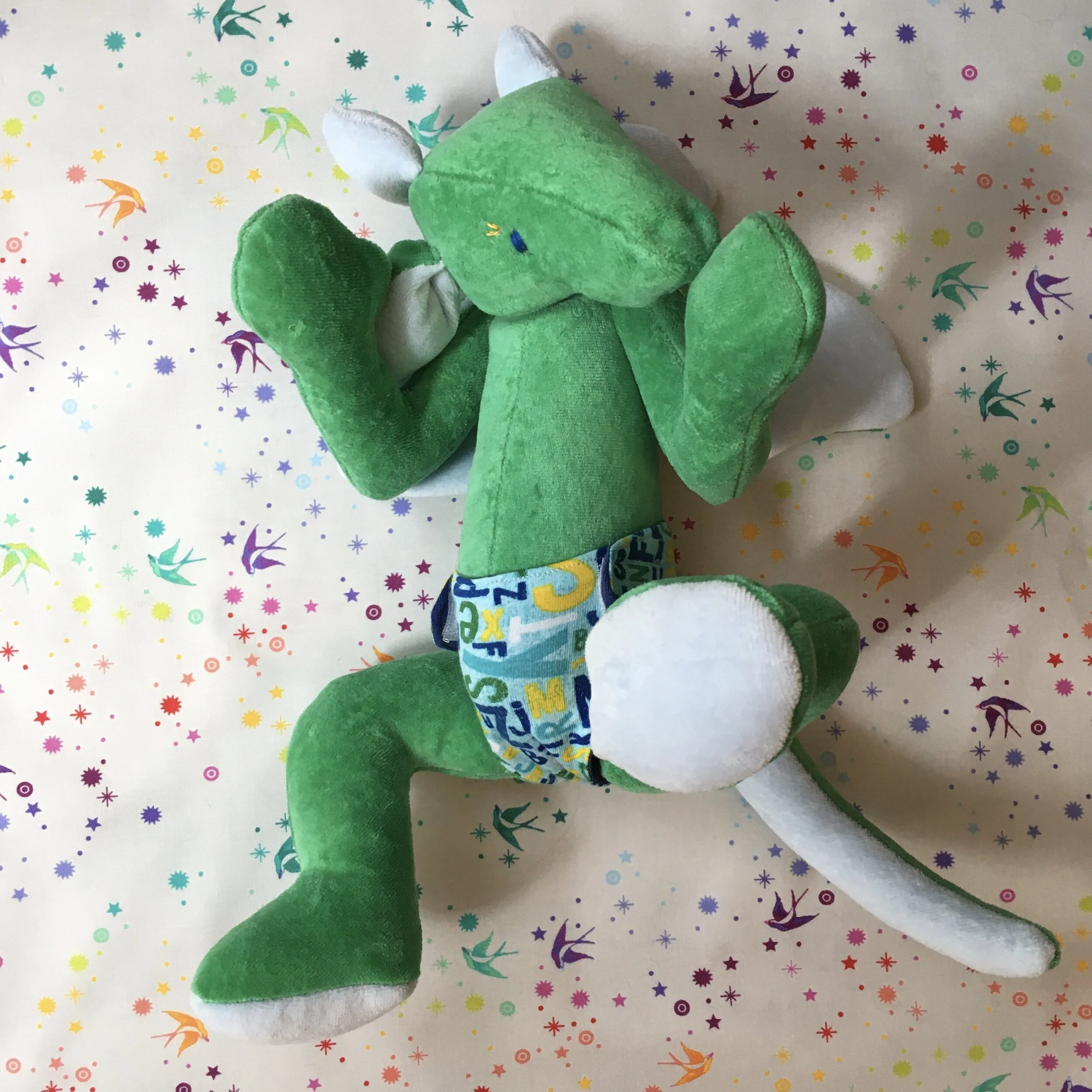
Stuffed Dragon: Made Using NimblePhish Creations "Sleepy Dragon Baby©" Pattern

by Judy Tucker


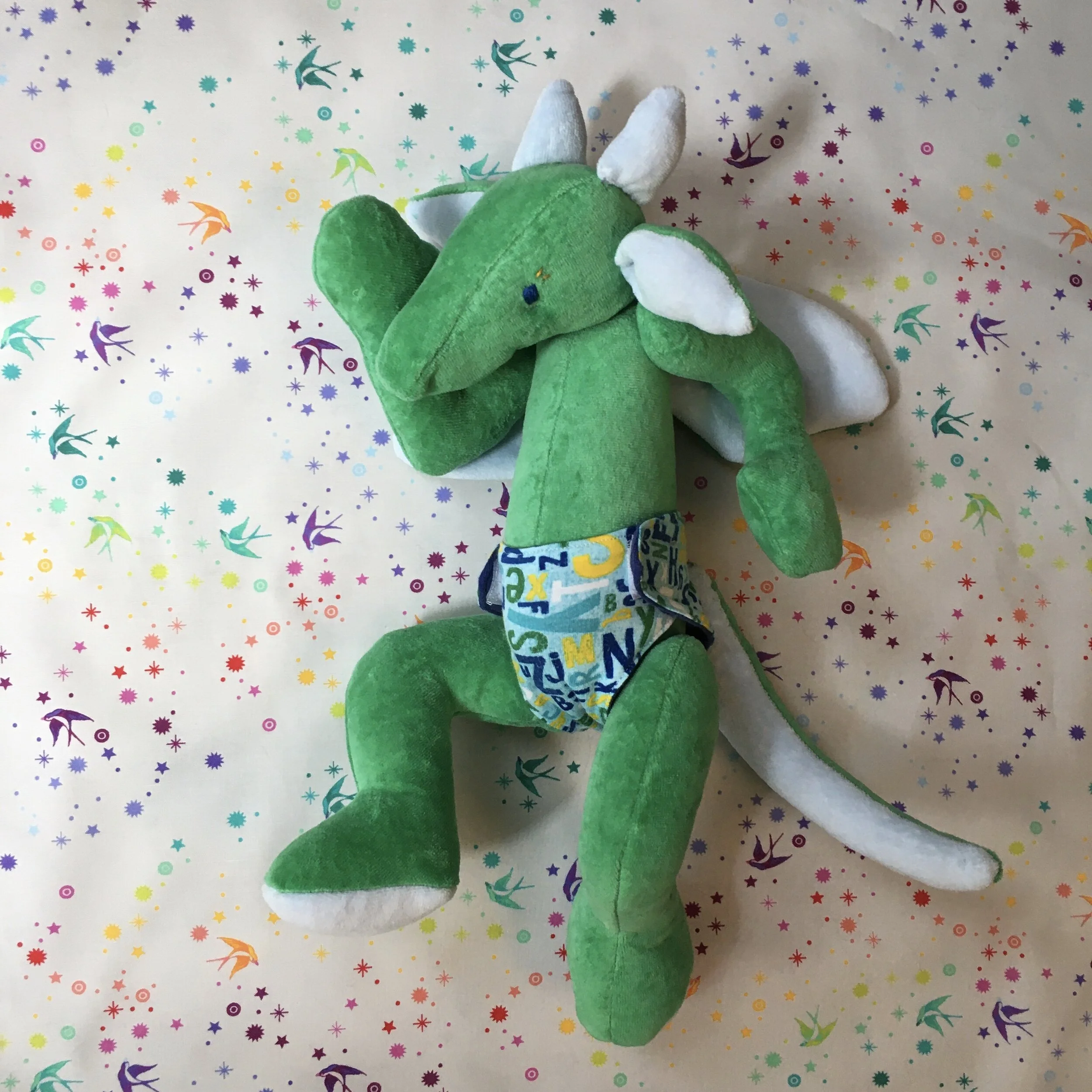
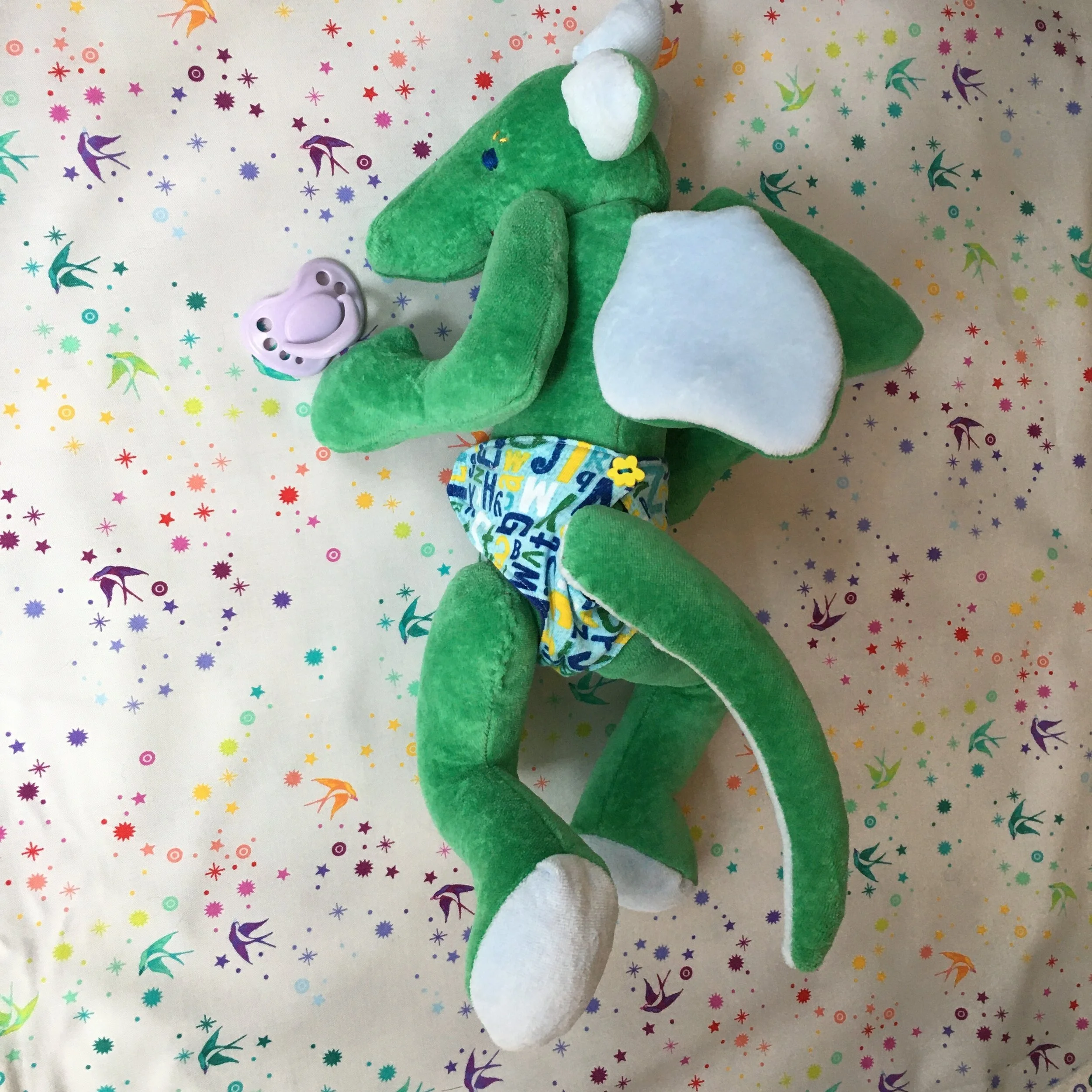
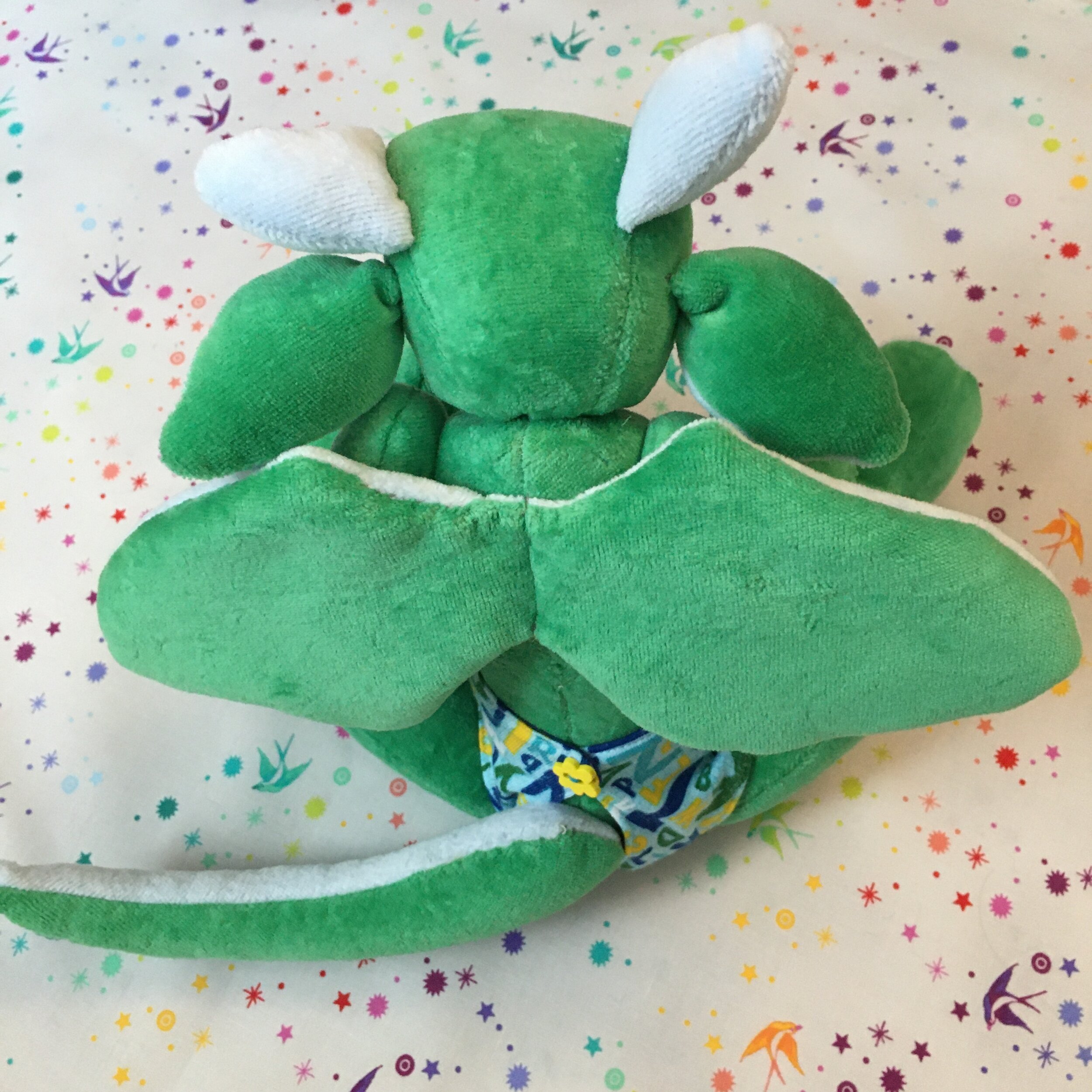
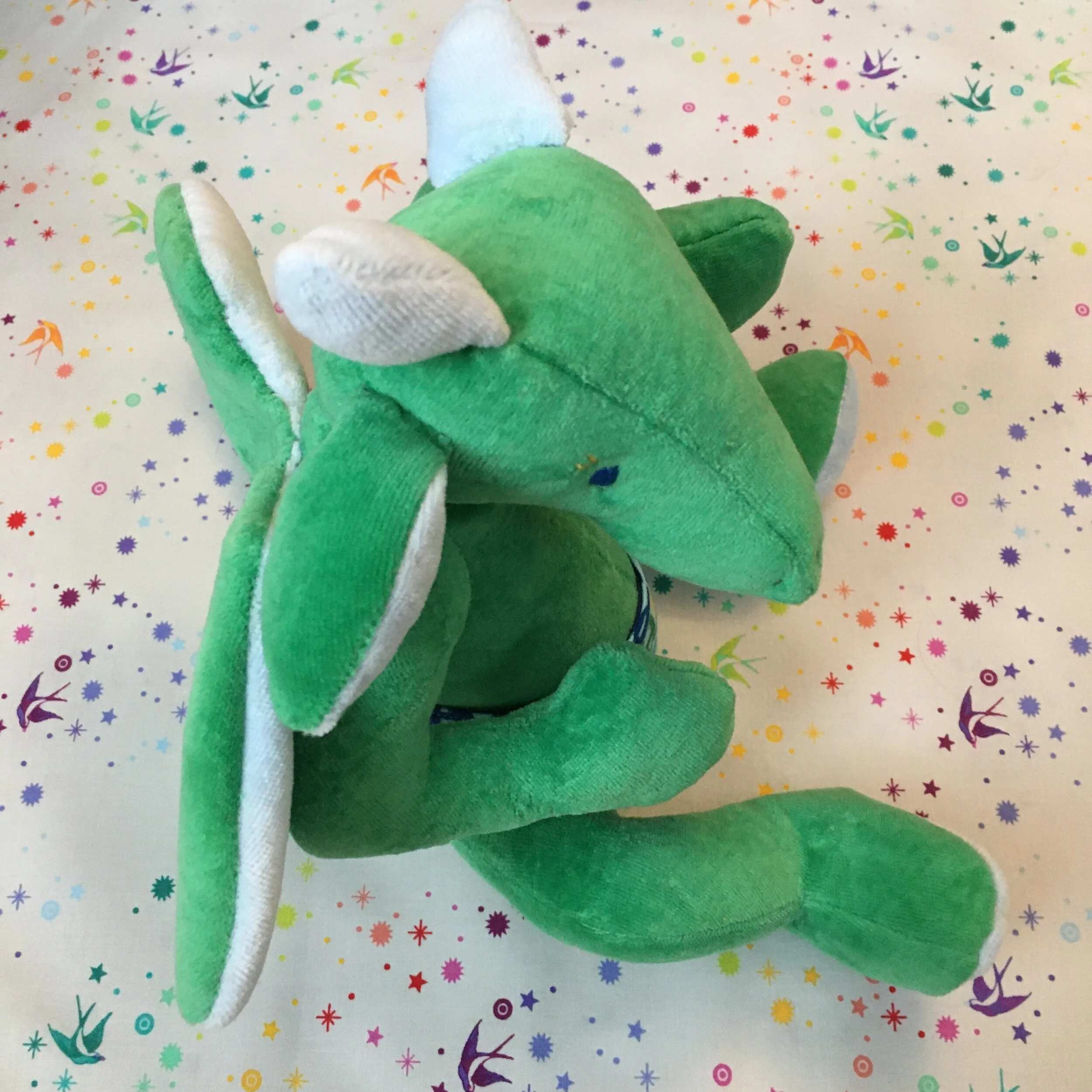
“The Sleepy Dragon Baby©”

“The Sleepy Dragon Baby©”

“The Sleepy Dragon Baby©”

“The Sleepy Dragon Baby©”

I follow a Facebook Group called Waldorf Adoption whose members sell previously owned Waldorf dolls and occasionally other handmade stuffies.

A couple weeks ago a NimblePhish Sleepy Dragon Baby© appeared. I’d never heard of NimblePhish Creations so I started searching. It didn’t take too long for the pattern to pop up. The Sleepy Baby Dragon© PDF pattern is for sale on Etsy in the NimbleFish shop. It was published October, 2012, so it’s been available for quite a while.

The pattern looked like fun. First of all, this is a really cute baby dragon. And I don’t believe I’ve ever made a jointed doll or stuffed animal. So here was an opportunity to learn a new skill! Into the cart went the dragon pattern!

The pattern suggested velour lined back with fusible fleece or just plain fleece. I had cotton velour in my stash so that’s what I used.

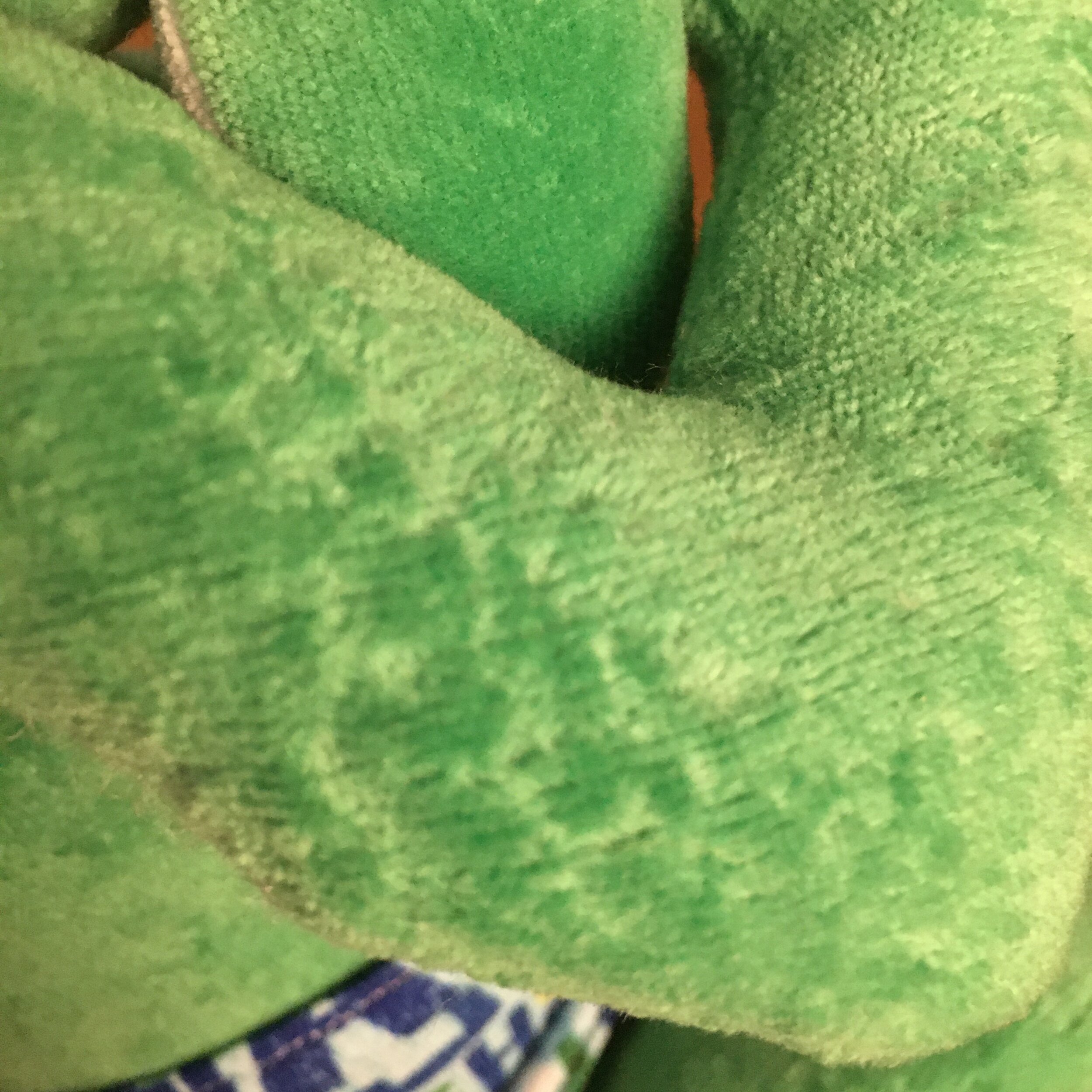
In hind sight, cotton velour probably wasn’t the best option for a stuffed animal with small limbs which needed to be turned inside out after sewing. The cotton velour really took a beating on the arms. If this had been another animal, I would have been upset, but the friction created a scale-like effect which is perfect for a dragon! So, no trauma, but any future dragon will be made of fleece or another polyester napped fabric.

Scale-like damage to the cotton velour from turning the dragon’s arm right side out.

Scale-like damage to the cotton velour from turning the dragon’s arm right side out.

Other than that, this project went swimmingly. The instructions and photos in the pattern were great. And it showed how to assemble the dragon using the plastic locking joints which turned out to be really easy. I did change a few things when I made this dragon.

  • I enlarged his diaper a bit so that comes up higher on his tummy

  • In keeping with Waldorf toys, he is stuffed with wool rather than polybeads and polyfill

  • His torso weighted with about 1 cup of glass beads which are secured in a small sack I sewed

  • This dragon is awake, and not a bit sleepy!

It is really fun to have a stuffed animal which can be posed in lots of different positions!

IMG_3747.jpg
IMG_3745 3.JPG
IMG_3750.JPG
IMG_3748.JPG

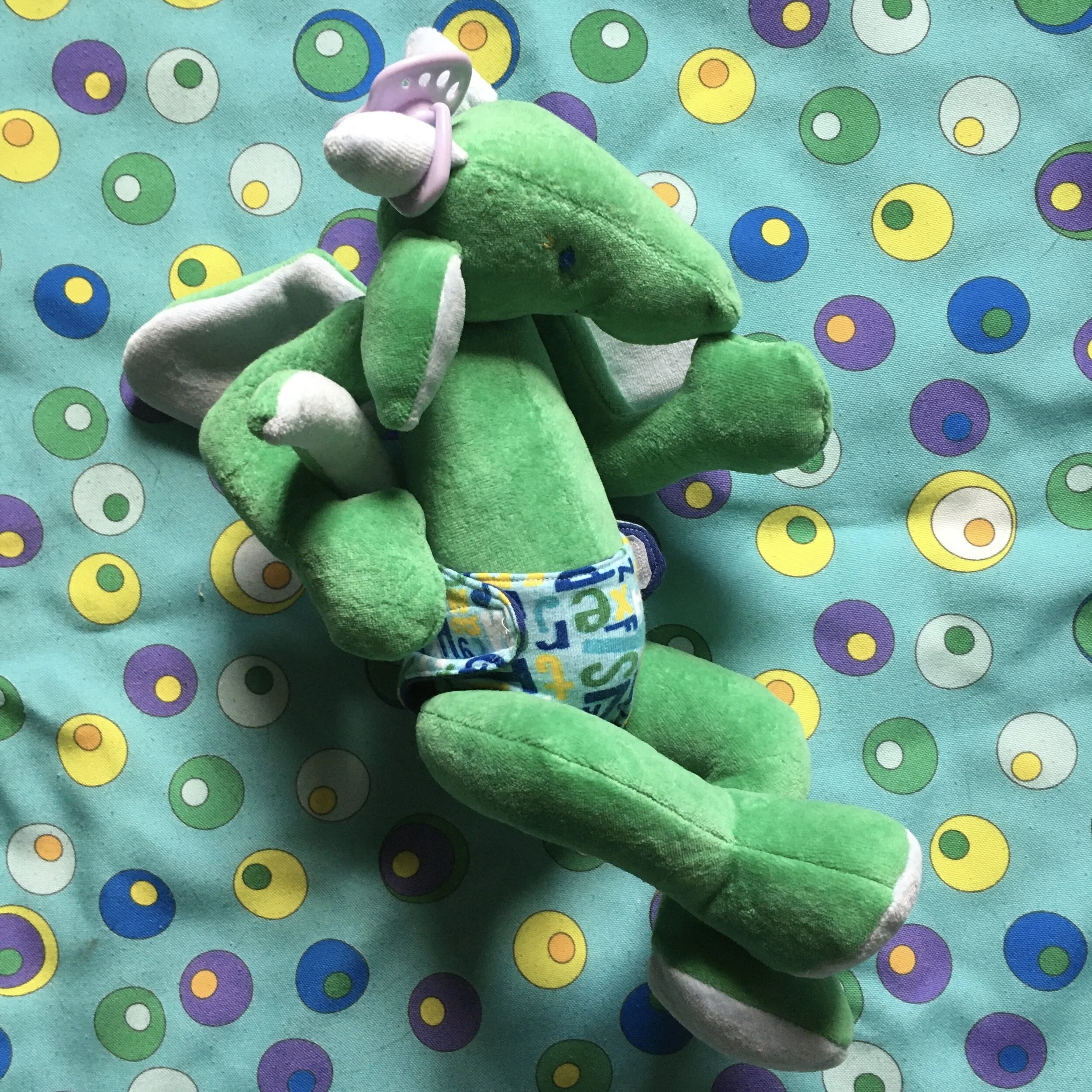
He is such a character! Here he is, holding his tail and sucking his thumb while his binky is in a safe place on his horn bud! Silly boy!

Dragon Contentment!

Dragon Contentment!

He may be my first, but I’m pretty sure he won’t be my last dragon! This pattern is definitely worth purchasing if you are interested in making your own Sleepy Dragon Baby©!

FYI: he is posing in the top pictures on the new Tula Pink’s TRUE COLORS© Fairy Dust-Whisper by Free Spirit. It's the perfect backdrop for a baby dragon!

In the last photo he is on a fabric I designed which is available in my Spoonflower shop. You may access that using the link, or at anytime from the Shop top at the top of the page.

Notice: This blog is not monetized: I do not use affiliate links. When there are links in a post, they are to give credit to another creative person, because I like or have used a product, or to help the reader easily find supplies for a project.

TAGS: NimblePhish Creations Sleepy Dragon Baby©, Stuffed dragon pattern, Stuffy Dragon, Waldorf Dragon, Waldorf toy, Stuffed Dragon


August 6, 2020

"Virtual Beach 2020" Quilt

by Judy Tucker


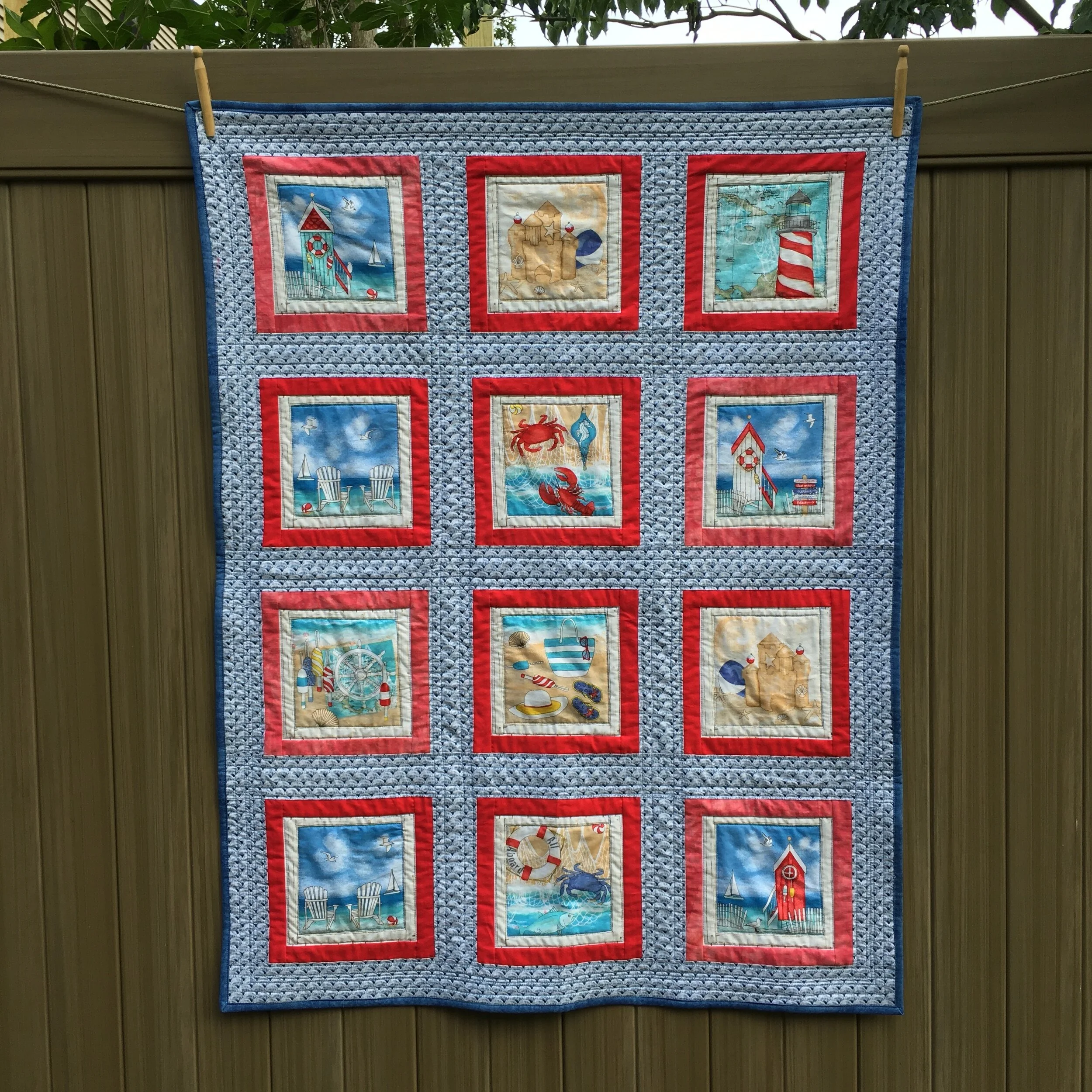
“Virtual Beach 2020” Quilt 36 x 47 1/2 inches

“Virtual Beach 2020” Quilt 36 x 47 1/2 inches

“Virtual Beach 2020” Quilt 36 x 47 1/2 inches

“Virtual Beach 2020” Quilt 36 x 47 1/2 inches

Just what this summer with COVID-19 needs: a “Virtual Beach 2020” quilt! It’s almost as nice as the real thing. Though sadly, not clam shack or ice-cream shop in sight!

I love how this summer quilt came out. I cut out the motifs from the “Surf’s Up” panel, designed by Julie Dobson Miner for Northcott. I didn’t use all the blocks in the panel…just my favorite 12.

I framed four of the panel blocks with a hand-dyed red fabric from my stash and the other blocks with one of the Kona® Cotton reds. The tiny blue scallop print is from Clothworks line “By The Seashore”. The scallop shells are tiny, just 3/4 inches wide.

The fabric with the wheeling gulls a the summer sky on the back of the quilt is from the Northcott line “Swept Away”. It was designed by Deborah Edwards and Melanie Samra. It’s the perfect back for a beach quilt.

IMG_3563.JPG

This little quilt is just the right size to throw over that back of a chair or use as a wall hanging.

In this summer of mostly-sheltering-in-place, it just makes me happy!

TAGS: "Virtual Beach 2020" Quilt, Quilt from a Panel, "Surf's Up" Panel from Northcott in a quilt


July 30, 2020

"Virtual Beach 2020"

by Judy Tucker


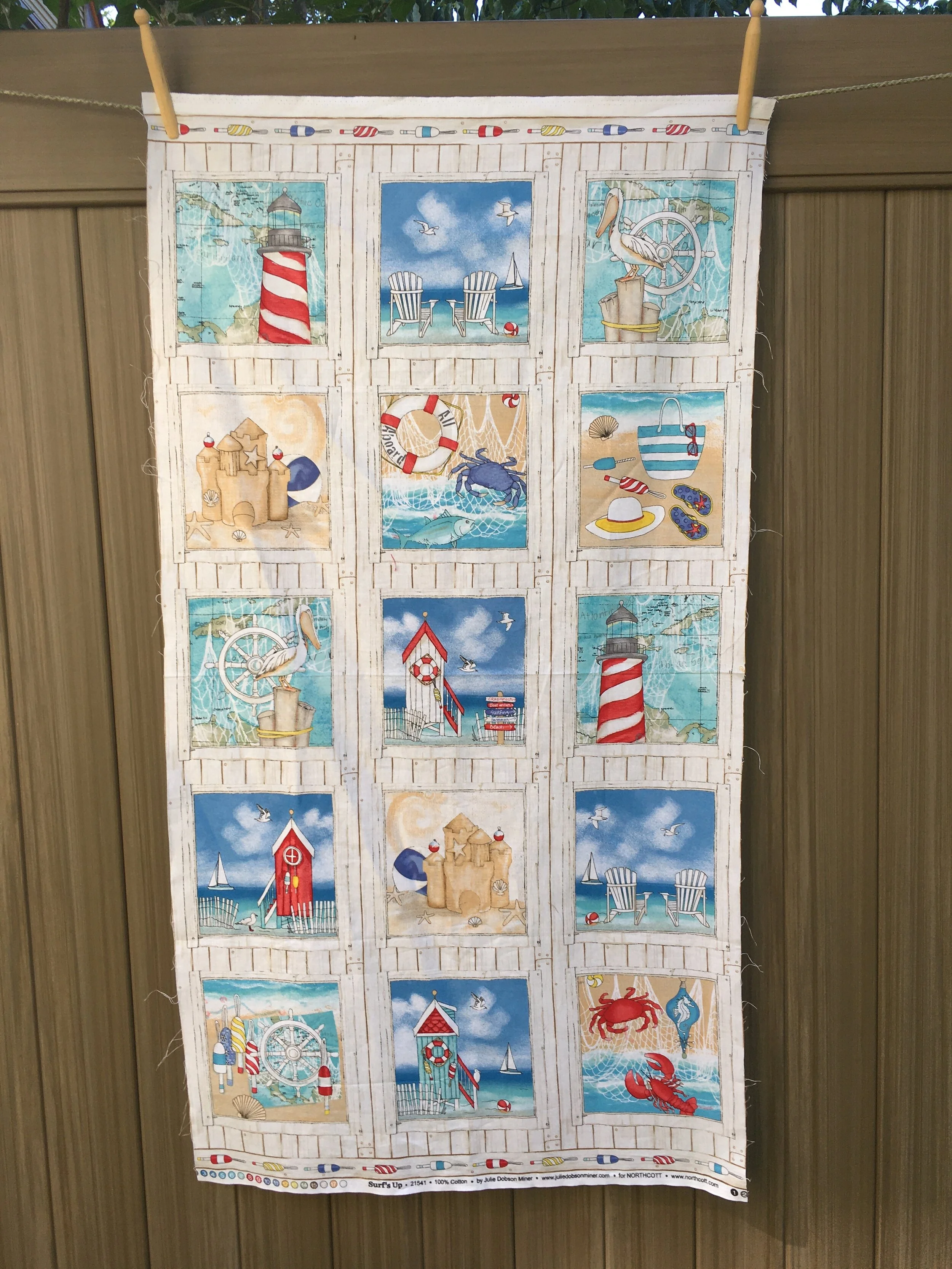
“Surf’s Up” Panel

“Surf’s Up” Panel

“Surf’s Up” Panel

“Surf’s Up” Panel

I think it’s official. This is going to be my summer of the quilt panel! I usually don’t like panels, but this year I seem to have purchased quite a few of them.

This is the panel from “Surf’s Up” designed by Julie Dobson Miner for Northcott. I bought it as a package with 4 fat quarters from the same line.

I thought for a long time about how to make a quilt using the 4 fat quarters but I just couldn’t figure out how to use them. So one of the light fat quarters turned into a shirt for a young friend’s boy doll. It was really cute, with a sand castle on the front of the shirt. I wish I had a photo of it but the doll shirt has already gone off as a part of a birthday present.

The other fat quarters in the set will probably become face masks.

The plan is to cut up the panel. The little blocks will make a sweet little summer quilt.

TAGS: Quilt panel, "Surf's Up" panel for Northcott


July 23, 2020

"Radiance" Flowers in Glass Bottles--More Table Runners/Wall Hangings/Table Toppers

by Judy Tucker


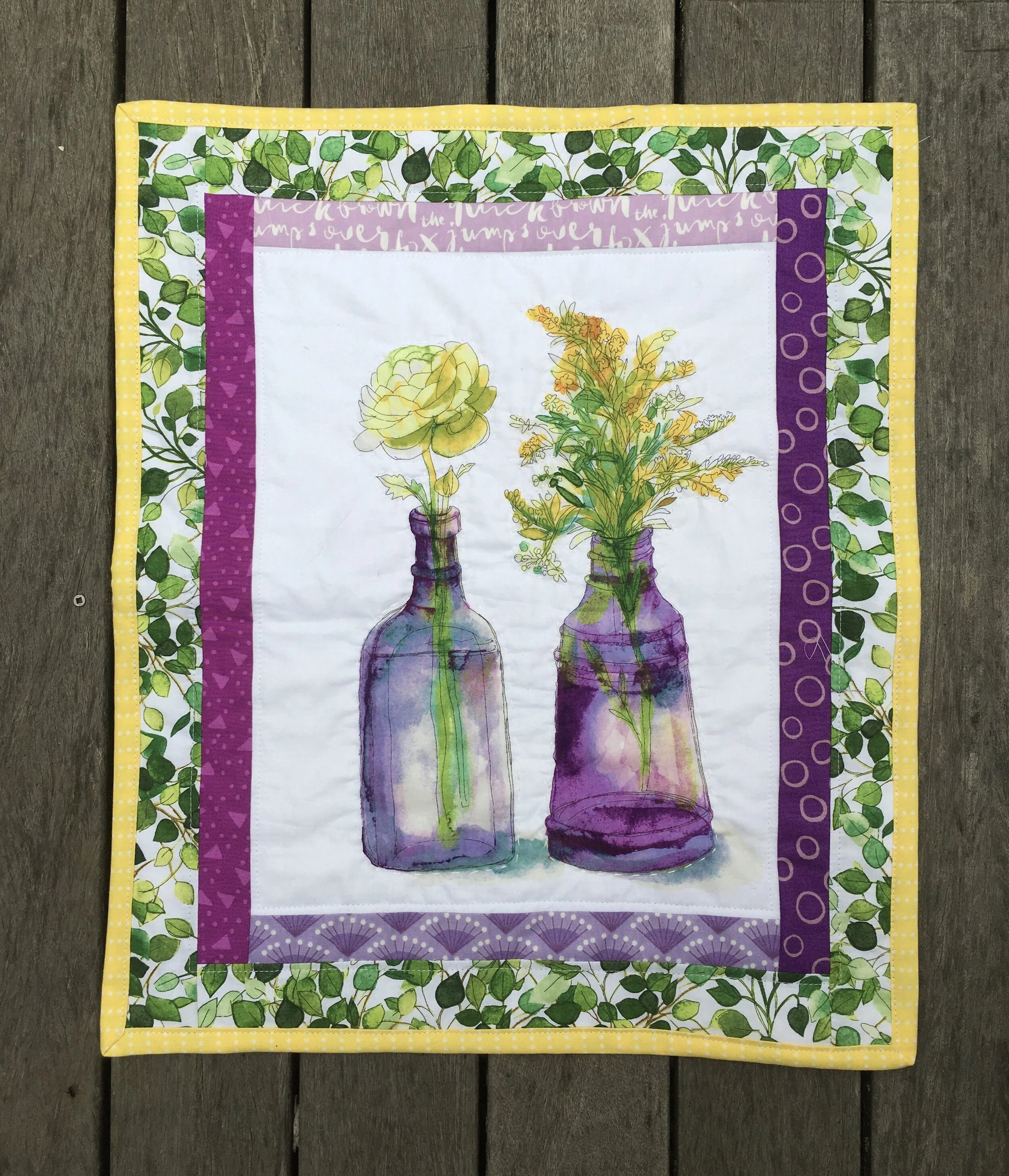
Table runner or Wall Hanging.  15 x 18 inches

Table runner or Wall Hanging. 15 x 18 inches

Table runner or Wall Hanging.  15 x 18 inches

Table runner or Wall Hanging. 15 x 18 inches

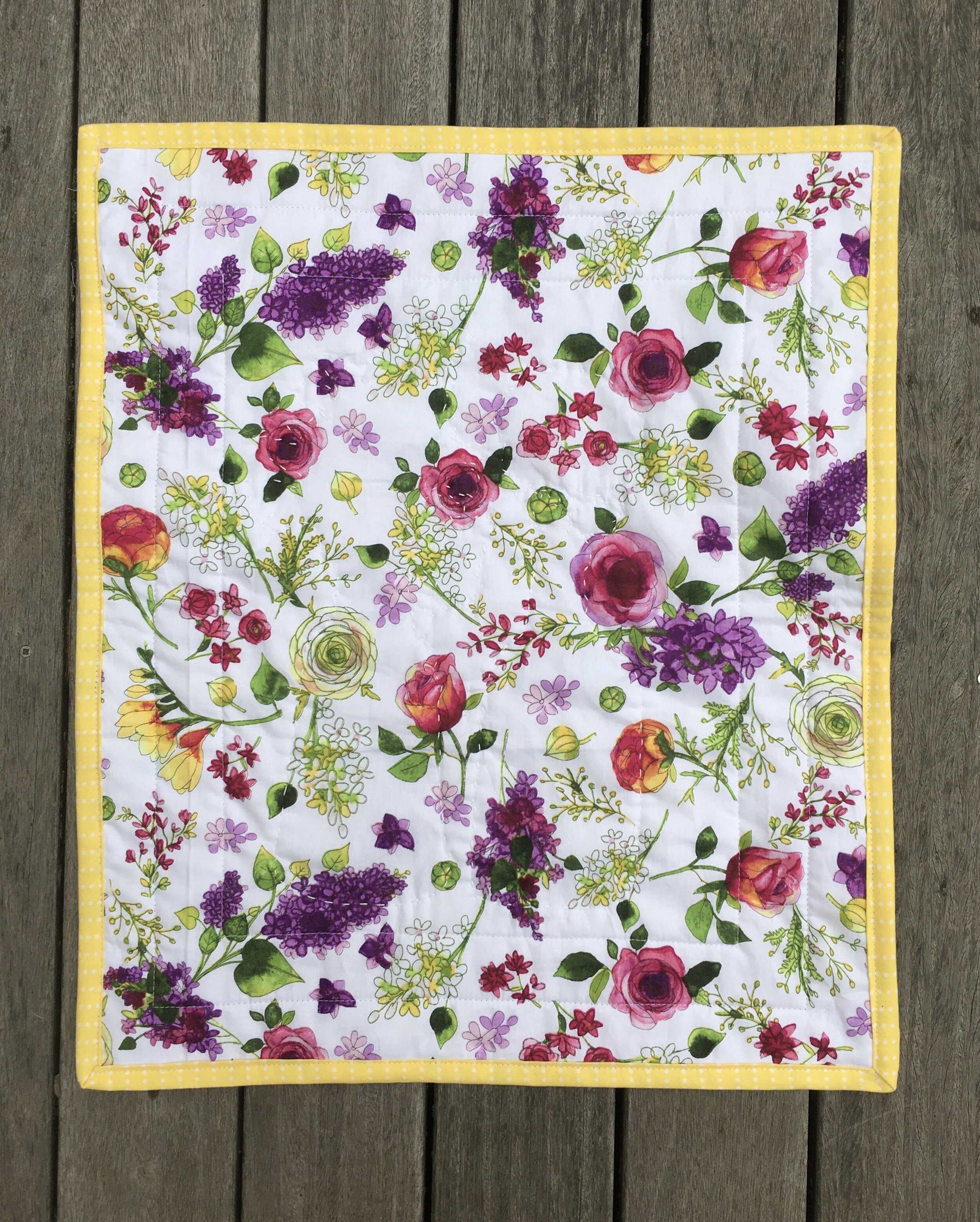
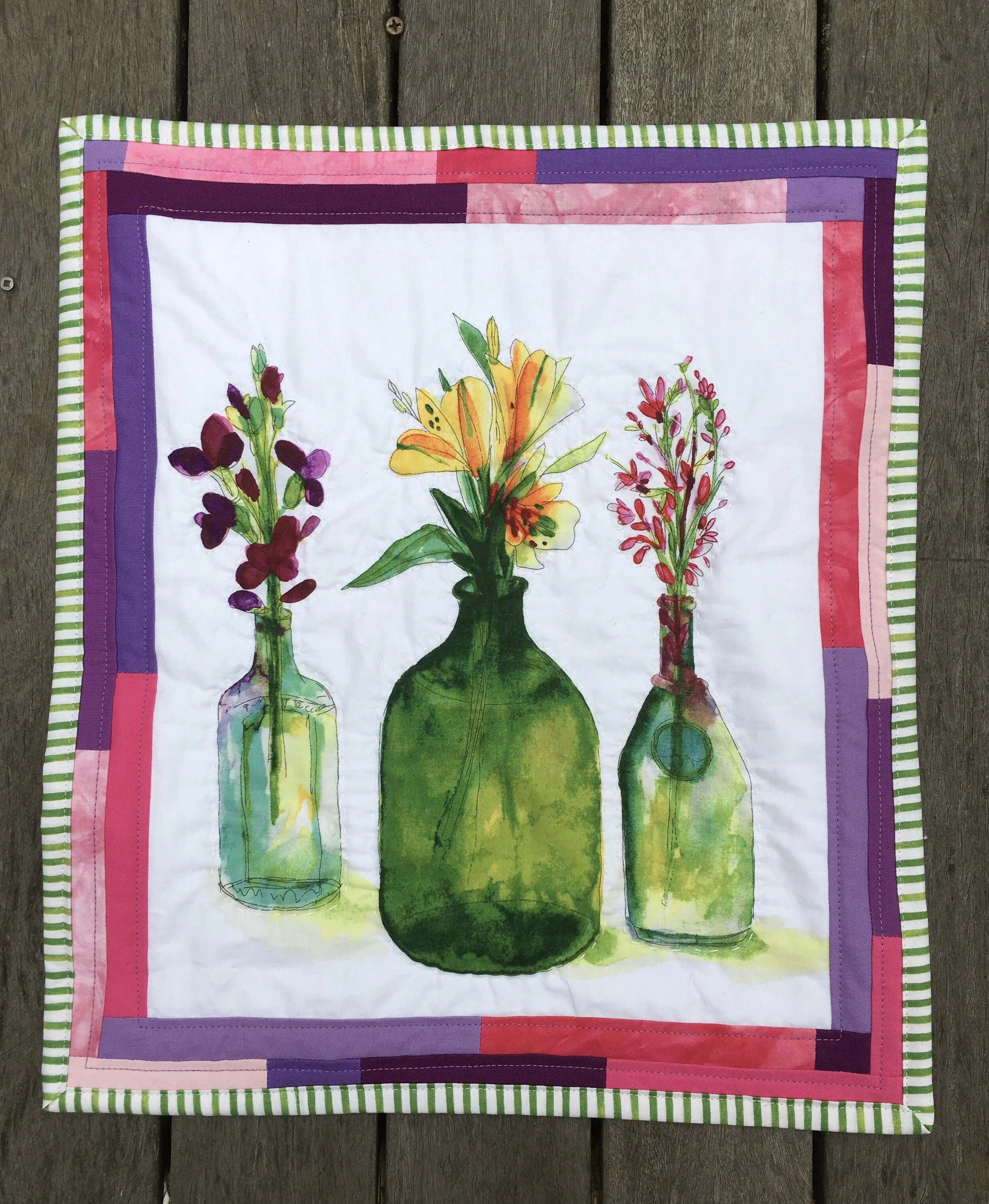
I’ve now cut up all the floral arrangements from the panel in the “Radiance” fabric line by Clothworks.

Last week I shared a table runner with an outer border of one inch “postage stamp” blocks. This week I’ve made a several more pieces with simpler borders. I think the simpler borders also do a great job of complimenting the flowers.

In the piece above, I used 1 1/2 inch wide purple strips for the inner border and 2 “ wide strips for the outer leafy border.
I like the back of the piece as much as the front! Dual duty!

Reverse side of the yellow floral arrangements

Reverse side of the yellow floral arrangements

In the piece below, I cut two sets of pink and purple strips at 1 1/4 inches.

Two sets of narrow pink and purple strips make the border of this part of the panel. 14 1/2 x 16 inches

Two sets of narrow pink and purple strips make the border of this part of the panel. 14 1/2 x 16 inches

This is the table topper that’s on my dining room table now. It’s a simpler version of the table runner in last week’s post.

A single border of 1 inch postage stamp blocks.  16 1/2 x 14 1/2 inches

A single border of 1 inch postage stamp blocks. 16 1/2 x 14 1/2 inches

It was so much fun think about lots of difference ways I could finish the blocks I cut out a single “Radiance” panel!

TAGS: "Radiance" by Sue Zipkin for Clothworks.com, "Radiance" Panel by Clothworks Tablerunner, Table runner, Wall Hanging, Table Toppers


July 16, 2020

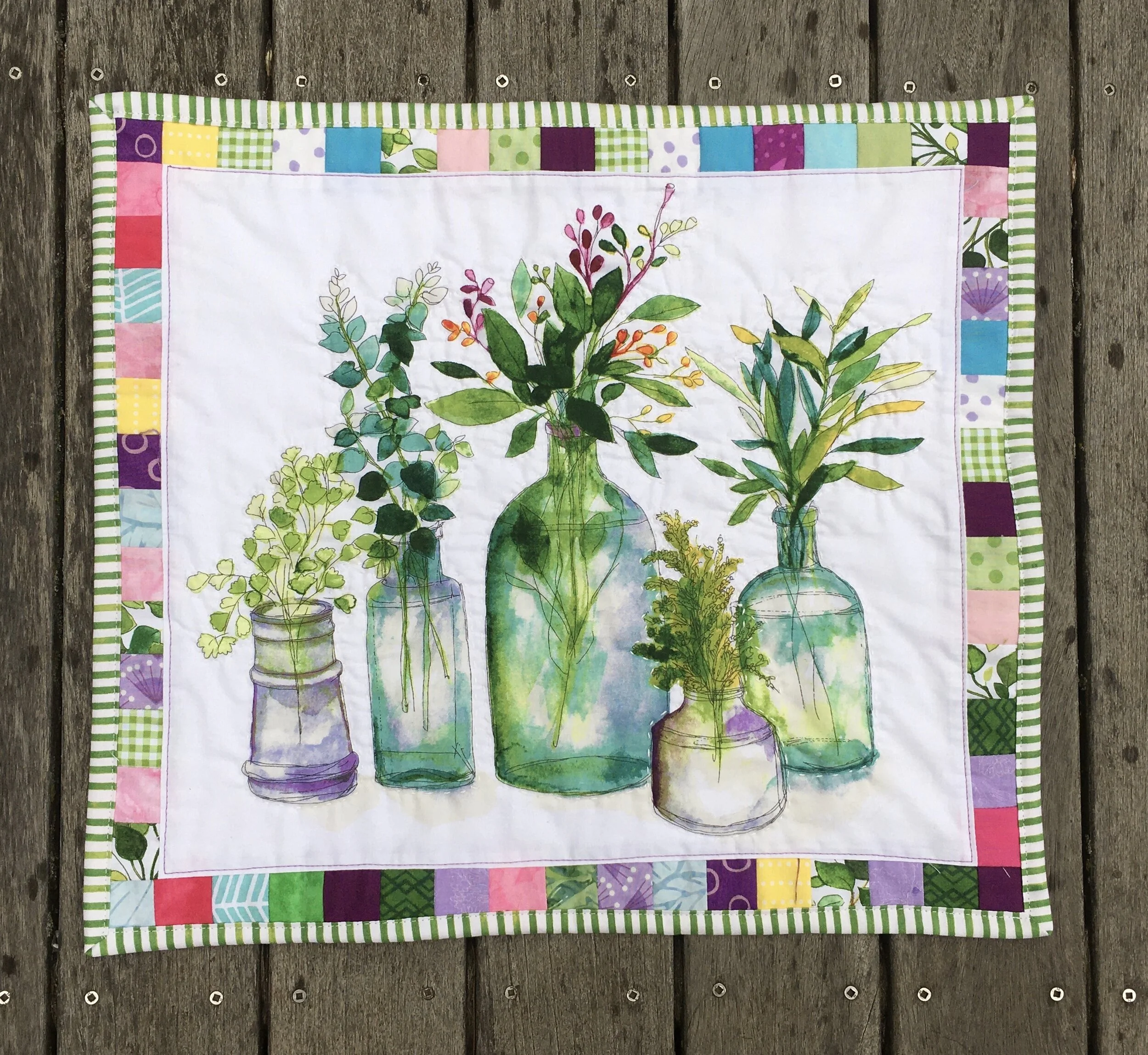
"Radiance" Flowers in Glass Bottles Table Runner

by Judy Tucker


“Radiance” Table Runner  31 x 20 inches

“Radiance” Table Runner 31 x 20 inches

“Radiance” Table Runner  31 x 20 inches

“Radiance” Table Runner 31 x 20 inches

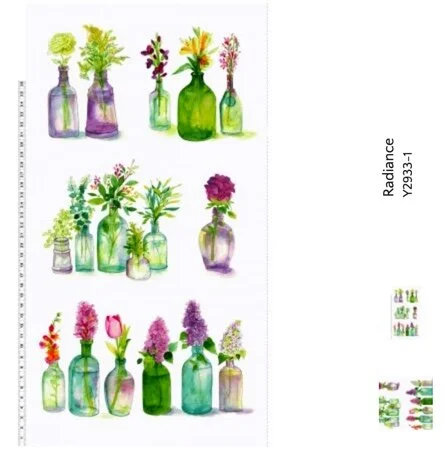
The panel from the panel from the “Radiance” fabric line by Sue Zipkin, printed by Clothworks.com, can be cut up into multiple smaller sections. This table runner is the largest grouping of bottles from the bottom third of the panel.

"Radiance"byClothworksPanel.jpg

Here’s a picture of the full panel, taken from the Clothwork’s link above.

I added a green strip inner border which I cut at 1 inch wide and the middle yellow border which I cut at 1 1/2 half inches wide.

The checkerboard border is composed of “postage stamp” blocks which finish at 1 inch square. This is a great way to use up a collection of tiny 1 1/2 inch square cut from scraps.

My border was mostly cut from scraps and a bit of yardage. Rather than cutting tiny patches, I cut three 1 1/2 inch wide strips which I sewed together. I then cut the strips into 1 1/2 inch wide blocks which I sewed end-to-end. It was a lot quicker than sewing tiny individual squares.

The beauty of those tiny 1 inch border blocks, is that it was very easy to fit the border to the panel. All I had to do was to cut the pieces so that when the the panel section and the two plain borders were sewn together, they finished at an even full inch. Then it was guaranteed to match up with my border of 1 inch squares.

Here are some strips prior to sewing them together.

BorderStrips.jpg

The backing of the table runner has one of the large purple print from the “Radiance” line. (See my previous post).

I quilted the borders by machine with the walking foot then did big stitch quilting by and around each of the bottle flower arrangements. I used #8 perle cotton to do the big stitch quilting. It slightly raises each of the bottles above the flat surface of the table runner.

It’s possible to make up to 5 wall hangings or table runners from each “Radiance” panel. That’s pretty amazing!


TAGS: "Radiance" Panel by Clothworks Tablerunner, Table runner, Postage stamp blocks


July 9, 2020

Flowers in Glass Bottles: "Radiance" by Clothworks

by Judy Tucker


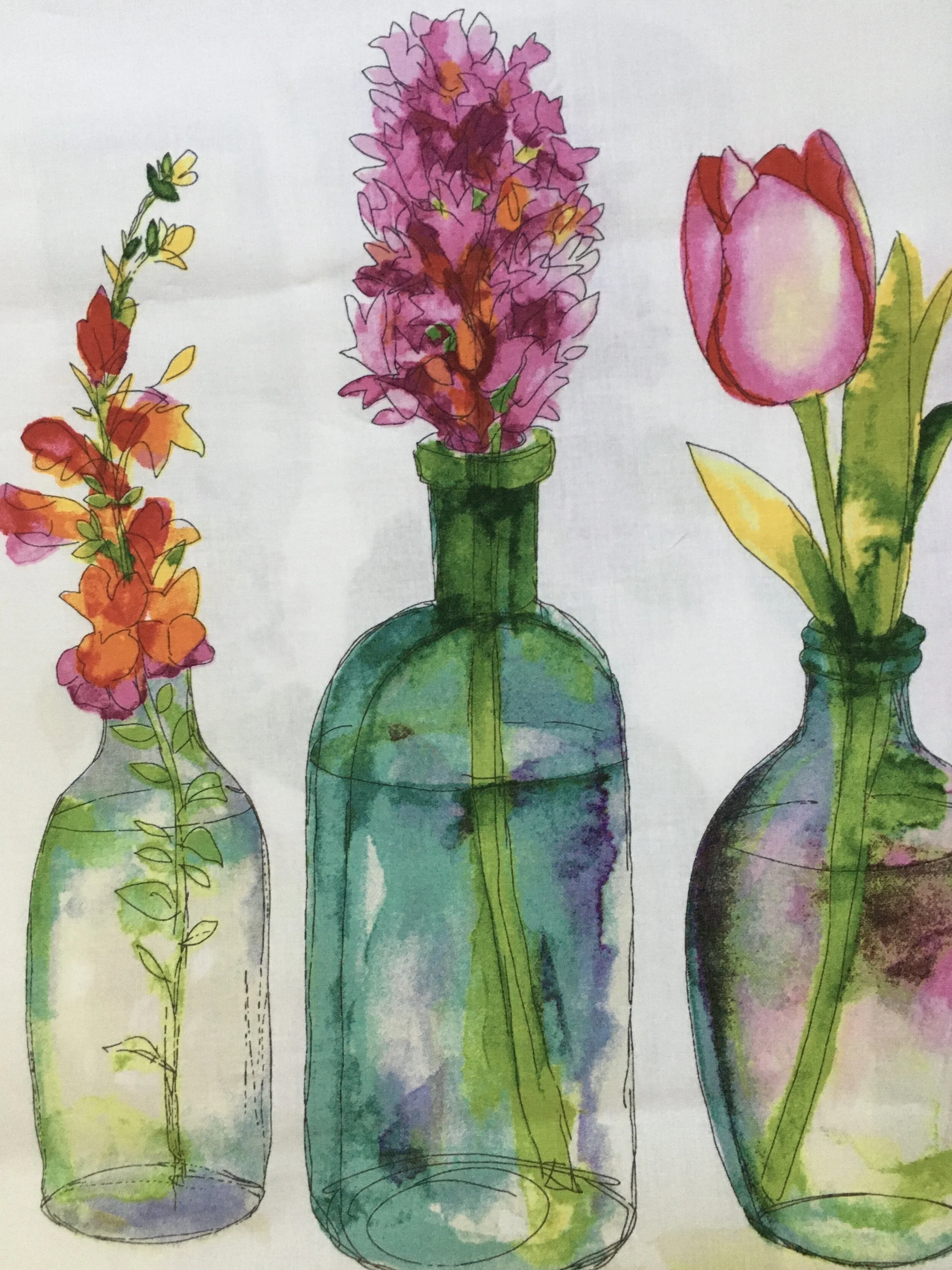
Part of the panel from the “Radiance” line by Sue Zipkin, printed by Clothworks.com.

Part of the panel from the “Radiance” line by Sue Zipkin, printed by Clothworks.com.

Part of the panel from the “Radiance” line by Sue Zipkin, printed by Clothworks.com.

Part of the panel from the “Radiance” line by Sue Zipkin, printed by Clothworks.com.

It’s unusual for me to blog about a fabric line which is new. Typically my fabric cools in my stash for a long time before I get around to making anything. Or I’m buying last year’s fabric lines from a discount fabric store. But I was immediately taken when I saw this panel. It is part of the fabric line “Radiance” designed by Sue Zipkin and printed by Clothworks.com. I had a “How to Have Flowers on the Table” all year round moment!

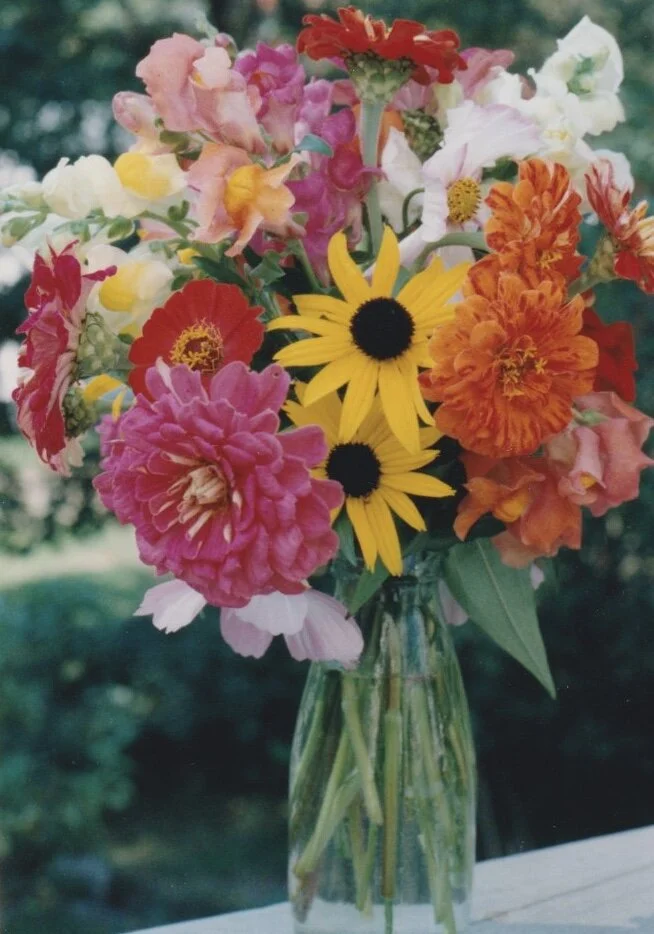
There’s a back story here., which should illuminate my immediate affinity to this panel. Back in the day, B.D. (before dogs) , I had an exuberant little flower bed on the side of my house. There was a slate path that meandered though it. There were mostly perennials in that bed, but I also had annuals growing other places in my yard. Every week in the summer, I would pick a bouquet and put it in a recycled single serve apple juice bottle. I just loved the simplicity of the flowers in the simple clear bottle. Here’s a photo of one of my arrangements.

Flowers from my garden in a recycled glass apple juice bottle.

Flowers from my garden in a recycled glass apple juice bottle.

Now you know why I love this fabric!

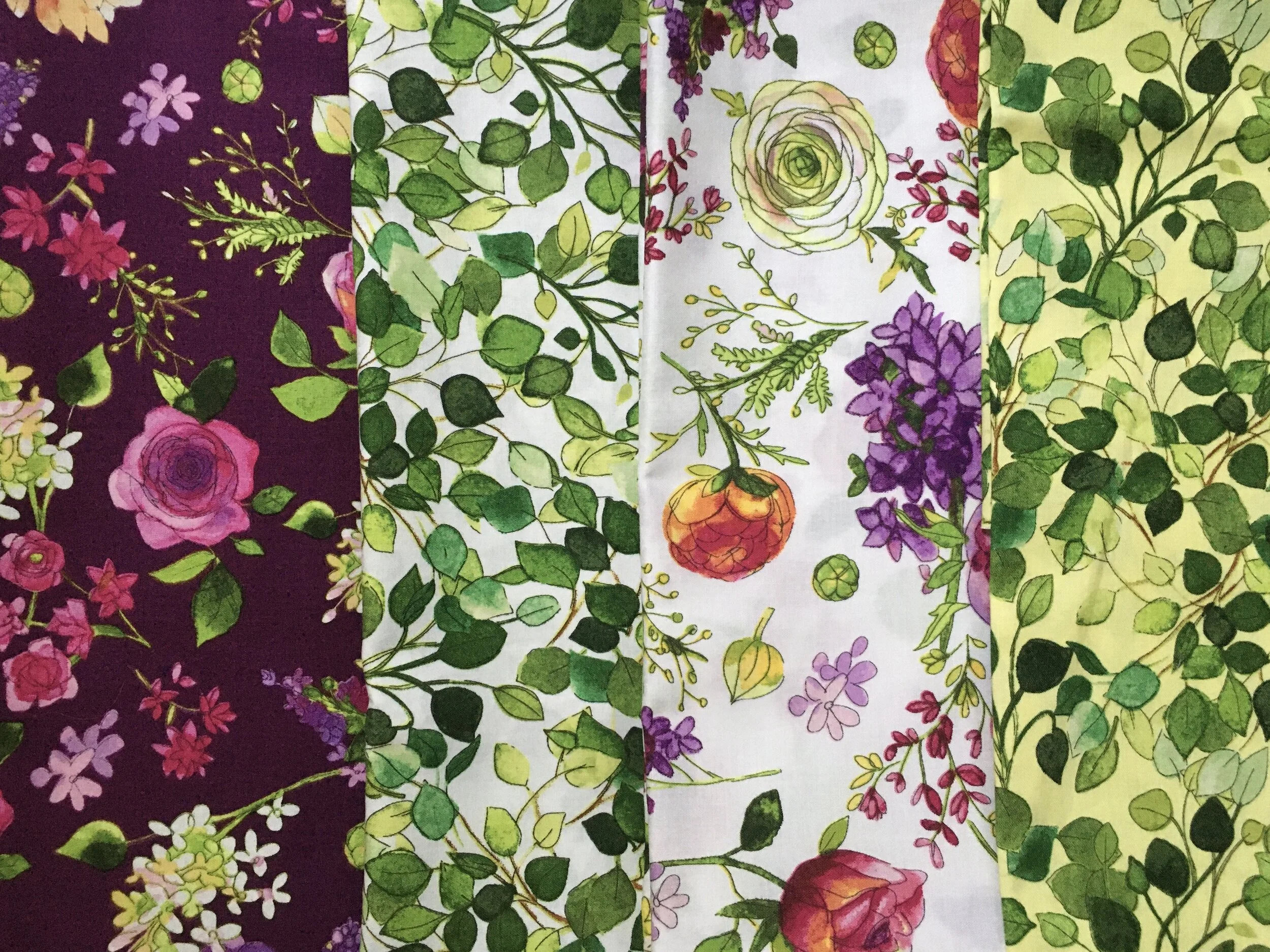
The other slightly shocking bit is that this fabric line has a lot of purple in it. Purple is definitely not my thing! But it makes sense in this fabric line. Other than the panel, the other fabric in this line that I really love is the leaf design with a faintly blue background. Here are the four fabrics in the line which I purchased for my project(s). The large print floral fabrics will be backings.

4 fabrics from the “Radiance” line by Clothworks.com

4 fabrics from the “Radiance” line by Clothworks.com

I plan to cut up the 36 x 42 inch panel into smaller sections. I’m thinking about making a table runner with a scrappy border. My already scant purple fabric bin is really looking almost empty due to using what purple fabric I did have for face masks. (I may not be fond of purple but lots of other folks are)! But a generous quilting friend brought over her purple bin and shared some of her great fabric collection with me. Sweet!

We’ll see what happens! But one thing for sure, I’ll soon be able to enjoy July flowers in February!

TAGS: "Radiance" by Sue Zipkin for Clothworks.com, "Radiance" fabric line by Clothworks.com, Flower arrangements in glass bottles, FLower arrangements in recycled glass bottles


July 2, 2020

Four Patch Quilt: "Four Patch for the Fourth"

by Judy Tucker


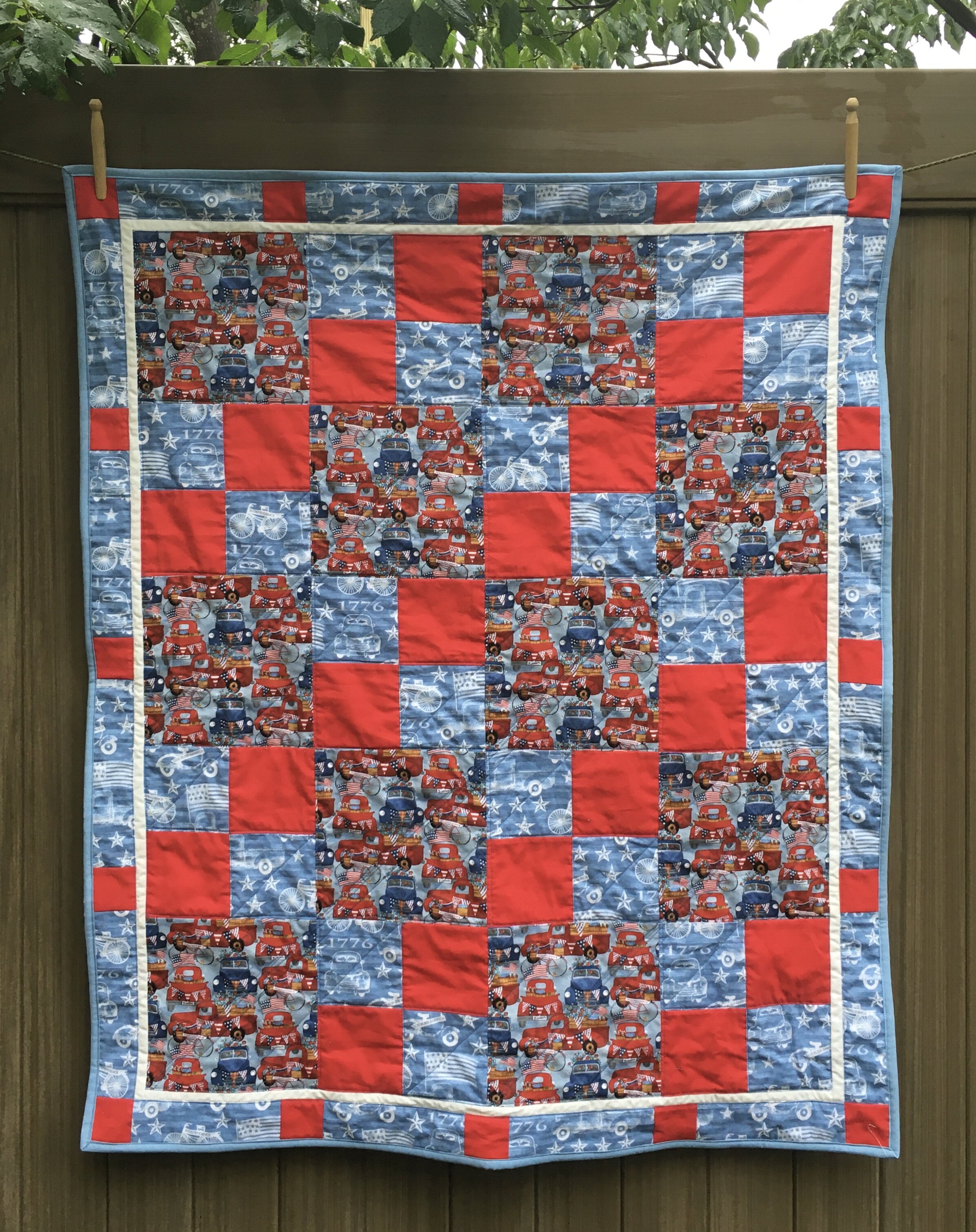
“Four Patch for the Fourth!” Lap quilt 37 x 44 inches

“Four Patch for the Fourth!” Lap quilt 37 x 44 inches

“Four Patch for the Fourth!” Lap quilt 37 x 44 inches

“Four Patch for the Fourth!” Lap quilt 37 x 44 inches

The quilt which I started cutting out in my post last week is done in time for the Fourth of July! This is my design, a simple four patch block quilt that I call “Four Patch for the Fourth.” It’s a small quilt…just big enough for two little children to sit on together.

It’s a easy quilt and sews up quickly.

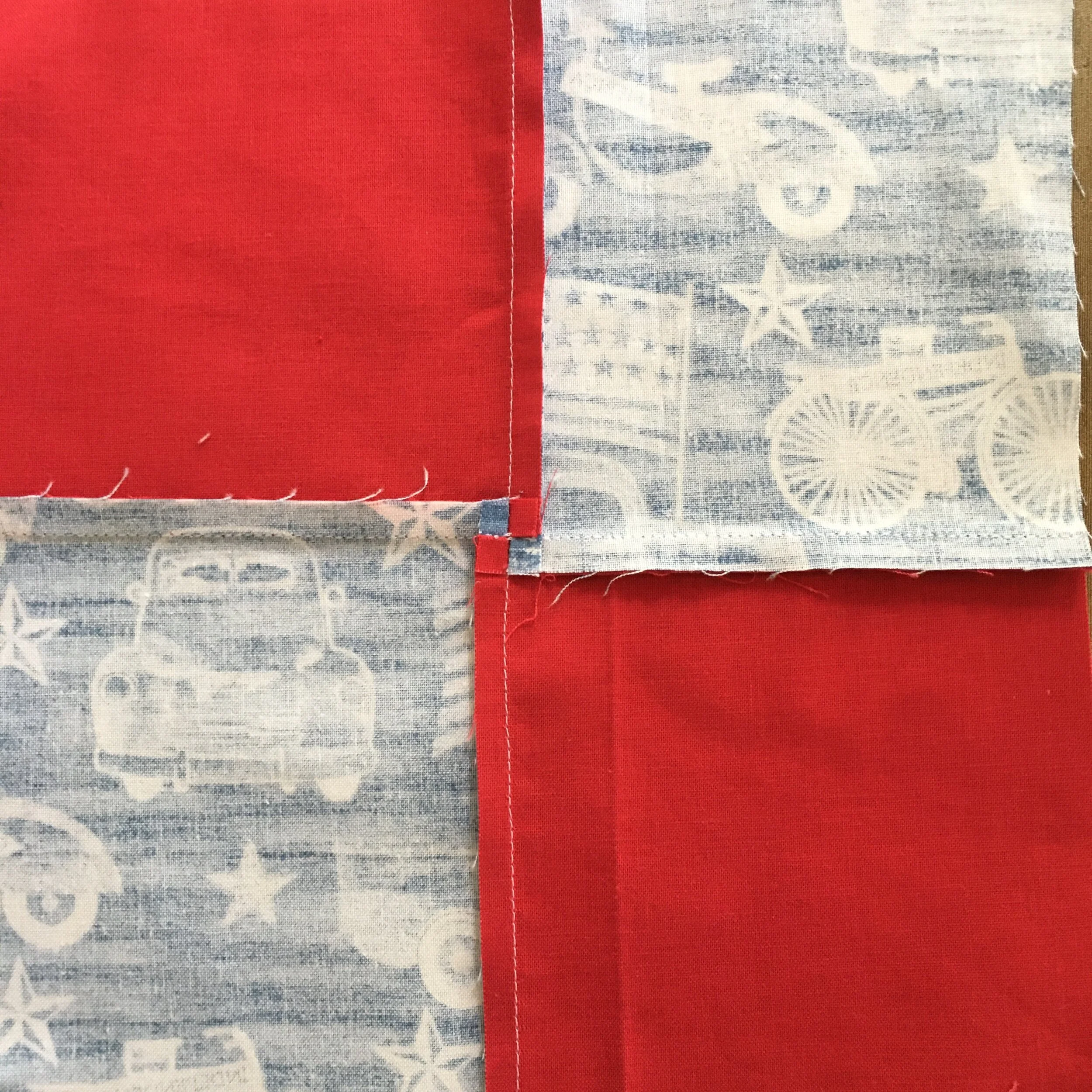
I love blocks that have 4 sections such as this four patch block or pinwheel blocks. In order to have the seams on the back of the block lie as flat as possible, the seams and be “spun”. The top seam can be gently opened up so that one side of the seam can be pressed upward and the other side pressed downward. The result is a tiny four patch on the back of the block. I think of these tiny central blocks as a hidden quilt in a quilt!

The back of a 4 patch block with the seams “spun”.  Note how each of the four seams is pressed toward a different patch, so the seams look like the vanes in a windmill.

The back of a 4 patch block with the seams “spun”. Note how each of the four seams is pressed toward a different patch, so the seams look like the vanes in a windmill.

All the quilting in this quilt was done with a walking foot. Each of the square blocks as been quilted and there is diagonal quilting across the large blocks to anchor them.

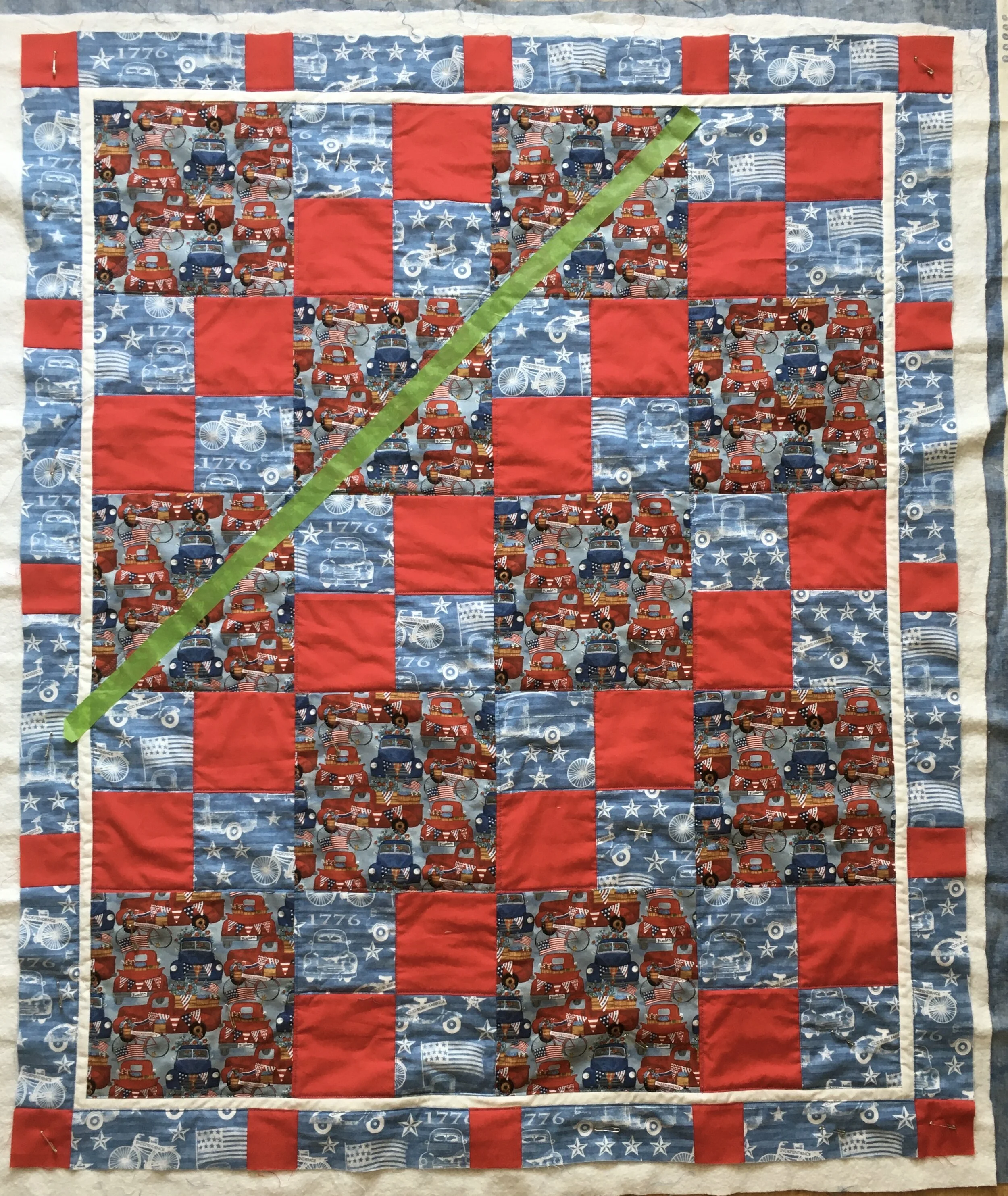
It’s easy to keep a long diagonal course of quilting straight by marking it using painter’s tape. Lay down the tape, quilt the line just beside the tape, not ON the tape. Then remove the tape. Do not leave the tape on the quilt for a long time. I find I can tape 2 diagonal lines at a time. But if I tape more than 2 diagonals, the tape tends to lift off the quilt as I’m stitching. Once the long diagonal line is quilted, additional lines of quilting can be added following the initial diagonal line with the edge of the walking foot. Remove the tape before addition parallel lines of stitching. The tape could be left in place but it’s easier to quilt additional lines without the tape on the quilt.

Don’t use masking tape which may leave glue residue on the fabric.

MarkingWithPaintersTape.jpg

This quilt looks great on the back of a rocking chair too. I like summer quilts that are on the small size. It’s just too hot in the summer to have a big lap quilt.

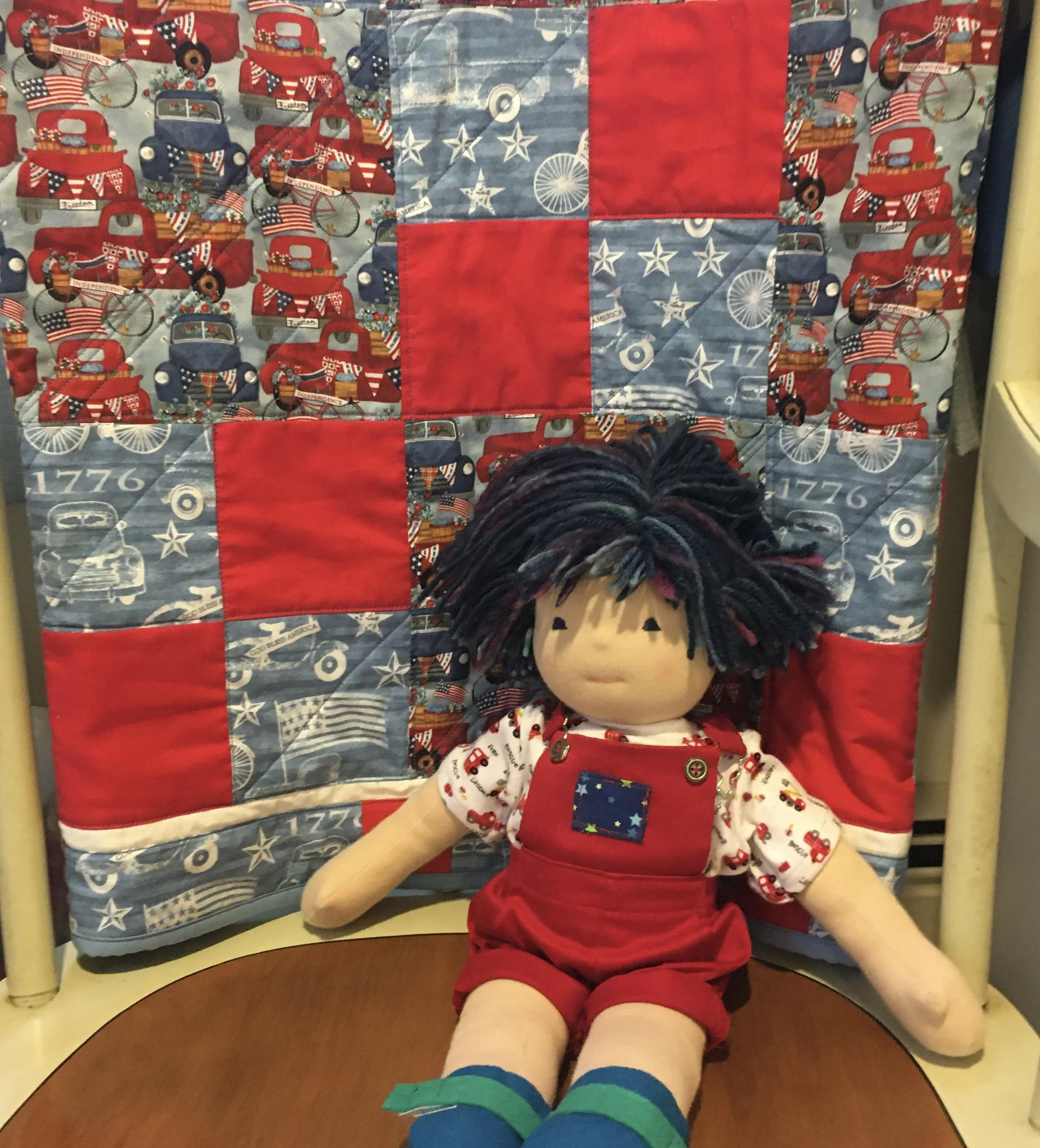
Here’s my Fourth of July quilt with Douglas, a classic Waldorf type doll which I made.

Ready for Staying at Home on July 4th, 2020.

Ready for Staying at Home on July 4th, 2020.

Have a safe, happy, and healthy weekend!

TAGS: Four Patch quilt, "Four Patch for the Fourth" quilt, Easy quilt, Quick Quilt, Four of July Quilt, Lap Quilt, Marking quilts for long diagonal quilting lines, Diagonal quilting tips


June 25, 2020

Four Patch Quilt for Fourth of July

by Judy Tucker


Fabrics for my “Four Patch for the Fourth” Quilt

Fabrics for my “Four Patch for the Fourth” Quilt

Fabrics for my “Four Patch for the Fourth” Quilt

Fabrics for my “Four Patch for the Fourth” Quilt

“Can she do it???”

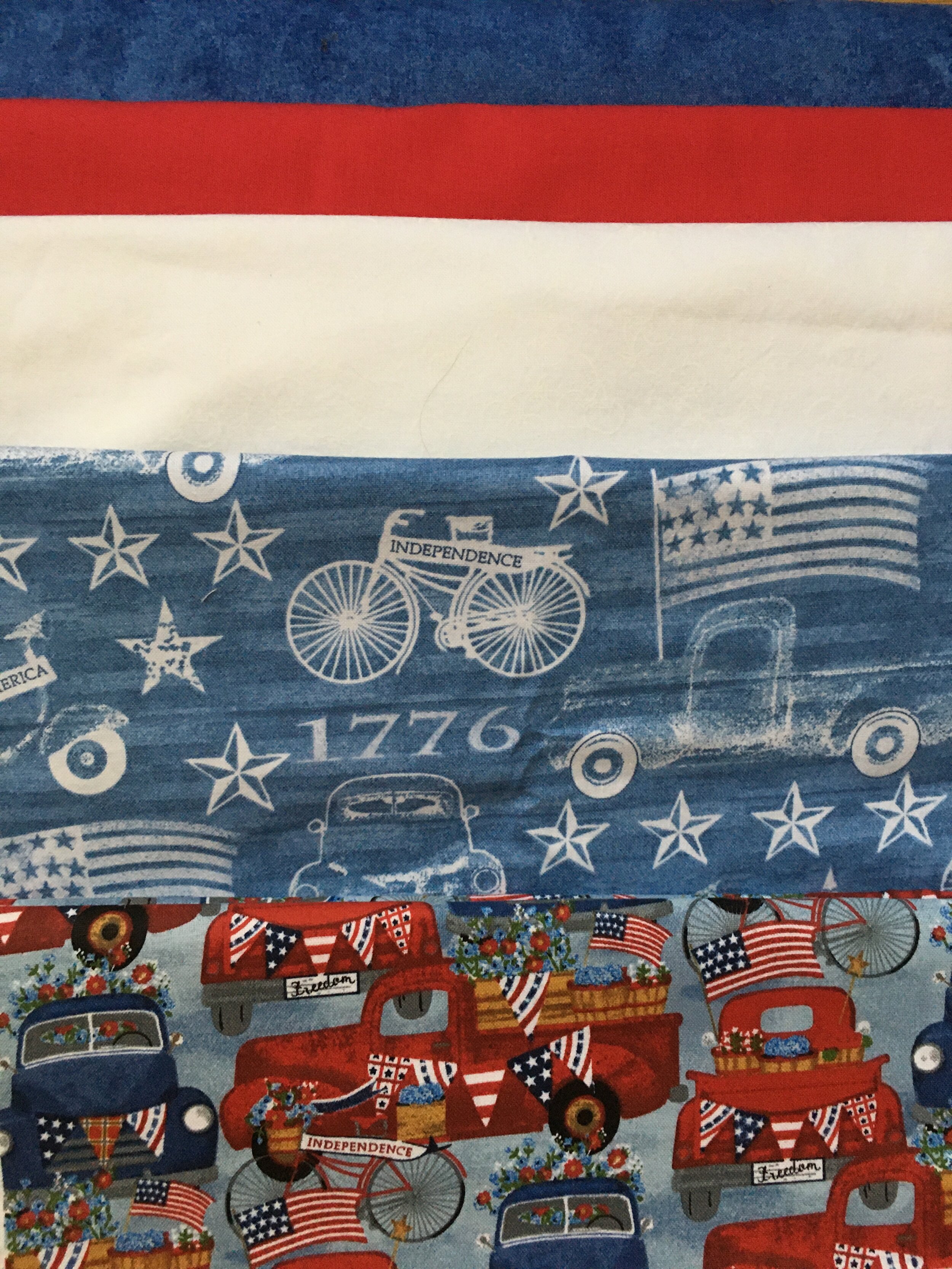
I got this collection of fabrics in the mail from Bits ‘n Pieces Quilt Shop in New Hampshire yesterday. The two focus fabrics and a different red fabric were one of their weekly “3 yard picks” that they showcase on their Sunday Facebook Live at 1 PM EDT.

So I have 10 days from today to get a quilt made for the Fourth of July holiday to make this 37 x 45 inch quilt.

The two feature fabrics were designed by Beth Albert for a line called “American Spirit” printed by 3 Wishes Fabric ™. The dark blue tonal is for the back of the quilt is “Shadow Play” by Maywood studio. Then there is a one of the Kona® cotton reds from my stash and a white on white with a cherry design which has been in my stash for years.

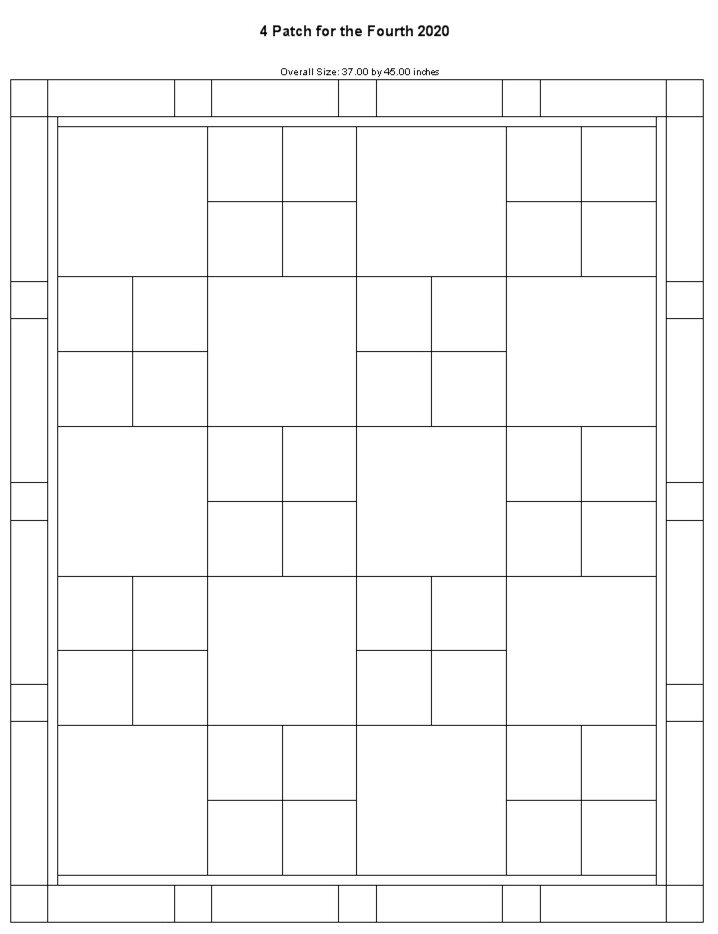
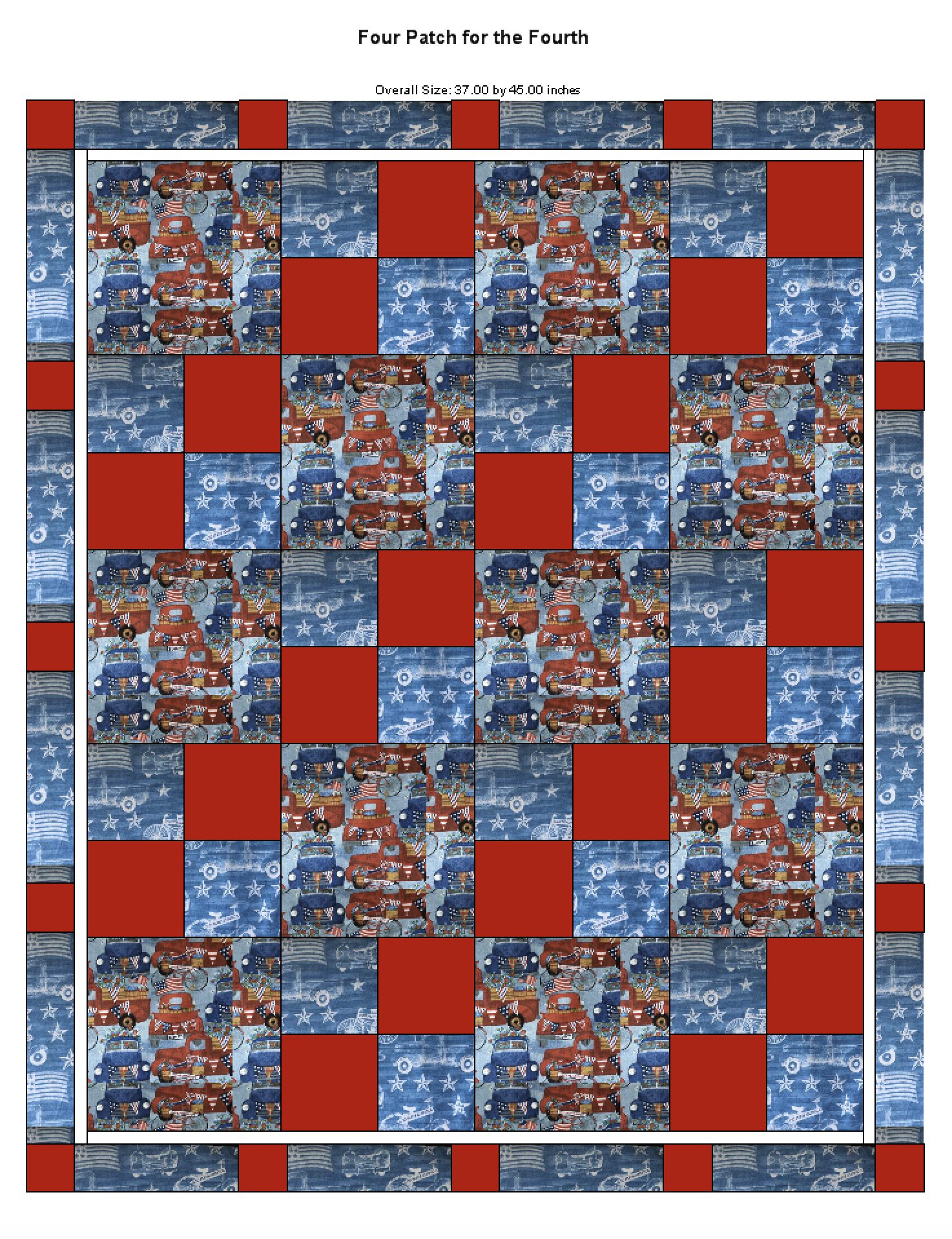
Here’s a mock up of the quilt I designed in Electric Quilt 8. First as a line drawing, and then as a mock up with the focus fabrics shown.

A66D5DFC-28A7-4675-B43B-2D4CC0220717_1_201_a.jpeg
8AB55AA6-F832-47F6-B826-2BE7FA54674A.png

If you want to make this four patch quilt, here is the information you need to cut the pieces. This isn’t a pattern but this does give the information needed to make this quilt.

The four patch blocks are cut as 4 1/2 inch squares and the large feature fabric blocks are cut as 8 1/2 inch squares. The completed blocks will finish at 8 inches square. The tiny white outer border is cut at 1 inch and finishes at 1/2 inch. The outer border is 2 inches wide. The red border blocks are cut at 2 1/2 inches square. The top and bottom blue border strips are cut at 7 1/4 x 21/2 inches and the blue side border strips are cut at 9 1/4 x 2 1/2 inches.

“It should go together quickly" she said. We’ll see whether or not that’s really true!

TAGS: Four Patch quilt, "Four Patch for the Fourth" quilt, Independence Day quilt, Quick Quilt, Lap Quilt


June 18, 2020

Peg Dolls: Badger

by Judy Tucker


BadgerPegDoll.jpg
BadgerPegDoll.jpg

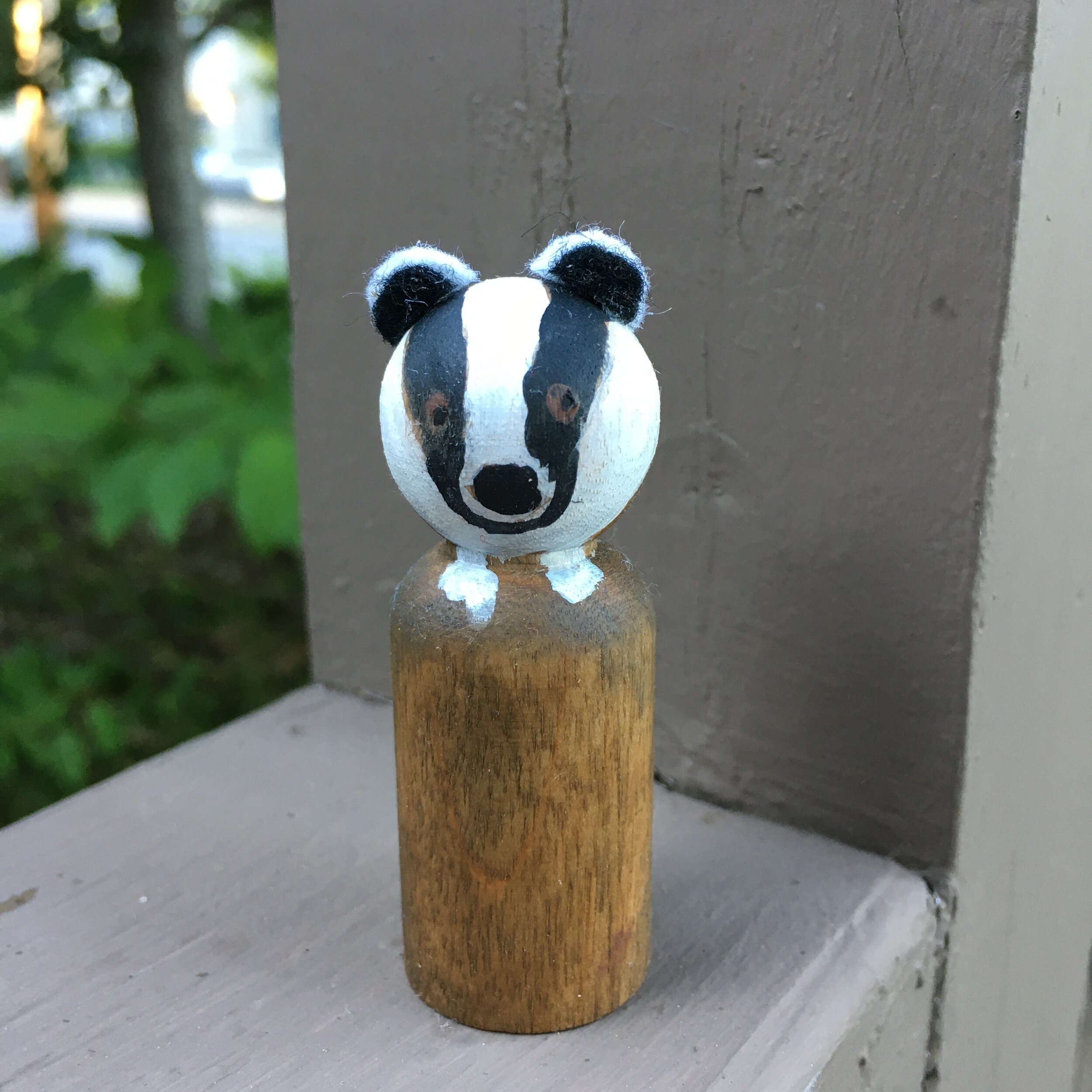
Summer is almost here and I’ve been thinking about Kenneth Grahame”s book Wind in the Willows—the original version with drawings by Ernest Shepherd. (He illustrated the original Winnie the Pooh too). I do really like Mole and Ratty. Toad, who is a free wheeling character (often literally!!), has always made me very anxious. But I think my favorite character is Badger. He is the calm and sensible one.

So I decided to make a badger peg doll.

I used the standard 2 3/8 inch boy peg. Here’s how you can make your own badger.

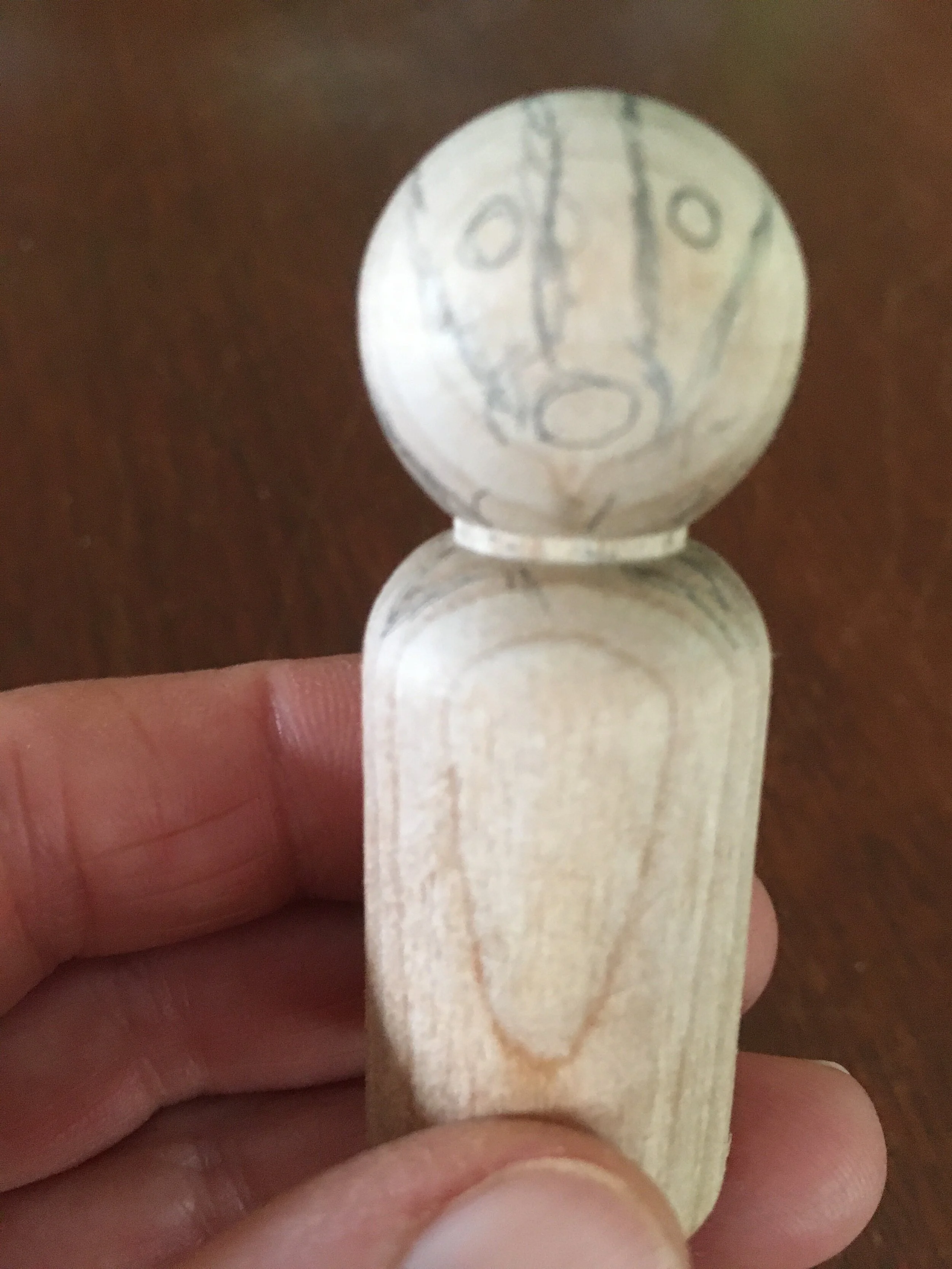
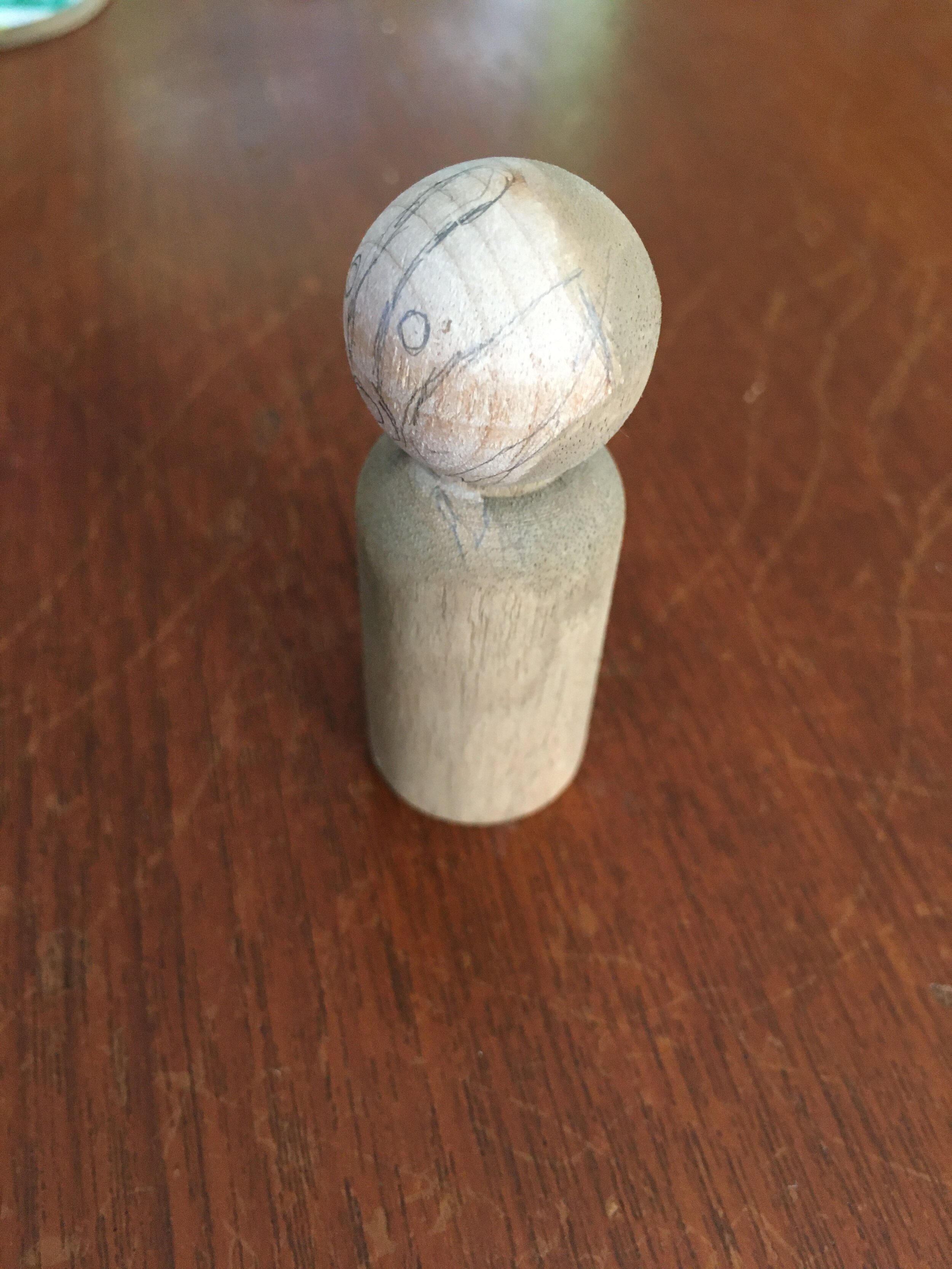
  • Draw the badger’s face on the peg with a pencil. I used the badger in this photo as my model.

Badger by PBarlowArt, royalty free for commercial use photo from www.Pixabay.com

Badger by PBarlowArt, royalty free for commercial use photo from www.Pixabay.com

B24AEE38-8657-47A0-AF15-EE06B8837882.jpeg
217A8AE9-551A-45CC-91B0-C6A8792485A7.jpeg
B9704A2E-0C63-40AD-B4B0-CBEC076E9274.jpeg
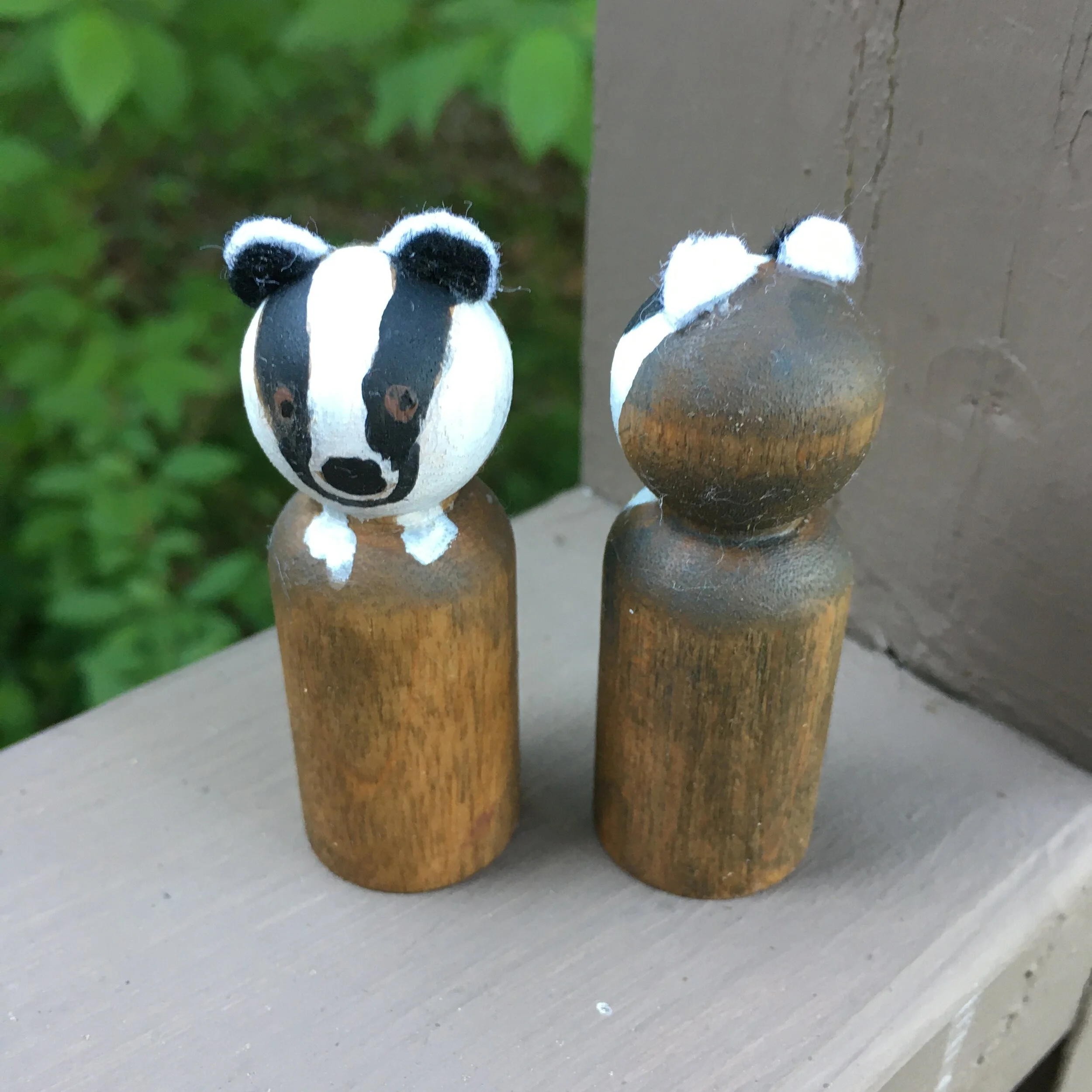
  • Using non-toxic watercolor paints, paint the body of the peg and the back of the head. I used a brown watercolor paint and then when it dried, painted over the brown with grey.

  • Paint the badger face with opaque acrylic paint. Paint the white stripe and cheeks first. Then the back stripes and nose

  • Allow all the paint to dry. Then seal it with beeswax polish.

  • Paint tiny brown eyes. Use a fine marker to add black pupils.

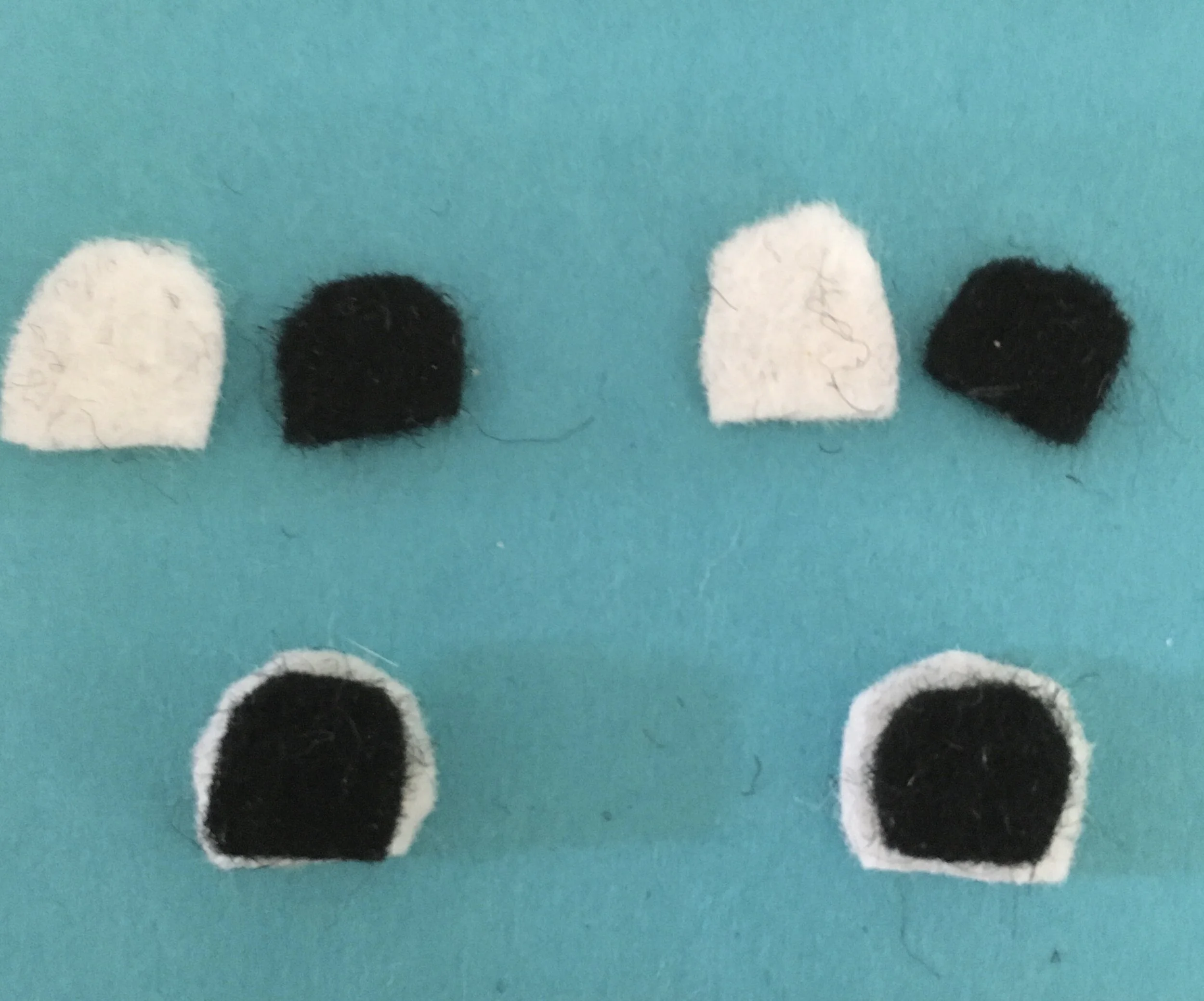
  • Cut ears from wool felt. Cut a small black semi-circle and a slightly larger white semi-circle. Glue the two pieces together with craft glue.

  • The finished ears in the photo were too large for badger ears. I cut a little bit off the flat side of the ears so there weren’t too tall.

  • Glue the ears on the peg doll with craft glue that will dry clear. Be generous with the glue. If you expect the peg to get a lot of play by a young child, it might be better to paint ears on the peg head instead.

Here are the front and back of the Badger Peg Dolls

Here are the front and back of the Badger Peg Dolls

The fox peg doll was happy to welcome badger to our forest. Me too!

TAGS: Badger peg doll, Peg Dolls, How to make a badger peg doll, forest animals peg dolls


June 11, 2020

Face Mask Scrap Quilt: "Post-Cuts" quilt top is done

by Judy Tucker


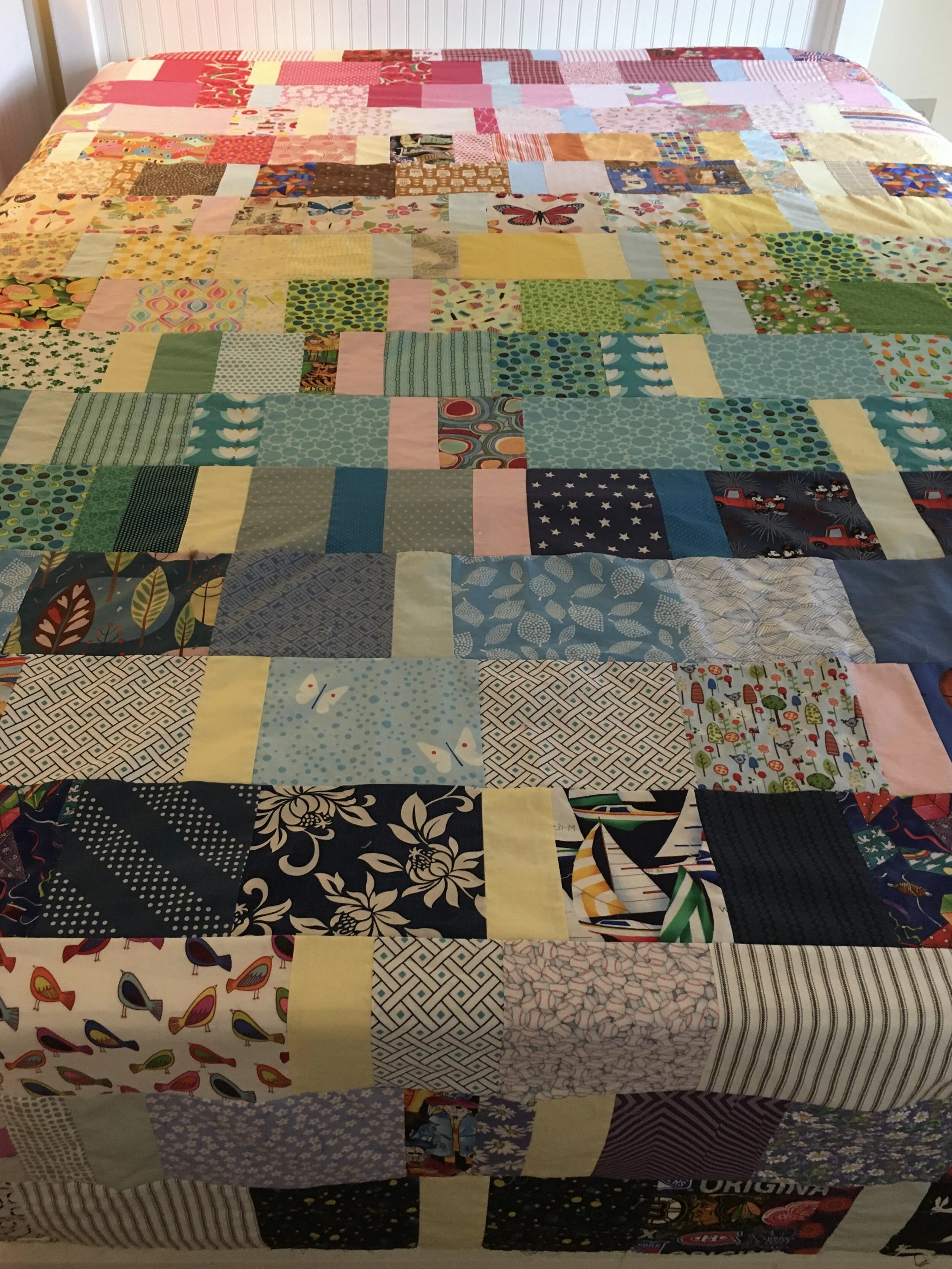
“Post-Cuts” Queen Size Quilt Top

“Post-Cuts” Queen Size Quilt Top

“Post-Cuts” Queen Size Quilt Top

“Post-Cuts” Queen Size Quilt Top

Here’s the completed quilt top which I made from scraps from making face masks and added pastel marker bars. I’ve named it “Post-Cuts”, sort of play on the quilter’s friend, pre-cut fabrics.

I decided to place the colors in a spectrum-like order. I started with red. And the bottom of the quilt there are navy blocks, white background blocks, purples and finally black background blocks. I did this deliberately so that my favorite colors are at the top and center of the quilt and my least favorite colors will end up tucked behind the foot board!

This quilt is a generous queen size—88 x 98 inches. I have quilted queen size quilts on my domestic machine, but this time I think I’m going to send it off to a long arm quilter. This one is just a wee bit big for me.

There is lots of information on how to make this quilt in my last 3 posts if you want to make a similar scrap quilt. The scraps don’t have to be from making face masks. They just need to all have the same height.

I expect it will be a while before this quilt is quilted. But I will share a picture when it is finally all done.

TAGS: Using Face Mask Scraps to make a quilt, Face Mask Scraps Quilt, "Post-cuts" scraps from making face masks, scrap quilts


June 4, 2020

Assembling a Quilt with Long Strips

by Judy Tucker


Measuring a strip of Blocks. The last block has been folded over, ready to be trimmed off.  (Notice that tape measure has moved a bit. That’s why it is a good idea to use tape makers which will stay put).

Measuring a strip of Blocks. The last block has been folded over, ready to be trimmed off. (Notice that tape measure has moved a bit. That’s why it is a good idea to use tape makers which will stay put).

Measuring a strip of Blocks. The last block has been folded over, ready to be trimmed off.  (Notice that tape measure has moved a bit. That’s why it is a good idea to use tape makers which will stay put).

Measuring a strip of Blocks. The last block has been folded over, ready to be trimmed off. (Notice that tape measure has moved a bit. That’s why it is a good idea to use tape makers which will stay put).

The “Post-Cuts” quilt blocks have all been sewn together. There were actually enough scraps left from the face masks I’ve sewn to make a queen size quilt!

This quilt is assembled in strips of blocks. The strips measure 88 inches long. All the blocks are 6 inches wide.

There was a time when I would have just sewn all these long strips of blocks together and tried to trim the finished quilt top. Let’s just say that is a disaster. I did that to myself more than once! It’s almost impossible to square up a quilt top sewn from strips of random lengths.

However, take the time to measure each long strip and cut to the desired length and the result will be a perfect quilt. It takes a few minutes but it is so worth the effort.

I marked my floor with two pieces of Washi tape, 88 inches apart. Painters tape works well too. Then I laid down each of the quilt strips and trimmed them to be exactly 88 inches.

Once the strips are trimmed, it is important to pin the strips together before sewing. Put two strips right sides together. Pin the pair of strips at each of the ends first. Then ease the two long strips together, pinning every 5-6 inches. I don’t usually pin anything when I make quilts, but it is very important to pin long strips to prevent one of the layers from traveling during sewing and coming out uneven at the end of the row.

Sew pairs of long strips together. Then sew pairs of paired strips. Continue until the quilt top is done. the quilt comes together quickly in the end.

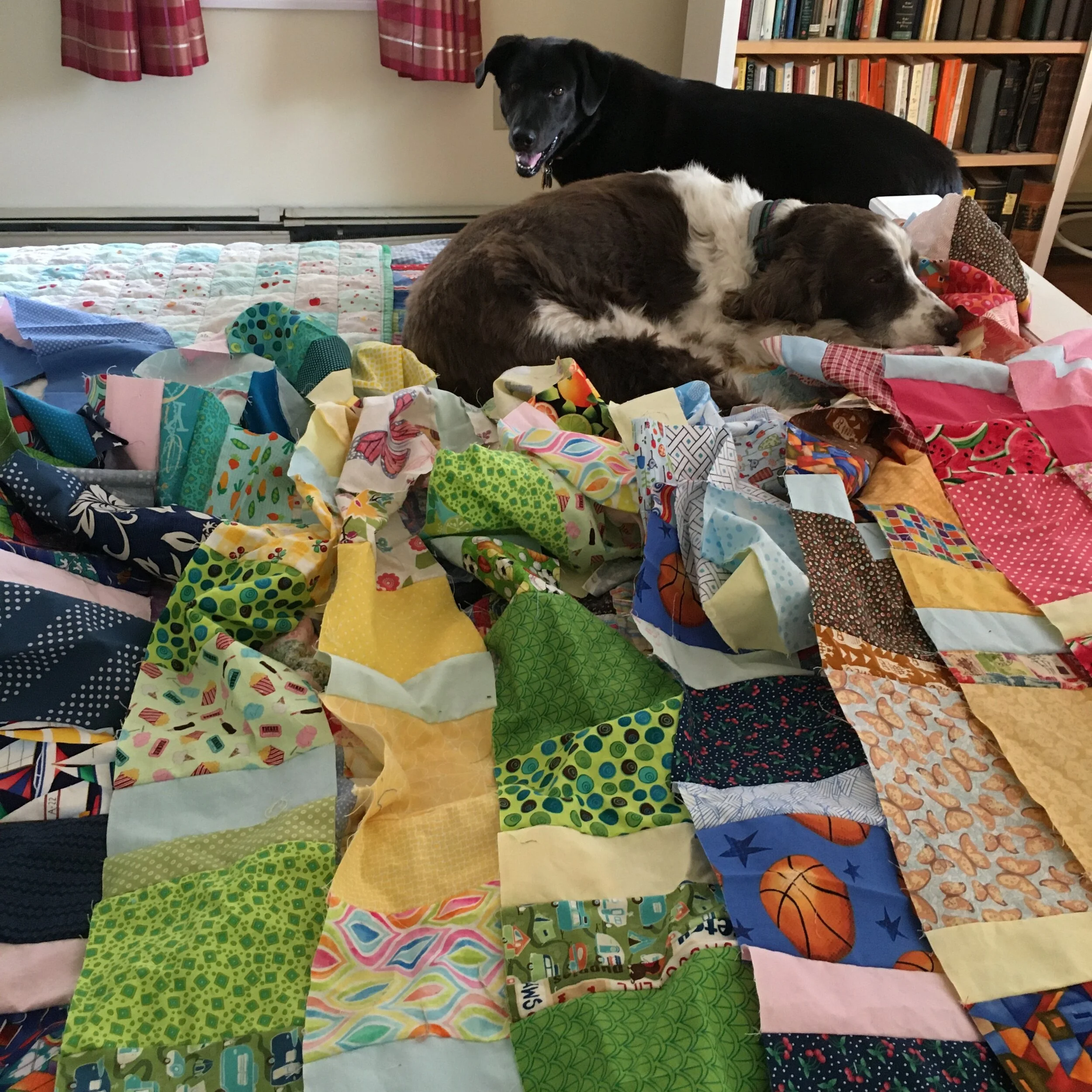
Checking to see if there were enough strips to for the length needed for a bed quilt.  Not even assembled yet, and the dogs already approve!

Checking to see if there were enough strips to for the length needed for a bed quilt. Not even assembled yet, and the dogs already approve!


TAGS: Quilt Assembly Tips, Assembling a qulit with long narrow strips, "Post-cuts" scraps from making face masks, Sewing strips of a quilt together, Measuring quilt strips


May 28, 2020

Mask Scraps Quilt: "Post-Cuts"

by Judy Tucker


Strips of Face mask “post-cuts’

Strips of Face mask “post-cuts’

Strips of Face mask “post-cuts’

Strips of Face mask “post-cuts’

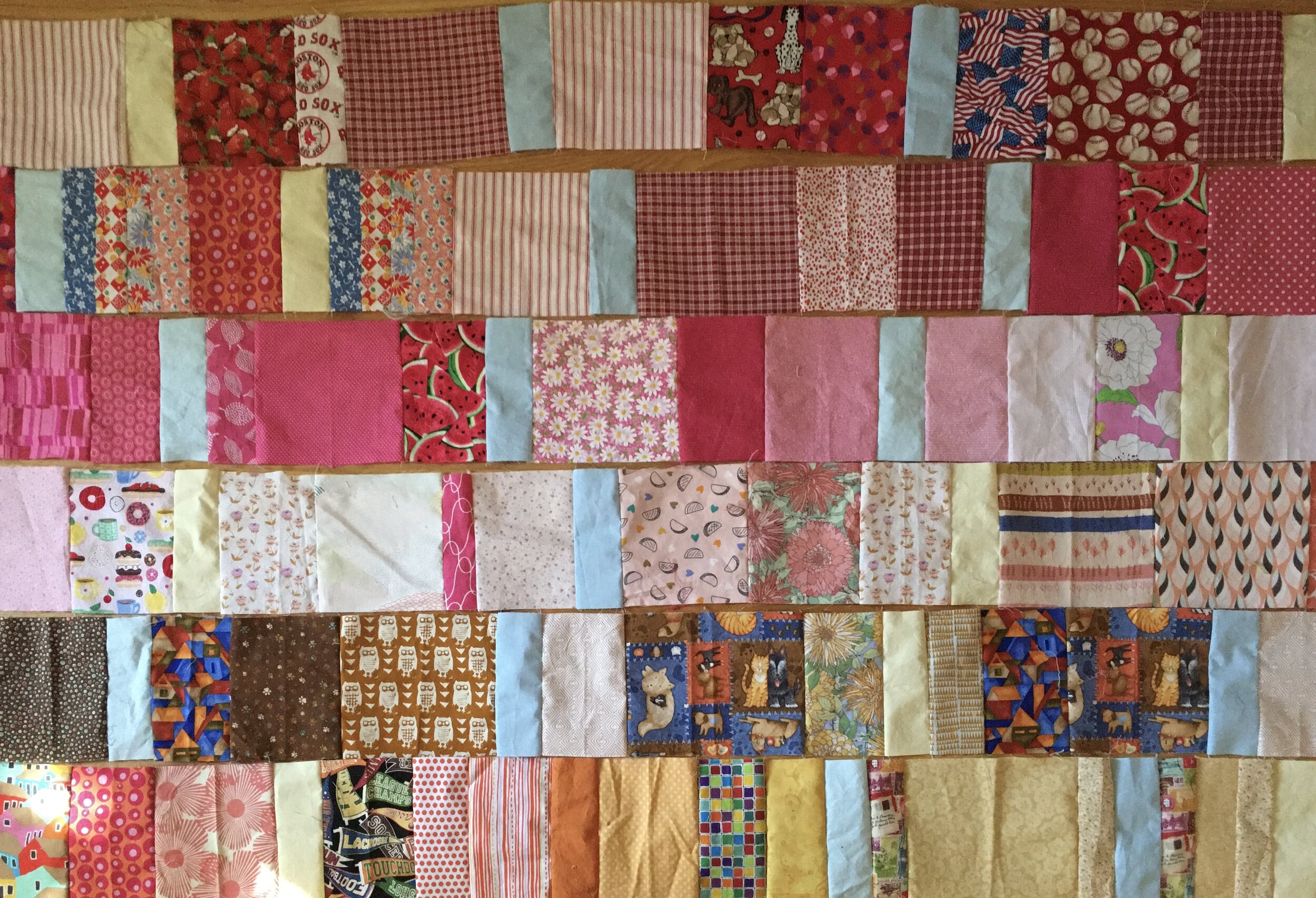
In my last post, I talked about some options I was mulling over for making a quilt using the 6” tall left over scraps from making rectangular face masks.

Here’s what I decided.

  • The scraps are sorted by colors.

  • Three scraps are sewn together and then a 2 1/2 x 6 inch pastel divider strip. It’s very easy to sew this combination. Two scraps are stitched together in a pair, then one scrap and divider strip in a pair. These pairs are then sewn together to keep the colors organized.

9884D237-52BF-4644-9FE0-237D4332AED7_1_201_a.jpeg
8AB4B011-F846-4318-A8FA-34867F688C4C_1_201_a.jpeg

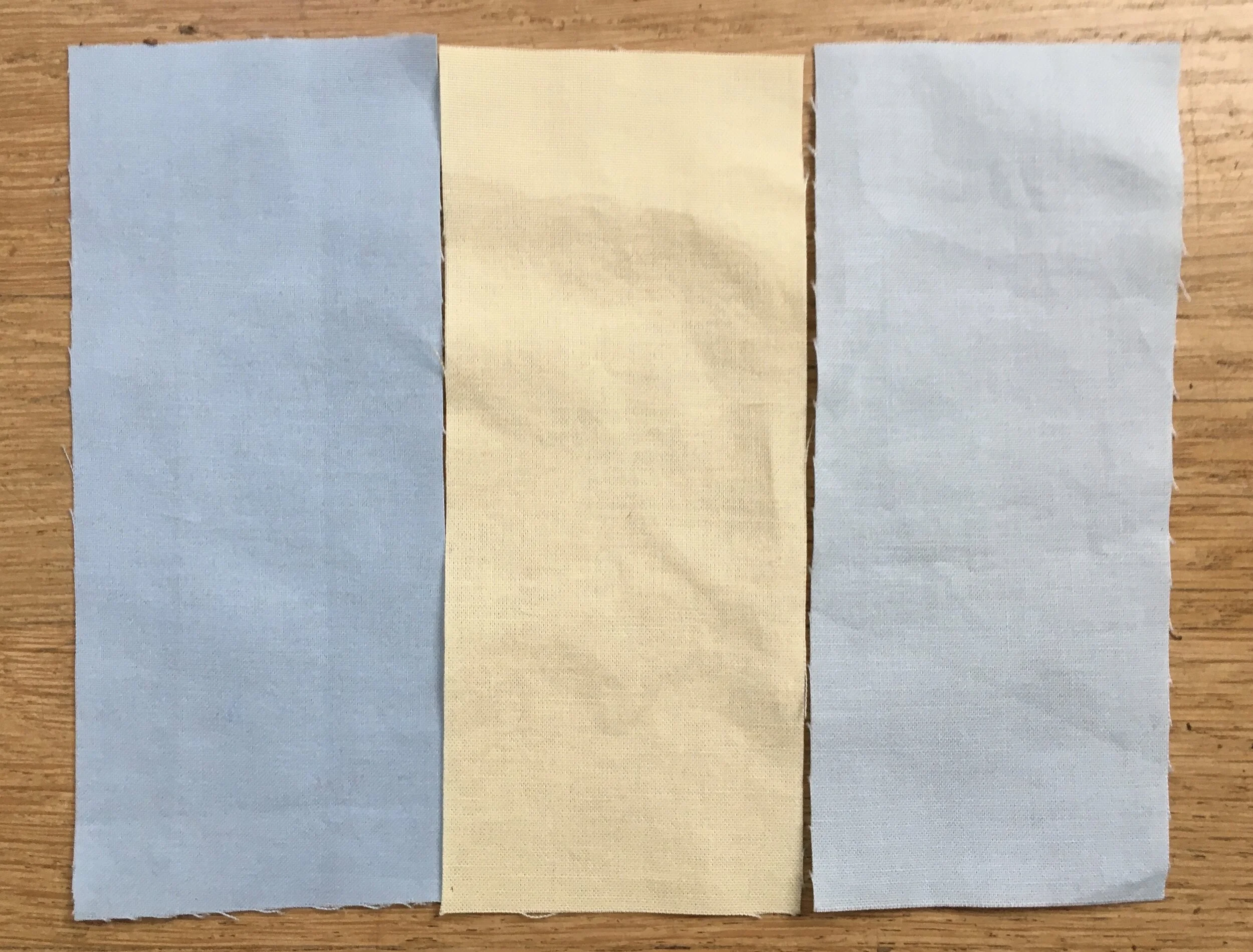
I think I prefer the two light blue separator strips. They show up better. But the separator strips are scraps too, so I’m using up what I have. I think I will end up needing to a light blue green strip too.

I’m sewing the sections so that they will be wide enough to make a queen size quilt. But if I don’t have enough scraps to make the quilt long enough, I’ll re-cut the strips. I believe I definitely will have enough to make at least a twin size quilt.

And yes, this is one of those quilts that the dogs will be welcome to sleep on! Nothing precious about this one. It’s just a fun collection off fabrics that are “old friends’and come with lots of happy memories of many previous projects.

TAGS: "Post-cuts" scraps from making face masks, scrap quilts, Using Face Mask Scraps to make a quilt


May 21, 2020

How to Use Scraps Left Over From Making Masks to Make a Quilt

by Judy Tucker


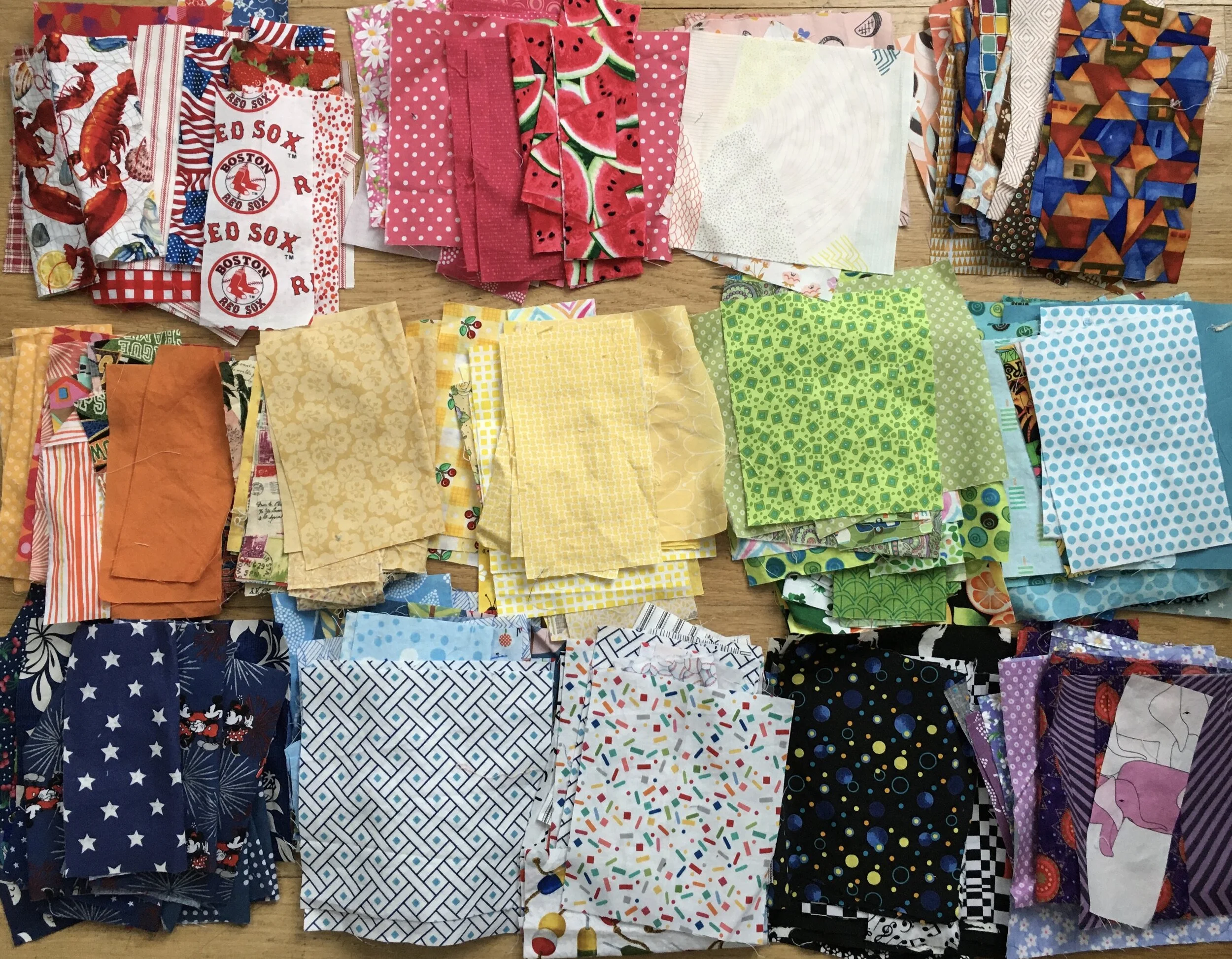
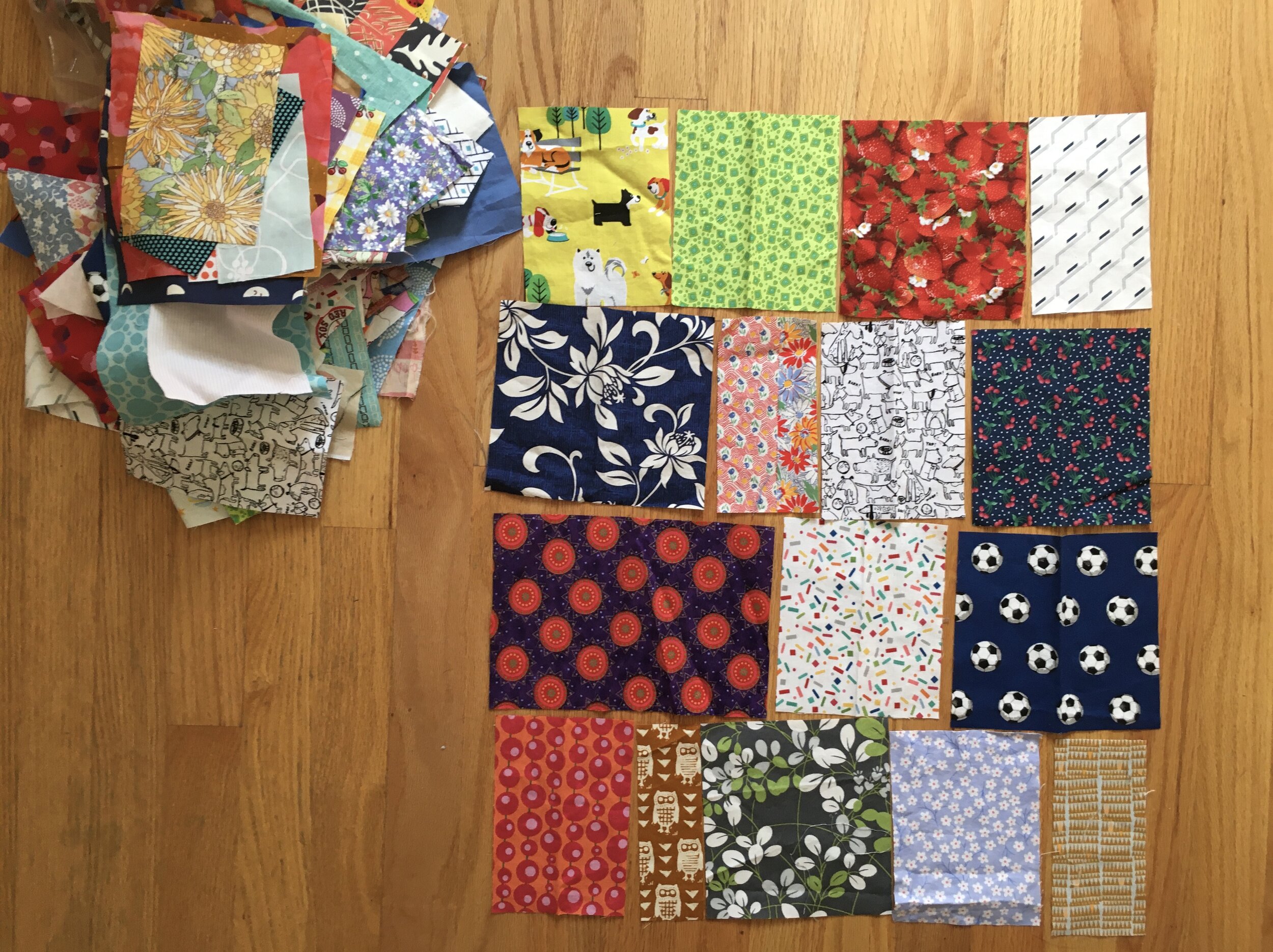
6 inch wide scraps from making face masks

6 inch wide scraps from making face masks

6 inch wide scraps from making face masks

6 inch wide scraps from making face masks

I haven’t done any quilting since the beginning of the Stay-at-Home order for COVID-19. But I have been churning out lots of face masks for volunteers of one of the local food pantries to use. I’ve dug deep into my stash of fabrics and have used a wide variety of fabric colors and patterns.

Some of the rectangular masks have been cut from scraps but others have been cut from yardage. Either way, I often end up with a 6 inch tall strip of left-over fabric.

The symmetry of these scraps makes me want to sew a quilt from them. They are sort of like pre-cuts—but not. I’ve taken to calling them my “post-cuts”!

I haven’t decided what to do yet. So I’m more or less thinking out loud in this post. My current plan is to cut standard 6 inch x 2 1/2 inch strips of one solid color to use as a spacer between the prints. Here are some of the ideas I’ve been kicking around.

  • Should the spacers come after 2 or 3 prints are sewn together? Or even less often in a row?

  • Should the post-cuts be randomly pulled from the bag to create a completely scrappy quilt?

  • Should I separate the post-cuts by their colors?

  • Should they be grouped by their design—florals, dogs, sports, geometrics?

  • What color should the spacer strips be? I’ve pulled out a light yellow. But pink or aqua would be good too. Or should I use a collection of different pastels? Whichever color(s) I choose, the spacer fabric needs to come out of my big stash of solids. Just making do with what I have on hand.

There are so many different ways this scrap quilt could be assembled.

No decisions yet! But I am having fun contemplating all the options!

Who else is making a quilt from mask scraps? Or even just thinking about it?

TAGS: Making a quilt from face mask scraps, "Post-cuts" scraps from making face masks, scrap quilts


May 14, 2020

Peg Dolls: Foxes

by Judy Tucker


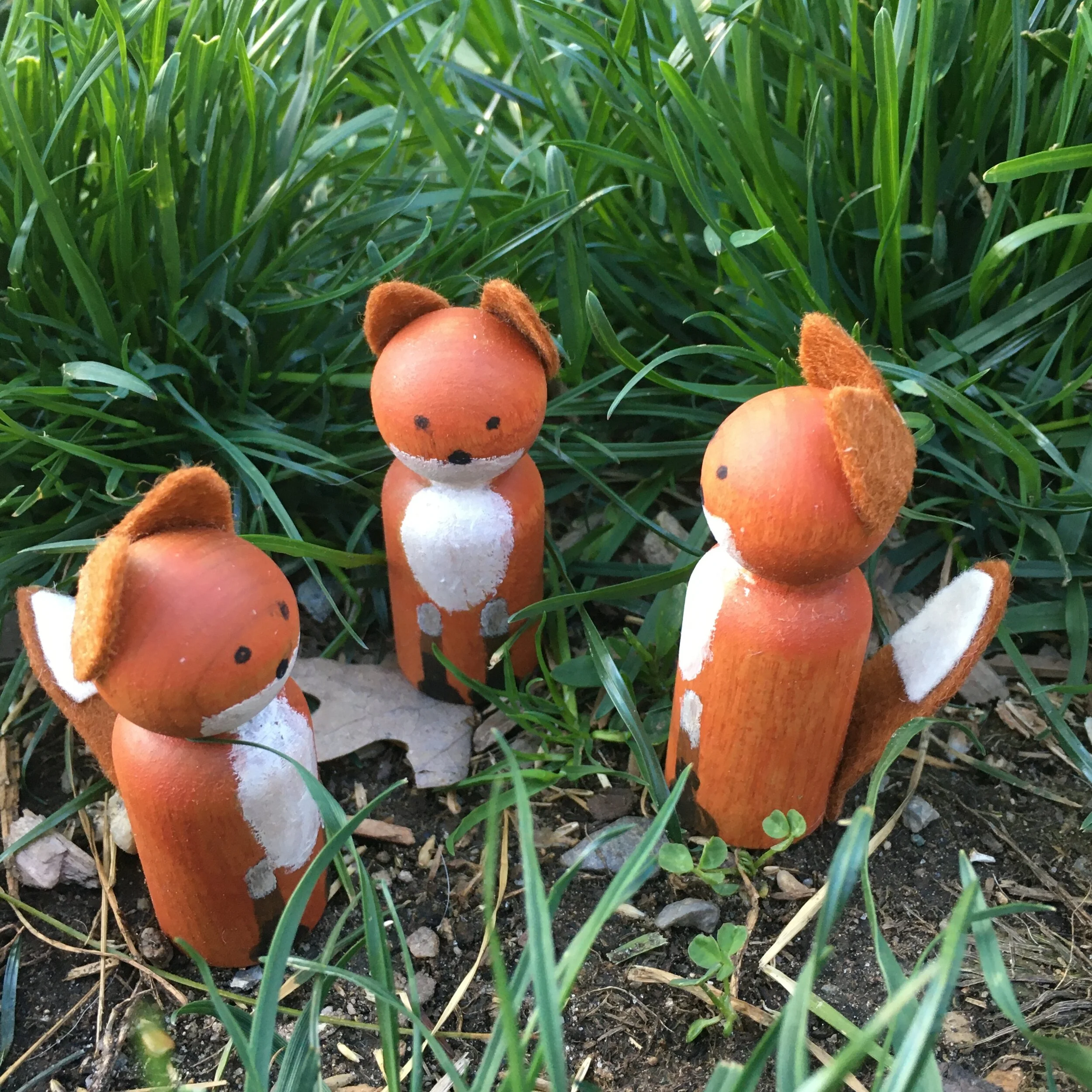
Fox Triplets

Fox Triplets

Fox Triplets

Fox Triplets

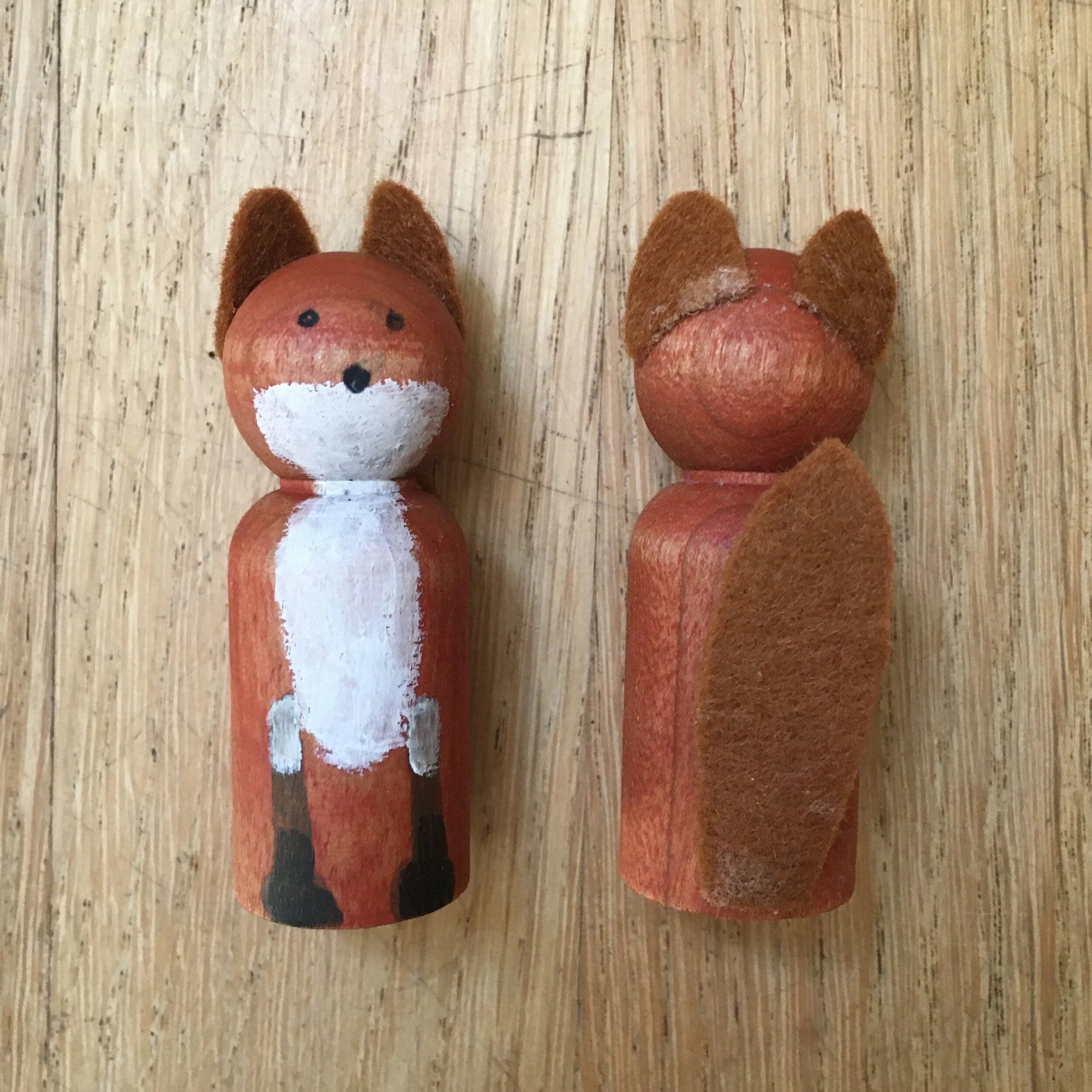
Fox peg dolls. I’ve been thinking about making fox peg dolls. And here they are! These are standard boy pegs, 2 3/8 inches tall.

How to make your own fox

  • Paint the peg with orange or reddish brown non-toxic watercolor paint. Leave a triangle on the lower 1/4 of the face and an oval on the chest. Allow the paint to dry.

  • Paint the lower face and the chest of the fox with non-toxic opaque white acrylic paint. Allow the pain to dry. Paint the tops of the legs. This can also be done after the legs are painted.

  • Paint the legs with olive green or dark brown non-toxic watercolor paint. Allow to dry. Paint the feet with black paint. Add the opaque white paint if that wasn’t done in the previous step. Allow to dry

  • Seal with beeswax polish. Allow to dry for several hours or overnight. Polish with a soft, dry cloth.

  • Using a watercolor brush pen, add eyes and nose.

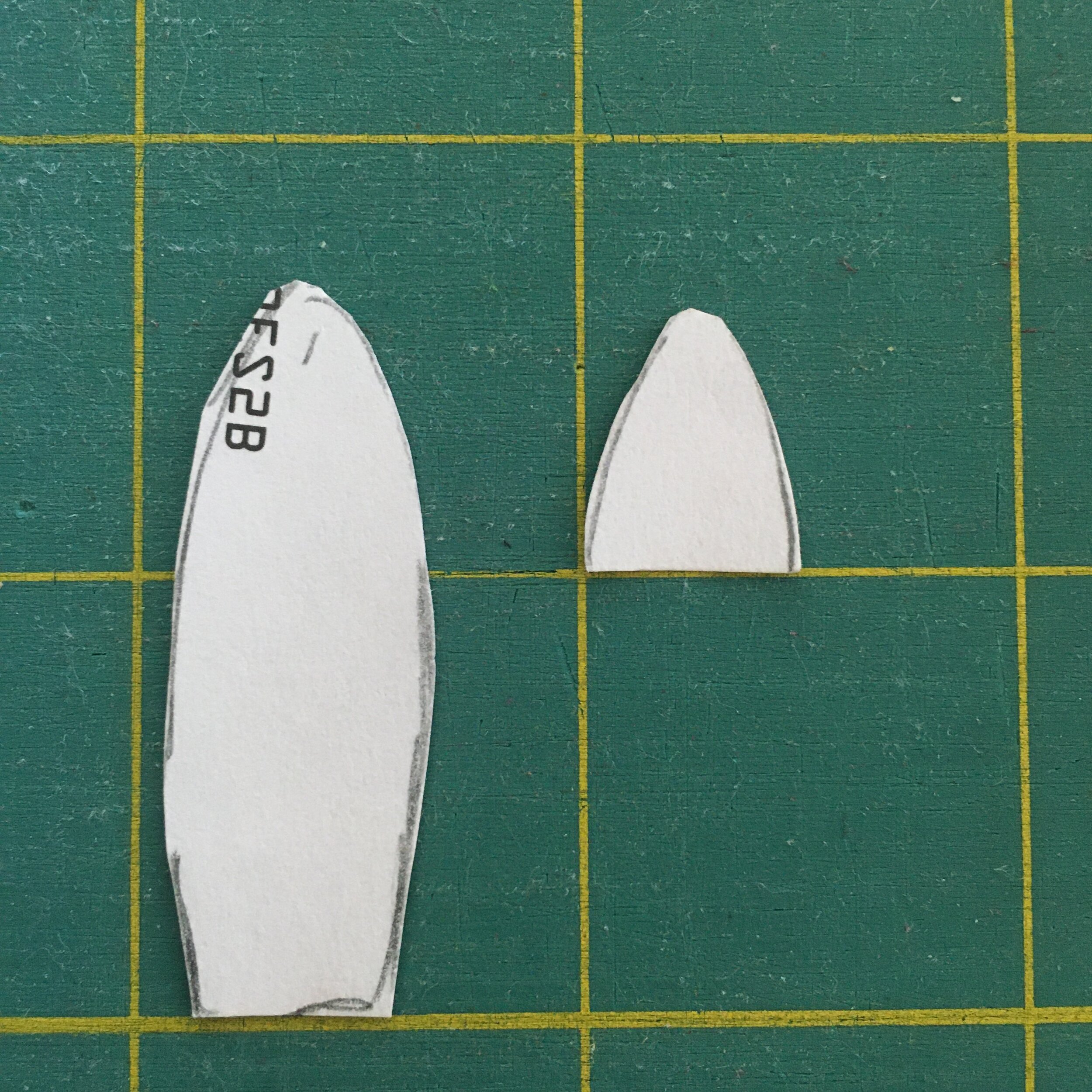
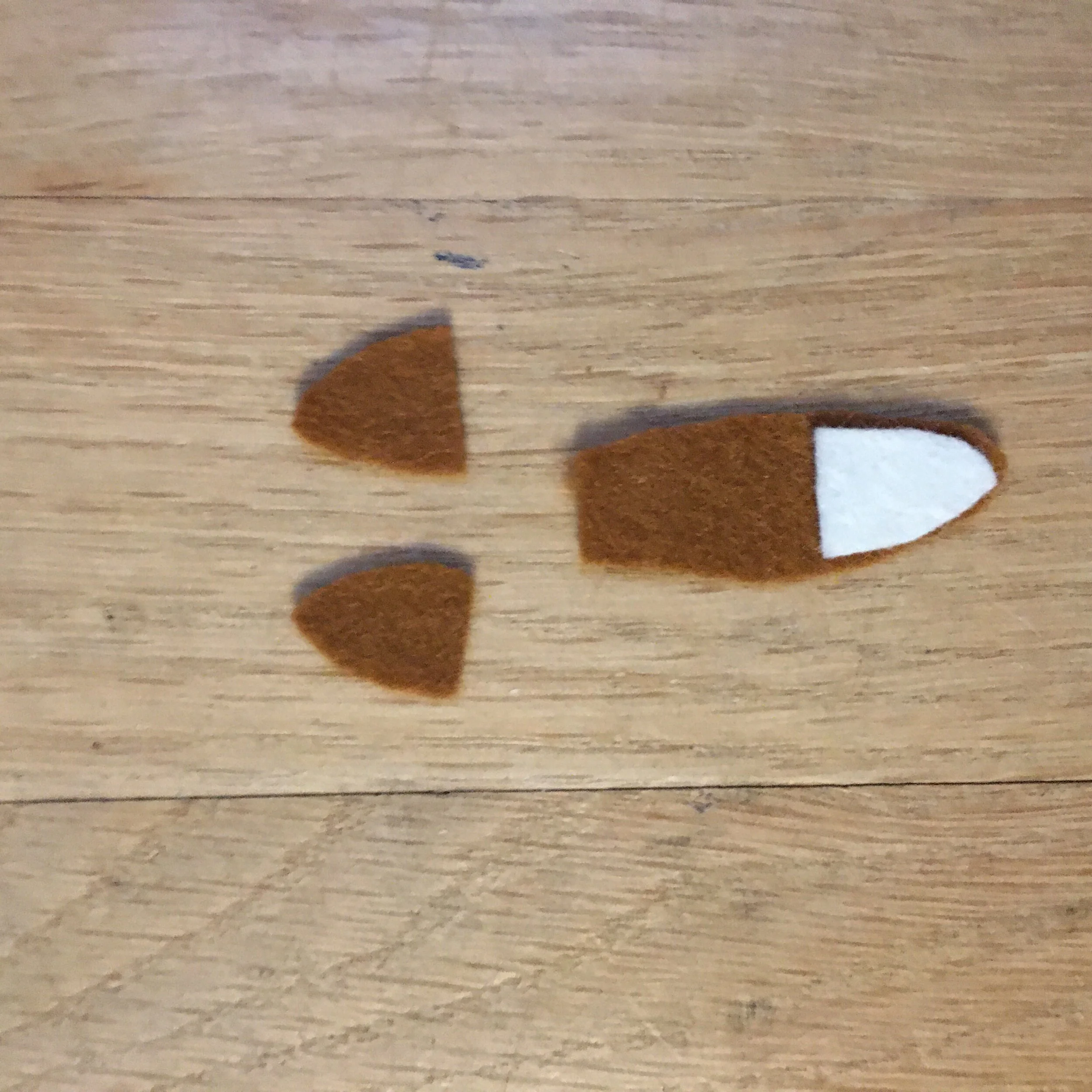
  • Cut two triangles of matching orange or reddish brown wool felt for the ears. Attach with craft glue. (The grid behind the scrap paper pattern templates below is 1 inch square).

  • Cut an oblong tail from the same felt as the ears. Cut small cream or white triangles and glue to the tip of the tail. If you drew a template for the ears, it can be used for the white on the tail too. Glue the tail to back of the peg, with the flat edge of the tail at the aligned with the bottom edge of the peg.

E80AEC6B-B2F2-44B4-AB46-4C7B463C7435.jpeg
5F3CC8B9-1326-44D3-AEB5-9CDBFEA2C8B5.jpeg
24CF19F4-914D-4E97-BE33-BF1C78221999.jpeg

Have fun with your new fox friends!

NOTE: Due to their small size and tiny parts, these fox pegs are not appropriate for children under age 3 years.


TAGS: Fox Peg Dolls, Peg Dolls, Make a Fox Peg Doll


May 7, 2020

Sewing Cotton Face Masks: Some Useful Hacks From the Quilting World

by Judy Tucker


Pleated “Deaconess” style Cotton Face Masks

Pleated “Deaconess” style Cotton Face Masks

Pleated “Deaconess” style Cotton Face Masks

Pleated “Deaconess” style Cotton Face Masks

There are lots of cotton face mask patterns, tutorials, and videos available so rather than add another tutorial, I thought I’d share some of the hacks I’ve borrowed from my quilting skills that help speed the process, save thread and up-cycle left over quilt bindings.

I mostly sew the “Deaconess” style rectangular face masks, but do also sew some molded masks. These tips can be adapted to both style masks but are probably most helpful for the pleated masks.

I make masks in big batches of 30 to 50, completing each stage on all the masks before going to the next step.

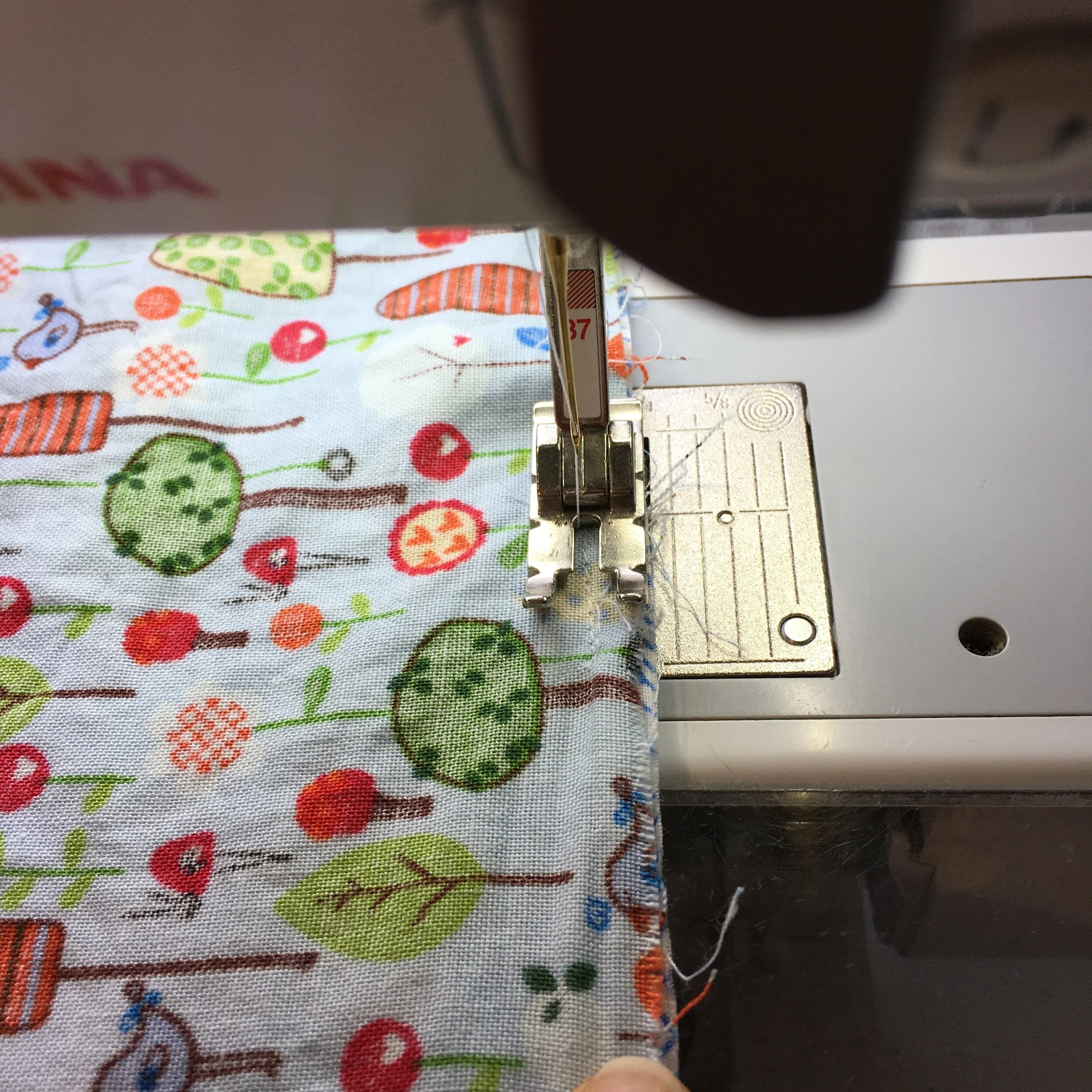
Using a Quarter Inch Foot—a perfect seam guide

  • Most sewing machines come with a quarter inch foot. Quilt piecing uses a 1/4 seam. Some quarter inch feet have a raised guide on the right hand side, others create a 1/4 inch seam by stitching along the right hand side of the foot. I’m using the later type of quarter inch foot.

  • The rectangular masks can be sewing with a 1/4 inch seams. (Be careful if you are sewing molded masks. My molded mask pattern uses the 3/8 inch seam common in industrial sewing).

Sewing a seam with a 1/4 inch foot.  This is the Bernina #37 foot.

Sewing a seam with a 1/4 inch foot. This is the Bernina #37 foot.

Chain piecing—saving thread and time

  • Piecing quilt patches, pairs of patches are run continuously through the sewing machine with a couple of stitches between each patch. The chain of pieced pairs will drop off the back of the sewing table in a lovely pile. This saves a lot of thread and it makes piecing a lot faster because there is no need to cut threads, or stop to hold the threads when you sew a new pair of patches.

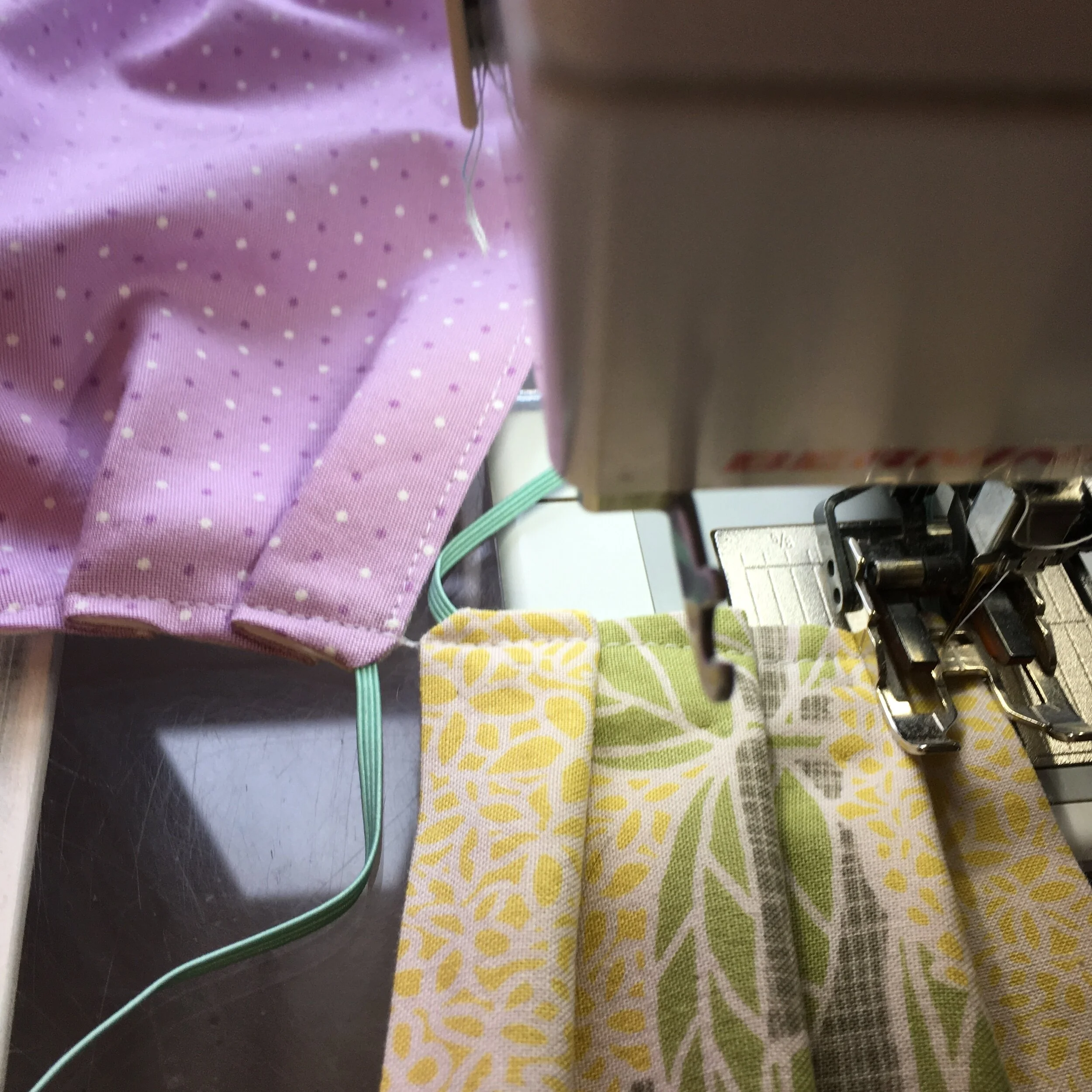
  • I am using “chain sewing” with the masks. Because the masks are stitched around the 4 sides of the mask, you’ll need to cut the masks apart as you sew so that the previous mask doesn’t get in your way. But that turns out to be easy to do. As you turn the corner on the new mask, the previous mask will flip around to the left of your machine and the connecting threads can be snipped. It just takes a second to stop and do that.

Note the thread connection between these two masks. This should be snipped at this point to separate the two masks.

Note the thread connection between these two masks. This should be snipped at this point to separate the two masks.

Using a Walking Foot to Edge Stitch the Pleated mask

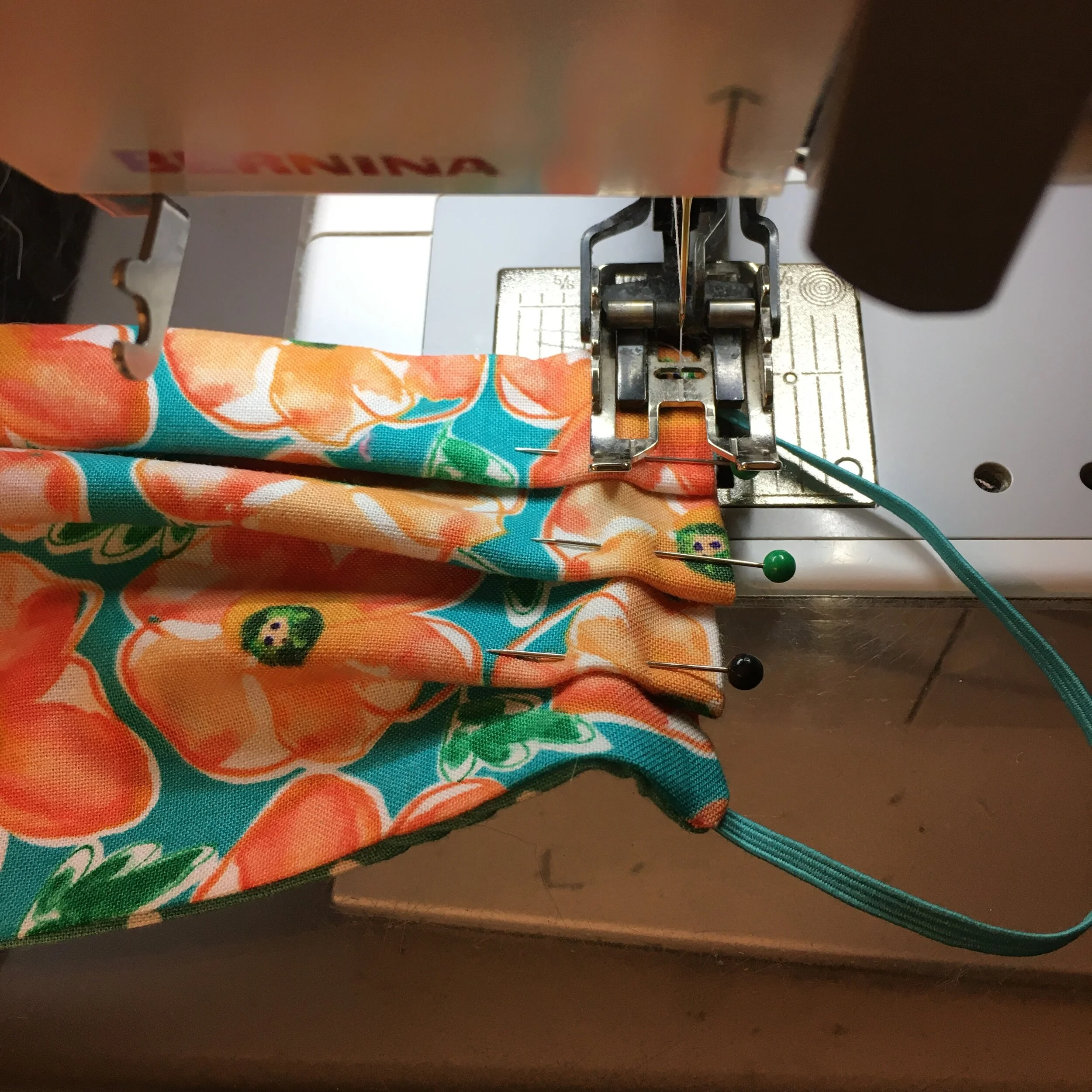
  • This is my favorite quilter hack. I found it really challenging sewing over the pleated in the mask with a regular foot. Those pleats are 6 layers of fabric. So I put a walking foot on my machine and suddenly sewing was smooth sailing.

  • The walking foot helps to pull the piece through on the top, augmenting the pull of the feed dogs under the piece. Walking feet are used to do straight machine quilting.

Edge stitching the pleated mask with a walking foot

Edge stitching the pleated mask with a walking foot

Ear Savers from Left over Quilt Bindings—A fun and useful up-cycle

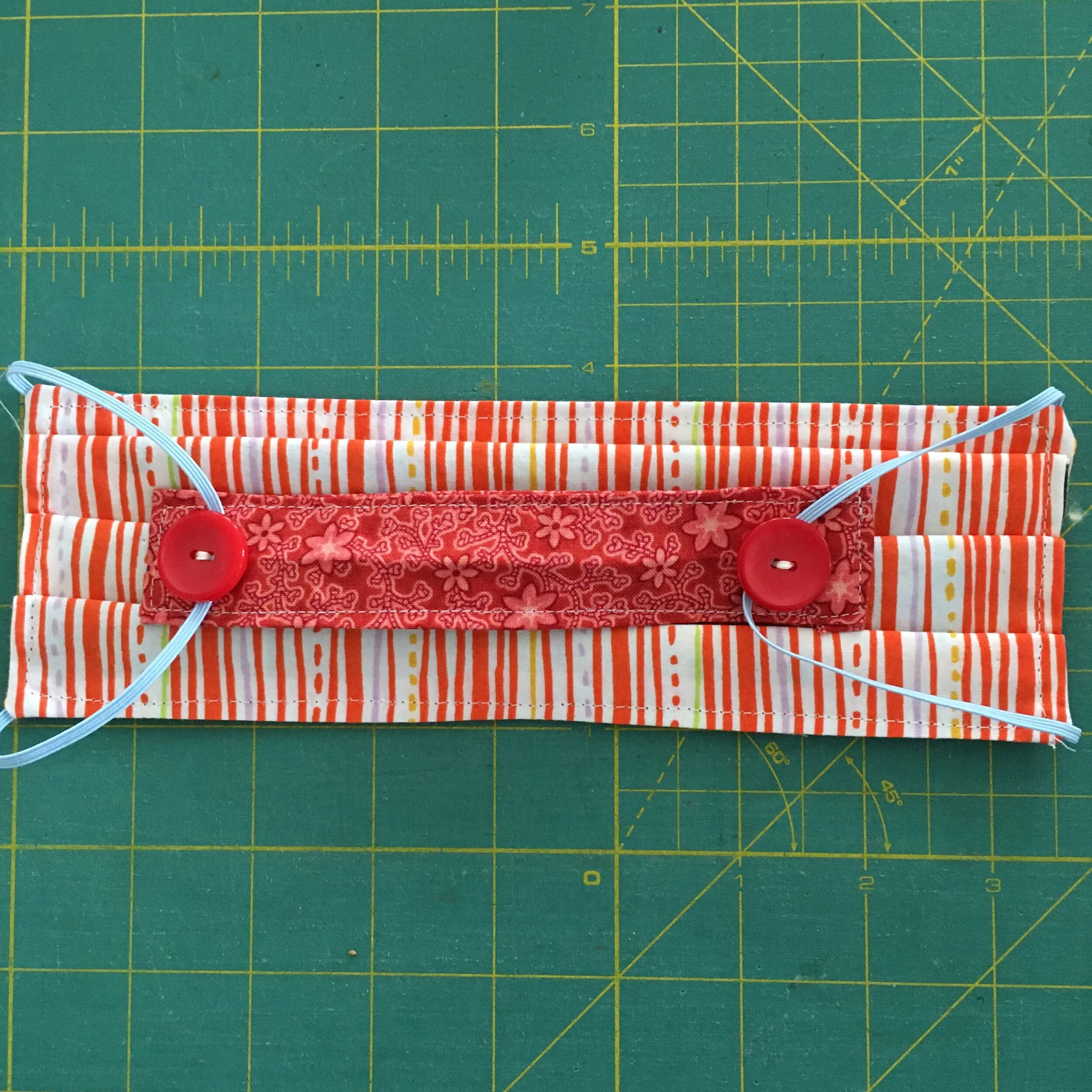
  • There is almost always some left over binding after a quilt is finished. It’s the perfect width to sew an “ear saver”. If a mask is worn for a long time, the elastic tends to make the back of the ears very sore. The buttons on the ear safer take the pressure from the ear elastic, giving the ears a much needed break.

  • Cut a binding remnant 13 inches long. Turn the short raw edges under 1/4 inch. Fold the remnant in half and edge stitch all for sides of the binding.

  • Sew on 2 large buttons. 3/4- 1 inch buttons are perfect.

Ear Saver from made from a quilt binding remnant.

Ear Saver from made from a quilt binding remnant.

Thank you for sewing face masks, whether for an organization or for your friends and family! I hope some of these tips are useful in your sewing!

TAGS: Tips for Sewing Cotton Face Masks, Hacks for Sewing Cotton Face Masks, Making Ear Savers from Quilting Binding Remnants, Chain Sewing Face Masks, Using a 1/4 inch foot to sew cotton face masks


April 30, 2020

Peg Dolls: Front Line Medical Staff

by Judy Tucker


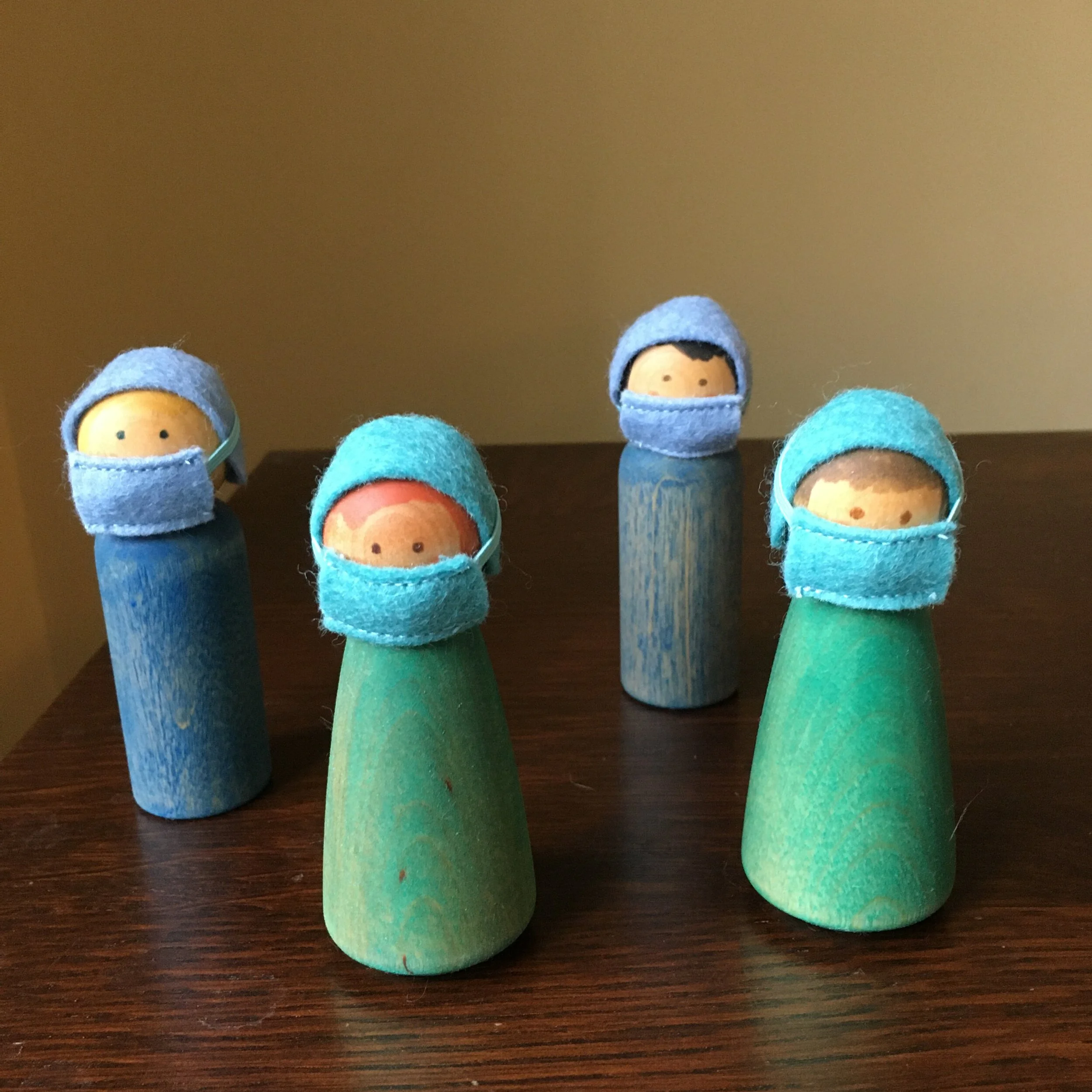
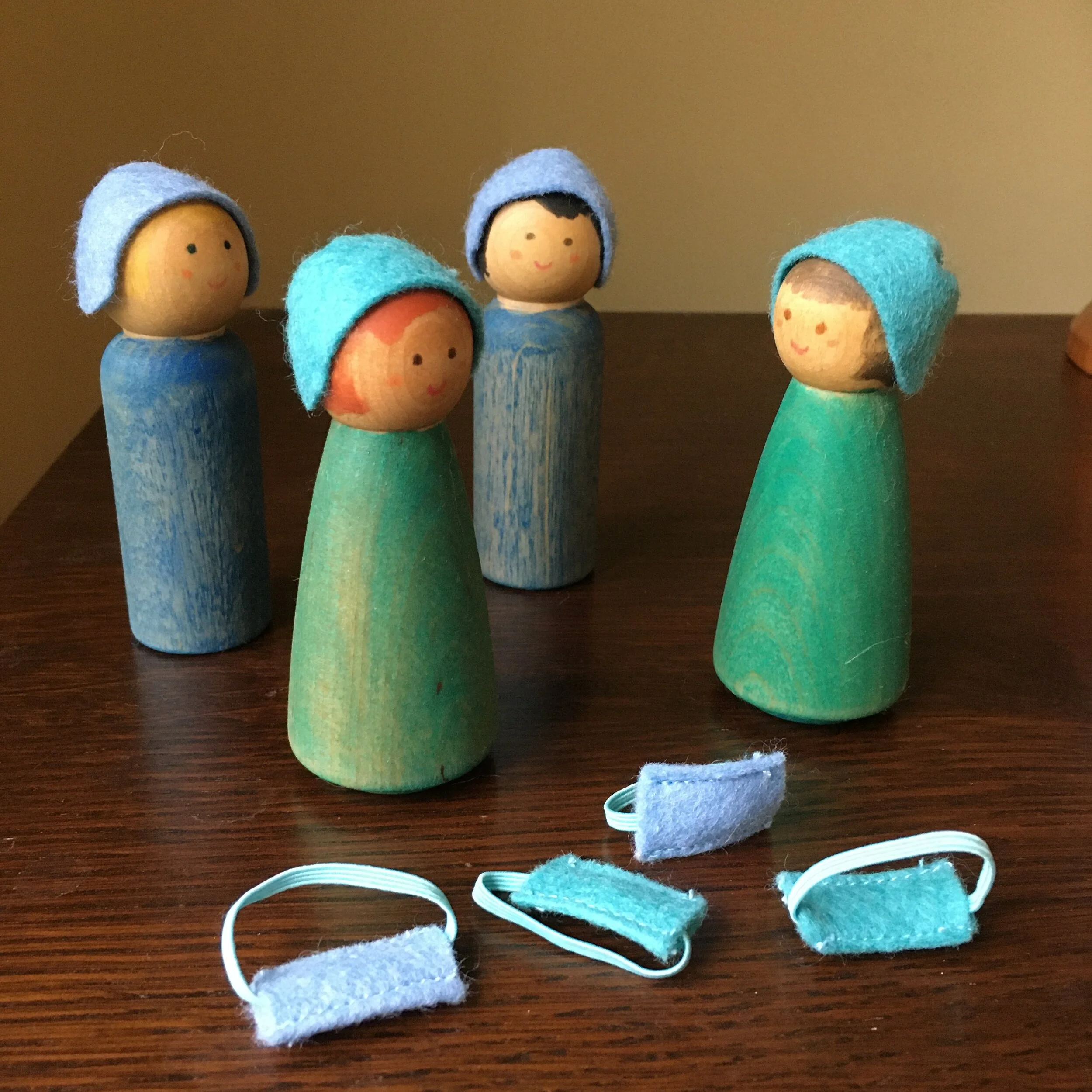
Peg Dolls Medical Staff

Peg Dolls Medical Staff

Peg Dolls Medical Staff

Peg Dolls Medical Staff

Like lots of quilters and sewists during this COVID-19 pandemic, I’ve been sewing cloth face masks. I thought it would be fun to make some for peg dolls too. I initially tried making pleated cloth masks, but they were just too small very difficult to sew. So I switched to wool felt, the traditional material for peg doll clothing.

So here are my new friends. You decide if they are doctors, nurses, respiratory therapists, medical assistants, x-ray techs or whoever else might be.

These are extra large 3 1/2 inch tall peg dolls.

If you want to make some for yourself, here’s how to do that.

Paint the doll with non-toxic paint. Allow the paint to dry completely. See this post for some information on painting wooden peg dolls.

Mask

  • Cut a square of wool felt, 1 inch square.

  • Fold it in half and stitch the long open end closed. I used the sewing machine but hand sewing is fine too. Then edge stitch the folded side.

  • Cut a piece of 1/8 inch elastic 4 inches long. If you squeeze the two long sides together, a “tunnel” will open and the elastic will slip through easily. Tie a square knot and pull it tight. Slip the knot into the center of the mask.

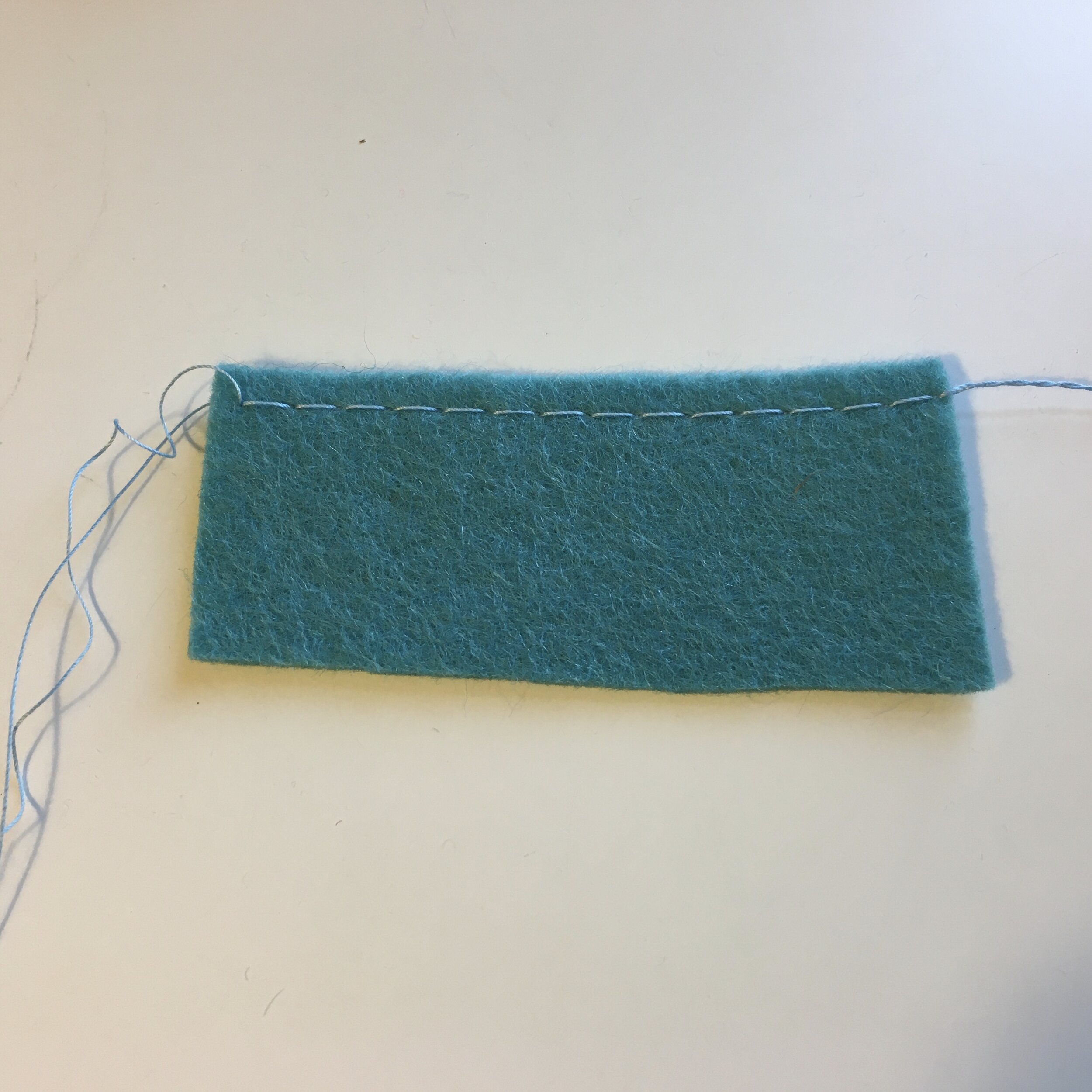
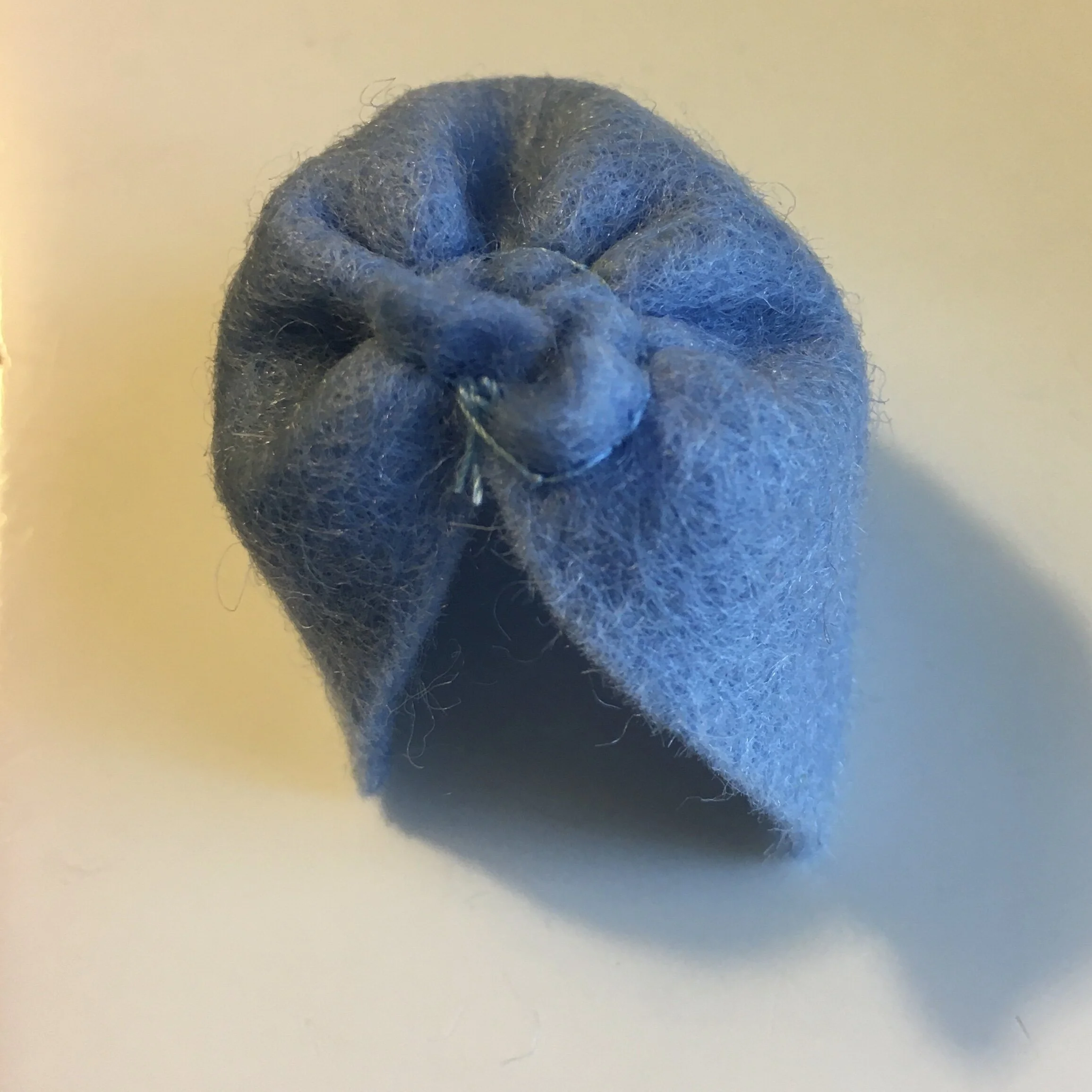
Surgical cap

  • Cut a piece of wool felt 1 inch x 2 3/4 inches. On ONE side, stitch a running gathering stitch. If you machine stitch do NOT lock either end of the stitching.

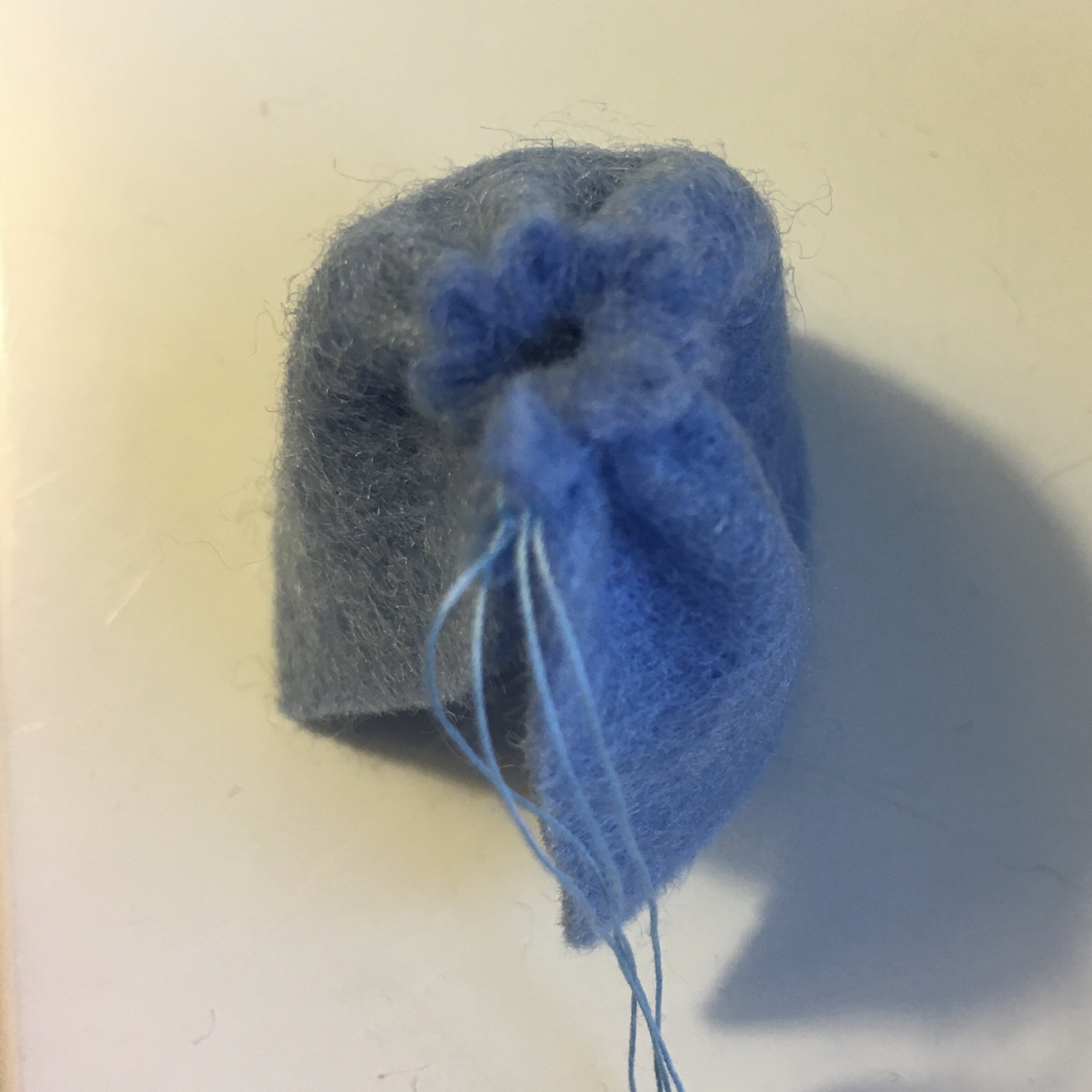
  • Pull the thread on BOTH ends to gather it as tight as you can. Tie a knot to keep the cap gathered.

  • Turn the cap inside out so that the gathering will be on the inside.

  • Using a doll that has already been painted, glue the hat to the head using a craft glue.

7E906D95-D2F5-46CC-8DC7-E947E97CFF5E_1_201_a.jpeg
90FE1DEA-BB7C-48FE-85BA-F86D50043A63_1_201_a.jpeg
5DB515A0-4F64-4D44-9B3C-A7DE81C5CB37_1_201_a.jpeg

As dedicated as our medical friends are, and as much as they like their work caring for the sick and injured, it’s always good when the shift is over and they can go home to their families.

“Bye!” “See you later!” “Hi to the kids!” “Have a great day off!”

“Bye!” “See you later!” “Hi to the kids!” “Have a great day off!”

Thank you medical staff everywhere!


TAGS: Wooden Peg Dolls, Wooden Peg Medical Staff, Wood Peg Nurses, Wooden Peg Doctors, Peg Doll Face Masks


April 23, 2020

Simple Knitted Wig for a Waldorf Type Baby Doll

by Judy Tucker


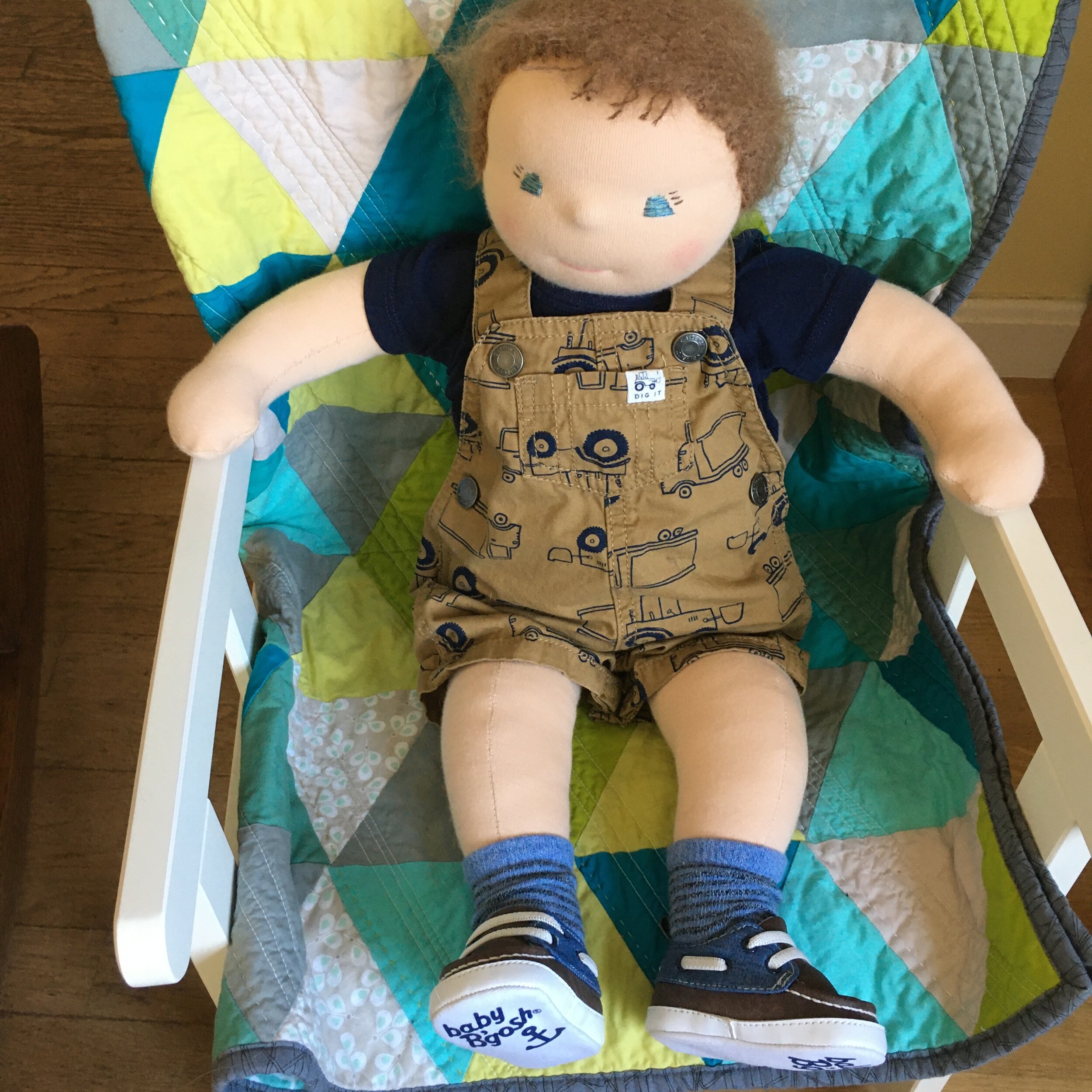
Knit mohair wig on a 19 inch tall Newborn size baby Waldorf Type Baby boy with a 15 inch head circumference

Knit mohair wig on a 19 inch tall Newborn size baby Waldorf Type Baby boy with a 15 inch head circumference

Knit mohair wig on a 19 inch tall Newborn size baby Waldorf Type Baby boy with a 15 inch head circumference

Knit mohair wig on a 19 inch tall Newborn size baby Waldorf Type Baby boy with a 15 inch head circumference

In my post of March 5, 2020, I discussed knitting a wig for a tiny Waldorf Type baby doll. It worked really well for doll whose head from forehead to crown measured 1 inch. But would the same technique work for larger Waldorf Type baby doll. The answer is a resounding—YES!

I used Smooth Mohair Doll Hair Yarn for both the tiny doll and this big boy, knitting with US size 3 straight knitting needles. I made the wigs by knitting a straight piece (like a scarf) to the length that fits from the where the ear would be on one side to where the ear would be on the opposite side.

I cast on 8 stitches for the tiny doll. This doll’s head, from forehead to the posterior crown of his head measured 4 inches. The tiny doll’s head had measured 1 inch, so I figured I could simply make this big doll’s wig 4 x larger. So I cast on 32 stitches. As I was knitting, it was quickly clear that there was a lot more stretch in 32 inches than there was in only 8 stitches. I had to start over twice before I got the correct number of stitches. Unfortunately, I’ve lost the scrap of paper I used to keep notes as I was working, but the final stitch count was between 24 and 28 stitches.

If you knit a doll wig, your stitch count may be different because everyone’s knitting varies a bit. Knit a sample, hold it up to the doll’s head and see how it fits.

Once the wig is the length needed (check by draping the knitting over the doll’s head, from side to side, NOT front to back), bind off.

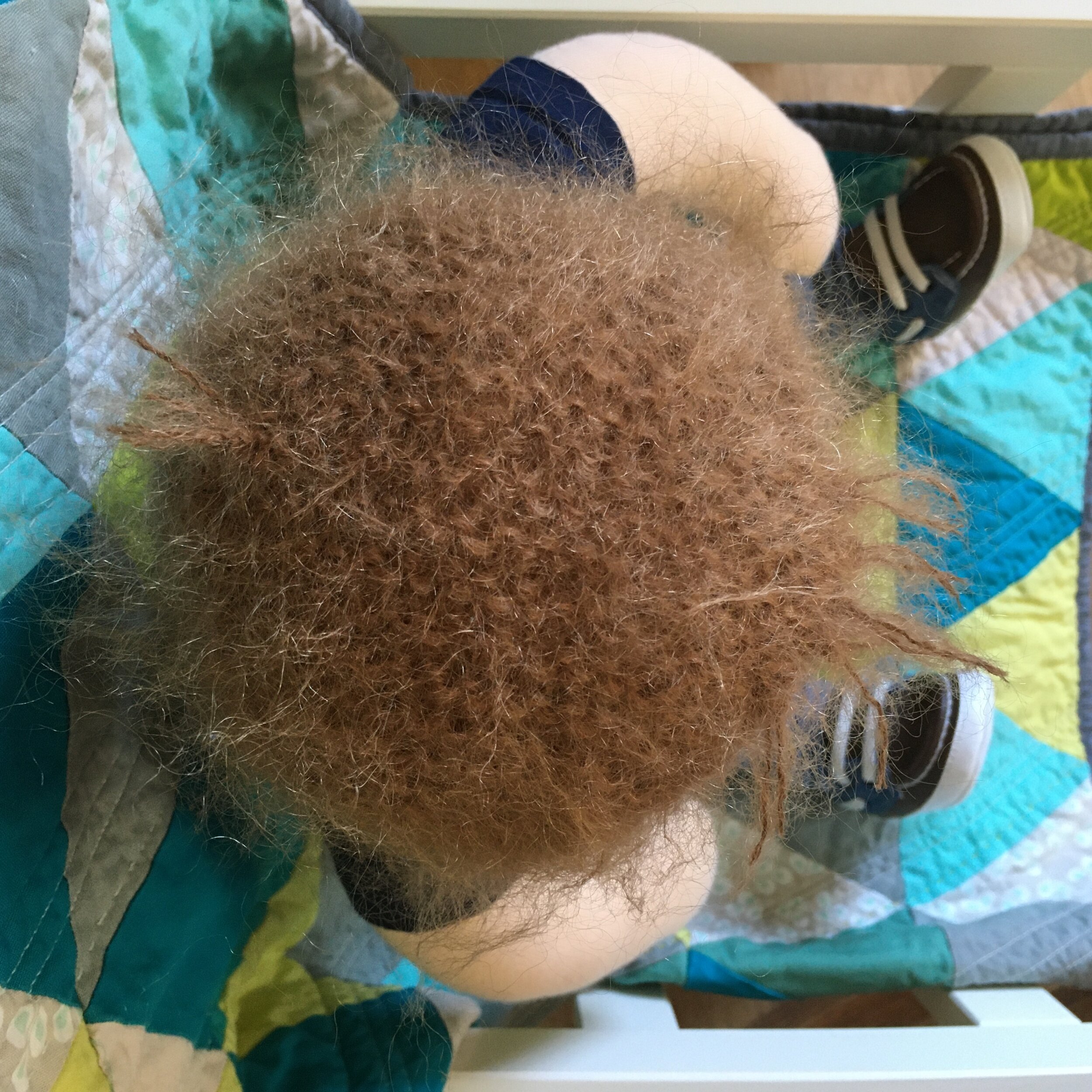
Fold the knit piece in half and slip stitch the two halves together, just on ONE of the folded ends. This creates a little hood that fits nicely on the doll’s head. Pin the wig along the forehead and mold it bit as needed along the sides and back to make a natural hair line. Attach the wig to the doll’s head using sewing thread in a matching color and a regular needle.

If you find that the back of the wig at the top of the head was a little loose and has a little point, use the sewing thread and needle and take a couple of stitches to tack down the wig where it feels loose. A couple tacking stitches at the top of the head should be all that’s needed.

To give the doll a cow lick, take a piece of scrap yarn and threaded a yarn needle. Run needle and yarn through the peak of the stitched end of the wig and come back out about a stitch away. Cut the yarn about 2 inches long and tie a knot. Trim to the the length you want.

To give him bangs, thread a needle with a little looped piece of yarn. Run the needle into the front edge of the wig, leaving the loop loose. Using the needle, bring the 2 strands of yarn back through the loop, pulling it tight.
Looking down at the top of the head at the knitted wig

Looking down at the top of the head at the knitted wig

Finally gently brush the mohair wig with a wire dog brush to fuzz up the mohair. The mohair will undoubtedly felt some with lots of play. That’s to be expected. And it’ll still be cute.


TAGS: Knit doll wig, Knitting a wig for a Waldorf Type doll, Knitting a doll wig


April 16, 2020

Newborn Size Waldorf Type Baby Boy

by Judy Tucker


Linc, NB size Waldorf Type Baby Doll, 19 inches tall (Thrifted velour PJs)

Linc, NB size Waldorf Type Baby Doll, 19 inches tall (Thrifted velour PJs)

Linc, NB size Waldorf Type Baby Doll, 19 inches tall (Thrifted velour PJs)

Linc, NB size Waldorf Type Baby Doll, 19 inches tall (Thrifted velour PJs)

Here’s Linc! He’s my newest newborn size Waldorf Type Baby dolls. He is based on a pattern found in Sewing Dolls by Karin Neuschutz. I altered the pattern slightly so that he will fit in commercially made baby clothes. His torso is a bit longer, his arms a bit narrower, and his feet a bit longer than the pattern in the book.

He is weighted with glass doll weighting beads. This is the third doll I’ve weighted using glass beads. I’ve found that making a couple little bead-filled cloth packets works well. A pair of weighted bags fit nicely into the bottom of the doll’s torso.

His hair is a knitted wig. I was really curious to see if the type of knit wig I made for a tiny doll works for a really big one. It does! More about that in my next post.
I just had to give him some eyelashes. Baby boys always have the best eyelashes. (I don’t put any eyelashes on my baby girl dolls).

Linc is a cutie—he looks like a real boy. He’s gonna steal some hearts!

Here is another photo of Linc and one of him with Lillibelle so you can see a boy and girl together.

Linc is wearing truck shortalls from Carter’s.

Linc is wearing truck shortalls from Carter’s.

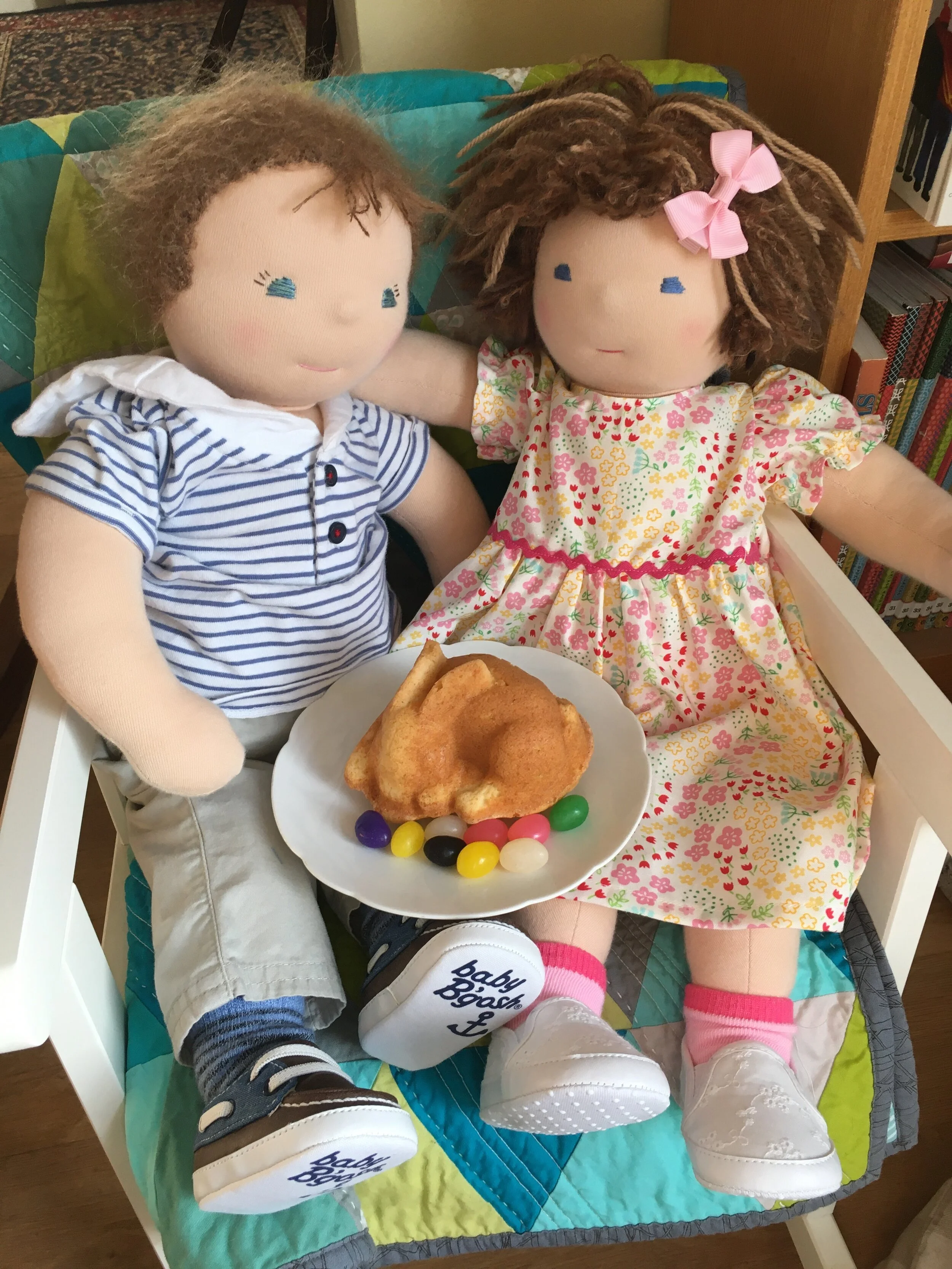
Linc and Lillibelle with a bunny cake made by my neighbor. I designed the pattern and made the dress Lillibelle is wearing. Linc’s shirt and pants are a thrifted outfit.

Linc and Lillibelle with a bunny cake made by my neighbor. I designed the pattern and made the dress Lillibelle is wearing. Linc’s shirt and pants are a thrifted outfit.


TAGS: Newborn size Waldorf type Baby Doll, Newborn boy Waldorf Type Baby Doll, "Sewing Dolls" by Karin Neuschutz, Waldorf type baby doll, Waldorf type boy doll


  • Newer
  • Older

Powered by Squarespace 7